Arrival without admission
In autumn 1948, a completed licence ès sciences, scholarship support, and Jacques Soula’s recommendation brought Grothendieck from Montpellier to Paris. Later accounts associate the scholarship with André Magnier and the Entraide Universitaire de France. Soula had studied with Cartan, but Grothendieck later remembered not knowing whether the intended mathematician was Élie Cartan or his son Henri. Élie was nearly eighty and retired from the center of teaching; Henri Cartan received the young visitor.11Grothendieck, Récoltes et Semailles (Université des Sciences et Techniques du Languedoc and Centre National de la Recherche Scientifique, 1986); Jean Dieudonné, “A. Grothendieck’s Early Work (1950–1960),” K-Theory 3, no. 4 (1989): 299–301, https://doi.org/10.1007/BF00584523; Jackson, “As If Summoned from the Void, I,” 1040–44; Laamri, Alexander Grothendieck: période 1928–1956, 69–79; Scharlau, “Who Is Alexander Grothendieck?” 931–33; Henri Cartan, Séminaire Henri Cartan, vol. 1 (1948–1949): Topologie algébrique (Secrétariat mathématique, 1949), https://www.numdam.org/issues/SHC_1948-1949__1_/.
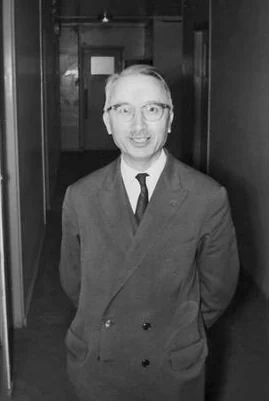
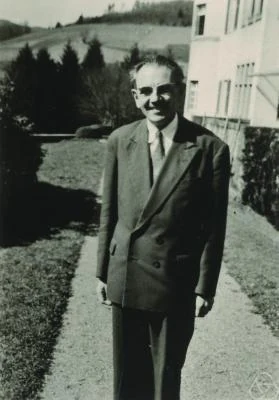
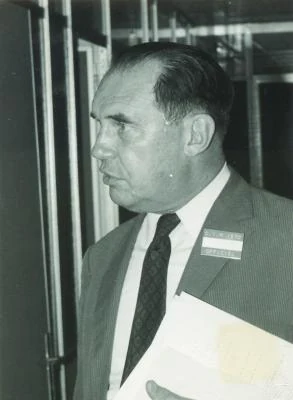
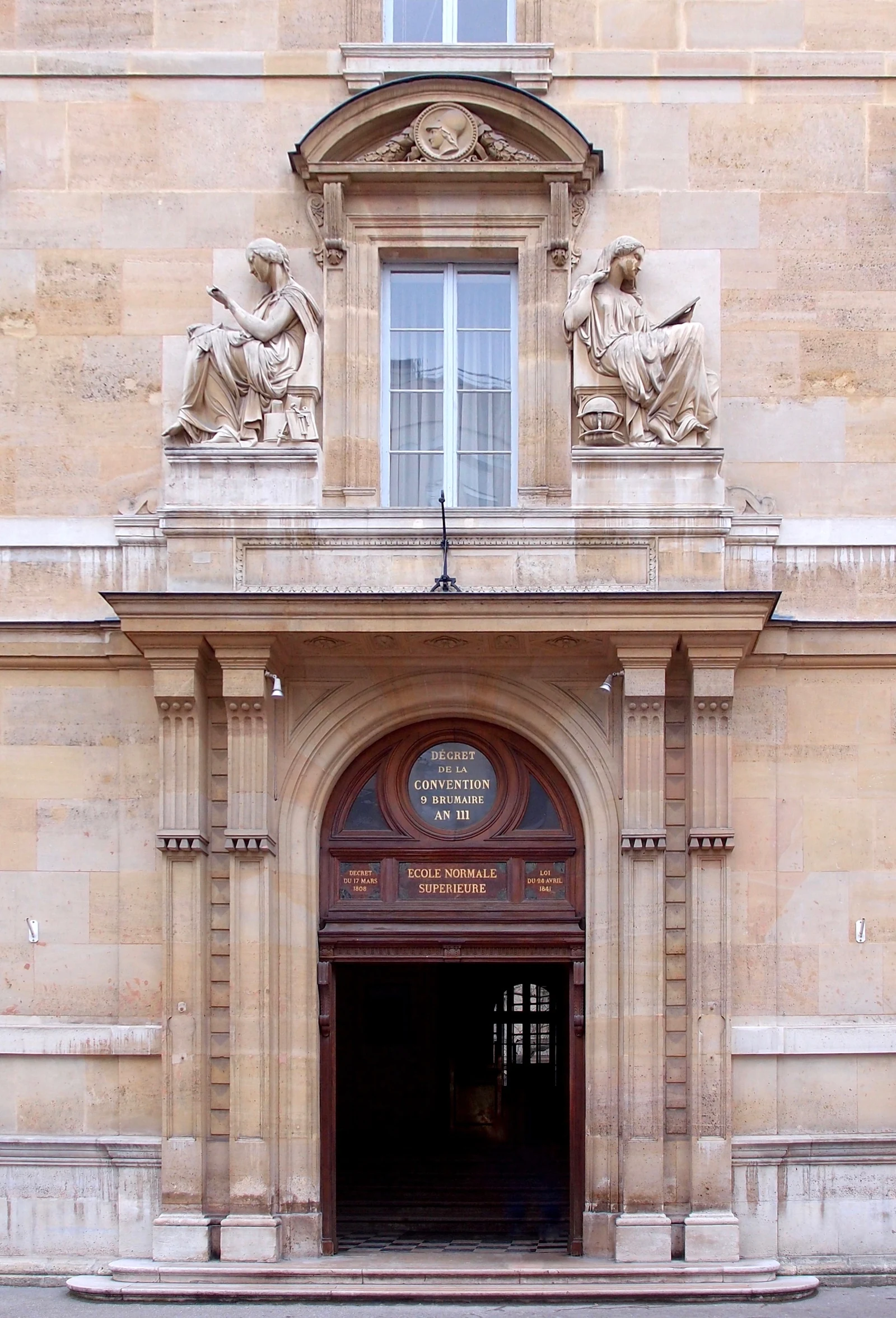
The institutional wording matters. Grothendieck had not passed the competitive entrance route that made someone a normalien. Later biographical sources describe him as an auditeur libre at the École Normale Supérieure during 1948–1949, but no ENS register has been checked. His attendance at Cartan’s course and seminar is retained; the formal administrative designation remains attributed pending the register. He did not share the standardized preparation of regularly admitted students.22Grothendieck, Récoltes et Semailles (Université des Sciences et Techniques du Languedoc and Centre National de la Recherche Scientifique, 1986); Dieudonné, “A. Grothendieck’s Early Work (1950–1960),” 299–301; Jackson, “As If Summoned from the Void, I,” 1040–44; Laamri, Alexander Grothendieck: période 1928–1956, 69–79; Scharlau, “Who Is Alexander Grothendieck?” 931–33; Cartan, Séminaire Henri Cartan, vol. 1 (1948–1949): Topologie algébrique.
He brought the Montpellier manuscript and learned that the territory he had worked through belonged to established measure theory. His retrospective account says this did not make the years feel wasted. The independent construction had taught him how it felt to make mathematics rather than merely receive it. Paris supplied the historical correction: Lebesgue and others had priority, and a research career required knowing the record.33Grothendieck, Récoltes et Semailles (Université des Sciences et Techniques du Languedoc and Centre National de la Recherche Scientifique, 1986); Dieudonné, “A. Grothendieck’s Early Work (1950–1960),” 299–301; Jackson, “As If Summoned from the Void, I,” 1040–44; Laamri, Alexander Grothendieck: période 1928–1956, 69–79; Scharlau, “Who Is Alexander Grothendieck?” 931–33; Cartan, Séminaire Henri Cartan, vol. 1 (1948–1949): Topologie algébrique.
The capital also supplied a more unsettling correction. The gap was not one missing author. It was a language. Grothendieck later listed algebraic terms he had scarcely encountered and described advanced discussions whose arrows, diagrams, and spectral sequences passed over him. He was a university graduate in mathematics who had already undertaken a long construction, yet much of the shared equipment of his new peers was unfamiliar. That asymmetry defines the Parisian year better than any single anecdote.44Grothendieck, Récoltes et Semailles (Université des Sciences et Techniques du Languedoc and Centre National de la Recherche Scientifique, 1986); Dieudonné, “A. Grothendieck’s Early Work (1950–1960),” 299–301; Jackson, “As If Summoned from the Void, I,” 1040–44; Laamri, Alexander Grothendieck: période 1928–1956, 69–79; Scharlau, “Who Is Alexander Grothendieck?” 931–33; Cartan, Séminaire Henri Cartan, vol. 1 (1948–1949): Topologie algébrique.
Henri Cartan’s seminar
The 1948–1949 Séminaire Henri Cartan treated simplicial algebraic topology and foundational ideas around sheaves, subjects at or near the research frontier in postwar France. The seminar became the first in a celebrated sequence. Its form mattered: a theme was pursued across a year, individual talks were written as exposés, and the resulting texts circulated as a coherent record. Grothendieck would later build seminars of still greater scale around a similar unity of oral work and systematic redaction. In 1948 he entered as a learner.55Grothendieck, Récoltes et Semailles (Université des Sciences et Techniques du Languedoc and Centre National de la Recherche Scientifique, 1986); Dieudonné, “A. Grothendieck’s Early Work (1950–1960),” 299–301; Jackson, “As If Summoned from the Void, I,” 1040–44; Laamri, Alexander Grothendieck: période 1928–1956, 69–79; Scharlau, “Who Is Alexander Grothendieck?” 931–33; Cartan, Séminaire Henri Cartan, vol. 1 (1948–1949): Topologie algébrique.
Published recollections and later histories place Claude Chevalley, Jean Delsarte, Jean Dieudonné, Roger Godement, Laurent Schwartz, André Weil, and Jean-Pierre Serre in the wider seminar world Grothendieck encountered. The list should not be turned into a group portrait unless attendance on a particular date is established. It identifies a network: Bourbaki founders, analysts, topologists, and a younger generation met across overlapping courses and seminars.66Grothendieck, Récoltes et Semailles (Université des Sciences et Techniques du Languedoc and Centre National de la Recherche Scientifique, 1986); Dieudonné, “A. Grothendieck’s Early Work (1950–1960),” 299–301; Jackson, “As If Summoned from the Void, I,” 1040–44; Laamri, Alexander Grothendieck: période 1928–1956, 69–79; Scharlau, “Who Is Alexander Grothendieck?” 931–33; Cartan, Séminaire Henri Cartan, vol. 1 (1948–1949): Topologie algébrique.
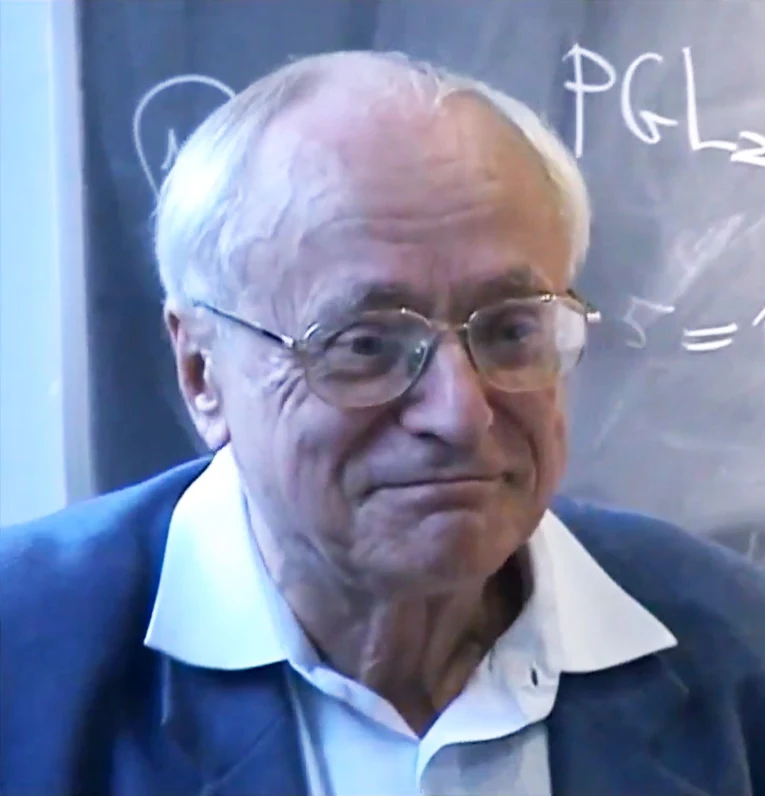
Cartan’s position joined several kinds of authority. He was an important mathematician, a professor at the ENS, a Bourbaki founder, and the son of Élie Cartan. Grothendieck later remembered his courtesy and benevolence. That testimony is significant because it counters a simple story of exclusion. Cartan allowed access and offered guidance. He could not make the assumed background vanish, and his initial advice may not have revealed how extensive the gaps were. Welcome was personal; fluency still had to be earned.77Grothendieck, Récoltes et Semailles (Université des Sciences et Techniques du Languedoc and Centre National de la Recherche Scientifique, 1986); Dieudonné, “A. Grothendieck’s Early Work (1950–1960),” 299–301; Jackson, “As If Summoned from the Void, I,” 1040–44; Laamri, Alexander Grothendieck: période 1928–1956, 69–79; Scharlau, “Who Is Alexander Grothendieck?” 931–33; Cartan, Séminaire Henri Cartan, vol. 1 (1948–1949): Topologie algébrique.
Jean Cerf later recalled a newcomer speaking to Cartan from the back of the room. His account supplies no exact exchange and remains one retrospective witness statement rather than a general judgment about Grothendieck’s character.88Grothendieck, Récoltes et Semailles (Université des Sciences et Techniques du Languedoc and Centre National de la Recherche Scientifique, 1986); Dieudonné, “A. Grothendieck’s Early Work (1950–1960),” 299–301; Jackson, “As If Summoned from the Void, I,” 1040–44; Laamri, Alexander Grothendieck: période 1928–1956, 69–79; Scharlau, “Who Is Alexander Grothendieck?” 931–33; Cartan, Séminaire Henri Cartan, vol. 1 (1948–1949): Topologie algébrique.
A shape made from pieces
Simplicial topology begins by replacing or modeling a space with vertices, edges, triangles, tetrahedra, and higher-dimensional analogues called simplices. The boundary of a triangle is a signed sum of its three edges; the boundary of a tetrahedron is a signed sum of its triangular faces. Combinatorial data can then record holes that survive continuous deformation. For an ordinary reader, it is a way of turning shape into algebra.
Let be the free abelian group generated by oriented -simplices. A boundary map
is defined by the alternating sum of faces. The essential identity is
A boundary has no boundary: each codimension-two face appears twice with opposite signs. The sequence
is a chain complex.
The -cycles are ; the -boundaries are . Because , every boundary is a cycle, so . Homology is the quotient
It measures cycles not already explained as boundaries of higher-dimensional chains. A loop around a hole may be a cycle without bounding a filled region inside the space.
The intuition “homology counts holes” is useful and incomplete. Homology groups contain torsion and depend on coefficients; different spaces with the same ranks can have different topology; and homology does not classify spaces. Its faithful content is algebraic: it records the failure of exactness at . This language of kernels, images, complexes, and quotients was among the language Grothendieck had to acquire.
Simplicial approximation and invariance require proofs that different triangulations or continuous deformations do not arbitrarily change the groups. The combinatorial pieces are not the space itself. They are a presentation through which topological information is extracted. The relation between presentation and invariant is one reason the subject demands a shared formalism rather than diagrams alone.
No source says Grothendieck mastered the seminar’s algebraic topology that year. Dieudonné later emphasized that, surprisingly in light of the future, Grothendieck was not then chiefly attracted to it. The seminar nevertheless exposed him to chain complexes, homological language, and the written collective form in which new theories were transmitted.99Grothendieck, Récoltes et Semailles (Université des Sciences et Techniques du Languedoc and Centre National de la Recherche Scientifique, 1986); Dieudonné, “A. Grothendieck’s Early Work (1950–1960),” 299–301; Jackson, “As If Summoned from the Void, I,” 1040–44; Laamri, Alexander Grothendieck: période 1928–1956, 69–79; Scharlau, “Who Is Alexander Grothendieck?” 931–33; Cartan, Séminaire Henri Cartan, vol. 1 (1948–1949): Topologie algébrique.
Local data and the sheaf
Sheaf theory was still new. Jean Leray had developed the central ideas during and around the war; Cartan’s circle was turning them into a powerful language. A sheaf begins with local information. For every open set in a space , one has a set, group, ring, or other object of sections over . If , there is a restriction map
Restrictions compose as expected.
Two further properties give the sheaf its force. If sections over agree after restriction to every member of an open cover, they are equal. And if sections agree on all overlaps , there is a unique section over restricting to each . Local data that are compatible can be glued into global data.
The ordinary analogy is a collection of local maps that agree where they overlap. It illuminates restriction and gluing. Its limit is that sections need not be maps or pictures. They may be functions, solutions of differential equations, algebraic data, or objects in more elaborate categories. The sheaf axiom is a precise condition on a contravariant assignment, not a claim that every local solution always globalizes: local sections may fail to be mutually compatible, and cohomology measures certain failures of global assembly.
To someone coming from measure and integration, the local-to-global language could appear remote. Measure is countably additive across sets; sheaf gluing is about agreement on overlaps. Both organize passage from pieces to a whole, but the operations and obstructions differ. It would be anachronistic to say Grothendieck recognized his future geometry in the seminar. His own later account stressed how little of the machinery’s meaning he then grasped.1010Grothendieck, Récoltes et Semailles (Université des Sciences et Techniques du Languedoc and Centre National de la Recherche Scientifique, 1986); Dieudonné, “A. Grothendieck’s Early Work (1950–1960),” 299–301; Jackson, “As If Summoned from the Void, I,” 1040–44; Laamri, Alexander Grothendieck: période 1928–1956, 69–79; Scharlau, “Who Is Alexander Grothendieck?” 931–33; Cartan, Séminaire Henri Cartan, vol. 1 (1948–1949): Topologie algébrique.
The word “sheaf” itself illustrates the social character of vocabulary. Once the definition is shared, one can ask about sheaves of groups, stalks, exact sequences, and cohomology without rebuilding the local-to-global problem each time. Before the word is meaningful, every sentence sounds like compressed code. Paris confronted Grothendieck with many such compressions simultaneously.
A presheaf that fails to glue
The gluing condition is substantive rather than automatic. On each open set , let be the vector space of bounded continuous functions on , with ordinary restriction maps. This assignment is a presheaf: restriction preserves boundedness and composes correctly. It is not a sheaf.
Cover by the open intervals . The function restricts to a bounded continuous function on every . These local restrictions agree on all overlaps. Their unique continuous gluing on the union is , which is unbounded on and therefore does not belong to .
The example isolates the failed axiom. Local existence and overlap agreement do not guarantee that the glued object remains in the prescribed global class. By contrast, all continuous real-valued functions do form a sheaf: compatible local continuous functions glue to a continuous global function.
The map analogy therefore has a precise limit. Local pieces can fit perfectly along every overlap while a global boundedness condition still fails. Sheaf theory records which properties are truly local. Other properties, including boundedness on a noncompact union, require additional global control.
Uniqueness is a separate half of the sheaf condition. If two global continuous functions have the same restriction on every member of a cover, each point lies in an open set where their values agree; the functions are therefore equal everywhere. Existence and uniqueness together make gluing canonical rather than a choice among possible extensions.
The bounded-function counterexample also shows why a definition must be tested on an infinite cover. A finite union of bounded compatible functions remains bounded, so the failure is invisible on finite covers. Countable or unrestricted open covers expose the difference between a local bound on each member and one global bound.
This counterexample clarifies why the Paris terminology mattered. The word sheaf did not rename any assignment of local data; it selected assignments satisfying exact locality and gluing conditions. Grothendieck’s later account says that he could verify such definitions in 1948–1949 without yet perceiving their geometric force. The example supplies modern clarification, not evidence about a specific seminar explanation.
Spectral sequences at the board
Grothendieck later remembered Cartan and Serre discussing spectral sequences amid diagrams filled with arrows. A spectral sequence is not one sequence but a succession of pages , each carrying a differential, whose next page is the homology of the preceding one:
Under convergence hypotheses, the pages approach graded information about a target object.
The ordinary-reader image is a calculation refined in stages: early pages contain accessible approximations; successive differentials cancel classes that do not survive; the stable page describes associated graded pieces of the desired answer. This is faithful as orientation. It becomes misleading if a spectral sequence is imagined as a numerical approximation. It is an algebraic machine, and convergence may involve filtrations, extension problems, and boundedness conditions.
For a student who had only recently learned basic algebraic words, hearing specialists move quickly through such a machine would be difficult for reasons deeper than speed. Each symbol presupposed chain complexes, gradings, exactness, and functorial constructions. Verifying a displayed proof line by line could still leave its purpose obscure. Grothendieck’s later testimony makes exactly that distinction: he could force himself through definitions and statements without yet sensing the mathematical substance.1111Grothendieck, Récoltes et Semailles (Université des Sciences et Techniques du Languedoc and Centre National de la Recherche Scientifique, 1986); Dieudonné, “A. Grothendieck’s Early Work (1950–1960),” 299–301; Jackson, “As If Summoned from the Void, I,” 1040–44; Laamri, Alexander Grothendieck: période 1928–1956, 69–79; Scharlau, “Who Is Alexander Grothendieck?” 931–33; Cartan, Séminaire Henri Cartan, vol. 1 (1948–1949): Topologie algébrique.
This gap between verification and meaning is common in advanced study. One may confirm that arrows compose and equations follow while not knowing why the construction was chosen. First-principles learning seeks the pressure behind the formalism. In Paris, however, too many layers arrived together for him to reconstruct each from the ground up at seminar speed.
The experience complicates any claim that Grothendieck was simply hostile to difficult technique. He stayed with courses he barely understood. His later mathematical style would deploy formidable technical systems. What he resisted was technique detached, in his perception, from an intelligible organizing problem. The Paris year supplied technique before it supplied that perception.
Leray and infinite-dimensional space
Cartan advised Grothendieck to attend Jean Leray’s teaching at the Collège de France. Jackson describes a course on locally convex spaces; Laamri describes Schauder degree in an infinite-dimensional setting. Without the Collège de France syllabus, neither description is silently preferred or merged. The bounded claim is that Grothendieck later recalled attending Leray’s advanced teaching and finding much of it difficult.1212Grothendieck, Récoltes et Semailles (Université des Sciences et Techniques du Languedoc and Centre National de la Recherche Scientifique, 1986); Dieudonné, “A. Grothendieck’s Early Work (1950–1960),” 299–301; Jackson, “As If Summoned from the Void, I,” 1040–44; Laamri, Alexander Grothendieck: période 1928–1956, 69–79; Scharlau, “Who Is Alexander Grothendieck?” 931–33; Cartan, Séminaire Henri Cartan, vol. 1 (1948–1949): Topologie algébrique.
The connection to his interests was real. Functional analysis treats spaces whose points are functions, sequences, or distributions. Such spaces are usually infinite-dimensional. A norm may measure size, but many natural function spaces require a topology generated by several seminorms. This was the world in which the Montpellier integral could become one example among many structural questions.
A seminorm on a vector space satisfies
but may have for nonzero . A family separates points if for every nonzero , some . Such a family defines a Hausdorff locally convex topology through neighborhoods
For , one may use seminorms controlling all derivatives up to order on a compact set :
No single norm naturally captures simultaneous convergence of every derivative on every compact subset in the same way. The family describes what it means for smooth functions to converge smoothly on compact sets.
The ordinary intuition is a dashboard with many gauges rather than one odometer. It conveys multiple kinds of control. Its limit is that seminorm families can be changed without changing the topology, may be uncountable, and interact through continuous linear maps and duality. Locally convexity is not mere multidimensional measurement; it is the existence of convex neighborhoods of zero, equivalently a topology defined by seminorms under standard assumptions.
Grothendieck was more attracted to this analytical direction than to algebraic topology in 1948–1949, according to Dieudonné’s later account. That preference made Nancy the logical next center. Dieudonné, Schwartz, Delsarte, and Godement were working there on topological vector spaces and distributions.1313Grothendieck, Récoltes et Semailles (Université des Sciences et Techniques du Languedoc and Centre National de la Recherche Scientifique, 1986); Dieudonné, “A. Grothendieck’s Early Work (1950–1960),” 299–301; Jackson, “As If Summoned from the Void, I,” 1040–44; Laamri, Alexander Grothendieck: période 1928–1956, 69–79; Scharlau, “Who Is Alexander Grothendieck?” 931–33; Cartan, Séminaire Henri Cartan, vol. 1 (1948–1949): Topologie algébrique.
Bourbaki as atmosphere and method
Bourbaki was a collective of mathematicians publishing under the name Nicolas Bourbaki. Its project reorganized large parts of modern mathematics through explicit structures and systematic exposition. Several people Grothendieck met in Paris or would meet in Nancy were members. The group’s private working culture and the public Séminaire Bourbaki overlapped with, but were not identical to, Cartan’s seminar.1414Grothendieck, Récoltes et Semailles (Université des Sciences et Techniques du Languedoc and Centre National de la Recherche Scientifique, 1986); Dieudonné, “A. Grothendieck’s Early Work (1950–1960),” 299–301; Jackson, “As If Summoned from the Void, I,” 1040–44; Laamri, Alexander Grothendieck: période 1928–1956, 69–79; Scharlau, “Who Is Alexander Grothendieck?” 931–33; Cartan, Séminaire Henri Cartan, vol. 1 (1948–1949): Topologie algébrique.
For an outsider, the culture could resemble a common language spoken at speed. Members had collaborated, criticized drafts, and accumulated shared references. Grothendieck later described the atmosphere in Récoltes et Semailles, but the account does not support sensory reconstruction of a particular session. Long collaboration had produced intellectual compression.
Bourbaki’s emphasis on structures may seem predestined to attract Grothendieck. In 1948 the evidence is less tidy. He was overwhelmed by the language and not especially drawn to the seminar’s main topological themes. His path into Bourbaki would come later. Structural taste was not instant social assimilation.
There was nevertheless an affinity between reconstructing from definitions and Bourbaki’s demand for explicit foundations. The difference was social scale. Grothendieck’s Montpellier theory was private and idiosyncratically sequenced. Bourbaki’s structures were collectively edited and situated within a program. Learning to move between those modes was part of his professional formation.
Asking from outside
An outsider in an advanced seminar faces a strategic choice. Asking a foundational question may expose ignorance but clarify a hidden assumption for everyone. Remaining silent preserves appearance and loses the chance to connect the argument. Grothendieck’s later reputation and Cerf’s recollection suggest that he often chose the question.1515Grothendieck, Récoltes et Semailles (Université des Sciences et Techniques du Languedoc and Centre National de la Recherche Scientifique, 1986); Dieudonné, “A. Grothendieck’s Early Work (1950–1960),” 299–301; Jackson, “As If Summoned from the Void, I,” 1040–44; Laamri, Alexander Grothendieck: période 1928–1956, 69–79; Scharlau, “Who Is Alexander Grothendieck?” 931–33; Cartan, Séminaire Henri Cartan, vol. 1 (1948–1949): Topologie algébrique.
Direct questioning can be misread as equality claimed too soon, especially in a hierarchy. Cartan’s response, as remembered by Grothendieck, was benevolent. The combination mattered. Boldness without a receptive teacher can end in exclusion; welcome without active questioning can leave the outsider passive.
The story should not be turned into effortless self-confidence. Grothendieck explicitly remembered struggling, forcing himself through definitions, and watching others handle concepts as if known from childhood. Asking a question and feeling lost are compatible. Indeed, a precise question often emerges from the place where comprehension fails.
Nor should the room be divided into complacent insiders and one authentic outsider. Serre and others were doing difficult creative work, not displaying inherited fluency. Their shared background let them direct effort toward the frontier. Grothendieck had to acquire some of that background before his distinctive method could operate there.
The advice to leave Paris
By spring or summer 1949 Cartan and Weil advised Grothendieck to go to Nancy. Dieudonné later explained the intellectual reason: Grothendieck showed greater interest in topological vector spaces than in the algebraic topology central to Cartan’s seminar, and Nancy housed a powerful group working in that area. The move was specialization, not rejection.1616Grothendieck, Récoltes et Semailles (Université des Sciences et Techniques du Languedoc and Centre National de la Recherche Scientifique, 1986); Dieudonné, “A. Grothendieck’s Early Work (1950–1960),” 299–301; Jackson, “As If Summoned from the Void, I,” 1040–44; Laamri, Alexander Grothendieck: période 1928–1956, 69–79; Scharlau, “Who Is Alexander Grothendieck?” 931–33; Cartan, Séminaire Henri Cartan, vol. 1 (1948–1949): Topologie algébrique.
Paris remained the main center and Grothendieck would return for seminars. Nancy offered a different density: fewer distractions, more contact with professors, and a live program with unresolved problems. Paulo Ribenboim later remembered the pace as less hectic and the teachers as more available. That assessment belongs to a participant and should not be inflated into a universal comparison of cities.1717Grothendieck, Récoltes et Semailles (Université des Sciences et Techniques du Languedoc and Centre National de la Recherche Scientifique, 1986); Dieudonné, “A. Grothendieck’s Early Work (1950–1960),” 299–301; Jackson, “As If Summoned from the Void, I,” 1040–44; Laamri, Alexander Grothendieck: période 1928–1956, 69–79; Scharlau, “Who Is Alexander Grothendieck?” 931–33; Cartan, Séminaire Henri Cartan, vol. 1 (1948–1949): Topologie algébrique.
Cartan suggested that Grothendieck write to Dieudonné and mention the work on measure and integration. Laamri quotes a reply referring to a letter dated June 30, 1949, welcoming the young man’s enthusiasm and offering guidance if he came for the next academic year. The original correspondence has not been located, so exact wording and completeness remain unverified. The secondary quotation supports, but does not independently establish, that Nancy was discussed in advance.1818Grothendieck, Récoltes et Semailles (Université des Sciences et Techniques du Languedoc and Centre National de la Recherche Scientifique, 1986); Dieudonné, “A. Grothendieck’s Early Work (1950–1960),” 299–301; Jackson, “As If Summoned from the Void, I,” 1040–44; Laamri, Alexander Grothendieck: période 1928–1956, 69–79; Scharlau, “Who Is Alexander Grothendieck?” 931–33; Cartan, Séminaire Henri Cartan, vol. 1 (1948–1949): Topologie algébrique.
Grothendieck arrived in Nancy in October 1949 according to Dieudonné’s account and the cross-checked chronology. The Parisian year had lasted long enough to reveal both his deficit and his direction. He had not become an algebraic topologist. He had learned where analysts were building a theory broad enough for his interests and incomplete enough for research.1919Grothendieck, Récoltes et Semailles (Université des Sciences et Techniques du Languedoc and Centre National de la Recherche Scientifique, 1986); Dieudonné, “A. Grothendieck’s Early Work (1950–1960),” 299–301; Jackson, “As If Summoned from the Void, I,” 1040–44; Laamri, Alexander Grothendieck: période 1928–1956, 69–79; Scharlau, “Who Is Alexander Grothendieck?” 931–33; Cartan, Séminaire Henri Cartan, vol. 1 (1948–1949): Topologie algébrique.
A threshold crossed twice
The first threshold was access: scholarship, recommendation, Cartan’s reception, permission to attend. The second was intelligibility. That one remained only partly crossed when he left. He knew more words and had seen current methods, but sources still describe a student with limited background. Nancy would teach by assigning problems rather than by asking him to absorb an entire seminar culture at once.
Paris also altered the meaning of first principles. In Montpellier the phrase meant reconstructing a subject from a private question. In Paris it had to include learning the principles other mathematicians had already stabilized. Beginning at the beginning is not always the deepest route when a field’s current problems depend on a long chain of constructions. Sometimes one begins by trusting a definition provisionally, then returns to understand why it is right.
Grothendieck did not surrender his habit of reconstruction. Witnesses in Nancy would remember that he owned few books and rebuilt arguments for himself. What changed was the source of questions. Dieudonné and Schwartz could point to failures inside a shared theory. Solitary method would be applied to public unknowns.
The year closes without a conversion scene. Later retrospective accounts place the Montpellier work in territory associated with established measure and integration theory and support an independent formative route. Without an authenticated manuscript, its theorem-level scope, degree of overlap, outcome of any comparison, and any historically new result cannot be determined. Paris supplied shared vocabulary, advanced teaching, and the contacts that prepared the move to Nancy.2020Grothendieck, Récoltes et Semailles (Université des Sciences et Techniques du Languedoc and Centre National de la Recherche Scientifique, 1986); Jackson, “As If Summoned from the Void, I,” 1040–44; Laamri, Alexander Grothendieck: période 1928–1956, 69–79; Scharlau, “Who Is Alexander Grothendieck?” 931–33; Lebesgue, “Intégrale, longueur, aire”, Lebesgue 1902, pp. 231-359, historical territory only.
A dictionary whose entries depend on one another
Grothendieck’s remembered list—group, field, ring, module, complex, homology—was not a row of independent definitions. Each entry supported the next. A group abstracts composition and inverse. A ring carries addition and multiplication. A field allows division by nonzero scalars. A module over a ring generalizes a vector space over a field. A chain complex is a sequence of modules and homomorphisms with consecutive maps composing to zero. Homology is formed from kernels and images in that complex. To miss an early entry is to hear every later one through static.
A group has an associative operation, identity , and an inverse for every element. The definition is elementary to state, but its abstraction is decisive: permutations, symmetries, integers under addition, and invertible matrices can be studied through one language. A homomorphism preserves the operation. Its kernel records what becomes invisible under the map; its image records what is reached.
A ring has an abelian additive group and an associative multiplication distributive over addition, with conventions differing about whether a multiplicative identity is required. A field is a commutative ring in which every nonzero element has a multiplicative inverse. A vector space over a field allows scalar multiplication; an -module permits scalars from a ring. Modules can carry torsion and other behavior absent from vector spaces, so linear intuition must be adjusted.
These definitions make quotient constructions systematic. If is a suitable normal subgroup or submodule, elements differing by are identified. The quotient does not throw away information arbitrarily; it records information modulo a declared class of trivial differences. Homology’s quotient follows this pattern: cycles are identified when their difference is a boundary.
The word exact compresses a relation between consecutive maps. A sequence
is exact at if
Everything killed by is precisely something produced by . A short exact sequence
says that is injective, is surjective, and is, in the appropriate sense, the quotient of by the copy of .
Exact sequences turn several paragraphs of element-chasing into a visible pattern. They also demand fluency in kernels, images, injection, surjection, and quotient. A spectral sequence presupposes this whole dictionary and adds gradings and filtrations. Grothendieck’s difficulty was therefore cumulative, not a failure to understand one ingenious trick.
For an ordinary reader, exactness can be imagined as a pipeline with no unexplained accumulation at the middle. The analogy helps with image equals kernel. It fails if one imagines elements physically flowing or maps preserving quantity. Exactness is an algebraic equality of subobjects; no time or material passes through it.
The speed of expert discussion comes from such compression. An instruction to apply a long exact sequence invokes a construction, its hypotheses, and a chain of connecting maps. A newcomer can memorize the instruction before being able to expand it. Grothendieck’s first-principles habit inclined him to expand, while Paris supplied many compressed constructions at once.
Functors before the word becomes natural
A functor carries objects and arrows from one category to another while preserving identities and composition. Although category theory was still young in the late 1940s, functorial language was becoming central in topology and homological algebra. Homology itself is functorial: a suitable continuous map induces homomorphisms
and composition is preserved.
Functoriality expresses controlled dependence. It is not enough to assign a group to every space; maps between spaces should produce compatible maps between groups. Otherwise the assignment may classify isolated objects but fail to track relationships. Natural transformations then compare functors in a way compatible with every object and arrow.
The ordinary intuition is a translation that carries both nouns and verbs while respecting grammar. It illuminates objects, maps, and composition. It fails where mathematical categories differ from natural languages: a functor need not be reversible, faithful, or structure-preserving beyond what its definition requires. “Natural” is a technical condition, not a judgment of elegance.
Grothendieck later made extensive use of functorial viewpoints. His account of the Paris year emphasizes unfamiliarity rather than mastery, so mature category theory cannot be assigned to his first seminar notes. The documented exposure was to a style in which constructions were judged by how they acted on maps, a demand broader than computing an invariant for one example.
This demand connects quietly to first principles. If a definition depends on arbitrary coordinates, induced maps may behave badly. Asking for functoriality helps detect which choices are accidental. Yet functorial language itself is inherited technique. Grothendieck first had to learn it as part of the shared world before he could extend it.
From sheaf gluing to cohomological obstruction
The sheaf axiom says compatible local sections glue. But local data may fail compatibility, or a locally defined object may have no global realization. Cohomology organizes such obstructions. One route begins with a resolution of a sheaf by sheaves for which taking global sections has good exactness properties, then derives cohomology groups from the resulting complex. That mature formulation was still being assembled in the period and should not be projected whole into one seminar session.
A simpler example comes from functions defined up to local choices. Suppose open sets cover a space and local functions differ on overlaps by transition data . Compatibility on triple overlaps requires a cocycle condition. If the transition data can be removed by changing each local choice, the cocycle is a coboundary. The quotient of cocycles by coboundaries measures gluing that cannot be undone.
This repeats the homological pattern: objects satisfying a closure condition are taken modulo objects arising from a simpler correction. The pattern is general enough to appear in topology, geometry, and algebra. Seeing it across contexts is part of what expert formation supplies.
The analogy of stitching patches is useful. Seams must match on overlaps; a global garment results if all compatibility conditions are satisfied. It fails because mathematical gluing can encode algebraic twists invisible in a physical picture, and a cocycle can satisfy local consistency while representing a globally nontrivial object rather than a failed garment.
For Grothendieck in 1948, the language appears to have been form without felt substance. His later recollection of being unable to sense the geometric content should be taken seriously. A formal definition can be checked without the examples that make its necessity vivid. Serre would later play a major role in transmitting that sense, especially after 1952. At this threshold, the machinery was present before the attraction.2121Grothendieck, Récoltes et Semailles (Université des Sciences et Techniques du Languedoc and Centre National de la Recherche Scientifique, 1986); Dieudonné, “A. Grothendieck’s Early Work (1950–1960),” 299–301; Jackson, “As If Summoned from the Void, I,” 1040–44; Laamri, Alexander Grothendieck: période 1928–1956, 69–79; Scharlau, “Who Is Alexander Grothendieck?” 931–33; Cartan, Séminaire Henri Cartan, vol. 1 (1948–1949): Topologie algébrique.
The category of spaces changes the theorem
The topologies of functional analysis differ from those of elementary geometry because the underlying points are functions or distributions. Consider , continuous functions on the unit interval. The supremum norm
makes it a Banach space. Uniform convergence is convergence in this norm. By contrast, pointwise convergence is generated by the family of seminorms , one for each . The two topologies are not the same.
The sequence converges pointwise on to a discontinuous limit that is zero on and one at . It does not converge uniformly. Under the pointwise topology, the limit exists inside the larger space of all functions but not inside . Under the uniform topology, there is no convergence to that limit. A statement about closure or completeness depends on the selected topology.
On , uniform convergence of functions alone ignores derivatives. The seminorms control derivatives through order on compact . A sequence converges when every derivative converges uniformly on every compact set. This topology turns differentiation into a continuous linear operation. Choosing topology is therefore choosing which operations and limits the space is designed to support.
Test functions , often denoted , present an additional complication. Support is compact but may vary. The standard topology is an inductive-limit type topology assembled from functions supported in fixed compact sets. Its continuous dual is the space of distributions . One norm would not express the required support and derivative controls naturally.
These examples explain the appeal of locally convex spaces in 1949. They form a setting broad enough for smooth functions, test functions, and distributions while retaining separation by continuous linear functionals and convex analytical tools. But breadth creates many topologies and many dual topologies. The Nancy program asked how to control them.
For an ordinary reader, a function space is a room whose notion of closeness depends on what work will be done there. If differentiation matters, derivatives must be monitored; if only values matter, pointwise gauges may suffice. The room analogy stops at the mathematics of completions and duals. A topology is not chosen merely by taste; theorems may fail or operations cease to be continuous under the wrong one.
Grothendieck’s measure background made function spaces relevant, while Leray’s teaching introduced contemporary infinite-dimensional questions. This is enough to explain his attraction without claiming a single decisive lecture. Interests consolidate through repeated contact, not always through revelation.
Continuous duals and the first glimpse of the Nancy problem
For a topological vector space , the continuous dual consists of continuous linear maps , where is or . Algebraically there may be many more linear maps; continuity selects those compatible with the topology. The dual can in turn receive several topologies.
The weak topology on is the coarsest topology making every member of continuous. A net converges weakly to when for every . The strong topology on a dual commonly means uniform convergence on bounded subsets of the original space, though exact conventions must be stated.
In a Hilbert space, the Riesz representation theorem identifies continuous linear functionals with inner products against vectors, making the dual look like the space itself. In a general locally convex space, duality is less symmetric. The bidual map , completeness, barrelledness, bornological properties, and choices of weak or strong topology all become nontrivial.
This is the country Dieudonné and Schwartz were charting. Banach-space duality had a substantial classical theory. Spaces arising from distributions were often Fréchet or inductive limits of Fréchet spaces, and their duals behaved in ways not captured by Banach intuition. The unresolved questions waiting in Nancy concerned this generality.2222Grothendieck, Récoltes et Semailles (Université des Sciences et Techniques du Languedoc and Centre National de la Recherche Scientifique, 1986); Dieudonné, “A. Grothendieck’s Early Work (1950–1960),” 299–301; Jackson, “As If Summoned from the Void, I,” 1040–44; Laamri, Alexander Grothendieck: période 1928–1956, 69–79; Scharlau, “Who Is Alexander Grothendieck?” 931–33; Cartan, Séminaire Henri Cartan, vol. 1 (1948–1949): Topologie algébrique.
Paris therefore did more than expose Grothendieck’s gaps. It narrowed a field of possible repair. He did not need to master every branch before beginning research. He needed a problem whose language was close enough to learn and whose structure rewarded reconstruction. Topological vector spaces provided that compromise.
Boundedness without one norm
In a normed space, a set is bounded if . In a locally convex space with seminorms , is bounded if
for every , equivalently if every neighborhood of zero absorbs . Each gauge is bounded, but the bounds may depend on the gauge.
An equicontinuous family is one for which there is a neighborhood of zero such that for all and , after a conventional scaling. Equicontinuity controls a whole family of functionals uniformly. The polar relation between neighborhoods and equicontinuous subsets of the dual is a central tool.
Banach–Steinhaus, or uniform boundedness, says under suitable completeness or Baire-category hypotheses that pointwise bounded families of continuous linear maps are equicontinuous or uniformly bounded in the appropriate sense. In locally convex spaces, the correct hypothesis leads to barrelled spaces. Such distinctions were precisely what early general theory had to organize.
The intuitive word “bounded” thus branches. Bounded set, bounded linear map, pointwise bounded family, and equicontinuous family are related but not interchangeable. A norm can conceal the branches because one number dominates them. When the norm disappears, definitions must expose which uniformity a proof uses.
This mathematical multiplication of near-synonyms parallels Grothendieck’s Paris experience. Several notions sounded like variants of one idea because in familiar spaces they often agree. General spaces separated them. Learning the field meant learning both the unifying principle and the counterexamples that prevented collapse.
Why Nancy rather than more Paris
One response to missing background would have been another year of broad courses. Cartan and Weil instead recommended a research environment organized around Grothendieck’s strongest interest. Their advice suggests that learning through a live problem seemed more useful than completing a standard sequence, but no available letter states such a pedagogical theory.2323Grothendieck, Récoltes et Semailles (Université des Sciences et Techniques du Languedoc and Centre National de la Recherche Scientifique, 1986); Dieudonné, “A. Grothendieck’s Early Work (1950–1960),” 299–301; Jackson, “As If Summoned from the Void, I,” 1040–44; Laamri, Alexander Grothendieck: période 1928–1956, 69–79; Scharlau, “Who Is Alexander Grothendieck?” 931–33; Cartan, Séminaire Henri Cartan, vol. 1 (1948–1949): Topologie algébrique.
Nancy’s faculty brought together Delsarte, Dieudonné, Godement, and Schwartz. Their seminar on topological vector spaces offered a bounded thematic field, while their individual work supplied problems. A student could learn definitions because a theorem needed them. This recreated, at a professional level, the problem-driven formation Grothendieck had given himself.
The move also preserved contact with Paris. Nancy was not exile from the capital’s mathematics, and later travel and seminars continued. French mathematical life operated through networks rather than one building. Bourbaki linked participants across posts; journals and letters carried problems; professors moved between Nancy, Paris, the United States, and Brazil.
The recommendation is therefore best read as matching, not sorting. Paris had shown Grothendieck a broad frontier. Nancy had a particular unfinished structure on which his analytical interest and tolerance for reconstruction could act. The next chapter begins when the match is tested.
The people before they become a pantheon
Lists of the mathematicians around Paris can flatten chronology. By later standards the names form a pantheon, but in 1948 their positions and ages differed. Henri Cartan, in his mid-forties, was already an established leader. André Weil and Jean Dieudonné were major figures and Bourbaki founders. Laurent Schwartz, only in his early thirties, was in the decisive period of his work on distributions and would receive the Fields Medal in 1950. Jean-Pierre Serre was two years older than Grothendieck and still at the beginning of a career whose scale no participant could yet know.2424Grothendieck, Récoltes et Semailles (Université des Sciences et Techniques du Languedoc and Centre National de la Recherche Scientifique, 1986); Dieudonné, “A. Grothendieck’s Early Work (1950–1960),” 299–301; Jackson, “As If Summoned from the Void, I,” 1040–44; Laamri, Alexander Grothendieck: période 1928–1956, 69–79; Scharlau, “Who Is Alexander Grothendieck?” 931–33; Cartan, Séminaire Henri Cartan, vol. 1 (1948–1949): Topologie algébrique.
The asymmetry matters. Grothendieck did not arrive among uniformly senior authorities. He met a layered community in which younger mathematicians could already possess far more standard preparation and current fluency than he did. Age and academic stage did not coincide. Serre could be a near contemporary and an advanced guide at once.
Cartan’s later role in Grothendieck’s life should not erase the limited claim for this year. He received him, allowed attendance, offered advice, and eventually directed him toward Nancy. There is no evidence in the available record of regular private tutorials that filled every gap. The mentorship was decisive partly because it connected institutions rather than trying to provide all instruction personally.
Leray represented another route through topology and analysis. His wartime work had contributed to sheaf ideas, and his post at the Collège de France placed him outside the ENS course structure. Grothendieck later remembered a benevolent reception there too, even while the course’s sense escaped him. Receptivity appears in his account as the thread that kept difficult material approachable.
Weil’s advice carried its own authority. He had wide international experience and a powerful interest in algebraic geometry and number theory, but the recommendation to Nancy did not send Grothendieck toward Weil’s own central field. It recognized the student’s current analytical inclination. This is a small but important instance of guidance not being recruitment into the guide’s program.2525Grothendieck, Récoltes et Semailles (Université des Sciences et Techniques du Languedoc and Centre National de la Recherche Scientifique, 1986); Dieudonné, “A. Grothendieck’s Early Work (1950–1960),” 299–301; Jackson, “As If Summoned from the Void, I,” 1040–44; Laamri, Alexander Grothendieck: période 1928–1956, 69–79; Scharlau, “Who Is Alexander Grothendieck?” 931–33; Cartan, Séminaire Henri Cartan, vol. 1 (1948–1949): Topologie algébrique.
Dieudonné and Schwartz were known in Paris before they became his day-to-day research mentors. Dieudonné’s structural command and Schwartz’s new theory of distributions represented complementary approaches to the locally convex world. The exact division of their early supervision would remain informal until Schwartz became official thesis director. At the Paris threshold they were names attached to a possible place of work.
Later relationships cannot be projected backward as first-sight recognition. The sources permit only a sequence in which acquaintance, advice, collaboration, and friendship acquired content over time. The warmth Grothendieck later associated with Nancy belongs to his account of that period, not to the Paris record.
The seminar volume
Unlike a remembered classroom scene, the published 1948–1949 seminar volume is a contemporaneous object. Its title pages, sequence of exposés, authors, and mathematical contents can be inspected. It confirms what the group selected for systematic treatment and how oral sessions became written mathematics. The volume does not establish which sentences Grothendieck heard or understood.2626Grothendieck, Récoltes et Semailles (Université des Sciences et Techniques du Languedoc and Centre National de la Recherche Scientifique, 1986); Dieudonné, “A. Grothendieck’s Early Work (1950–1960),” 299–301; Jackson, “As If Summoned from the Void, I,” 1040–44; Laamri, Alexander Grothendieck: période 1928–1956, 69–79; Scharlau, “Who Is Alexander Grothendieck?” 931–33; Cartan, Séminaire Henri Cartan, vol. 1 (1948–1949): Topologie algébrique.
This difference makes it an ideal documentary window. An image of the table of contents would show the architecture of the year without pretending to show the audience. A caption can state that Grothendieck later reported attending. It should not mark his seat, add his notes, or imply authorship where none existed.
The exposé form distributes labor. One participant presents a part of the theme, often synthesizing work not solely his own. A written text is reviewed, corrected, and placed in sequence. Authority attaches to the seminar and its editorial process as well as to individual discovery. This collective form would later be central to the Séminaire de Géométrie Algébrique, though its scale and authorship practices differed.
For a newcomer, the written volume offered a second pass. Speech moves at the lecturer’s pace; a text can be reread, definitions traced backward, and proofs checked. Grothendieck’s own account says he forced himself to ingest definitions and verify proofs even when meaning remained elusive. The survival of exposés made that labor possible in a way an unrecorded lecture would not.
Written seminar notes are nevertheless not transparent transcripts. They can be revised after discussion, omit false starts, and present a cleaner route than the meeting took. A historian should use them to establish mathematical content and publication, not every utterance. The same caution will apply to later SGA volumes, where oral collaboration and final redaction have complex relations.
The documentary object also records typography: arrows, diagrams, indexing, and exact sequences. What Grothendieck remembered as a board crowded with arrows appears in disciplined print. The transition from one to the other—the noisy development of an argument into stable exposition—is part of seminar culture. No visual recreation is needed when the actual redacted object survives.
A year measured by incomprehension
Accounts of intellectual formation often report only what a subject learned. Grothendieck’s retrospective pages preserve what he did not understand. Spectral sequences remained frightening signs; sheaf language lacked felt geometry; algebraic terms arrived together; Leray’s course largely escaped him. These negative records are not incidental humility. They make the later acceleration in Nancy intelligible.2727Grothendieck, Récoltes et Semailles (Université des Sciences et Techniques du Languedoc and Centre National de la Recherche Scientifique, 1986); Dieudonné, “A. Grothendieck’s Early Work (1950–1960),” 299–301; Jackson, “As If Summoned from the Void, I,” 1040–44; Laamri, Alexander Grothendieck: période 1928–1956, 69–79; Scharlau, “Who Is Alexander Grothendieck?” 931–33; Cartan, Séminaire Henri Cartan, vol. 1 (1948–1949): Topologie algébrique.
Incomprehension has kinds. One may not know a definition. One may know the definition and be unable to follow a proof. One may verify the proof and not see why the theorem matters. One may understand the local theorem and not recognize its relation to a field. Grothendieck described at least the middle distinction: formal verification without a sense of substance.
A curriculum usually stages these kinds. Definitions come with examples; basic proofs precede research talks; exercises test local mastery. An attendee without regular normalien preparation at a frontier seminar receives the stages superimposed. Every new exposition can require remedial work in several directions. Progress may be real without being visible as confident participation.2828Jackson, “As If Summoned from the Void, I,” 1040–44; Laamri, Alexander Grothendieck: période 1928–1956, 69–79.
The willingness to remain in such a setting is different from the persistence of Montpellier. There he controlled the question and pace. In Paris other people chose the sequence, and shared assumptions determined speed. He had to accept partial understanding. This may be one of the least celebrated but most important adaptations in the period.
Partial understanding is not license for vagueness in a published proof. It is a temporary educational state. A learner can use a theorem provisionally, return to its hypotheses, and gradually connect it to examples. First-principles integrity does not require refusing every tool until it has been reconstructed. It requires knowing which tools are provisional and where the debt of understanding remains.
Grothendieck’s later work sometimes began with large programs whose details were supplied over years by him and collaborators. The Paris experience may look like a mirror image: he first saw a broad formal structure before possessing details. The resemblance is suggestive but not a documented causal claim. It shows that tolerance for incomplete maps can coexist with insistence on eventual rigor.
Paris as a system of thresholds
The first threshold was financial. Without support, residence and study in Paris would have been difficult. Magnier’s scholarship decision belongs to the intellectual history because it purchased access. The second was referential: Soula’s letter gave a name through which an unknown graduate could be received. The third was institutional: Cartan allowed him to attend courses and seminar without regular admission.2929Grothendieck, Récoltes et Semailles (Université des Sciences et Techniques du Languedoc and Centre National de la Recherche Scientifique, 1986); Dieudonné, “A. Grothendieck’s Early Work (1950–1960),” 299–301; Jackson, “As If Summoned from the Void, I,” 1040–44; Laamri, Alexander Grothendieck: période 1928–1956, 69–79; Scharlau, “Who Is Alexander Grothendieck?” 931–33; Cartan, Séminaire Henri Cartan, vol. 1 (1948–1949): Topologie algébrique.
The fourth threshold was linguistic. Words had to become concepts, and concepts had to become usable. The fifth was historical: his measure construction had to be placed after Lebesgue rather than outside the literature. The sixth was disciplinary: among the fields displayed in Paris, he had to identify one where his interest and current capacity could develop. Nancy lay beyond that sixth threshold.
These levels explain why “he went to Paris” is not enough. Physical arrival can occur in a day; intellectual entry occupies a year and remains incomplete. They also explain why personal benevolence mattered without being sufficient. A kind reception can open the next gate, not abolish the knowledge required beyond it.
Threshold language has limits. It suggests fixed borders and gatekeepers, whereas communities have overlapping centers and informal routes. Grothendieck could attend a seminar and receive advice without possessing formal membership. Here the term names differentiated access, not one guarded door.
The gates were not neutral. Elite French preparation favored those who knew its sequence, and Grothendieck’s disrupted education made him an extreme outsider. Yet the system contained people and organizations capable of recognizing nonstandard ability. The history includes both hierarchy and permeability. Removing either would simplify the very process that enabled him.
Language acquired through examples
An abstract definition becomes usable when a stock of examples and counterexamples surrounds it. For groups, integers and permutations. For rings, polynomial and residue rings. For modules, vector spaces and abelian groups. For topologies, Euclidean, discrete, quotient, product, weak, and function-space examples. Paris offered speakers for whom this stock was ready to hand.
Grothendieck’s independent habit could rebuild definitions, but building a stock of examples takes exposure. Counterexamples are often highly crafted. The first nonmetrizable space, nonreflexive Banach space, or pathological locally convex limit one meets is unlikely to be invented on demand. A research school carries such examples as collective memory.
The function of an example is not only illustration after a theorem. It tests whether hypotheses are sharp, suggests the correct generality, and supplies intuition for a definition. A single counterexample can separate two notions that coincide throughout elementary mathematics. This is why Dieudonné and Schwartz’s list of problems was more than a list: it came from contact with spaces whose behavior resisted the existing theory.
In the measure project, Grothendieck had generated enough examples to build substantial structure but apparently not enough to force nonmeasurable sets. In Paris he encountered fields already equipped with pathologies. Nancy would ask him to construct new ones. The move from solving equations to designing examples is one marker of research maturity.
Limits of emotional evidence
It would be easy to describe Paris as humiliation followed by triumph, or intimidation followed by belonging. The documents do not support that arc in such simple emotional terms. Grothendieck later used words for shock, astonishment, benevolence, and difficulty, but a memoir’s selected vocabulary does not provide a continuous interior diary.3030Grothendieck, Récoltes et Semailles (Université des Sciences et Techniques du Languedoc and Centre National de la Recherche Scientifique, 1986); Dieudonné, “A. Grothendieck’s Early Work (1950–1960),” 299–301; Jackson, “As If Summoned from the Void, I,” 1040–44; Laamri, Alexander Grothendieck: période 1928–1956, 69–79; Scharlau, “Who Is Alexander Grothendieck?” 931–33; Cartan, Séminaire Henri Cartan, vol. 1 (1948–1949): Topologie algébrique.
The record establishes states of knowledge and attributed recollection rather than private feeling. Grothendieck lacked terms, attended courses and seminars, later remembered welcome and difficulty, preferred functional analysis at that stage, and followed advice to go to Nancy.
Magnier’s later recollection includes a personal assessment of the young student that lacks contemporaneous corroboration. It is not used to explain Grothendieck’s seminar behavior, directness, or mathematics.
Nor does the record establish a private plan for future stature. In 1948, the secure evidence consists of sustained effort, attendance at advanced teaching, and a developing preference for functional analysis.
Letters as infrastructure
The letter Cartan advised Grothendieck to write to Dieudonné transformed a verbal recommendation into a durable connection. Later scholarship quotes a reply referring to Grothendieck’s letter of June 30 and welcoming his enthusiasm for modern mathematics. Until the documents are located, the content remains known through a secondary source.3131Grothendieck, Récoltes et Semailles (Université des Sciences et Techniques du Languedoc and Centre National de la Recherche Scientifique, 1986); Dieudonné, “A. Grothendieck’s Early Work (1950–1960),” 299–301; Jackson, “As If Summoned from the Void, I,” 1040–44; Laamri, Alexander Grothendieck: période 1928–1956, 69–79; Scharlau, “Who Is Alexander Grothendieck?” 931–33; Cartan, Séminaire Henri Cartan, vol. 1 (1948–1949): Topologie algébrique.
Correspondence can introduce a student, summarize prior work, and ask whether supervision is possible. In this case, however, only a secondary quotation is available. It supports the conclusion that Nancy was under discussion by summer 1949, before the reported October move, but the original letters are still needed to establish wording and sequence.3232Laamri, Alexander Grothendieck: période 1928–1956, 69–79.
Dieudonné’s reply does not establish the whole content of Grothendieck’s letter. Laamri’s reconstruction says that he mentioned measure and integration, consistent with Cartan’s advice. Until the letter itself is transcribed, the exact self-description and proposed topics remain unknown.
Letters also reveal the distributed nature of French mathematics. Cartan in Paris could route a student to Dieudonné and Schwartz in Nancy because professional ties already existed. Delsarte’s role in building Nancy and Bourbaki’s network made the provincial university a center rather than a fallback. Recommendation followed mathematical subject, not only institutional prestige.
Exact dates and their confidence
Autumn 1948 for arrival in Paris is supported across memoir and biographies. The academic year 1948–1949 is fixed by the Cartan seminar record. June 1949 appears in a secondary quotation from correspondence. October 1949 for arrival in Nancy comes from Dieudonné’s later account and is repeated by Jackson. Together, these sources support a bounded sequence, but they do not independently establish every date.3333Grothendieck, Récoltes et Semailles (Université des Sciences et Techniques du Languedoc and Centre National de la Recherche Scientifique, 1986); Dieudonné, “A. Grothendieck’s Early Work (1950–1960),” 299–301; Jackson, “As If Summoned from the Void, I,” 1040–44; Laamri, Alexander Grothendieck: période 1928–1956, 69–79; Scharlau, “Who Is Alexander Grothendieck?” 931–33; Cartan, Séminaire Henri Cartan, vol. 1 (1948–1949): Topologie algébrique.
Other dates remain less exact. The day Grothendieck first met Henri Cartan, the schedule of Leray lectures he attended, the sessions at which named visitors appeared, and the date when Cartan and Weil reached their recommendation are not fixed here. A narrative should not convert an academic year into a daily itinerary.
Precision should follow evidence rather than prose rhythm. “In spring 1949,” “by summer,” and “in October” are not stylistic evasions when documents support only those scales. False exactness gives an invented scene the authority of a calendar.
The mathematical chronology is also bounded. Grothendieck encountered sheaves and homological language in 1948–1949; that does not mean he adopted them then. His sustained engagement with sheaf cohomology and algebraic geometry belongs later. Exposure, comprehension, use, and innovation require separate dates.
From known answers to open questions
The measure manuscript had posed a research-like problem whose public answer was known. Cartan’s seminar posed frontier mathematics but at a level Grothendieck could not yet inhabit easily. Nancy offered a third arrangement: questions within functional analysis, posed by experts, whose answers they did not know.3434Grothendieck, Récoltes et Semailles (Université des Sciences et Techniques du Languedoc and Centre National de la Recherche Scientifique, 1986); Dieudonné, “A. Grothendieck’s Early Work (1950–1960),” 299–301; Jackson, “As If Summoned from the Void, I,” 1040–44; Laamri, Alexander Grothendieck: période 1928–1956, 69–79; Scharlau, “Who Is Alexander Grothendieck?” 931–33; Cartan, Séminaire Henri Cartan, vol. 1 (1948–1949): Topologie algébrique.
This progression is pedagogically exact. Personal reconstruction established agency. Advanced exposure established scale. Mentor-supplied open problems established public research. The famous productivity at Nancy becomes less magical when the preceding thresholds are visible, though it remains extraordinary in degree.
An open problem is not simply a theorem with the last line missing. It may require a counterexample, a new definition, or a reorganization of the field. Dieudonné and Schwartz had reached difficulties in the duality of Fréchet spaces and their inductive limits. Their inability to solve them was part of the information: the obvious methods had been tried.
Grothendieck’s lack of reverence for established routes could now become an advantage. Because he had not internalized all standard limitations, he might try constructions experts had not. But lack of background alone produces no solution. It became useful only in combination with rapid learning, technical power, and problems selected by people who knew the field.
Paris ends at this intersection. Cartan and Weil had not completed Grothendieck’s education; they had identified where it could continue. He left without mastery of the seminar but with a clearer field in which to work.
What one year could not supply
A year of access did not reproduce the formation of a normalien. Grothendieck could acquire definitions and follow selected proofs, but there was no reason to expect instant breadth across algebra, topology, geometry, and analysis. Later success can make the interval look like a compressed miracle of catch-up. The sources instead show ongoing unevenness when he reached Nancy.3535Grothendieck, Récoltes et Semailles (Université des Sciences et Techniques du Languedoc and Centre National de la Recherche Scientifique, 1986); Dieudonné, “A. Grothendieck’s Early Work (1950–1960),” 299–301; Jackson, “As If Summoned from the Void, I,” 1040–44; Laamri, Alexander Grothendieck: période 1928–1956, 69–79; Scharlau, “Who Is Alexander Grothendieck?” 931–33; Cartan, Séminaire Henri Cartan, vol. 1 (1948–1949): Topologie algébrique.
Some gaps were terminological. Others were experiential. Knowing the definition of a ring is not the same as having worked through polynomial rings, ideals, quotients, and modules until their behavior becomes familiar. Knowing a chain complex is not the same as recognizing which complex to construct for a new problem. Fluency is accumulated through examples and failed attempts.
Research schools often transmit tacit questions: which generalization is likely to be empty, which hypothesis is probably removable, which journals and seminars matter, whom to ask about a lemma. Such orientation rarely appears in a textbook. Grothendieck began acquiring it through Cartan’s network, but Nancy would provide the repeated contact needed to make it operational.
The Paris year also did not settle a permanent field. Algebraic topology and sheaves would later become central to his work, yet in 1949 he chose functional analysis. Any account that calls the seminar a direct awakening to algebraic geometry mistakes later consequence for current interest. The delay is historically productive: ideas can be encountered before they become usable or attractive.
This distinction helps explain memory. Grothendieck could later recognize that he had stood near concepts whose power he did not feel. Retrospective recognition is not evidence of secret comprehension. It is evidence that the meaning of an earlier encounter changed after later work.
A precise comparison of three learning settings
Montpellier, Paris, and Nancy should not be ranked on one scale. Montpellier gave a university program and room for a private problem but little connection to current research. Paris gave maximal exposure to current language and elite seminars but, for this outsider, a steep gradient of assumed knowledge. Nancy would give a concentrated field, available mentors, and open problems.3636Grothendieck, Récoltes et Semailles (Université des Sciences et Techniques du Languedoc and Centre National de la Recherche Scientifique, 1986); Dieudonné, “A. Grothendieck’s Early Work (1950–1960),” 299–301; Jackson, “As If Summoned from the Void, I,” 1040–44; Laamri, Alexander Grothendieck: période 1928–1956, 69–79; Scharlau, “Who Is Alexander Grothendieck?” 931–33; Cartan, Séminaire Henri Cartan, vol. 1 (1948–1949): Topologie algébrique.
The mathematical task changed with each setting. In Montpellier, Grothendieck selected the problem and judged when its answer satisfied him. In Paris, other people selected the themes and the main task was comprehension. In Nancy, mentors would select initial problems while Grothendieck constructed answers that had to satisfy them and the literature. The shift is from private autonomy, through apprenticeship by exposure, to research accountability.
Each setting also has a different documentary record. Montpellier survives mainly through memoir and sparse institutional claims. Paris has a contemporaneous seminar corpus and retrospective testimony. Nancy has published papers, a thesis, seminar accounts, letters, and several witnesses. The archive becomes denser as the mathematical work enters publication.
That archival gradient can distort perceived importance. The archive records more about a theorem submitted to a journal than about months spent learning prerequisites, although the latter may have been indispensable. Document count does not measure intellectual significance.
The discipline of not pretending to understand
Grothendieck later admitted that much of the Paris material escaped him. Modern definitions can clarify what he encountered, but they do not establish retrospective mastery by a 1948 auditor.3737Grothendieck, Récoltes et Semailles (Université des Sciences et Techniques du Languedoc and Centre National de la Recherche Scientifique, 1986); Dieudonné, “A. Grothendieck’s Early Work (1950–1960),” 299–301; Jackson, “As If Summoned from the Void, I,” 1040–44; Laamri, Alexander Grothendieck: période 1928–1956, 69–79; Scharlau, “Who Is Alexander Grothendieck?” 931–33; Cartan, Séminaire Henri Cartan, vol. 1 (1948–1949): Topologie algébrique.
The same discipline applies to ordinary analogies. “Holes,” “patches,” “pipelines,” and “dashboards” orient a first reading. Each has been accompanied by a boundary because analogy can counterfeit understanding as readily as notation can. The precise window states what survives when the picture is removed.
For historians, admitting nonunderstanding protects chronology. For mathematicians, it protects hypotheses. For general readers, it creates permission to continue without treating every technical inset as an examination. The layered method mirrors, in a controlled way, Grothendieck’s situation: one can first know what problem a language addresses, then enter its exact form.
No person reconstructs every prerequisite of advanced mathematics at once. Grothendieck did not immediately understand spectral sequences, yet within a few years senior analysts treated his functional-analysis work as a major contribution. Keeping the initial distance visible makes the acceleration measurable.
What he took to Nancy
By the time the Nancy plan was fixed, Grothendieck possessed three forms of evidence about himself. The Montpellier manuscript showed that he could sustain a construction. The Paris year showed that he could remain amid material beyond him and learn. The response of Cartan, Weil, Magnier, and Dieudonné showed that experienced people considered further support warranted. None guaranteed the result.3838Grothendieck, Récoltes et Semailles (Université des Sciences et Techniques du Languedoc and Centre National de la Recherche Scientifique, 1986); Dieudonné, “A. Grothendieck’s Early Work (1950–1960),” 299–301; Jackson, “As If Summoned from the Void, I,” 1040–44; Laamri, Alexander Grothendieck: période 1928–1956, 69–79; Scharlau, “Who Is Alexander Grothendieck?” 931–33; Cartan, Séminaire Henri Cartan, vol. 1 (1948–1949): Topologie algébrique.
He also possessed a clearer subject. Topological vector spaces were general enough to demand definitions and close enough to analysis to connect with functions, integration, and distributions. Their duality theory contained unsettled points. The fit did not need a mythic moment; it was visible in the mathematical landscape.
October 1949 provides the next firm anchor. Grothendieck went to Nancy, where his mother would also live and where Laurent and Marie-Hélène Schwartz’s household, Dieudonné, Godement, Delsarte, fellow students, and a Saturday seminar formed a new social perimeter. The warmth he later remembered belongs to that chapter.
Paris had supplied thresholds rather than a home. Its most important act was not to certify what Grothendieck already was. It routed unfinished ability toward work that could reveal what it might become.
Notes
- Grothendieck, Récoltes et Semailles (Université des Sciences et Techniques du Languedoc and Centre National de la Recherche Scientifique, 1986); Jean Dieudonné, “A. Grothendieck’s Early Work (1950–1960),” K-Theory 3, no. 4 (1989): 299–301, https://doi.org/10.1007/BF00584523; Jackson, “As If Summoned from the Void, I,” 1040–44; Laamri, Alexander Grothendieck: période 1928–1956, 69–79; Scharlau, “Who Is Alexander Grothendieck?” 931–33; Henri Cartan, Séminaire Henri Cartan, vol. 1 (1948–1949): Topologie algébrique (Secrétariat mathématique, 1949), https://www.numdam.org/issues/SHC_1948-1949__1_/. ↩
- Grothendieck, Récoltes et Semailles (Université des Sciences et Techniques du Languedoc and Centre National de la Recherche Scientifique, 1986); Dieudonné, “A. Grothendieck’s Early Work (1950–1960),” 299–301; Jackson, “As If Summoned from the Void, I,” 1040–44; Laamri, Alexander Grothendieck: période 1928–1956, 69–79; Scharlau, “Who Is Alexander Grothendieck?” 931–33; Cartan, Séminaire Henri Cartan, vol. 1 (1948–1949): Topologie algébrique. ↩
- Grothendieck, Récoltes et Semailles (Université des Sciences et Techniques du Languedoc and Centre National de la Recherche Scientifique, 1986); Dieudonné, “A. Grothendieck’s Early Work (1950–1960),” 299–301; Jackson, “As If Summoned from the Void, I,” 1040–44; Laamri, Alexander Grothendieck: période 1928–1956, 69–79; Scharlau, “Who Is Alexander Grothendieck?” 931–33; Cartan, Séminaire Henri Cartan, vol. 1 (1948–1949): Topologie algébrique. ↩
- Grothendieck, Récoltes et Semailles (Université des Sciences et Techniques du Languedoc and Centre National de la Recherche Scientifique, 1986); Dieudonné, “A. Grothendieck’s Early Work (1950–1960),” 299–301; Jackson, “As If Summoned from the Void, I,” 1040–44; Laamri, Alexander Grothendieck: période 1928–1956, 69–79; Scharlau, “Who Is Alexander Grothendieck?” 931–33; Cartan, Séminaire Henri Cartan, vol. 1 (1948–1949): Topologie algébrique. ↩
- Grothendieck, Récoltes et Semailles (Université des Sciences et Techniques du Languedoc and Centre National de la Recherche Scientifique, 1986); Dieudonné, “A. Grothendieck’s Early Work (1950–1960),” 299–301; Jackson, “As If Summoned from the Void, I,” 1040–44; Laamri, Alexander Grothendieck: période 1928–1956, 69–79; Scharlau, “Who Is Alexander Grothendieck?” 931–33; Cartan, Séminaire Henri Cartan, vol. 1 (1948–1949): Topologie algébrique. ↩
- Grothendieck, Récoltes et Semailles (Université des Sciences et Techniques du Languedoc and Centre National de la Recherche Scientifique, 1986); Dieudonné, “A. Grothendieck’s Early Work (1950–1960),” 299–301; Jackson, “As If Summoned from the Void, I,” 1040–44; Laamri, Alexander Grothendieck: période 1928–1956, 69–79; Scharlau, “Who Is Alexander Grothendieck?” 931–33; Cartan, Séminaire Henri Cartan, vol. 1 (1948–1949): Topologie algébrique. ↩
- Grothendieck, Récoltes et Semailles (Université des Sciences et Techniques du Languedoc and Centre National de la Recherche Scientifique, 1986); Dieudonné, “A. Grothendieck’s Early Work (1950–1960),” 299–301; Jackson, “As If Summoned from the Void, I,” 1040–44; Laamri, Alexander Grothendieck: période 1928–1956, 69–79; Scharlau, “Who Is Alexander Grothendieck?” 931–33; Cartan, Séminaire Henri Cartan, vol. 1 (1948–1949): Topologie algébrique. ↩
- Grothendieck, Récoltes et Semailles (Université des Sciences et Techniques du Languedoc and Centre National de la Recherche Scientifique, 1986); Dieudonné, “A. Grothendieck’s Early Work (1950–1960),” 299–301; Jackson, “As If Summoned from the Void, I,” 1040–44; Laamri, Alexander Grothendieck: période 1928–1956, 69–79; Scharlau, “Who Is Alexander Grothendieck?” 931–33; Cartan, Séminaire Henri Cartan, vol. 1 (1948–1949): Topologie algébrique. ↩
- Grothendieck, Récoltes et Semailles (Université des Sciences et Techniques du Languedoc and Centre National de la Recherche Scientifique, 1986); Dieudonné, “A. Grothendieck’s Early Work (1950–1960),” 299–301; Jackson, “As If Summoned from the Void, I,” 1040–44; Laamri, Alexander Grothendieck: période 1928–1956, 69–79; Scharlau, “Who Is Alexander Grothendieck?” 931–33; Cartan, Séminaire Henri Cartan, vol. 1 (1948–1949): Topologie algébrique. ↩
- Grothendieck, Récoltes et Semailles (Université des Sciences et Techniques du Languedoc and Centre National de la Recherche Scientifique, 1986); Dieudonné, “A. Grothendieck’s Early Work (1950–1960),” 299–301; Jackson, “As If Summoned from the Void, I,” 1040–44; Laamri, Alexander Grothendieck: période 1928–1956, 69–79; Scharlau, “Who Is Alexander Grothendieck?” 931–33; Cartan, Séminaire Henri Cartan, vol. 1 (1948–1949): Topologie algébrique. ↩
- Grothendieck, Récoltes et Semailles (Université des Sciences et Techniques du Languedoc and Centre National de la Recherche Scientifique, 1986); Dieudonné, “A. Grothendieck’s Early Work (1950–1960),” 299–301; Jackson, “As If Summoned from the Void, I,” 1040–44; Laamri, Alexander Grothendieck: période 1928–1956, 69–79; Scharlau, “Who Is Alexander Grothendieck?” 931–33; Cartan, Séminaire Henri Cartan, vol. 1 (1948–1949): Topologie algébrique. ↩
- Grothendieck, Récoltes et Semailles (Université des Sciences et Techniques du Languedoc and Centre National de la Recherche Scientifique, 1986); Dieudonné, “A. Grothendieck’s Early Work (1950–1960),” 299–301; Jackson, “As If Summoned from the Void, I,” 1040–44; Laamri, Alexander Grothendieck: période 1928–1956, 69–79; Scharlau, “Who Is Alexander Grothendieck?” 931–33; Cartan, Séminaire Henri Cartan, vol. 1 (1948–1949): Topologie algébrique. ↩
- Grothendieck, Récoltes et Semailles (Université des Sciences et Techniques du Languedoc and Centre National de la Recherche Scientifique, 1986); Dieudonné, “A. Grothendieck’s Early Work (1950–1960),” 299–301; Jackson, “As If Summoned from the Void, I,” 1040–44; Laamri, Alexander Grothendieck: période 1928–1956, 69–79; Scharlau, “Who Is Alexander Grothendieck?” 931–33; Cartan, Séminaire Henri Cartan, vol. 1 (1948–1949): Topologie algébrique. ↩
- Grothendieck, Récoltes et Semailles (Université des Sciences et Techniques du Languedoc and Centre National de la Recherche Scientifique, 1986); Dieudonné, “A. Grothendieck’s Early Work (1950–1960),” 299–301; Jackson, “As If Summoned from the Void, I,” 1040–44; Laamri, Alexander Grothendieck: période 1928–1956, 69–79; Scharlau, “Who Is Alexander Grothendieck?” 931–33; Cartan, Séminaire Henri Cartan, vol. 1 (1948–1949): Topologie algébrique. ↩
- Grothendieck, Récoltes et Semailles (Université des Sciences et Techniques du Languedoc and Centre National de la Recherche Scientifique, 1986); Dieudonné, “A. Grothendieck’s Early Work (1950–1960),” 299–301; Jackson, “As If Summoned from the Void, I,” 1040–44; Laamri, Alexander Grothendieck: période 1928–1956, 69–79; Scharlau, “Who Is Alexander Grothendieck?” 931–33; Cartan, Séminaire Henri Cartan, vol. 1 (1948–1949): Topologie algébrique. ↩
- Grothendieck, Récoltes et Semailles (Université des Sciences et Techniques du Languedoc and Centre National de la Recherche Scientifique, 1986); Dieudonné, “A. Grothendieck’s Early Work (1950–1960),” 299–301; Jackson, “As If Summoned from the Void, I,” 1040–44; Laamri, Alexander Grothendieck: période 1928–1956, 69–79; Scharlau, “Who Is Alexander Grothendieck?” 931–33; Cartan, Séminaire Henri Cartan, vol. 1 (1948–1949): Topologie algébrique. ↩
- Grothendieck, Récoltes et Semailles (Université des Sciences et Techniques du Languedoc and Centre National de la Recherche Scientifique, 1986); Dieudonné, “A. Grothendieck’s Early Work (1950–1960),” 299–301; Jackson, “As If Summoned from the Void, I,” 1040–44; Laamri, Alexander Grothendieck: période 1928–1956, 69–79; Scharlau, “Who Is Alexander Grothendieck?” 931–33; Cartan, Séminaire Henri Cartan, vol. 1 (1948–1949): Topologie algébrique. ↩
- Grothendieck, Récoltes et Semailles (Université des Sciences et Techniques du Languedoc and Centre National de la Recherche Scientifique, 1986); Dieudonné, “A. Grothendieck’s Early Work (1950–1960),” 299–301; Jackson, “As If Summoned from the Void, I,” 1040–44; Laamri, Alexander Grothendieck: période 1928–1956, 69–79; Scharlau, “Who Is Alexander Grothendieck?” 931–33; Cartan, Séminaire Henri Cartan, vol. 1 (1948–1949): Topologie algébrique. ↩
- Grothendieck, Récoltes et Semailles (Université des Sciences et Techniques du Languedoc and Centre National de la Recherche Scientifique, 1986); Dieudonné, “A. Grothendieck’s Early Work (1950–1960),” 299–301; Jackson, “As If Summoned from the Void, I,” 1040–44; Laamri, Alexander Grothendieck: période 1928–1956, 69–79; Scharlau, “Who Is Alexander Grothendieck?” 931–33; Cartan, Séminaire Henri Cartan, vol. 1 (1948–1949): Topologie algébrique. ↩
- Grothendieck, Récoltes et Semailles (Université des Sciences et Techniques du Languedoc and Centre National de la Recherche Scientifique, 1986); Jackson, “As If Summoned from the Void, I,” 1040–44; Laamri, Alexander Grothendieck: période 1928–1956, 69–79; Scharlau, “Who Is Alexander Grothendieck?” 931–33; Lebesgue, “Intégrale, longueur, aire”, Lebesgue 1902, pp. 231-359, historical territory only. ↩
- Grothendieck, Récoltes et Semailles (Université des Sciences et Techniques du Languedoc and Centre National de la Recherche Scientifique, 1986); Dieudonné, “A. Grothendieck’s Early Work (1950–1960),” 299–301; Jackson, “As If Summoned from the Void, I,” 1040–44; Laamri, Alexander Grothendieck: période 1928–1956, 69–79; Scharlau, “Who Is Alexander Grothendieck?” 931–33; Cartan, Séminaire Henri Cartan, vol. 1 (1948–1949): Topologie algébrique. ↩
- Grothendieck, Récoltes et Semailles (Université des Sciences et Techniques du Languedoc and Centre National de la Recherche Scientifique, 1986); Dieudonné, “A. Grothendieck’s Early Work (1950–1960),” 299–301; Jackson, “As If Summoned from the Void, I,” 1040–44; Laamri, Alexander Grothendieck: période 1928–1956, 69–79; Scharlau, “Who Is Alexander Grothendieck?” 931–33; Cartan, Séminaire Henri Cartan, vol. 1 (1948–1949): Topologie algébrique. ↩
- Grothendieck, Récoltes et Semailles (Université des Sciences et Techniques du Languedoc and Centre National de la Recherche Scientifique, 1986); Dieudonné, “A. Grothendieck’s Early Work (1950–1960),” 299–301; Jackson, “As If Summoned from the Void, I,” 1040–44; Laamri, Alexander Grothendieck: période 1928–1956, 69–79; Scharlau, “Who Is Alexander Grothendieck?” 931–33; Cartan, Séminaire Henri Cartan, vol. 1 (1948–1949): Topologie algébrique. ↩
- Grothendieck, Récoltes et Semailles (Université des Sciences et Techniques du Languedoc and Centre National de la Recherche Scientifique, 1986); Dieudonné, “A. Grothendieck’s Early Work (1950–1960),” 299–301; Jackson, “As If Summoned from the Void, I,” 1040–44; Laamri, Alexander Grothendieck: période 1928–1956, 69–79; Scharlau, “Who Is Alexander Grothendieck?” 931–33; Cartan, Séminaire Henri Cartan, vol. 1 (1948–1949): Topologie algébrique. ↩
- Grothendieck, Récoltes et Semailles (Université des Sciences et Techniques du Languedoc and Centre National de la Recherche Scientifique, 1986); Dieudonné, “A. Grothendieck’s Early Work (1950–1960),” 299–301; Jackson, “As If Summoned from the Void, I,” 1040–44; Laamri, Alexander Grothendieck: période 1928–1956, 69–79; Scharlau, “Who Is Alexander Grothendieck?” 931–33; Cartan, Séminaire Henri Cartan, vol. 1 (1948–1949): Topologie algébrique. ↩
- Grothendieck, Récoltes et Semailles (Université des Sciences et Techniques du Languedoc and Centre National de la Recherche Scientifique, 1986); Dieudonné, “A. Grothendieck’s Early Work (1950–1960),” 299–301; Jackson, “As If Summoned from the Void, I,” 1040–44; Laamri, Alexander Grothendieck: période 1928–1956, 69–79; Scharlau, “Who Is Alexander Grothendieck?” 931–33; Cartan, Séminaire Henri Cartan, vol. 1 (1948–1949): Topologie algébrique. ↩
- Grothendieck, Récoltes et Semailles (Université des Sciences et Techniques du Languedoc and Centre National de la Recherche Scientifique, 1986); Dieudonné, “A. Grothendieck’s Early Work (1950–1960),” 299–301; Jackson, “As If Summoned from the Void, I,” 1040–44; Laamri, Alexander Grothendieck: période 1928–1956, 69–79; Scharlau, “Who Is Alexander Grothendieck?” 931–33; Cartan, Séminaire Henri Cartan, vol. 1 (1948–1949): Topologie algébrique. ↩
- Jackson, “As If Summoned from the Void, I,” 1040–44; Laamri, Alexander Grothendieck: période 1928–1956, 69–79. ↩
- Grothendieck, Récoltes et Semailles (Université des Sciences et Techniques du Languedoc and Centre National de la Recherche Scientifique, 1986); Dieudonné, “A. Grothendieck’s Early Work (1950–1960),” 299–301; Jackson, “As If Summoned from the Void, I,” 1040–44; Laamri, Alexander Grothendieck: période 1928–1956, 69–79; Scharlau, “Who Is Alexander Grothendieck?” 931–33; Cartan, Séminaire Henri Cartan, vol. 1 (1948–1949): Topologie algébrique. ↩
- Grothendieck, Récoltes et Semailles (Université des Sciences et Techniques du Languedoc and Centre National de la Recherche Scientifique, 1986); Dieudonné, “A. Grothendieck’s Early Work (1950–1960),” 299–301; Jackson, “As If Summoned from the Void, I,” 1040–44; Laamri, Alexander Grothendieck: période 1928–1956, 69–79; Scharlau, “Who Is Alexander Grothendieck?” 931–33; Cartan, Séminaire Henri Cartan, vol. 1 (1948–1949): Topologie algébrique. ↩
- Grothendieck, Récoltes et Semailles (Université des Sciences et Techniques du Languedoc and Centre National de la Recherche Scientifique, 1986); Dieudonné, “A. Grothendieck’s Early Work (1950–1960),” 299–301; Jackson, “As If Summoned from the Void, I,” 1040–44; Laamri, Alexander Grothendieck: période 1928–1956, 69–79; Scharlau, “Who Is Alexander Grothendieck?” 931–33; Cartan, Séminaire Henri Cartan, vol. 1 (1948–1949): Topologie algébrique. ↩
- Laamri, Alexander Grothendieck: période 1928–1956, 69–79. ↩
- Grothendieck, Récoltes et Semailles (Université des Sciences et Techniques du Languedoc and Centre National de la Recherche Scientifique, 1986); Dieudonné, “A. Grothendieck’s Early Work (1950–1960),” 299–301; Jackson, “As If Summoned from the Void, I,” 1040–44; Laamri, Alexander Grothendieck: période 1928–1956, 69–79; Scharlau, “Who Is Alexander Grothendieck?” 931–33; Cartan, Séminaire Henri Cartan, vol. 1 (1948–1949): Topologie algébrique. ↩
- Grothendieck, Récoltes et Semailles (Université des Sciences et Techniques du Languedoc and Centre National de la Recherche Scientifique, 1986); Dieudonné, “A. Grothendieck’s Early Work (1950–1960),” 299–301; Jackson, “As If Summoned from the Void, I,” 1040–44; Laamri, Alexander Grothendieck: période 1928–1956, 69–79; Scharlau, “Who Is Alexander Grothendieck?” 931–33; Cartan, Séminaire Henri Cartan, vol. 1 (1948–1949): Topologie algébrique. ↩
- Grothendieck, Récoltes et Semailles (Université des Sciences et Techniques du Languedoc and Centre National de la Recherche Scientifique, 1986); Dieudonné, “A. Grothendieck’s Early Work (1950–1960),” 299–301; Jackson, “As If Summoned from the Void, I,” 1040–44; Laamri, Alexander Grothendieck: période 1928–1956, 69–79; Scharlau, “Who Is Alexander Grothendieck?” 931–33; Cartan, Séminaire Henri Cartan, vol. 1 (1948–1949): Topologie algébrique. ↩
- Grothendieck, Récoltes et Semailles (Université des Sciences et Techniques du Languedoc and Centre National de la Recherche Scientifique, 1986); Dieudonné, “A. Grothendieck’s Early Work (1950–1960),” 299–301; Jackson, “As If Summoned from the Void, I,” 1040–44; Laamri, Alexander Grothendieck: période 1928–1956, 69–79; Scharlau, “Who Is Alexander Grothendieck?” 931–33; Cartan, Séminaire Henri Cartan, vol. 1 (1948–1949): Topologie algébrique. ↩
- Grothendieck, Récoltes et Semailles (Université des Sciences et Techniques du Languedoc and Centre National de la Recherche Scientifique, 1986); Dieudonné, “A. Grothendieck’s Early Work (1950–1960),” 299–301; Jackson, “As If Summoned from the Void, I,” 1040–44; Laamri, Alexander Grothendieck: période 1928–1956, 69–79; Scharlau, “Who Is Alexander Grothendieck?” 931–33; Cartan, Séminaire Henri Cartan, vol. 1 (1948–1949): Topologie algébrique. ↩
- Grothendieck, Récoltes et Semailles (Université des Sciences et Techniques du Languedoc and Centre National de la Recherche Scientifique, 1986); Dieudonné, “A. Grothendieck’s Early Work (1950–1960),” 299–301; Jackson, “As If Summoned from the Void, I,” 1040–44; Laamri, Alexander Grothendieck: période 1928–1956, 69–79; Scharlau, “Who Is Alexander Grothendieck?” 931–33; Cartan, Séminaire Henri Cartan, vol. 1 (1948–1949): Topologie algébrique. ↩