Two manuscripts in Lawrence
Grothendieck spent 1955 at the University of Kansas. Two manuscripts mark the year: the work later published in the Tôhoku Mathematical Journal and a hundred-page departmental report. The report bore the English title A General Theory of Fibre Spaces with Structure Sheaf. The University of Kansas Department of Mathematics issued it in Lawrence as Report no. 4 of a National Science Foundation research project on the geometry of function space. A library record gives the grant number, NSF-G 1126, and the extent: two preliminary pages and one hundred pages of text. A second edition appeared in 1958.11Grothendieck, A General Theory of Fibre Spaces with Structure Sheaf.
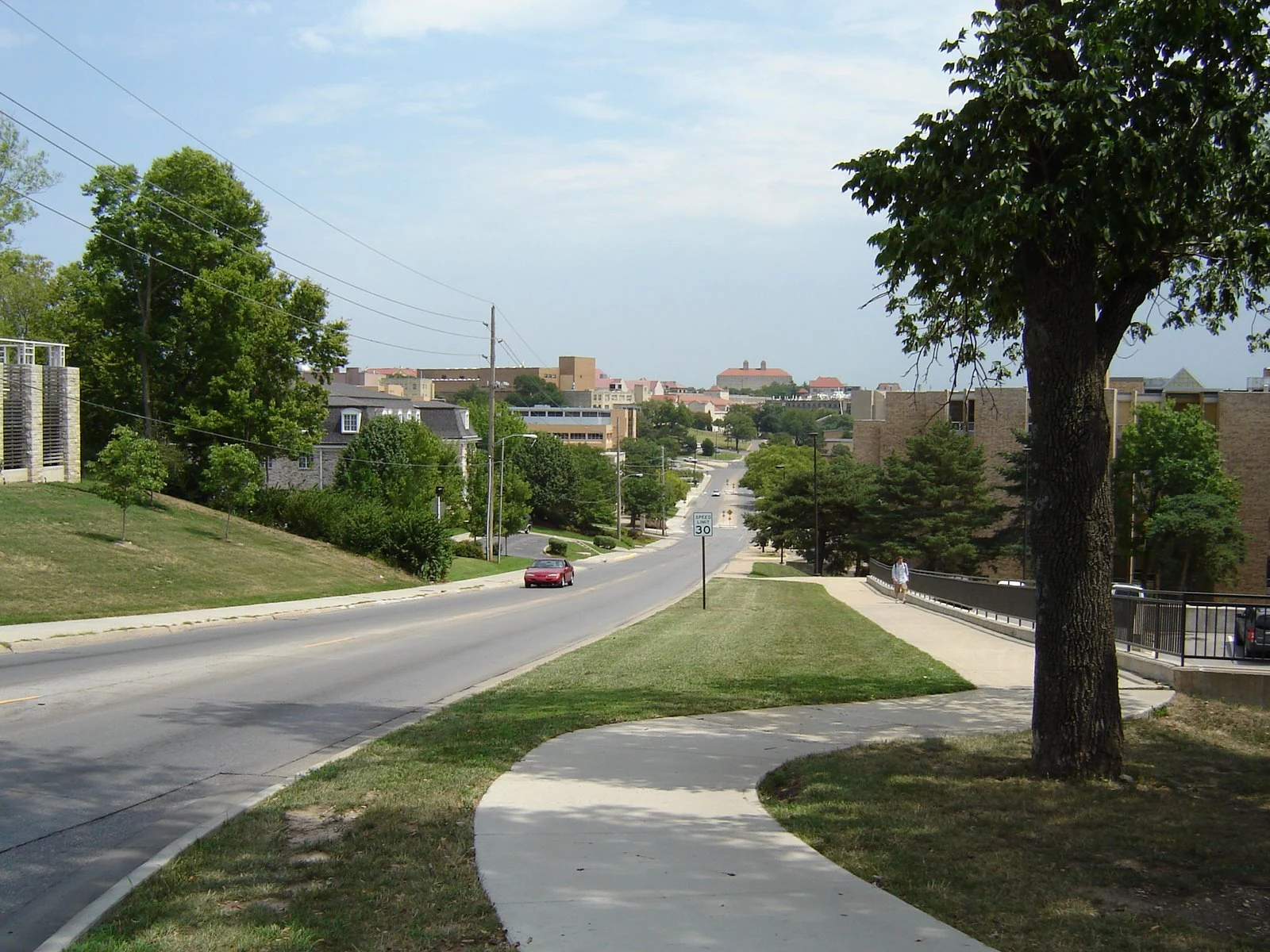
The catalog cannot say how many drafts preceded the report or where each page was written. It does establish a conjunction of words that would become increasingly important: general theory, fiber spaces, structure sheaf. It also establishes that the report was in English, unlike most of Grothendieck’s early published mathematics. The work belongs to an American institutional series, yet it entered a transnational conversation. Serre cited it in GAGA. Grothendieck cited it in the second part of his Tôhoku paper. The report’s surviving bibliographic trail leads from Kansas into the central literature of French algebraic geometry.22Jean-Pierre Serre, “Géométrie algébrique et géométrie analytique,” Annales de l’Institut Fourier 6 (1956): 1–42, https://doi.org/10.5802/aif.59, bibliography (10); Alexandre Grothendieck, “Sur quelques points d’algèbre homologique, II,” Tôhoku Mathematical Journal, Second Series 9, no. 3 (1957): 185–221, https://doi.org/10.2748/tmj/1178244774, bibliography (11).
No full copy was available for inspection for this account. That limit governs what can responsibly be said. Later biographical synthesis describes the report as developing initial ideas on nonabelian cohomology, to which Grothendieck returned in algebraic geometry. The title and contemporary citations confirm its broad domain, but they do not license a chapter-by-chapter synopsis. A biography can treat the report as a documentary threshold without inventing propositions that may or may not be on its pages.
The threshold is already substantial. A topological vector space is one object carrying algebraic and topological structure. A fiber space distributes objects over a base. A structure sheaf assigns algebraic data to open parts of that base and supplies restriction maps when one open set lies inside another. The question has shifted. Instead of asking which topology should complete a tensor product, Grothendieck was asking how spaces, fibers, local algebra, and gluing data might be treated in one theory.
The shift did not happen on a blank page. Sheaves had entered French mathematics through Jean Leray and the Cartan seminar. Fiber spaces belonged to topology and geometry, and André Weil had discussed them in algebraic geometry. Serre’s work was making coherent sheaves into effective tools. Kansas gave Grothendieck time to reorganize this inheritance.
A departmental report as mathematical publication
The Kansas object belonged to a category of publication common in mid-century mathematics: a departmental report tied to a research grant. Such reports could circulate substantial work before or outside commercial monograph series. Their institutional imprint supplied an address, series number, and means of reproduction.
Report no. 4 names the University of Kansas Department of Mathematics and the National Science Foundation project on the geometry of function space. The cataloged first edition has 100 pages after two preliminary pages. These details establish that the report was an extended treatment rather than an abstract or brief announcement.33Grothendieck, A General Theory of Fibre Spaces with Structure Sheaf.
The format does not establish editorial procedure. A series number does not prove external peer review, a particular print run, or a specified classroom audience. Those facts require departmental records or a surviving copy. The chapter therefore avoids claims about review, distribution size, and reception beyond citations that can be located.
Serre’s GAGA bibliography cited the report in 1956, and Tôhoku’s second part cited it in 1957. These independent contemporary uses show that the object circulated into the literature of algebraic geometry and sheaf theory. They do not show which pages each author used or whether every cited idea originated in Kansas.
The 1958 second edition confirms continued institutional life. Its catalog record retains the title, report identity, grant connection, and 100-page extent. Without both copies, the word edition cannot be converted into a claim of extensive revision. Pagination alone cannot show textual identity either.44Grothendieck, A General Theory of Fibre Spaces with Structure Sheaf. The two editions were not compared page by page.
This publication history explains why the report should remain distinct from the Tôhoku paper. One was an English departmental report on fiber spaces with structure sheaf; the other was a French journal article on homological algebra. They shared mathematical concerns and citations, but their genres, languages, and later reception differed.
The report also differs from the São Paulo course. The Brazilian object grew from teaching and appeared through university and mathematical-society imprints. The Kansas object belonged to a grant report series. Both were longer expositions produced outside an ordinary journal, yet the records do not justify treating their production processes as the same.
For historical method, the object demonstrates what metadata can and cannot bear. A catalog can establish title, author, edition, place, year, extent, language, and series. Contemporary bibliographies can establish that named readers cited it. Mathematical content beyond the title and bounded later description still requires the pages.
For the biography, the report gives the Kansas year a durable institutional artifact. It shows Grothendieck using a temporary appointment to produce a sustained work in a new field. It does not reveal a private decision, daily schedule, or complete later program. The artifact carries exactly the level of claim preserved by its catalog and citation trail.55Serre, “Géométrie algébrique et géométrie analytique”, bibliography, item 10; Grothendieck, “Sur quelques points d’algèbre homologique, II”, bibliography; Grothendieck, A General Theory of Fibre Spaces with Structure Sheaf.
A year in Lawrence
After the Brazilian appointment, Grothendieck spent 1955 at the University of Kansas. Jackson’s account, drawing on the Grothendieck–Serre correspondence, identifies Nachman Aronszajn as a possible link to the invitation. No invitation letter has been inspected here, so the route remains unresolved. Aronszajn was an analyst associated with function spaces and had joined the Kansas faculty earlier in the decade. That context explains why the proposed link merits archival follow-up without establishing it.66Jackson, “As If Summoned from the Void, I,” 1044.
The year 1955 does not provide exact months. The records used here do not support a journey from São Paulo to Lawrence, an encounter with the plains, or a first lecture in English. Nor do they support any reconstruction of the household. The campus must therefore appear through mathematical documents rather than fabricated weather or domestic detail.77Jackson, “As If Summoned from the Void, I,” 1044.
The report supplies one piece of institutional texture. It was attached to a research project, numbered in a departmental series, and reproduced for circulation. This was a different format from the Paris seminar or the São Paulo extension course. Its existence suggests an environment in which an extended manuscript could be prepared and issued outside a commercial press. It does not reveal whether Grothendieck held a particular teaching load, attended specific departmental meetings, or worked daily with Aronszajn. Those ordinary facts may be recoverable from archives, but they are not recoverable by imagining what a visiting mathematician “must have” done.
Kansas occupied a different position in Grothendieck’s intellectual geography. Paris and Nancy were dense with the colleagues who had formed his first mathematical world. São Paulo belonged to a long Franco-Brazilian exchange and offered a French-speaking community. Lawrence placed him in the United States but outside the best-known East Coast centers. The documented output consists of the fiber-space report and the work that became the Tôhoku paper.
The departmental setting nevertheless had a mathematical profile. Nachman Aronszajn worked in analysis and function spaces, and the series containing Grothendieck’s report belonged to an NSF project named “Geometry of Function Space.” The shared vocabulary makes the probable invitation intelligible. It does not prove daily collaboration or assign Aronszajn a role in the contents of the report.
This is a useful case of contextual evidence. An institutional series can show why a manuscript had a plausible home without showing who suggested a theorem. The report’s title fits a project on geometry of function space; its structure sheaves and nonabelian cohomology carry it beyond a conventional analysis report.
Grothendieck had recently taught topological vector spaces and remained known for analysis. An invitation through an analyst would not have required colleagues to foresee his geometric future.
The sequence corrects a triumphalist hiring story. Kansas did not recruit the established founder of scheme theory. It hosted a recent doctorate known for topological tensor products, and the surviving output shows him changing the scale of his questions. Institutional categories lagged behind intellectual movement.
The name “Geometry of Function Space” also bridges the subjects without erasing their difference. A function space is an infinite-dimensional object in analysis. A fiber space with structure sheaf belongs to topology and geometry. Both ask how local structure, maps, and variation should be organized. The report could stand in the project’s orbit while opening another field.
These two manuscripts point in related but distinct directions. The Kansas report addressed spaces with local algebra and forms of nonabelian cohomology. The Tôhoku work asked what formal conditions allowed homological algebra to operate in categories of sheaves and other objects. One dealt with geometric structures and gluing; the other with exactness, resolutions, and derived functors. Their coexistence matters. Grothendieck did not first complete a general theory of homological algebra and only afterward apply it to geometry. Formal language and geometric need developed against one another.
What a structure sheaf adds
A bare topological space consists of points and open sets, with axioms governing how the open sets combine. For many geometric purposes that is too little. On a smooth manifold, one wants to know which functions are smooth. On a complex analytic space, which functions are holomorphic. On an algebraic variety, which functions are regular. The relevant functions vary from open set to open set and restrict from larger domains to smaller ones. A sheaf records this local-to-local system and includes a gluing rule: compatible local sections determine a unique section on their union.
A structure sheaf makes this data part of the space itself. The pair joins the underlying topology of to a sheaf of rings . At a point, the stalk gathers functions defined nearby and identifies two when they agree on some smaller neighborhood.
This description uses language that became standard later; it should not be mistaken for a summary of every definition in the inaccessible Kansas report. Its purpose here is to explain why the report’s title marks a turn. Topological vector spaces had required Grothendieck to place an appropriate topology on an algebraic object. Ringed spaces required him to place appropriate local algebra over a topological base. Both constructions join layers of structure. The second opens a route to geometry because local rings can encode vanishing, singularity, and infinitesimal behavior.
Fiber spaces add another layer. A fiber bundle or related fiber space has a total space mapping to a base so that the inverse image over a point is a fiber. Locally, the total space may resemble a product; globally, the local products can twist. With a structure sheaf, the attachment of fibers and the transformation of local algebra must be tracked together.
The attraction of a “general theory” is clear. Principal bundles, vector bundles, torsors, and other locally trivial objects share a pattern: they are locally simple and globally classified by the way local pieces are glued. Ordinary abelian cohomology can classify some additive data. Nonabelian gluing, where transition functions take values in a noncommutative group, requires a more careful formalism. The first cohomology set may not be a group at all. Composition order matters, and higher analogues cannot be obtained by casually reusing abelian formulas.
Grothendieck’s later work made descent and nonabelian cohomology central. That later achievement must not be read as fully present in the 1955 report. The report is evidence of an initial engagement, not a complete forecast. Its title, citations, and later description place local geometric objects and gluing within its scope.88Jackson, “As If Summoned from the Void, I,” 1044; Grothendieck, A General Theory of Fibre Spaces with Structure Sheaf.
The distinction between an object and its gluing data also carried a philosophical charge without requiring a philosophical declaration. A global entity need not be specified all at once. It can be recovered from local entities plus compatibilities on overlaps, provided the compatibility conditions are correct. This was not Grothendieck’s invention; sheaf theory and bundle theory already embodied it. His later originality lay partly in how far he trusted and generalized the principle.
Cocycles without addition
The phrase nonabelian cohomology needs particular care because it can sound like an already finished extension of ordinary cohomology. Begin instead with the elementary gluing problem. Cover a space by open sets . Suppose an object is trivial over each . On an overlap , choose a transition function that identifies the two local trivializations. On a triple overlap the identifications must agree: with the order adjusted to the convention in use. A collection satisfying this compatibility is a 1-cocycle.
Changing the trivialization on each changes the transition functions without changing the glued object. Thus cocycles are grouped by an equivalence relation. When the values lie in an abelian group, equivalence classes can often be added, and cohomology is itself a group. When the structural group is noncommutative, multiplication order matters. The equivalence classes generally form only a pointed set, with a distinguished class for the trivial object. Calling that set is useful, but it does not turn it into an abelian group.
This construction classifies principal bundles or torsors under suitable hypotheses. A torsor resembles a group with its origin forgotten. Local choices can identify it with the group, while a cocycle records their failure to agree globally. Existing sections and obstructions to coherent choice both carry geometric information.
The Kansas report’s title and later descriptions place it in this mathematical region. Because the text itself was not inspected here, the chapter does not assert which modern torsor theorem it contains. The explanatory background concerns geometric objects reconstructed from local forms and transition maps.
There is a decisive asymmetry between and higher nonabelian cohomology. For sheaves of abelian groups, chain complexes and derived functors produce for every . In the nonabelian setting, there is no simple sequence of groups continuing the construction with all the familiar exactness. One must remember automorphisms of objects, automorphisms between automorphisms, and increasingly higher coherence. Decades of later mathematics would address these layers through gerbes, stacks, simplicial methods, and higher categories. None of that mature language should be installed in Lawrence in 1955.
What can be installed there is the problem. A theory of gluing must account for objects whose symmetries do not commute. Abelian homological algebra supplies a powerful machine but does not contain every classification problem. Grothendieck’s two Kansas projects stand on either side of that border. One makes the abelian machine more general; the other asks how far local-to-global geometry can proceed when addition is absent.
The border would remain productive throughout his career. Even in ordinary sheaf cohomology, automorphisms affect uniqueness. In moduli problems, an object can possess symmetries that prevent the set of isomorphism classes from carrying enough information. The later theory of stacks responds by retaining objects and arrows rather than collapsing everything to a set. It would be anachronistic to call the Kansas report a stack treatise; the later development is included only as a boundary.99Jackson, “As If Summoned from the Void, I,” 1044.
A line bundle assembled from overlaps
A line bundle gives a concrete gluing example without requiring noncommutative structure. Cover a space by open sets . Over each , choose a local basis , so the bundle looks like a product with a one-dimensional vector space. On an overlap, the bases differ by an invertible function:
On a triple overlap, consistency requires Changing the local bases replaces the functions by an equivalent cocycle. Under the usual hypotheses, the equivalence class determines the line bundle.
Because the sheaf is abelian, these classes form the first cohomology group . In algebraic geometry this group is the Picard group, with tensor product as its operation.
The projective line supplies a true algebraic example. The bundle can be defined by a transition function on the overlap of the two standard affine charts. Its powers produce the line-bundle degrees on the projective line. The transition function records global twisting that neither chart sees by itself.
The example shows what local triviality means: every piece is simple, while the overlap data carry the global class. It also shows why a structure sheaf matters. Transition functions are invertible sections of the relevant local rings, not arbitrary set maps.
The boundary appears when the structure group is nonabelian. For a rank- vector bundle, transition functions take values in the general linear group. Matrix multiplication need not commute, and the set of cocycle classes generally lacks an abelian group operation. The notation can remain, but the output is a pointed set rather than a cohomology group in the ordinary additive sense.
Automorphisms create another boundary. Passing directly to isomorphism classes forgets stabilizers and maps between objects. Later stack theory retains this information. That solution is not attributed to the 1955 Kansas report; the line-bundle example only identifies the gluing problem to which the report’s title and later description point.
Fiber bundles, sheaves, and cohomology had already supplied the ingredients. Grothendieck’s Kansas work belongs to the effort to organize them across algebraic and topological settings. The report itself remains unavailable for proposition-level inspection, so this modern example functions as explanation rather than synopsis.1010Grothendieck, A General Theory of Fibre Spaces with Structure Sheaf; Serre, “Géométrie algébrique et géométrie analytique”.
The example also clarifies why the Kansas report and Tôhoku manuscript belonged to one year. The line bundle is a geometric object defined by gluing, and its classification uses cohomological language. The abelian case fits part of the homological machinery, while the nonabelian case exposes its boundary.
The scale of “local”
Sheaf language can make “local” sound geographically small, as if locality meant inspecting a tiny neighborhood. Mathematically, locality is a rule about restriction, covering, and gluing across overlaps.
This distinction would become crucial in algebraic geometry. The Zariski topology covers a variety by open sets defined through nonvanishing of functions. It is often coarse: two nonempty open sets on an irreducible variety tend to meet. Many objects that are locally trivial in a finer sense are not locally trivial in the Zariski sense. A general theory of cohomology therefore cannot assume that one inherited topology will make every geometric phenomenon local.
In 1955 the full response was still ahead. Grothendieck would later treat a topology as a specification of covering families in a category rather than as a collection of open subsets. Sites and topoi belong to the 1960s development. The Kansas title, however, already joins fiber spaces to a structure sheaf and so makes locality part of the object under study. It directs attention to data over portions of a base and to their descent.
There are three levels that prose often merges. A presheaf gives restriction maps. A sheaf adds the local identity and gluing axioms. A ringed space specifies a sheaf of rings as structural data. A bundle or torsor over that space adds geometric objects varying over the base. Grothendieck’s later foundations would distinguish these levels with relentless care because different theorems depend on different layers.
Care also prevents a false analogy with political or personal belonging. A sheaf has no experience of exile; a local trivialization has no homeland. Grothendieck’s statelessness and his mathematics of gluing occupy the same biography, but there is no source making one a metaphorical cause of the other. The strongest connection the evidence permits is institutional: international networks gave a stateless mathematician temporary places to work, and in one of those places he wrote about mathematical objects defined through local compatibility.
The difference between suggestive juxtaposition and causal explanation is a central biographical discipline. Kansas matters because Grothendieck was there and because the report bears the university’s name; no source turns legal status into a mathematical cause.
The homological inheritance
The other Kansas manuscript began from an inheritance whose major book appeared in 1956. Henri Cartan and Samuel Eilenberg’s Homological Algebra gathered techniques that had grown in topology and algebra and organized them around functors, resolutions, Ext, Tor, and exact sequences. Its publication date falls after the Kansas year, but the ideas and manuscript circulated earlier. Grothendieck’s May 1957 Bourbaki exposé explicitly said that results found in the winters of 1955 and 1956 used Cartan–Eilenberg homological algebra intensively.1111Henri Cartan and Samuel Eilenberg, Homological Algebra, Princeton Mathematical Series 19 (Princeton University Press, 1956); Weibel, “History of Homological Algebra,” 797–98; Alexandre Grothendieck, “Théorèmes de dualité pour les faisceaux algébriques cohérents,” Exposé 149, Séminaire Bourbaki, vol. 4 (1956–1958), 1958, 149–01, https://www.numdam.org/item/SB_1956-1958__4__169_0/.
The central problem can be approached through what a functor fails to preserve. Suppose a short exact sequence expresses as the kernel of a map from to and as the corresponding quotient. Apply a functor such as or global sections. Part of the sequence remains exact, but exactness may fail at the far end. Derived functors turn that failure into new objects. Instead of treating the lost information as an annoyance, homological algebra makes it the next layer of the theory.
To calculate those layers, one replaces an object by a resolution. A projective resolution maps a chain of projective objects onto the original object; an injective resolution embeds it into a chain of injectives. Apply the functor to the resolution and take cohomology. Under the right conditions the answer does not depend on the chosen resolution, even though the resolution itself is far from unique.
Cartan and Eilenberg developed this systematically for modules. Geometry supplied categories that looked similar but were not literally module categories over one fixed ring. Sheaves of modules vary over open sets. Global sections form a left-exact functor. Higher sheaf cohomology should be its derived functors. To make that statement more than an analogy, one needs a category with kernels, cokernels, exact sequences, and enough injective objects.
This need helps explain the simultaneity of the Kansas works. A structure sheaf turns geometry into local algebra, but local algebra alone does not produce global invariants. Sheaf cohomology measures obstructions to gluing and the failure of global sections to preserve exactness. Homological algebra supplies the machinery. Geometry tests whether the machinery is general enough.
The direction of influence was circular. Module theory suggested formal constructions; sheaves demanded their extension. Grothendieck preserved the motivating examples while identifying an environment in which their common arguments could be stated once.
Exactness as a portable structure
The word exact carries much of the transition. In a vector-space sequence, exactness can be checked element by element: what maps to zero is exactly what came from the preceding space. In a sheaf sequence, the same sentence must be interpreted locally, often on stalks. In an abstract category, there may be no elements to chase. One must define kernels, cokernels, images, and coimages through universal properties.
That passage changes the status of a proof. An argument written with elements may depend on facts invisible in its final diagram. To transport it to sheaves, one needs to know which steps use addition, which use the existence of quotients, which use a choice of lifts, and which use an injective or projective object. Homological algebra audits why the arrows support an argument; drawing them is insufficient.
Once exactness is portable, a short exact sequence generates a long exact sequence in derived functors. For a left-exact functor , the sequence begins The connecting homomorphism is not an arbitrary repair. It measures how an element or section that exists after applying fails to lift through the original sequence. Higher derived functors continue the obstruction.
For global sections of a sheaf, this has a direct geometric reading. Compatible local data may fail to come from a global section. A short exact sequence of coefficient sheaves can transfer that failure into the next cohomology group. The long exact sequence makes local-to-global obstruction calculable and functorial.
The construction requires resolutions or an equivalent universal characterization. Modules over a ring have ample free and projective modules; sheaf categories often have few useful projectives. Injective resolutions therefore become central. To say a category has “enough injectives” means every object embeds in an injective one, so the resolution can begin. It does not mean injectives are plentiful in an elementary or concrete sense. Their existence may require a theorem at the level of the entire category.
This was where generality had a cost. In one familiar module category, the necessary objects might be explicitly constructed. In categories of sheaves, Grothendieck needed axioms controlling sums, limits, and generators strongly enough to prove existence. Tôhoku made both the surviving formulas and the environment supporting them objects of study.
Kansas thus marks a move from using a machine to specifying its operating conditions. Cartan–Eilenberg had built an extraordinarily powerful machine for modules. Grothendieck asked what properties of modules the proofs actually used and whether sheaves possessed analogues. The answer became an axiomatic theory broad enough that subsequent mathematicians could recognize new examples without rebuilding homological algebra each time.
This kind of transport differs from superficial formalism. Replacing nouns by letters without identifying additive structure, kernels, cokernels, exact colimits, injectives, and acyclicity can produce false theorems. Each hypothesis corresponds to a possible failure of proof.
The later record shows Grothendieck favoring arguments that exposed a stable structure over isolated devices. That preference was not always achieved, and his own proofs could use ingenious reductions. In the Kansas mathematics, the auditable claim is narrower: exactness hypotheses identify which parts of a module proof survive for sheaves.1212Cartan and Eilenberg, Homological Algebra; Weibel, “History of Homological Algebra”.
Serre as transmitter and critic
Around this time the correspondence with Jean-Pierre Serre became one of Grothendieck’s principal mathematical channels. They had met in Paris and Nancy. Their temperaments and working styles differed. Later readers of the letters have emphasized Grothendieck’s expansive conjectures and Serre’s ability to supply a decisive example, reference, correction, or sharply posed question. A biography should not reduce either mathematician to one role. The exchange mattered because both could alter the other’s direction.1313Jackson, “As If Summoned from the Void, I,” 1044–45; Alexander Grothendieck and Jean-Pierre Serre, Correspondance Grothendieck–Serre, ed. Pierre Colmez and Jean-Pierre Serre, Documents Mathématiques 2 (Société Mathématique de France, 2001), https://smf.emath.fr/publications/correspondance-grothendieck-serre.
Grothendieck later credited Serre with drawing his attention to the substance behind statements that had not initially engaged him. The account is retrospective and describes one function of their correspondence.1414Jackson, “As If Summoned from the Void, I,” 1044–45; Grothendieck and Serre, Correspondance Grothendieck–Serre.
Serre later remarked that Grothendieck’s knowledge of classical algebraic geometry was then practically zero. Serre’s own, he added, was only somewhat better, but the field contained so many open questions that this did not prevent work. The recollection protects the history from inevitability. Grothendieck did not enter algebraic geometry after mastering its full classical archive. He learned selectively, often by reconstructing, while Serre pointed toward results and problems that mattered.1515Jackson, “As If Summoned from the Void, I,” 1044.
Such ignorance could be a liability. It could also prevent inherited formulations from appearing compulsory. A mathematician who had not spent years internalizing every classical technique might ask why a theorem had been stated for individual varieties rather than for maps, or why a cohomology theory depended on a particular construction rather than on formal properties. This does not mean ignorance caused originality. Many people lack background without remaking a field. It means that Grothendieck’s dependence on Serre and his habit of first-principles reconstruction formed a specific working combination.
The letters and telephone conversations continued after Kansas. They carried questions between Grothendieck’s large frameworks and Serre’s precise mathematical world. The exchange also complicates the geography. “Kansas” names the place of composition, not an intellectual isolation from France. Manuscripts, books, letters, and remembered telephone calls joined Lawrence to Paris. The decisive community was partly present at a distance.
The Weil conjectures enter as a cohomological demand
Grothendieck later credited Serre with presenting the Weil conjectures to him around 1955 in a cohomological context. André Weil had formulated the conjectures in 1949 for zeta functions of varieties over finite fields. Serre did not author them; his role in this episode was to expose the form in which they could seize Grothendieck’s attention.1616Jackson, “As If Summoned from the Void, I,” 1044, citing Récoltes et Semailles, p. 840.
For a variety over a finite field, point counts over the original field and each finite extension can be packaged into a zeta function. Weil’s conjectures predicted rationality, a functional equation, and restrictions on zeros and poles analogous to a Riemann hypothesis. They also connected the degrees in the rational expression with topological invariants familiar from complex varieties.
The suggestion was audacious because a variety over a finite field does not carry the ordinary complex topology from which classical Betti numbers arise. If the analogy was genuine, algebraic geometry required a new cohomology theory: one capable of existing in positive characteristic, carrying functorial maps and products, satisfying duality, receiving classes of algebraic cycles, and supporting a trace formula that converted an endomorphism into a point count.
In 1955 this theory did not exist. The mature answer—étale cohomology constructed within a much larger apparatus—belongs to subsequent years and many mathematicians. It would be false to place it in the Kansas report or the first Tôhoku draft. The Weil conjectures instead supplied a cohomological demand that remained unanswered.1717Jackson, “As If Summoned from the Void, I,” 1044, reporting Grothendieck’s later account of Serre’s cohomological presentation of the Weil conjectures.
That demand aligned with homological algebra. Cohomology as a derived functor already showed that a theory could be defined through categorical properties rather than through one explicit complex. Spectral sequences could compare constructions. Sheaves could encode local coefficients. But the Zariski topology used in algebraic geometry was too coarse for all the invariants the Weil conjectures required. The gap between formal machinery and geometric adequacy remained open.
The gap explains why the move toward geometry did not amount to choosing a new collection of objects. Categories, sheaves, and functors were candidates for a setting in which the required cohomology could exist.
Writing Tôhoku before “Tôhoku”
The work now routinely called the Tôhoku paper was written in Kansas, according to the detailed biographical reconstruction. It was published in 1957 in the Tôhoku Mathematical Journal. The nickname comes from the journal, not from a visit by Grothendieck to Sendai documented in this period. There is no reason to invent one.1818Jackson, “As If Summoned from the Void, I,” 1044.
Bibliographic databases divide the work into two records. Part I appears in volume 9, issue 2, beginning at page 119. Part II appears in issue 3 at pages 185–221. Standard references usually cite the whole work as volume 9 (1957), 119–221.1919Grothendieck, “Sur quelques points d’algèbre homologique, I”; Grothendieck, “Sur quelques points d’algèbre homologique, II”.
This chronology separates three events. In 1955 Grothendieck composed the work in Kansas. In 1957 the Japanese journal published it. Over later decades the journal’s name became the standard shorthand for the paper.2020Jackson, “As If Summoned from the Void, I,” 1044.
The distinction also protects the narrative from a false sequence. Cartan–Eilenberg’s book bears a 1956 publication date, while Tôhoku appeared in 1957. One might infer that Grothendieck read the finished book and then wrote his paper. His own 1957 account dates related discoveries to the winters of 1955 and 1956, and the Cartan–Eilenberg project had circulated before publication. Mathematics moved through seminars and manuscripts as well as bound volumes. The correct claim is influence and intensive use, not a simplistic before-and-after based only on title pages.
The deposited bibliography for Tôhoku’s second part is a map of the transition. It cites Cartan and Eilenberg, Buchsbaum’s 1955 “Exact Categories and Duality,” Cartan seminars, Godement, Mac Lane, Serre’s FAC and GAGA, Weil’s fiber-space notes, and Grothendieck’s own Kansas report.2121Grothendieck, “Sur quelques points d’algèbre homologique, II”, deposited bibliography; David A. Buchsbaum, “Exact Categories and Duality,” Transactions of the American Mathematical Society 80 (1955): 1–34, https://doi.org/10.1090/S0002-9947-1955-0074407-6; Jean-Pierre Serre, “Faisceaux algébriques cohérents,” Annals of Mathematics 61, no. 2 (1955): 197–278, https://doi.org/10.2307/1969915; Serre, “Géométrie algébrique et géométrie analytique”.
That list is contemporaneous evidence stronger than a later claim that all of Grothendieck’s subjects were always unified in his mind. It shows which works the published treatment acknowledged. It also reveals that the Kansas report was not a discarded preliminary. Grothendieck cited it when treating Ext for sheaves, and Serre cited it in GAGA. The report had become part of the shared scaffolding even though it did not achieve the fame of Tôhoku.
Nonabelian and abelian directions
The two Kansas projects can be distinguished by a basic algebraic divide. Homological algebra in its classical form works especially well with abelian groups and modules, where addition is commutative. Kernels, cokernels, exact sequences, and chain complexes depend on this additive structure. An abelian category abstracts the formal behavior needed for those operations.
Bundles and torsors often involve noncommutative groups. Their transition functions multiply in an order that cannot be ignored. First nonabelian cohomology can classify forms of gluing, but it generally produces a pointed set rather than an abelian group. There may be no addition of classes and no chain complex yielding higher groups by the usual recipe.
Grothendieck’s simultaneous interest in both directions is revealing. He was not pursuing generality by insisting that every phenomenon fit one algebraic template. The Tôhoku framework clarified the enormous reach of the abelian case. The fiber-space report confronted structures outside it. Later theories of descent, stacks, and nonabelian cohomology would broaden the second path, but those later names should not be backdated.
The relation between the two paths lies in gluing and obstruction. In the abelian setting, higher cohomology groups measure failures and extensions with an additive structure. In the nonabelian setting, cocycles and equivalence relations classify twisted objects without that structure. A general geometer needed to know both what the powerful additive machine could do and where it ceased to apply.
This is one reason “the homological turn” must not be mistaken for a turn away from geometry. Homological algebra supplied a machine; fiber spaces with structure sheaf supplied geometric problems and exposed the machine’s limits.2222Grothendieck, “Sur quelques points d’algèbre homologique, I”; Grothendieck, “Sur quelques points d’algèbre homologique, II”; Grothendieck, A General Theory of Fibre Spaces with Structure Sheaf.
A report read through later citations
When a primary text is inaccessible, its citations in contemporary work can establish limited facts. Serre’s 1956 GAGA bibliography lists A General Theory of Fibre Spaces with Structure Sheaf, Kansas University, 1955. The reference appears in a paper comparing algebraic and analytic geometry through coherent sheaves. It establishes that Serre cited the report by the time GAGA appeared; it does not establish that every GAGA theorem derives from it.2323Serre, “Géométrie algébrique et géométrie analytique”, bibliography (10).
Grothendieck’s own 1957 bibliography lists the report alongside Weil’s fiber-space notes and Serre’s geometric papers. This locates it within his declared sources. Again, the inference must remain proportional. A bibliography shows acknowledged relevance, not the exact route of every idea.
The 1958 second edition adds a final bibliographic layer. Its catalog record retains the same length, title, report number, and grant connection. Without comparing copies, one cannot say how extensively the text changed. “Second edition” is the safe description. To call it a rewritten 1958 theory would exceed the evidence.2424Grothendieck, A General Theory of Fibre Spaces with Structure Sheaf.
These cautious inferences may seem modest beside the dramatic narrative of a great mathematician changing fields. They are what make that narrative trustworthy. A report existed in 1955. Serre cited it in 1956. Grothendieck cited it in 1957. A second edition appeared in 1958. Across four years, the object remained visible while its author’s program widened. The sequence shows continuity without requiring invented scenes of reception.
It also shows how a work can be historically important without remaining widely read. The Tôhoku paper acquired an enduring nickname. The Kansas report became scarce. Yet the less famous object preserves a phase that the famous paper alone would obscure: an effort to treat fiber spaces, structure sheaves, and nonabelian gluing before the foundational geometry of schemes had taken its later form.
A temporary post and durable manuscripts
The contrast between temporary employment and durable writing runs through the period. Grothendieck had no secure national academic home. São Paulo and Kansas offered bounded appointments. The reports and papers outlasted the posts, crossed languages, and entered bibliographies far from their place of composition.
It would be easy to make this contrast morally neat: institutions were temporary, ideas permanent. Actual mathematical work depends on institutions even when a post is short. Salary, time, colleagues, reproduction facilities, libraries, and grant-supported publication all leave traces. The Kansas report’s series number and grant note are evidence that abstract thought had material supports. A hundred pages do not circulate by pure intellect.
The same point complicates the heroic image of solitude. Later witnesses emphasize Grothendieck’s capacity for concentrated work, but the manuscripts are full of relations: the unresolved Aronszajn link, Cartan–Eilenberg’s framework, Serre’s correspondence, Weil’s questions, departmental publication, and a Japanese journal. Independence of method did not mean absence of a community.
Nor was the community confined to contemporaries in one room. Serre cited Kansas in GAGA, Grothendieck placed the report in Tôhoku’s bibliography, and Japanese editors published a French paper written in America. The geography of the work forms a network.
That network gave Grothendieck mobility without resolving belonging. A visiting appointment ends. A CNRS fellowship can remain insecure. A paper can be reviewed, cited, and reprinted regardless of the author’s passport, though travel and employment still depend on legal status. The mathematical republic did not abolish the nation-state; it sometimes created passages through its restrictions.
This institutional reading helps resist another retrospective distortion. Because Grothendieck later became the central figure of IHÉS, earlier temporary posts can look like mere preliminaries before the “right” institution discovered him. In 1955 IHÉS did not yet exist. Kansas was not an audition for a known future. It was one of the actual places in which the future work became possible.
The report’s second edition appeared in the same year IHÉS was founded and EGA writing began. These are separate bibliographic and institutional facts, not evidence that one caused the others.2525Grothendieck, A General Theory of Fibre Spaces with Structure Sheaf; Institut des Hautes Études Scientifiques, “The Foundation,” History of the IHES, https://www.ihes.fr/en/institute/history/; Jackson, “As If Summoned from the Void, I,” 1049–50.
The genre of a general theory
A report called A General Theory makes a different promise from an article whose title concerns several points. The first offers an architecture; the second isolates problems without claiming completion. Grothendieck used both forms in Kansas, though a title alone cannot establish his intention.
An architecture begins by selecting its base spaces, the structures carried over them, the maps that preserve those structures, the rules for restriction and gluing, and the relevant notion of equivalence. Once these choices are made, examples can be placed within the system and classification questions can be asked uniformly. A hundred-page report has room to build such an entrance.
Homological algebra presented through axioms identifies a category, exact sequences, functors, and resolutions, then tests which theorems remain valid. The paper’s scope was broader than its restrained title.
The two genres also carry different risks. A general theory can be too broad to control examples or too narrow to include the phenomena that motivated it. An axiomatic paper can hide geometric meaning behind formal conditions. Grothendieck’s later practice repeatedly moved between them: large foundational expositions and focused seminar talks, expansive programs and precise lemmas. Kansas already shows the alternation.
Because the full report is absent, this chapter cannot judge how successfully it fulfilled its title. Contemporary citations prove that colleagues found it relevant. Later work proves that Grothendieck continued reworking the subject rather than treating the 1955 framework as final. A first general theory can be historically important because it identifies what remains inadequately general.
The English title deserves notice but not speculation. The catalog identifies the report’s language as English. It does not reveal whether Grothendieck drafted every sentence unaided, how he lectured in Lawrence, or who edited the prose. No claim about his spoken fluency follows from a bibliographic language field. The distinction prevents a document from being turned into a personality anecdote.
A year between unfinished books
Kansas lay between two major publication moments. Grothendieck’s functional-analysis thesis appeared as an American memoir in 1955, fixing work largely completed before São Paulo. Cartan and Eilenberg’s Homological Algebra appeared in 1956, fixing a framework Grothendieck was already extending. The year of composition sat between books whose print dates do not capture when their ideas became active.
This is characteristic of mid-century research. Seminar notes and prepublication manuscripts could shape work before a bound volume arrived. A mathematician might cite a book as forthcoming, learn a theorem by letter, and publish an extension in another country after the source itself appeared.
The chronology cautions against a model in which reading follows publication and discovery follows reading. Grothendieck’s 1957 duality exposé dates results to the winters of 1955 and 1956 while crediting intensive use of Cartan–Eilenberg. The evidence supports circulation and overlap, not a neat sequence from bookstore to theorem.
It also qualifies the claim that he learned by reconstructing rather than reading. Witnesses describe a powerful habit of reconstruction and limited interest in exhaustive literature. His papers nevertheless cite predecessors and depend on contemporary frameworks. Independence of method was not isolation from texts.
The two surrounding books represent different relations to completion. The thesis memoir gathered a theory Grothendieck later described as finished for his own work. Homological Algebra supplied a theory whose limits he immediately tested. One publication closed a personal phase while the other opened a field of generalization.
The Kansas report occupied a third status. It was long enough to be a small book, issued in a departmental series, and still preliminary to later descent theory. Its second edition showed continuing use without converting it into the final foundation.
These forms—memoir, monograph, report, journal article, seminar exposé—are part of the biography of ideas. Each offers a different balance of speed, permanence, and scope. Grothendieck moved among them as his questions enlarged.
The 1955 record contains a printed thesis memoir, a departmental report, a journal manuscript, and tools whose definitive book appeared in 1956. Their dates do not represent simultaneous discovery.2626Grothendieck, Produits tensoriels topologiques et espaces nucléaires; Cartan and Eilenberg, Homological Algebra; Grothendieck, A General Theory of Fibre Spaces with Structure Sheaf; Grothendieck, “Sur quelques points d’algèbre homologique, I”; Grothendieck, “Sur quelques points d’algèbre homologique, II”.
The word general itself did not mean “maximally abstract.” In fiber-space theory, generality had to preserve the operations that classified actual bundles. In homological algebra, it had to preserve exact sequences and derived functors. A framework that omitted the decisive maps would be less general in the useful sense, however few assumptions it displayed.
This practical generality was one of the skills Grothendieck brought from analysis. The projective tensor product was general because continuous bilinear maps factored through it. Nuclearity was general because it identified a condition under which comparison maps became isomorphisms across a class of partners. The Kansas work extended the same demand to local structures and cohomological operations: define the environment by what it enables.
There is an ethical temptation in biography to equate such mathematical generality with universal human openness. Grothendieck’s later political commitments make the equation attractive. It remains unsupported. A universal property is a formal characterization, not a social program. Keeping the domains distinct allows both the mathematics and the life to retain their particular evidence.
The report and Tôhoku manuscript survive as the principal records of a year whose ordinary texture is missing. The chapter does not compensate for that absence with private or sensory detail.
Languages and routes of circulation
The Kansas report was written in English. The Tôhoku paper was written in French and published by a Japanese journal. The mathematician corresponding most intensely with Grothendieck was in France; the report’s institutional support was American; its later catalog copies are dispersed internationally. The objects crossed linguistic borders even when the surviving evidence says little about spoken life in Lawrence.
French still functioned as a major language of international mathematics. A Japanese journal could print a hundred-page French article. Serre’s FAC and GAGA, the Cartan and Bourbaki seminars, and Grothendieck’s duality work all used French. English was increasingly dominant in American publication, but it had not yet made French mathematically provincial.
The report’s English title does not prove that Grothendieck had adopted English as his principal working language. His 1958 Edinburgh paper would also appear in English, while the Riemann–Roch and Chern-class papers appeared in French. Language followed venue and collaborators as well as personal fluency.
Translation in mathematics is not limited to words. The Kansas year translated constructions between disciplines. fiber bundles became ringed or structured spaces. Module resolutions became sheaf resolutions. Local gluing became cohomology. Each translation preserved some operations and required corrections for others.
The bibliography shows which translations were active. Weil’s fiber spaces linked topology and algebraic geometry. Serre’s coherent sheaves linked commutative algebra and geometry. Cartan–Eilenberg linked topology’s homology to module theory. Buchsbaum sought an axiomatic exact setting. Grothendieck’s report and Tôhoku paper entered at the crossings.
A transnational narrative can overstate the freedom of mathematical circulation. Papers traveled more easily than their author. Grothendieck’s statelessness continued to constrain employment and border procedures. International prestige did not grant citizenship. The Kansas post was temporary.
Nor should the Japanese journal be treated as an exotic container for European work. Tôhoku Mathematical Journal had its own scholarly institution and editorial history. The nickname by which the paper became known preserves that institutional contribution, even though later accounts rarely discuss the editorial route.
Why Grothendieck submitted there remains unresolved for this account. Without correspondence, one should not invent a recommendation or editorial decision. The correct statement is bibliographic: the journal published the work in two parts in 1957 and thereby supplied the name under which it entered the field.
The route from Lawrence manuscript to Tôhoku print ran through journals, seminars, correspondence, and temporary appointments. The reason for choosing the Japanese journal remains unknown in the inspected record.2727Grothendieck, “Sur quelques points d’algèbre homologique, I”; Grothendieck, “Sur quelques points d’algèbre homologique, II”.2828Grothendieck, “Sur quelques points d’algèbre homologique, I”; Grothendieck, “Sur quelques points d’algèbre homologique, II”. The publication venue is established; an editorial route is not.
Kansas occupies that infrastructure as more than geography. It is printed in the report’s imprint and cited in GAGA. The university’s name became part of a French theorem’s bibliography. A temporary American appointment left a durable address inside algebraic geometry.
Returning to Paris
Grothendieck returned to France in 1956. He again held a CNRS position and spent most of his time in Paris. The administrative fact should not be embellished into secure permanence; the inspected sources do not specify a permanent rank. Mathematically, the return placed him close to Serre, Cartan’s seminar, Bourbaki, and the community in which coherent sheaves and algebraic topology were developing rapidly.2929Jackson, “As If Summoned from the Void, I,” 1044–45; O’Connor and Robertson, “Alexander Grothendieck”.
The geographic return did not restore the pre-Brazilian situation. He came back with the Kansas manuscripts and a new field of work. In February 1957 he presented a Cartan Seminar exposé generalizing results of Serre; in May he explained coherent-sheaf duality using Cartan–Eilenberg’s homological machinery. The Tôhoku paper appeared that year, followed by the Riemann–Roch work.
It is possible to list these achievements so quickly that Kansas disappears into a sentence between São Paulo and Paris. The report resists that compression. Its institutional title page places Grothendieck in Lawrence at the moment when “space” was becoming inseparable from “structure sheaf.” The Tôhoku composition places him there when module homological algebra was becoming an abstract theory of abelian categories and sheaves.
The year did not provide a conversion scene. It provided work. Grothendieck did not need to announce that he had become an algebraic geometer before he could begin constructing the languages algebraic geometry would use. Nor did he cease being an analyst by crossing a border. The habits of tensor products, duality, and universal constructions entered the new subject with him.
Kansas therefore marks a change in scale. Tôhoku supplied axioms for categories in which sheaves, modules, and their cohomology could be treated together, extending the earlier organization of spaces and maps.
The hundred-page report points to the other half of the change. A category is not enough unless it carries the geometry one wants: local structures must glue, fibers must vary, and automorphisms must be retained.
What the Kansas year left open
The quantity of writing can make Kansas look like a completed foundation. It was not. The Tôhoku framework provided a broad home for abelian homological algebra, but nonabelian cohomology remained less systematic. The fiber-space report addressed structured spaces, but scheme theory had not yet supplied the final category of bases. The Weil conjectures demanded a cohomology theory that neither manuscript constructed.
The open status is visible in later work. Grothendieck returned to descent, torsors, sites, and topoi because local gluing required more than the first report. He returned to homological foundations through derived categories and duality because abelian groups alone did not retain every complex-level relation. He rebuilt algebraic geometry because the objects on which the machinery should act were still too narrowly framed.
These later returns should not be read as corrections of failure. A first theory can be successful by exposing the precise obstruction to its own extension. Tôhoku made clear what an abelian category could support. Its clarity made the nonabelian boundary visible.
The year also left personal and institutional questions unresolved. The Kansas post ended. Statelessness remained. The sources do not establish a permanent American offer or a plan to remain. Return to CNRS support in France restored a mathematical center but not yet the independent long-term position IHÉS would later provide.
The report’s scarcity limits the account. Contemporary citations establish circulation, but the unavailable text prevents claims about its detailed terminology, examples, or 1958 revisions.3030Grothendieck, A General Theory of Fibre Spaces with Structure Sheaf.
Kansas therefore contributes a beginning rather than a closed period. The two works use categories and functors alongside geometric objects defined by local structure and gluing; they do not yet form one scheme-theoretic foundation.
The return to Paris supplied the next tests. Serre’s coherent sheaves gave a concrete category. Cartan’s seminar gave a forum. Duality gave a theorem whose classical and homological forms had to agree. Riemann–Roch gave a map-centered statement large enough to expose the power of the language.
Calling Kansas a turning point is accurate only with this openness preserved. The surviving record consists of manuscripts, citations, and unresolved archival questions. In 1956 Grothendieck returned to France; the two Kansas works remained different records of the same change in mathematical direction.
The distinction between them remained useful. Tôhoku supplied a formal environment for exact sequences, resolutions, and derived functors. The report placed fiber spaces, local algebra, and gluing in the foreground. One text became a standard reference; the other remained scarce but continued to appear in contemporary bibliographies. Their different reception should not be mistaken for a difference between important and irrelevant work.
The Kansas year can therefore be closed without assigning a private decision to Grothendieck. By its end, two bodies of mathematics had acquired manuscript form, while the permanent post, mature scheme foundation, and cohomology sought for the Weil conjectures did not yet exist. The return to Paris changed the institutional setting; it did not erase the questions recorded in Lawrence.3131Jackson, “As If Summoned from the Void, I,” 1044–45; Grothendieck, A General Theory of Fibre Spaces with Structure Sheaf; Grothendieck, “Sur quelques points d’algèbre homologique, I”; Grothendieck, “Sur quelques points d’algèbre homologique, II”.
The source boundary remains part of the conclusion. The report’s catalog record establishes title, date, extent, language, series, and grant. Citations in GAGA and Tôhoku establish circulation and relevance to the contemporary discussion. Jackson’s synthesis identifies nonabelian cohomology as part of its subject. None of these sources substitutes for opening the report itself.
Accordingly, the chapter does not assign theorem numbers, quote definitions, or claim that later descent and stack language already appeared there. Those questions remain for a copy-level archival review. This restraint preserves a useful difference between what the 1955 object proves by existing and what only its pages could prove about mathematical content.
The distinction also keeps publication history separate from retrospective influence. A scarce report can matter without containing the completed future theory; a widely taught paper can become standard without having been written with that reception in view. Kansas left both kinds of document.3232Serre, “Géométrie algébrique et géométrie analytique”, bibliography, item 10; Grothendieck, “Sur quelques points d’algèbre homologique, II”, bibliography; Jackson, “As If Summoned from the Void, I,” 1044; Grothendieck, A General Theory of Fibre Spaces with Structure Sheaf.
Notes
- Grothendieck, A General Theory of Fibre Spaces with Structure Sheaf. ↩
- Jean-Pierre Serre, “Géométrie algébrique et géométrie analytique,” Annales de l’Institut Fourier 6 (1956): 1–42, https://doi.org/10.5802/aif.59, bibliography (10); Alexandre Grothendieck, “Sur quelques points d’algèbre homologique, II,” Tôhoku Mathematical Journal, Second Series 9, no. 3 (1957): 185–221, https://doi.org/10.2748/tmj/1178244774, bibliography (11). ↩
- Grothendieck, A General Theory of Fibre Spaces with Structure Sheaf. ↩
- Grothendieck, A General Theory of Fibre Spaces with Structure Sheaf. The two editions were not compared page by page. ↩
- Serre, “Géométrie algébrique et géométrie analytique”, bibliography, item 10; Grothendieck, “Sur quelques points d’algèbre homologique, II”, bibliography; Grothendieck, A General Theory of Fibre Spaces with Structure Sheaf. ↩
- Jackson, “As If Summoned from the Void, I,” 1044. ↩
- Jackson, “As If Summoned from the Void, I,” 1044. ↩
- Jackson, “As If Summoned from the Void, I,” 1044; Grothendieck, A General Theory of Fibre Spaces with Structure Sheaf. ↩
- Jackson, “As If Summoned from the Void, I,” 1044. ↩
- Grothendieck, A General Theory of Fibre Spaces with Structure Sheaf; Serre, “Géométrie algébrique et géométrie analytique”. ↩
- Henri Cartan and Samuel Eilenberg, Homological Algebra, Princeton Mathematical Series 19 (Princeton University Press, 1956); Weibel, “History of Homological Algebra,” 797–98; Alexandre Grothendieck, “Théorèmes de dualité pour les faisceaux algébriques cohérents,” Exposé 149, Séminaire Bourbaki, vol. 4 (1956–1958), 1958, 149–01, https://www.numdam.org/item/SB_1956-1958__4__169_0/. ↩
- Cartan and Eilenberg, Homological Algebra; Weibel, “History of Homological Algebra”. ↩
- Jackson, “As If Summoned from the Void, I,” 1044–45; Alexander Grothendieck and Jean-Pierre Serre, Correspondance Grothendieck–Serre, ed. Pierre Colmez and Jean-Pierre Serre, Documents Mathématiques 2 (Société Mathématique de France, 2001), https://smf.emath.fr/publications/correspondance-grothendieck-serre. ↩
- Jackson, “As If Summoned from the Void, I,” 1044–45; Grothendieck and Serre, Correspondance Grothendieck–Serre. ↩
- Jackson, “As If Summoned from the Void, I,” 1044. ↩
- Jackson, “As If Summoned from the Void, I,” 1044, citing Récoltes et Semailles, p. 840. ↩
- Jackson, “As If Summoned from the Void, I,” 1044, reporting Grothendieck’s later account of Serre’s cohomological presentation of the Weil conjectures. ↩
- Jackson, “As If Summoned from the Void, I,” 1044. ↩
- Grothendieck, “Sur quelques points d’algèbre homologique, I”; Grothendieck, “Sur quelques points d’algèbre homologique, II”. ↩
- Jackson, “As If Summoned from the Void, I,” 1044. ↩
- Grothendieck, “Sur quelques points d’algèbre homologique, II”, deposited bibliography; David A. Buchsbaum, “Exact Categories and Duality,” Transactions of the American Mathematical Society 80 (1955): 1–34, https://doi.org/10.1090/S0002-9947-1955-0074407-6; Jean-Pierre Serre, “Faisceaux algébriques cohérents,” Annals of Mathematics 61, no. 2 (1955): 197–278, https://doi.org/10.2307/1969915; Serre, “Géométrie algébrique et géométrie analytique”. ↩
- Grothendieck, “Sur quelques points d’algèbre homologique, I”; Grothendieck, “Sur quelques points d’algèbre homologique, II”; Grothendieck, A General Theory of Fibre Spaces with Structure Sheaf. ↩
- Serre, “Géométrie algébrique et géométrie analytique”, bibliography (10). ↩
- Grothendieck, A General Theory of Fibre Spaces with Structure Sheaf. ↩
- Grothendieck, A General Theory of Fibre Spaces with Structure Sheaf; Institut des Hautes Études Scientifiques, “The Foundation,” History of the IHES, https://www.ihes.fr/en/institute/history/; Jackson, “As If Summoned from the Void, I,” 1049–50. ↩
- Grothendieck, Produits tensoriels topologiques et espaces nucléaires; Cartan and Eilenberg, Homological Algebra; Grothendieck, A General Theory of Fibre Spaces with Structure Sheaf; Grothendieck, “Sur quelques points d’algèbre homologique, I”; Grothendieck, “Sur quelques points d’algèbre homologique, II”. ↩
- Grothendieck, “Sur quelques points d’algèbre homologique, I”; Grothendieck, “Sur quelques points d’algèbre homologique, II”. ↩
- Grothendieck, “Sur quelques points d’algèbre homologique, I”; Grothendieck, “Sur quelques points d’algèbre homologique, II”. The publication venue is established; an editorial route is not. ↩
- Jackson, “As If Summoned from the Void, I,” 1044–45; O’Connor and Robertson, “Alexander Grothendieck”. ↩
- Grothendieck, A General Theory of Fibre Spaces with Structure Sheaf. ↩
- Jackson, “As If Summoned from the Void, I,” 1044–45; Grothendieck, A General Theory of Fibre Spaces with Structure Sheaf; Grothendieck, “Sur quelques points d’algèbre homologique, I”; Grothendieck, “Sur quelques points d’algèbre homologique, II”. ↩
- Serre, “Géométrie algébrique et géométrie analytique”, bibliography, item 10; Grothendieck, “Sur quelques points d’algèbre homologique, II”, bibliography; Jackson, “As If Summoned from the Void, I,” 1044; Grothendieck, A General Theory of Fibre Spaces with Structure Sheaf. ↩