Exactness leaves a remainder
A left-exact functor preserves the beginning of a short exact sequence and can fail at the end. Homological algebra retains that failure as a higher functor instead of treating it as lost information. During the Kansas year, Grothendieck worked to make this procedure available in categories of sheaves and other objects beyond modules.
The resulting paper carried the restrained title Sur quelques points d’algèbre homologique. The standard citation gives Tôhoku Mathematical Journal, second series, volume 9 (1957), pages 119–221. Modern records distinguish a Part I in issue 2 and a Part II in issue 3; the latter begins at page 185 with Chapitre IV: Les Ext de faisceaux de modules. Mathematicians later shortened this hundred-page object to “the Tôhoku paper.”11Grothendieck, “Sur quelques points d’algèbre homologique, I”; Grothendieck, “Sur quelques points d’algèbre homologique, II”. Aggregators differ in displaying the Part I range; the conventional whole-work reference remains 119–221.
That familiar name can blur three different histories. Grothendieck wrote the work during his 1955 stay at the University of Kansas. The journal published it in 1957. Its standard status accumulated afterward through use, teaching, and citation. There is no evidence in this period of a journey by Grothendieck to Tôhoku University.22Jackson, “As If Summoned from the Void, I,” 1044.
The distinction affects the history. Placing the achievement entirely in 1957 would detach it from Kansas, while treating its mature reputation as present in 1955 would backdate reception. Treating it as solitary invention would erase the sources named in its bibliography.
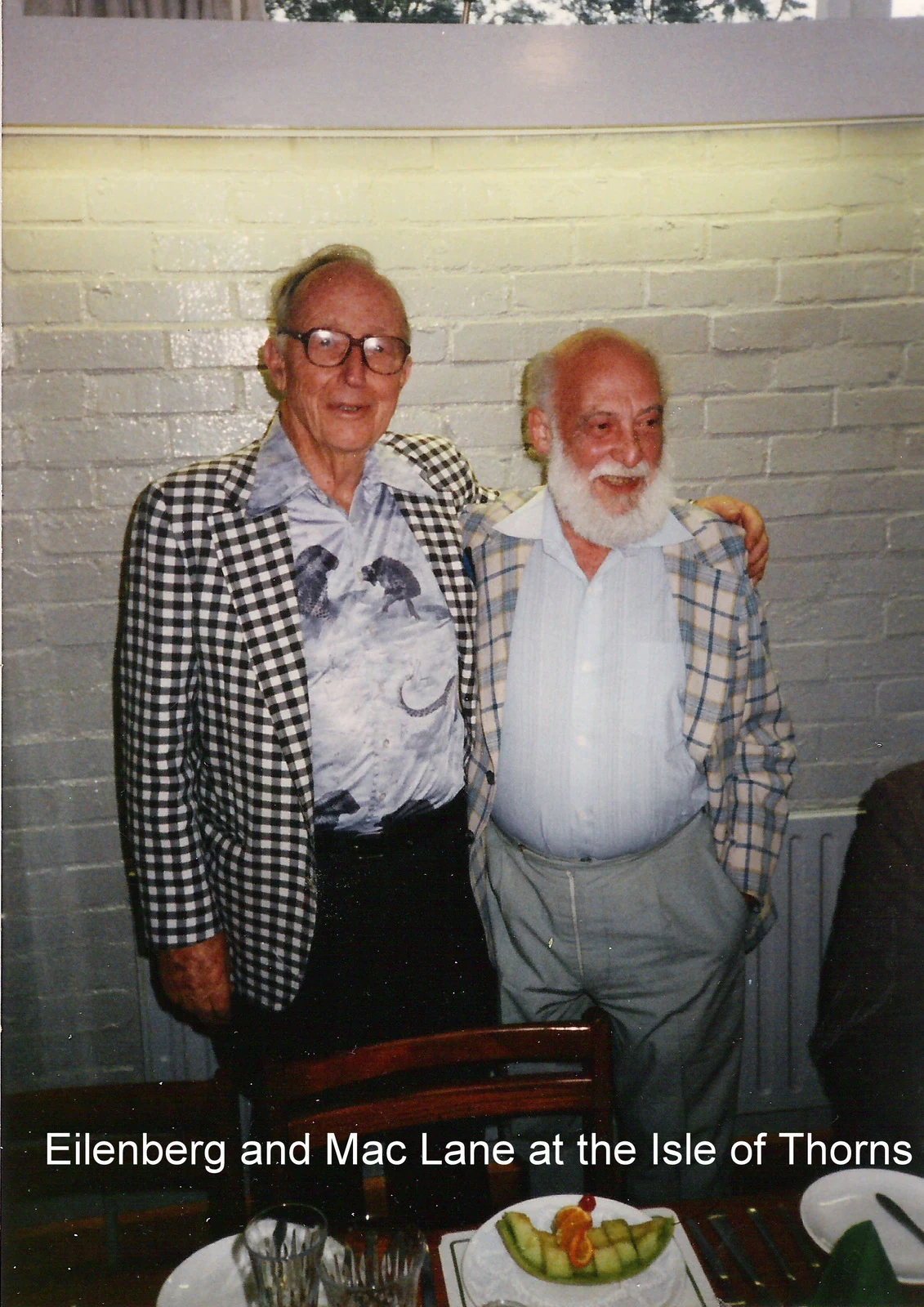
The paper helped make the Cartan–Eilenberg machinery portable beyond module categories. Building after Eilenberg and Mac Lane’s categorical framework and Buchsbaum’s prior exact-category axiomatization, Grothendieck worked with abelian categories broad enough to include categories of sheaves. Under stated exactness and size hypotheses, he proved enough injectives for a broad class of categories, developed derived functors in that setting, and established the composite-functor spectral sequence under its acyclicity conditions.33Samuel Eilenberg and Saunders Mac Lane, “General Theory of Natural Equivalences,” Transactions of the American Mathematical Society 58 (1945): 231–94, https://doi.org/10.1090/S0002-9947-1945-0013131-6; Buchsbaum, “Exact Categories and Duality”; Weibel, “History of Homological Algebra”.
Before “homological algebra”
Homology began in topology as a way of associating algebraic invariants with spaces. A space could be triangulated or otherwise decomposed; formal combinations of its pieces formed chains; a boundary operation sent each chain to the algebraic sum of its faces. Because the boundary of a boundary vanishes, cycles and boundaries fit into a quotient. Homology groups measured cycles not themselves boundaries.
The pattern migrated. Group extensions, Lie algebras, associative algebras, and modules developed their own homology and cohomology theories. Similar exact sequences appeared in different settings. Ext and Tor recorded extensions and failures of flatness. Spectral sequences organized calculations in stages. Sheaf cohomology translated local-to-global problems into algebraic invariants. By the early 1950s, the methods were distributed among subjects.44Weibel, “History of Homological Algebra,” 797–815.
Cartan and Eilenberg’s book gave the distribution a common center. Charles Weibel later called its effect a revolution: derived functors defined through projective and injective resolutions united theories that had looked disparate. The book was published in 1956, but its project and results circulated during the years in which Grothendieck was working. The publication date should not be used as a wall preventing influence in 1955.55Cartan and Eilenberg, Homological Algebra; Weibel, “History of Homological Algebra,” 797–98.
The title Homological Algebra announced homology as a branch of algebra with a general method. Given an additive functor preserving one side of exactness, resolve the input by objects on which the functor behaves well, apply the functor, and take cohomology.
This method carries a strong reversal. A failure becomes data rather than remaining a defect. Global sections fail to take every short exact sequence of sheaves to a short exact sequence of groups. Instead of discarding the functor, and higher cohomology record the failure. Tensor product fails to preserve injections; Tor records the obstruction. Hom fails to preserve surjections; Ext records what is lost. Homological algebra turns imperfect preservation into a graded theory.
Grothendieck’s turn involved a method that treated obstruction as structure and matched geometric questions entering through Serre. Higher cohomology groups capture the mismatch between local availability and global realization.
Two ways to resolve an object
The word resolution can suggest that an object is being dissolved. Homological algebra uses it in almost the opposite sense: an object is replaced by a longer sequence whose terms are easier for a chosen operation. The replacement contains more visible structure while preserving the invariant one wants to compute.
A projective object has a lifting property against epimorphisms. If is onto in the categorical sense and is given, then the map from can be lifted to . Free modules are projective, and many module categories have enough projectives: every module receives a surjection from a projective. Repeating with kernels gives a projective resolution Apply a right-exact functor such as tensor product and take homology to obtain left derived functors such as Tor.66Cartan and Eilenberg, Homological Algebra.
An injective object has the dual extension property against monomorphisms. If is an inclusion in the categorical sense and is given, the map extends to . If every object embeds in an injective, repeated cokernels give an injective resolution extending to the right. Apply a left-exact functor such as Hom or global sections and take cohomology to obtain right derived functors such as Ext or sheaf cohomology.77Cartan and Eilenberg, Homological Algebra; Weibel, “History of Homological Algebra,” 815–16.
The two procedures are formally dual but not practically interchangeable. A category can have enough injectives and too few projectives for geometric use. Categories of sheaves naturally favor injective resolutions. This asymmetry is one reason Tôhoku’s existence theorem mattered: a formal duality of definitions did not guarantee that both kinds of resolution existed in the examples.
Resolutions are highly nonunique. A module has many free presentations; a sheaf has many embeddings into injectives. Homological algebra succeeds only if the resulting groups and maps are independent of the choice. Comparison maps between resolutions, unique up to homotopy in the appropriate setting, establish that independence. The construction produces canonical derived functors from noncanonical scaffolding.
This pattern would recur in Grothendieck’s work. Choose an auxiliary cover, compactification, embedding, or resolution; perform a construction; then prove that the answer is independent of the choice and natural under maps. The auxiliary object is not denied. It is controlled so completely that it disappears from the final invariant.
The contrast with approximation theory is instructive. A finite-rank approximation approaches an operator in a topology and may fail to exist. A homological resolution does not converge numerically to an object. It maps to or from the object exactly, with exactness recording how successive errors are corrected. Both replace something difficult by a structured sequence of simpler terms, but the meanings of “replace” and “error” are different.
Cartan–Eilenberg’s achievement was to make these procedures systematic for modules and functors. Grothendieck’s question was whether the procedure depended on hidden properties of modules. If only projective or injective lifting, additive structure, and exactness were used, those properties could become axioms. If infinite constructions entered the proof, their exact behavior also had to be named.
Categories were already there
Category theory was not Grothendieck’s invention. Samuel Eilenberg and Saunders Mac Lane introduced categories, functors, and natural transformations together in their 1945 paper “General Theory of Natural Equivalences.” Their primary interest lay in functors and the natural relations among them; categories supplied domains and codomains precise enough to keep those constructions exact.88Eilenberg and Mac Lane, “General Theory of Natural Equivalences”; Jean-Pierre Marquis, “Category Theory,” in The Stanford Encyclopedia of Philosophy, https://plato.stanford.edu/entries/category-theory/.
A category has objects and morphisms. Each object has an identity morphism. Morphisms compose associatively when source and target match. This minimal definition becomes useful only when examples specify what the arrows mean. Sets with functions form one category; groups with homomorphisms another; topological spaces with continuous maps another. Keep the same objects and change the allowed arrows, and the category changes.99Eilenberg and Mac Lane, “General Theory of Natural Equivalences”.
A functor maps one category to another while preserving identities and composition. Homology is functorial because a continuous map of spaces induces a homomorphism of homology groups, and composition of maps induces composition of homomorphisms. A natural transformation compares two functors through a family of maps compatible with every morphism in the source category.1010Eilenberg and Mac Lane, “General Theory of Natural Equivalences,” 231–47; Marquis, “Category Theory”.
The word natural is essential. Mathematics often produces an isomorphism after choices—a basis, a cover, a resolution. A natural isomorphism is compatible with all relevant maps and does not change capriciously when the input changes. Grothendieck’s later work would make this standard so pervasive that it can be mistaken for his creation. His contribution in Tôhoku was to make the categorical language bear a new weight.
It is common to summarize category theory by saying that arrows matter more than objects. The slogan can illuminate Grothendieck–Riemann–Roch, where a theorem about a variety becomes a theorem about proper morphisms. It can also falsify. Categories contain objects, and the properties of those objects matter. What changes is the criterion of identity and relevance: an object is understood through the morphisms it supports, the constructions it represents, and the relations preserved across maps.
In homological algebra, the arrows form sequences. Exactness is a property of how consecutive arrows meet. A category broad enough for homology must allow addition of arrows, zero morphisms, kernels, cokernels, and the passage from a map to its image and coimage. Those requirements led to the abelian category.
Buchsbaum and the genealogy of exactness
The genealogy did not leap directly from Eilenberg–Mac Lane to Grothendieck. Mac Lane used “abelian category” in an earlier, different sense. David Buchsbaum, working under Eilenberg, sought an abstract setting in which Cartan–Eilenberg methods could be generalized. His 1955 paper “Exact Categories and Duality” axiomatized categories with a notion of exact sequence and included conditions ensuring enough projective or injective objects.1111Buchsbaum, “Exact Categories and Duality”; Weibel, “History of Homological Algebra”, “Abelian Categories”.
This predecessor matters for two reasons. Historically, it prevents the Tôhoku paper from being presented as the first thought that homological algebra might extend beyond modules. Mathematically, it shows that the correct axioms were a live problem shared by several researchers. Grothendieck’s distinctive work lay in the formulation he developed, the hierarchy of exactness conditions for infinite operations, the existence theorem for injectives, and the force of sheaf categories as examples.
Priority is not a zero-sum allocation in which one name must own a concept. A definition can have several near ancestors, and a later formulation can become standard because of what it proves and connects. Weibel’s specialist history credits the name “abelian category” in the durable sense to Grothendieck and Alex Heller, while also tracing the earlier attempts by Mac Lane and Buchsbaum. Tôhoku’s significance does not require forgetting them.
Cartan and Eilenberg are equally indispensable. Derived functors, resolutions, Ext, and Tor were not born in Tôhoku. Grothendieck generalized and reorganized their machinery. His May 1957 Bourbaki exposé explicitly credited intensive use of Cartan–Eilenberg homological algebra.1212Grothendieck, “Théorèmes de dualité pour les faisceaux algébriques cohérents,” 149–01.
The deposited bibliography of Tôhoku’s second part names Buchsbaum, Cartan, Eilenberg, Godement, Mac Lane, Serre, Weil, and Grothendieck’s Kansas report. Though incomplete as an account of influence, it records a declared field of relation.1313Grothendieck, “Sur quelques points d’algèbre homologique, II”.
What makes a category abelian
An abelian category is an additive category with sufficiently well-behaved kernels and cokernels. For every pair of objects , the morphisms form an abelian group, and composition is bilinear. Finite products and coproducts agree as biproducts. Every morphism has a kernel and a cokernel. Every monomorphism is the kernel of its cokernel; every epimorphism is the cokernel of its kernel.1414Grothendieck, “Sur quelques points d’algèbre homologique, I”; Weibel, “History of Homological Algebra,” 815–16.
These axioms imply that image and coimage exist and are canonically isomorphic. A sequence is exact at when the image of equals the kernel of . The familiar diagrammatic behavior of modules survives without requiring that the objects possess elements accessible to the proof.
The phrase “equals the kernel” is shorthand for an isomorphism compatible with the relevant maps, not a literal equality of subsets. This is one point at which category theory changes mathematical reflexes. In a module, the kernel is a subset of elements sent to zero. In an arbitrary category, the kernel is characterized by a universal property: it is a map killed by , through which every other map killed by factors uniquely.
The definition abstracts exactly enough module behavior to support homological arguments. It does not say that every abelian category is visibly a category of modules. Later embedding theorems by Lubkin, Freyd, and Mitchell would show that small abelian categories can be represented inside module categories in precise ways. Those results belong around 1960 and after, not to Grothendieck’s Kansas desk. In 1955–57, the absence of elementwise reasoning was a real technical challenge.1515Weibel, “History of Homological Algebra,” 815–16 and the later-embedding discussion.
Geometry required this level because its natural objects included sheaves. A sheaf of abelian groups on a topological space has kernels and cokernels formed sheafwise. Sheaves of modules over a structure sheaf form an abelian category under suitable conditions. Exact sequences of sheaves can be checked on stalks. The category cannot be reduced to modules over one global ring; its local structure is essential.
An abelian category gives a portable grammar. Once a proof uses only that grammar, it applies to modules, sheaves, and future examples. The gain is not that all objects become the same. It is that one can distinguish which parts of a theorem depend on abelian exactness and which require additional hypotheses.
Exact at every stalk, not necessarily on sections
A sheaf has a stalk at each point , formed from sections over neighborhoods of with two sections identified when they agree after restriction to a smaller neighborhood. The stalk records local germs while discarding the particular neighborhood used to represent them.
A sequence of sheaves of abelian groups is exact if and only if the induced sequence of stalks is exact at every point. Stalks therefore provide a concrete test for the abstract categorical definition.1616Alexandre Grothendieck, “Sur les faisceaux algébriques et les faisceaux analytiques cohérents,” Exposé 2, Séminaire Henri Cartan, vol. 9 (1956–1957), 1957, https://www.numdam.org/item/SHC_1956-1957__9__A2_0/.
The corresponding sequence of sections over one open set need not be exact on the right. A germ of a section of may lift near every point, while the local lifts fail to agree on overlaps. The sheaf map is an epimorphism because lifting is local; the map on global sections can fail to be surjective because gluing is global.
This distinction explains why the global-sections functor is left exact. Kernels of sections can be checked directly, so injectivity and exactness at the first terms survive. Surjectivity can fail because a quotient section may have only incompatible local lifts.
The failure is measured by a connecting homomorphism into . Local differences between lifts form a cocycle with values in . If its class vanishes, the lifts can be adjusted and glued. If the class remains nonzero, no global lift exists.
The example follows the seven-step pattern of the chapter. The problem is failed global lifting. The anchor is a short exact sequence of sheaves. The precise kernel is stalkwise exactness together with derived global sections. The true case is any locally liftable quotient section. The boundary is the absence of a compatible global lift.
Historically, sheaf theory made this local/global distinction explicit before Tôhoku. Grothendieck’s contribution was to place it inside a general abelian and derived-functor framework, so the same reasoning could be applied to many coefficient sheaves and maps.
The distinction also checks a common but misleading simplification. A sheaf epimorphism is not required to be surjective on sections over every open set. It is locally surjective, equivalently surjective on stalks. Confusing these statements would erase the cohomological obstruction the theory is designed to record.1717Grothendieck, “Sur les faisceaux algébriques et les faisceaux analytiques cohérents,” sec. 3.
For geometry, this is the point at which exact category language meets an actual cover. The arrows and kernels are abstract enough to travel across categories, while stalks and local lifts preserve the geometric source of the argument.
For the biography, the stalkwise test explains why Grothendieck needed both the Kansas projects. Tôhoku supplied the formal environment; the report on fiber spaces with structure sheaf supplied local objects and gluing problems. Their relation is mathematical and documented without requiring a claim about private intention.1818Grothendieck, A General Theory of Fibre Spaces with Structure Sheaf; Grothendieck, “Sur quelques points d’algèbre homologique, I”; Grothendieck, “Sur quelques points d’algèbre homologique, II”.
Kernels without subsets
The kernel illustrates how a familiar object is rebuilt from arrows. Given , a kernel is a morphism such that and such that every with factors uniquely through . The object is determined only up to unique isomorphism compatible with the map.1919Grothendieck, “Sur quelques points d’algèbre homologique, I”; Grothendieck, “Sur quelques points d’algèbre homologique, II”.
In groups or modules, this universal object is represented by the subset of elements sent to zero. The categorical definition discards the subset description but retains exactly the mapping property that proofs use. Cokernels are dual: kills the image of , and every map out of that kills factors uniquely through .
Image and coimage are then constructed from kernel and cokernel. The coimage of is the cokernel of its kernel; the image is the kernel of its cokernel. In an abelian category the canonical map from coimage to image is an isomorphism. This axiom captures the first isomorphism theorem without mentioning elements or quotient sets.
The definitions show why “arrows rather than objects” is incomplete. Kernels and cokernels are objects characterized by arrows. Their universality makes them stable across equivalences and compatible functors. Object and relation are not rivals; the relation specifies the object.
Exactness can now be checked at a morphism : the image of the incoming arrow must identify with the kernel of the outgoing one. A short exact sequence packages a subobject, an ambient object, and a quotient. It is the atomic narrative of homological algebra: one object built by extending another by a third.
Extensions become classes because the middle object may vary while the ends remain fixed. A split sequence is the trivial class; a nonsplit one measures a way of combining objects that cannot be decomposed. turns these ways into an abelian group when the category permits. Higher Ext arises from the same derived mechanism, not from an informal stack of short sequences alone.
This exact language made duality possible at greater scale. A contravariant Hom functor reverses arrows. Kernels become cokernel phenomena after dualization under suitable conditions. Derived Ext groups record how far naive duality fails. Grothendieck’s coherent-sheaf duality work used this machinery because singularities and global geometry prevent ordinary linear duals from being enough.
The language also made dévissage—breaking an object into pieces through exact sequences—a general method. The K-group used in Riemann–Roch later formalized this additivity; Tôhoku supplied part of its homological bookkeeping.
Proof without elements
The loss of elements changes the craft of proof. In a module category, one can choose , map it, lift an element through a surjection, and compare representatives. In an abstract category there is no authorized phrase “take an element of .” A proof must use universal properties and commutative diagrams.
Diagram chasing translates the movement of elements into relations among arrows. The snake lemma, five lemma, and nine lemma become basic devices. Yet their familiar elementwise proofs do not automatically justify the abstract versions. One must construct connecting morphisms and prove their uniqueness using kernels and cokernels. Weibel notes how difficult even simple lemmas could be before later embedding theorems supplied a general justification for element-style reasoning in small abelian categories.2020Weibel, “History of Homological Algebra,” 816, including the later embedding-theorem chronology.
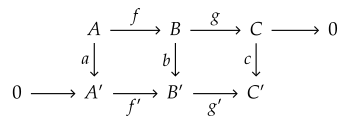
This difficulty reveals what abstraction costs. A theorem stated in a broader setting may be shorter, but obtaining it can require rebuilding elementary tools. Grothendieck’s work is sometimes described as making difficult mathematics easy. The phrase is accurate only if “easy” refers to later use. Creating the framework that makes the theorem formal may be the difficult part.
There is also a discipline of notation. A commutative square says that two composites are equal. A diagram with exact rows and columns packages many kernel-image relations. If every arrow is natural in the input, the whole proof can be transported by a functor. A diagram is not a picture of a geometric object; it is a compressed assertion about compatible operations.
Grothendieck was not the only mathematician working in this style, and Tôhoku did not abolish elementwise mathematics. It established that some of the deepest local-to-global arguments could be made independent of elements. For a future theory of geometry over arbitrary fields, that independence was decisive. Points over a field, geometric points over extensions, prime ideals, and infinitesimal directions would all have to coexist. A language tied too closely to one set of visible points could not carry the program.
Enough injectives
Derived functors require objects on which the original functor has no higher obstruction. For right derived functors, injective objects are the standard choice. An object is injective if every morphism into defined on a subobject extends across the containing object, expressed categorically through a lifting property against monomorphisms.
An abelian category has enough injectives if every object admits a monomorphism with injective. One can then continue: take the cokernel, embed it in another injective, and build a resolution Applying a left-exact functor to this complex and taking cohomology defines its right derived functors.2121Grothendieck, “Sur quelques points d’algèbre homologique, I”; Grothendieck, “Sur quelques points d’algèbre homologique, II”; Weibel, “History of Homological Algebra,” 815–16.
For modules, familiar constructions provide injectives, though they may not be simple. For sheaves, the existence question operates at the scale of an entire category. Tôhoku gave broad conditions under which enough injectives exist. In modern terminology, an abelian category with exact filtered colimits and a generator—a Grothendieck category—has enough injectives. The eponymous term is later.2222Grothendieck, “Sur quelques points d’algèbre homologique, I”; Weibel, “History of Homological Algebra”.
A generator is an object capable of detecting distinctions among morphisms: maps out of copies of supply enough tests. Exact filtered colimits mean, roughly, that directed unions or assemblies preserve exact sequences. These conditions connect size to exactness. A very large category can be manageable if its objects are detectable from one source and if directed construction does not destroy the relations homological algebra needs.
The assertion should not be diluted into “infinite sums behave well.” Tôhoku presented a hierarchy of axioms, conventionally labeled AB3 through AB6 and their duals, controlling products, coproducts, and limits. Different categories satisfy different combinations. The category of sheaves of abelian groups satisfies strong colimit exactness but not every corresponding statement about products. Generality requires recording asymmetry, not pretending all infinite operations are interchangeable.2323Weibel, “History of Homological Algebra,” 816.
The existence of injectives transformed sheaf cohomology. One no longer needed a special resolution invented separately for every space or coefficient sheaf. Global sections is left exact. Its right derived functors define . Other resolutions—flasque, soft, fine, Čech under suitable hypotheses—could be compared with the derived-functor definition. The definition identified what the theories had in common.
The AB hierarchy and the problem of infinity
Finite direct sums exist in every abelian category. Infinite families are another matter. Tôhoku named a hierarchy of additional axioms to prevent proofs from using infinite operations silently. In later standard summaries, AB3 says that all small coproducts exist. AB4 says that coproducts preserve exactness. AB5 strengthens the directed behavior: filtered colimits of exact sequences remain exact. Dual axioms, marked by a star, concern products and inverse constructions.2424Weibel, “History of Homological Algebra,” 815–16.
A filtered system is organized so that any finite collection of stages maps onward to a common later stage. Directed unions of subobjects are the elementary model. Exactness of filtered colimits says that assembling an object from an increasing family does not create or erase kernels in the process. This property is indispensable when large sheaves or modules are built from manageable subobjects.
The hierarchy prevents a common fallacy: if every finite step is exact, the infinite result must be exact. Limits and colimits can introduce derived obstructions of their own. Products of surjections may fail to be surjective in categories where one expects pointwise behavior; inverse limits famously need not preserve exactness. Each infinite operation must be audited.
Weibel notes a revealing example from Tôhoku’s setting. Sheaves of abelian groups satisfy AB5, the exactness of filtered colimits, but need not satisfy the dual axiom AB4*, exactness of arbitrary products. A category suited to building objects by directed unions need not be equally well behaved when taking infinite products. Formal duality has concrete limits.
The generator condition addresses detection. Under standard equivalent formulations, a generator distinguishes morphisms or supplies epimorphisms from coproducts of its copies. The category remains large while gaining a common testing source.
Combine a generator with AB5 and the abelian axioms, and one obtains the modern notion of a Grothendieck category. The theorem that such categories have enough injectives is not a tautology. It connects set-sized generation and exact colimits to the existence of objects with a powerful extension property.2525Weibel, “History of Homological Algebra,” 815–16.
Sheaf categories supplied the motivating examples. A sheaf can be assembled from local data and from subobjects generated by sections. Filtered colimits are computed in ways compatible with stalks. A suitable family of representable or extension-by-zero sheaves can detect objects. The exact formulation depends on the site or space and coefficient structure, but the pattern fits the axioms.
The later name can make the theorem seem designed to define an eponym. In 1957 it was a working answer to a concrete need. To derive global sections, one needed injective resolutions. To prove they existed for sheaves, one needed conditions broad enough to cover the categories at hand. The axioms were a route to calculation.
This relation between infinity and calculation carried forward. Grothendieck’s algebraic geometry would use inverse and direct limits, completions, quasi-coherent sheaves, and categories far larger than the varieties originally studied. Foundational control was not a taste added after the geometry. It was what kept infinite construction from invalidating exact arguments.
Derived functors as controlled failure
Let be a left-exact functor between appropriate abelian categories. For an object , choose an injective resolution . Apply degree by degree. The resulting complex need not be exact. Its cohomology in degree is .2626Cartan and Eilenberg, Homological Algebra; Grothendieck, “Sur les faisceaux algébriques et les faisceaux analytiques cohérents”.
The zero-th derived functor recovers , while higher ones measure failure of exactness. A short exact sequence produces a long exact sequence in the , with connecting morphisms joining the degrees into a coherent response.
The construction appears to depend on the chosen resolution. The comparison theorem shows that different injective resolutions yield canonically isomorphic derived functors. A satisfactory definition must also make maps between objects induce compatible maps between groups.
Grothendieck developed the language of cohomological -functors and universal -functors. A -functor assigns a sequence of functors together with connecting maps for short exact sequences. Universality says that a transformation in degree zero extends uniquely through all degrees. Effaceability or enough acyclic objects can establish universality.2727Weibel, “History of Homological Algebra,” 816; Grothendieck, “Sur quelques points d’algèbre homologique, I”; Grothendieck, “Sur quelques points d’algèbre homologique, II”.
The philosophical movement is exact. Failure becomes an object, but not every failure. It must be stable under maps, fit long exact sequences, and be independent of auxiliary choices. An obstruction that changes when notation changes is not yet knowledge. Derived functors turn obstruction into invariant structure.
This stance would shape Grothendieck’s geometry. Instead of defining cohomology by a convenient complex and hoping it behaved, ask what functor is being derived, in what category, and with which acyclic objects. Instead of proving comparison theorems ad hoc, use universality. Instead of treating a spectral sequence as an isolated computational trick, derive it from composition.
How a short sequence grows
Given and a left-exact functor , derived functors produce The connecting map is the hinge. An element of may fail to lift to ; its image under is the obstruction class.
For global sections, take a section of a quotient sheaf . Locally it may lift to sections of . On overlaps, two local lifts differ by sections of . Those differences form a cocycle. Its cohomology class vanishes exactly when the local lifts can be adjusted to glue to a global lift.2828Grothendieck, “Sur les faisceaux algébriques et les faisceaux analytiques cohérents,” sec. 3.
This example joins the abelian and geometric sides of Kansas. Cocycles arise from gluing. Exact sequences identify where the differences live. Derived functors make the obstruction independent of the chosen local lifts. Naturality ensures that maps of short exact sequences carry obstruction classes compatibly.
The long exact sequence also supports calculation. If two of the three sheaves have known cohomology, exactness constrains the third. Vanishing in one range forces isomorphisms in another. Induction on supports or resolutions becomes possible.
For , the same mechanism yields Ext. A map may not lift to ; the obstruction lies in . Thus sheaf cohomology and extension theory are instances of one derived pattern.
The construction associates groups together with connecting maps that have the right signs and commute with morphisms. A long sequence assembled nonnaturally would fail as a -functor and could not support the comparison theorems Tôhoku sought.
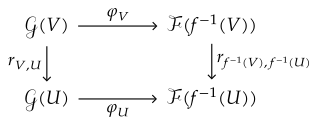
One can now see why Grothendieck emphasized universal -functors. The long exact sequence is the operational identity of cohomology. Any alternative construction that supplies the same degree-zero functor and an effaceable sequence of higher obstructions is forced into a unique comparison.
The growth from a three-term sequence to an unbounded sequence is one of homological algebra’s characteristic enlargements. A local failure at one arrow opens higher degrees. Rather than close the gap with an ad hoc correction, the theory follows it as far as it leads.
Universality, acyclicity, and effacement
An injective resolution is a construction. A universal -functor is a characterization. The difference parallels the distinction between building a tensor product as a quotient of a free vector space and defining it by the bilinear maps it represents. One supplies an object; the other says what makes any such object uniquely appropriate.
A cohomological -functor assigns functors and, to every short exact sequence, connecting morphisms that make a long exact sequence. A morphism of -functors is a compatible family of natural transformations in all degrees. Universality says that any natural transformation from to the degree-zero part of another -functor extends uniquely to all degrees.
Derived functors form a universal -functor under standard hypotheses. If another construction—Čech cohomology in a favorable situation, for example—has the same degree-zero functor and the right exact-sequence behavior, there is a unique comparison.2929Weibel, “History of Homological Algebra,” 816.
An object is -acyclic when its higher derived functors vanish. Injective objects are acyclic for a left-exact functor in the standard construction, but other classes may be easier to use. Flasque sheaves are acyclic for global sections. Fine sheaves on suitable spaces have partitions-of-unity arguments making them acyclic. The calculation can use these convenient resolutions without changing the abstract definition.
Effacement supplies another criterion. Roughly, a positive-degree class can be made to vanish after embedding its object into a suitable larger one. A cohomological -functor effaceable in positive degrees is universal. The terminology captures the idea that higher obstruction can be killed locally in the category even though it remains an invariant of the original object.
The distinction between injective and acyclic is important. Every injective is suitable for the derived construction, but an acyclic object need not be injective. Confusing the two would turn a computational convenience into a categorical lifting property. Grothendieck’s formalism made room for both: injectives guarantee existence; acyclic classes make concrete calculations possible.
Universality also restrains authorship claims. A cohomology theory may have several constructions developed by different mathematicians. If they satisfy the same universal property, their equivalence is part of the mathematics, not a reason to erase the distinct routes by which they were found. Grothendieck’s derived-functor viewpoint unified earlier sheaf-cohomology methods while depending on them as examples and computational tools.
Definitions now state criteria by which different constructions can be compared. A theory acquires authority when adequate constructions are forced into a unique relation, rather than when one notation dominates.
Several constructions called cohomology
Before a derived-functor definition becomes standard, cohomology can look like the output of a particular recipe. Choose a cover and form Čech cochains from intersections. Choose a flasque resolution and take global sections. On a differentiable manifold, use differential forms. On a complex manifold, use Dolbeault forms. On a simplicial complex, use cochains on simplices. Each recipe has its own terms and differential.
The recipes do not agree in all settings without hypotheses. Čech cohomology for an arbitrary cover can miss sheaf cohomology. A fine resolution depends on geometric structures such as partitions of unity. Differential forms calculate constant-sheaf cohomology through the de Rham theorem on smooth manifolds, a substantive comparison result.3030Grothendieck, “Sur les faisceaux algébriques et les faisceaux analytiques cohérents,” sec. 3; Weibel, “History of Homological Algebra,” 815–16.
The derived-functor definition changes the hierarchy. Begin with the category of sheaves and the global-sections functor. Define its right derived functors abstractly. Then ask when a concrete complex is an acyclic resolution and therefore computes those functors. The abstract object becomes the reference; the recipes become models justified by comparison theorems.
This move can appear to demote calculation. In practice it protects calculation from accidental dependence on a method. A Čech complex may be efficient for one cover. A flasque resolution may establish existence but be too large for hand computation. A spectral sequence may compare a practical complex with the abstract target. Different methods can coexist because their relation is organized.
The change also clarifies what belongs to the space and what belongs to the coefficients. Ordinary singular cohomology starts from a topological space and an abelian coefficient group. Sheaf cohomology allows coefficients that vary locally. A local system can twist along loops; a coherent sheaf can encode algebraic functions, sections of a bundle, or ideals. The same global-sections functor acts on all of them, and its derived functors produce different geometric information.
For algebraic geometry this flexibility was essential. The structure sheaf , invertible sheaves, coherent modules, and later étale sheaves could not all be reduced to one constant coefficient group. A categorical definition made the coefficient object part of the input.3131Serre, “Faisceaux algébriques cohérents”; Grothendieck, “Sur les faisceaux algébriques et les faisceaux analytiques cohérents,” sec. 3.
The approach also separated cohomology from an underlying supply of simplices. An algebraic variety over a finite field lacks the classical topology needed for singular cochains. A derived-functor characterization identified the missing category of sheaves and notion of covering without itself creating étale cohomology.
One missing piece was topology. The Zariski topology supports coherent-sheaf cohomology and already yields powerful theorems. It does not provide the finite-field analogue of every topological invariant predicted by Weil. Grothendieck would later alter the notion of cover. Tôhoku supplied the homological apparatus that any such category of sheaves would need once the topology was found.
Thus the paper’s importance to the Weil program was enabling rather than conclusive. It did not prove the conjectures. It established that cohomology could be generated from categorical structure with enough independence from any one classical construction to travel into a new geometry.
The spectral sequence of a composite
Suppose and are left-exact functors. One can derive , then derive , or derive the composite . These procedures are not generally equal term by term. Under suitable hypotheses—most importantly, that sends injective objects to objects acyclic for —Grothendieck’s spectral sequence begins 3232Weibel, “History of Homological Algebra,” 816; Weibel, “History of Homological Algebra,” 816; Grothendieck, “Sur les faisceaux algébriques et les faisceaux analytiques cohérents,” sec. 3.
A spectral sequence is a succession of pages, each a graded array of groups with differentials. Taking cohomology of one page produces the next. Under convergence conditions the pages stabilize enough to recover a filtered version of the target. It is not an equality between the terms and the answer. It is a machine that manages interactions between two degrees.
For a continuous map , take , the direct-image functor on sheaves, and , global sections on . Since global sections on equal global sections on after direct image, the composite is . The spectral sequence becomes the Leray spectral sequence in derived-functor form.3333Grothendieck, “Sur les faisceaux algébriques et les faisceaux analytiques cohérents,” sec. 3; Weibel, “History of Homological Algebra,” 816.
This example shows why the abstraction mattered to geometry. A map between spaces produces a direct-image functor. Its higher derived functors are sheaves on the target. Their cohomology assembles into the cohomology upstairs. Geometry can be decomposed along a morphism, and the decomposition is governed by functor composition.
The 1958 Riemann–Roch exposition used precisely this kind of machinery. For composable proper maps, higher direct images give a spectral sequence; alternating sums in the Grothendieck group then make pushforward functorial. The homological language preceded the theorem chronologically and supplied the reason that successive pushforwards agreed with pushforward along the composite.
Again, later use should not be confused with original motive. The spectral sequence is significant whether or not Grothendieck wrote it with Riemann–Roch already in mind. Its general form created a reusable bridge. Once available, each new pair of functors could be tested against its hypotheses rather than assigned a wholly new calculation.
A local-to-global calculation in stages
Consider a sheaf on and a map . The direct image assigns to an open set the sections of over . It is left exact: a section that vanishes or two sections that agree can be checked before and after direct image, but lifting a section through a quotient sheaf may fail.
The higher direct images record that failure locally on . Their stalks cannot generally be identified with fiber cohomology without extra hypotheses and base-change theorems.3434Grothendieck, “Sur les faisceaux algébriques et les faisceaux analytiques cohérents,” sec. 3.
Now apply global sections on . The composite equals . Deriving in two stages yields the Leray spectral sequence. Its page first computes the obstruction sheaves created by , then computes their global cohomology on . Its target is the total cohomology on .
This staged procedure offers a mathematical image of mediation without becoming a biographical metaphor. Information on is reorganized on ; local higher effects become sheaves; global higher effects are then computed. The spectral sequence tracks how the two degrees mix. Differentials show that a class visible at one stage may be killed or altered before reaching the target.
When is a point, direct image becomes global sections and the picture collapses. When is an inclusion, the higher direct images reflect extension behavior. When is a fibration or proper algebraic morphism under suitable conditions, they encode how cohomology varies along the map. One formal machine accommodates these cases while leaving geometry to determine which terms vanish or identify.
The composite-functor theorem therefore does not replace geometric knowledge. It says where geometric knowledge enters. If one proves that certain vanish, the spectral sequence simplifies. If the base has bounded cohomological dimension, only a region of the page matters. If a projection formula relates tensor products and direct images, additional structure appears. Formalism organizes consequences once these facts are supplied.
Grothendieck’s strength lay partly in refusing the choice between formal machine and geometric theorem. The machine should be general, but it should also expose the exact local result needed to make a computation collapse. His later work with spectral sequences repeatedly used this division of labor. The hard theorem might be a vanishing or finiteness statement; the rest should follow from the language.
The Riemann–Roch pushforward offers an early instance. Define in the Grothendieck group. For composable proper maps, the spectral sequence for higher direct images shows that alternating sums compose correctly. Many groups on intermediate pages cancel in pairs. The spectral sequence’s detailed filtration disappears, leaving a functorial class. Homological complexity has been compressed into K-theoretic additivity.3535Armand Borel and Jean-Pierre Serre, “Le théorème de Riemann–Roch,” Bulletin de la Société Mathématique de France 86 (1958): 97–136, https://doi.org/10.24033/bsmf.1500.
This compression is a model of Grothendieck’s method. Do not deny the higher groups. Arrange them so that the invariant required by the theorem sees exactly their alternating sum. The object chosen for the next theory determines which complexity remains visible.
Sheaf Ext and the second part
The second digital record for the Tôhoku work identifies its content as Chapter IV, “Les Ext de faisceaux de modules.” For sheaves and , several related constructions appear. The sheaf records local homomorphisms. Its derived sheaves record local higher extensions. Global records extensions in the category of sheaves. A spectral sequence relates the cohomology of local Ext sheaves to global Ext.3636Grothendieck, “Sur quelques points d’algèbre homologique, II”, metadata; Grothendieck, “Théorèmes de dualité pour les faisceaux algébriques cohérents”; Grothendieck, “Sur quelques points d’algèbre homologique, II,” 185–221.
This local-global pairing suited coherent-sheaf duality. Local algebra near a point controls singularity and depth. Global Ext groups participate in pairings and duality theorems across a complete variety. The machinery allows a local resolution to feed a global invariant without pretending the local and global objects are identical.
Ext has an elementary meaning in degree one. Under suitable hypotheses, classifies short exact sequences up to an equivalence. The zero class corresponds to a split extension. Higher Ext groups generalize the pattern through resolutions and cannot be described as longer short exact sequences without qualification.3737Cartan and Eilenberg, Homological Algebra; Grothendieck, “Théorèmes de dualité pour les faisceaux algébriques cohérents”.
A nonsplit extension over the integers
The integers provide a concrete Ext calculation. For an integer , consider The first map multiplies by , and the last takes a residue class. The sequence is exact but does not split: a group homomorphism from to must be zero, so it cannot provide a section of the quotient map.3838Cartan and Eilenberg, Homological Algebra.
A short free resolution of is Applying reverses the arrows. The induced map between the two Hom groups is again multiplication by . Its cokernel is , giving
The displayed nonsplit sequence represents a nonzero class. Baer sum turns equivalence classes of extensions into an abelian group, and repeating the class times gives zero. The computation connects the abstract derived functor with an explicit failure to split.
The example also marks a boundary. classifies extensions in an abelian category with a specified equivalence relation; it does not classify every possible middle object without regard to its maps. Higher Ext requires derived machinery and cannot be explained by one short exact sequence alone.
For sheaves, the same pattern acquires local and global layers. An extension may split on each member of a cover and fail to split globally. The sheaf records local derived Hom, while global Ext records extensions in the sheaf category. A spectral sequence compares them.
Historically, Cartan–Eilenberg supplied the module framework, and Tôhoku carried it into categories of sheaves. The integer calculation is modern explanatory material, not a claim about an example printed on a particular Tôhoku page unavailable for this account.3939Grothendieck, “Sur quelques points d’algèbre homologique, II,” 185–221; Cartan and Eilenberg, Homological Algebra.
Biographically, the calculation shows the kind of transport Grothendieck sought. The explicit module extension has elements and a concrete quotient. The categorical formulation keeps exactly the maps, exactness, and equivalence needed to recognize the same construction for sheaves, where a single global element calculation may be unavailable.
The relation to geometry is immediate. A vector bundle or coherent sheaf can be extended by another; the extension may split locally but not globally. Deformations and obstructions later acquire Ext interpretations. Those later applications should be dated where they occur. In 1957, the important point was already present: the category of sheaves supported the same derived language as modules, and that language linked local homomorphisms to global cohomology.
Grothendieck’s May 1957 duality exposé makes the link public. Its opening says that the results were found in the winters of 1955 and 1956, inspired by Serre’s algebraic duality theorem, and proved using projective-space cohomology and Cartan–Eilenberg homological algebra.4040Grothendieck, “Théorèmes de dualité pour les faisceaux algébriques cohérents,” 149–01.
A paper reaches its consequences
When Tôhoku appeared in 1957, Serre’s FAC had already developed coherent algebraic sheaves, GAGA had related coherent algebraic and analytic sheaves on complex projective varieties, and Grothendieck’s February Cartan Seminar talks had invoked injective resolutions and derived functors.4141Serre, “Faisceaux algébriques cohérents”; Serre, “Géométrie algébrique et géométrie analytique”; Grothendieck, “Sur les faisceaux algébriques et les faisceaux analytiques cohérents”; Grothendieck, “Théorèmes de dualité pour les faisceaux algébriques cohérents”; Serre, “Faisceaux algébriques cohérents,” 197–278; Grothendieck, “Sur les faisceaux algébriques et les faisceaux analytiques cohérents”, exposé 2.
Publication gathered these currents into a reference. A reader could find axioms, derived-functor formalism, spectral sequences, and sheaf Ext within one extensive treatment. The paper’s length mattered because general machinery requires more than an announcement. Definitions have to be tested, enough injectives proved, comparison results established, and examples connected.
Its later reputation can be measured through terminology. “Grothendieck category” became the name for the AB5-plus-generator setting. “Grothendieck spectral sequence” became the standard name for the composite-functor machine. The Fields Medal citation in 1966 referred to the Tôhoku paper, nine years after publication.4242Jackson, “As If Summoned from the Void, I,” 1044 and 1055; Weibel, “History of Homological Algebra,” 815–16.
Routine use changes historical perception. A student who learns abelian categories before seeing sheaf cohomology may imagine that the axioms arrived first and applications followed. The chronology ran both ways. Concrete cohomology theories and sheaf problems pressed for abstraction; the abstraction then reorganized the concrete theories.
The same routine can obscure the audacity of size. To assert that one should do homological algebra in categories of sheaves required confidence that proofs could survive without elements and that injectives existed under usable hypotheses. It also required accepting that a foundational paper might be longer than many monographs and still call itself “several points.”
What later readers inherited
Later textbooks separated the paper into definitions that can be taught in a semester: abelian category, injective object, derived functor, Grothendieck category, spectral sequence. Separation is pedagogically necessary. It can hide the fact that the concepts entered together as responses to a connected problem.
The category axioms make exact sequences portable. AB5 and a generator make injective resolutions available in large examples. Resolutions define derived functors. Universal -functors compare constructions. The composite-functor spectral sequence makes iteration calculable. Sheaf examples return the apparatus to geometry. Remove one piece and the rest loses part of its force.
The inherited vocabulary also bears Grothendieck’s name unevenly. “Grothendieck category” and “Grothendieck spectral sequence” are standard. “Abelian category” is not eponymous, although his formulation helped fix its meaning. “Derived functor” rightly recalls a broader Cartan–Eilenberg genealogy. Names function as handles, not complete histories.
This is why a biographical chapter must do more than count eponyms. It must recover the collaboration across time embedded in the formalism. Leray’s sheaves and spectral sequences, Cartan’s seminar, Eilenberg–Mac Lane’s categories, Cartan–Eilenberg’s resolutions, Buchsbaum’s exact categories, Godement’s sheaf methods, Serre’s geometry, and Grothendieck’s synthesis all remain present when a modern reader writes .
Later normalization is one form of impact. Tôhoku’s influence lies less in a quoted sentence than in the routine questions subsequent geometers asked about categories, functors, and derived functors.
That normality should not be mistaken for finality. Derived categories in Verdier’s sense emerged later and retained whole complexes rather than only their cohomology groups. Higher categories and derived algebraic geometry transformed the setting later still.4343Weibel, “History of Homological Algebra,” 826–27, on Verdier’s later derived-category work.
A common workshop
An axiomatic language changes collaboration. Before it is shared, two mathematicians may recognize an analogy between their subjects but translate every lemma by hand. Once the category and exactness hypotheses are named, they can test the same theorem in different examples.4444Weibel, “History of Homological Algebra,” 815–16; Grothendieck, “Sur quelques points d’algèbre homologique, II”, deposited bibliography.
This makes generality social as well as logical. A sheaf theorist, a module theorist, and an algebraic geometer can work inside one diagram while supplying different examples. Their results remain distinct, but the proof architecture becomes transferable.
The transfer requires discipline. Terms such as injective, acyclic, derived, and exact must have stable meanings. A spectral sequence must state its page and convergence. A functor’s variance must be visible. Shared language fails if each participant silently changes conventions.
Tôhoku helped standardize this workshop. Its size allowed definitions and hypotheses to be cited rather than reinvented. A seminar exposé could say that the category of sheaves has the required injectives and move to geometry. A later text could invoke the composite-functor spectral sequence and focus on its application.
The paper also made teaching cumulative. Students could learn abelian categories once and then encounter Ext, sheaf cohomology, and higher direct images as related constructions. That pedagogical conversion belongs to the paper’s later reception.4545Weibel, “History of Homological Algebra,” 815–16.
The workshop metaphor has a boundary. Nonabelian gluing did not fit the abelian machine, while explicit computation and analytic estimates remained indispensable.4646Grothendieck, A General Theory of Fibre Spaces with Structure Sheaf.
Grothendieck’s strongest work often held both levels. He built an ambient category broad enough for formal consequences, then depended on a concrete vanishing theorem or projective-space calculation to make the consequences useful. Tôhoku supplied the ambient half; Serre’s geometry supplied many of the tests.
The historical network recorded in the bibliography is therefore also a model of the paper’s use. Results from Cartan, Eilenberg, Buchsbaum, Godement, Serre, Weil, and others are not dissolved into one authorship. They enter a workshop in which their relations can be made explicit.
The next chapters show the workshop under pressure. Functorial language must carry coherent sheaves and duality, then a theorem with a century of prior forms. Its success there explains why the axioms did not remain a specialist branch of algebra.
What turned
The “homological turn” was not a single day in Kansas. In the functional-analysis period, the central objects had been spaces, tensor products, maps, and topologies. In Tôhoku, the unit could be a category equipped with exactness and infinite operations, together with functors whose failures generated cohomology.4747Jackson, “As If Summoned from the Void, I,” 1044; Grothendieck, “Sur quelques points d’algèbre homologique, I”; Grothendieck, “Sur quelques points d’algèbre homologique, II”.
This change increased scale. A theorem about one functor could become a theorem about every functor satisfying specified conditions. A resolution invented for one coefficient system could be replaced by a theory of derived functors. A Leray spectral sequence could become an instance of a composite-functor spectral sequence. The gain was not only many results at once. It was a map of why the results were related.
The change also increased responsibility for hypotheses. Generality can conceal false analogies. Products may fail to preserve epimorphisms. Filtered colimits may or may not be exact. A category may lack enough injectives. A functor may not send injectives to acyclic objects for the next functor. Tôhoku’s hierarchies and conditions kept these failures visible.
Biographically, the turn depended on other people’s mathematics. Eilenberg and Mac Lane supplied the categorical language. Cartan and Eilenberg supplied the derived-functor architecture. Buchsbaum supplied an earlier exact-category axiomatization. Leray, Cartan, Godement, and Serre supplied sheaves and cohomology. Weil supplied geometric demands. Grothendieck’s originality lay in seeing how much of this could be rebuilt as one extensible environment and in proving that the environment was usable.
That environment soon carried Riemann–Roch, recast as the compatibility of transformations with a proper morphism. The passage from number to functorial statement required exact sequences, higher direct images, alternating sums, and composition laws.4848Borel and Serre, “Le théorème de Riemann–Roch,” secs. 5–7.
In February 1957, the first page of Grothendieck’s Cartan Seminar exposé announced that its purpose was to generalize certain theorems of Serre and that it used Serre’s techniques essentially. The dated page records the homological language entering an algebraic-geometric argument with its inheritance stated explicitly.4949Grothendieck, “Sur les faisceaux algébriques et les faisceaux analytiques cohérents,” 2–01.
Notes
- Grothendieck, “Sur quelques points d’algèbre homologique, I”; Grothendieck, “Sur quelques points d’algèbre homologique, II”. Aggregators differ in displaying the Part I range; the conventional whole-work reference remains 119–221. ↩
- Jackson, “As If Summoned from the Void, I,” 1044. ↩
- Samuel Eilenberg and Saunders Mac Lane, “General Theory of Natural Equivalences,” Transactions of the American Mathematical Society 58 (1945): 231–94, https://doi.org/10.1090/S0002-9947-1945-0013131-6; Buchsbaum, “Exact Categories and Duality”; Weibel, “History of Homological Algebra”. ↩
- Weibel, “History of Homological Algebra,” 797–815. ↩
- Cartan and Eilenberg, Homological Algebra; Weibel, “History of Homological Algebra,” 797–98. ↩
- Cartan and Eilenberg, Homological Algebra. ↩
- Cartan and Eilenberg, Homological Algebra; Weibel, “History of Homological Algebra,” 815–16. ↩
- Eilenberg and Mac Lane, “General Theory of Natural Equivalences”; Jean-Pierre Marquis, “Category Theory,” in The Stanford Encyclopedia of Philosophy, https://plato.stanford.edu/entries/category-theory/. ↩
- Eilenberg and Mac Lane, “General Theory of Natural Equivalences”. ↩
- Eilenberg and Mac Lane, “General Theory of Natural Equivalences,” 231–47; Marquis, “Category Theory”. ↩
- Buchsbaum, “Exact Categories and Duality”; Weibel, “History of Homological Algebra”, “Abelian Categories”. ↩
- Grothendieck, “Théorèmes de dualité pour les faisceaux algébriques cohérents,” 149–01. ↩
- Grothendieck, “Sur quelques points d’algèbre homologique, II”. ↩
- Grothendieck, “Sur quelques points d’algèbre homologique, I”; Weibel, “History of Homological Algebra,” 815–16. ↩
- Weibel, “History of Homological Algebra,” 815–16 and the later-embedding discussion. ↩
- Alexandre Grothendieck, “Sur les faisceaux algébriques et les faisceaux analytiques cohérents,” Exposé 2, Séminaire Henri Cartan, vol. 9 (1956–1957), 1957, https://www.numdam.org/item/SHC_1956-1957__9__A2_0/. ↩
- Grothendieck, “Sur les faisceaux algébriques et les faisceaux analytiques cohérents,” sec. 3. ↩
- Grothendieck, A General Theory of Fibre Spaces with Structure Sheaf; Grothendieck, “Sur quelques points d’algèbre homologique, I”; Grothendieck, “Sur quelques points d’algèbre homologique, II”. ↩
- Grothendieck, “Sur quelques points d’algèbre homologique, I”; Grothendieck, “Sur quelques points d’algèbre homologique, II”. ↩
- Weibel, “History of Homological Algebra,” 816, including the later embedding-theorem chronology. ↩
- Grothendieck, “Sur quelques points d’algèbre homologique, I”; Grothendieck, “Sur quelques points d’algèbre homologique, II”; Weibel, “History of Homological Algebra,” 815–16. ↩
- Grothendieck, “Sur quelques points d’algèbre homologique, I”; Weibel, “History of Homological Algebra”. ↩
- Weibel, “History of Homological Algebra,” 816. ↩
- Weibel, “History of Homological Algebra,” 815–16. ↩
- Weibel, “History of Homological Algebra,” 815–16. ↩
- Cartan and Eilenberg, Homological Algebra; Grothendieck, “Sur les faisceaux algébriques et les faisceaux analytiques cohérents”. ↩
- Weibel, “History of Homological Algebra,” 816; Grothendieck, “Sur quelques points d’algèbre homologique, I”; Grothendieck, “Sur quelques points d’algèbre homologique, II”. ↩
- Grothendieck, “Sur les faisceaux algébriques et les faisceaux analytiques cohérents,” sec. 3. ↩
- Weibel, “History of Homological Algebra,” 816. ↩
- Grothendieck, “Sur les faisceaux algébriques et les faisceaux analytiques cohérents,” sec. 3; Weibel, “History of Homological Algebra,” 815–16. ↩
- Serre, “Faisceaux algébriques cohérents”; Grothendieck, “Sur les faisceaux algébriques et les faisceaux analytiques cohérents,” sec. 3. ↩
- Weibel, “History of Homological Algebra,” 816; Weibel, “History of Homological Algebra,” 816; Grothendieck, “Sur les faisceaux algébriques et les faisceaux analytiques cohérents,” sec. 3. ↩
- Grothendieck, “Sur les faisceaux algébriques et les faisceaux analytiques cohérents,” sec. 3; Weibel, “History of Homological Algebra,” 816. ↩
- Grothendieck, “Sur les faisceaux algébriques et les faisceaux analytiques cohérents,” sec. 3. ↩
- Armand Borel and Jean-Pierre Serre, “Le théorème de Riemann–Roch,” Bulletin de la Société Mathématique de France 86 (1958): 97–136, https://doi.org/10.24033/bsmf.1500. ↩
- Grothendieck, “Sur quelques points d’algèbre homologique, II”, metadata; Grothendieck, “Théorèmes de dualité pour les faisceaux algébriques cohérents”; Grothendieck, “Sur quelques points d’algèbre homologique, II,” 185–221. ↩
- Cartan and Eilenberg, Homological Algebra; Grothendieck, “Théorèmes de dualité pour les faisceaux algébriques cohérents”. ↩
- Cartan and Eilenberg, Homological Algebra. ↩
- Grothendieck, “Sur quelques points d’algèbre homologique, II,” 185–221; Cartan and Eilenberg, Homological Algebra. ↩
- Grothendieck, “Théorèmes de dualité pour les faisceaux algébriques cohérents,” 149–01. ↩
- Serre, “Faisceaux algébriques cohérents”; Serre, “Géométrie algébrique et géométrie analytique”; Grothendieck, “Sur les faisceaux algébriques et les faisceaux analytiques cohérents”; Grothendieck, “Théorèmes de dualité pour les faisceaux algébriques cohérents”; Serre, “Faisceaux algébriques cohérents,” 197–278; Grothendieck, “Sur les faisceaux algébriques et les faisceaux analytiques cohérents”, exposé 2. ↩
- Jackson, “As If Summoned from the Void, I,” 1044 and 1055; Weibel, “History of Homological Algebra,” 815–16. ↩
- Weibel, “History of Homological Algebra,” 826–27, on Verdier’s later derived-category work. ↩
- Weibel, “History of Homological Algebra,” 815–16; Grothendieck, “Sur quelques points d’algèbre homologique, II”, deposited bibliography. ↩
- Weibel, “History of Homological Algebra,” 815–16. ↩
- Grothendieck, A General Theory of Fibre Spaces with Structure Sheaf. ↩
- Jackson, “As If Summoned from the Void, I,” 1044; Grothendieck, “Sur quelques points d’algèbre homologique, I”; Grothendieck, “Sur quelques points d’algèbre homologique, II”. ↩
- Borel and Serre, “Le théorème de Riemann–Roch,” secs. 5–7. ↩
- Grothendieck, “Sur les faisceaux algébriques et les faisceaux analytiques cohérents,” 2–01. ↩