A father of uncertain names
Scharlau reconstructs Grothendieck’s father as born around 1889–1890, usually identified as Alexander or Sascha Schapiro and later documented as Alexander Tanaroff. No civil birth entry has been consulted for this chapter, and the surviving dates and surnames conflict. The paternal history therefore begins with a range and an attributed identity, not a repaired register. 11Winfried Scharlau, Who Is Alexander Grothendieck? Anarchy, Mathematics, Spirituality, Solitude. Part 1: Anarchy, trans. Melissa Schneps (n.d.), chap. 1, https://webusers.imj-prg.fr/~leila.schneps/grothendieckcircle/Scharlau/Anarchy.pdf.
Novozybkov is the firmest element in that first cluster of facts. The town lay in the western borderlands of the Russian Empire, between Bryansk and Gomel, in a region whose later national descriptions shifted. It is now in Russia, close to Belarus and Ukraine. Old Believers had been important in its founding history, and by the beginning of the twentieth century it also had a substantial Jewish population. The exact demographic figures repeated in the online biography depend on web sources that have not been checked against a census record, so they are not needed here. What matters is narrower: Sasha was remembered as having been born there into a Jewish household, in a town where confessional identity and imperial administration had immediate civic consequences. 22Scharlau, Anarchy, chap. 1.
Scharlau reports the family claim that Sasha came from a religious Hasidic household and that one grandfather had been a rabbi. No birth, synagogue, or school record inspected for this chapter independently establishes those particulars. Scharlau also reports a 1930 Berlin declaration made under Tanaroff and a privately held family photograph; neither can serve here as an untouched genealogy. Sasha’s parents’ occupations, his siblings if any, his schooling, and the language chiefly used at home remain unknown. 33Scharlau, Anarchy, chap. 1.
Those blanks must not be filled with a stock picture of a Jewish borderland childhood. Novozybkov possessed markets, religious institutions, administrative offices, workshops, and factories, but such facts do not identify the street on which one family lived or the speech heard in its rooms. Sasha later spoke Russian and was remembered in Western Europe for a strong Russian accent. Hebrew script appeared on the reverse of one family photograph. German may have been accessible to him early, and Yiddish is possible. The traces do not establish a single mother tongue. They show why the normal biographical shorthand—one place, one language, one name—would be misleading at the outset.
Two Alexander Schapiros
The documentary problem is intensified by another man. Alexander Schapiro, commonly called Sania, was a prominent anarcho-syndicalist organizer, editor, translator, and international activist. He was born in 1882, worked with well-known figures in the movement, took part in conferences, and left extensive records. Grothendieck’s father did not. Both men passed through some of the same cities and political networks, and both could be called Sasha Shapiro. As a result, later accounts transferred episodes from the better-documented organizer to the less-documented refugee. Scharlau’s separation of the two biographies is therefore not a minor correction of spelling. It removes an archive that never belonged to Grothendieck’s father. 44Scharlau, Anarchy, chap. 2; Ching-Li Chai and Frans Oort, “Life and Work of Alexander Grothendieck,” Notices of the International Congress of Chinese Mathematicians 5, no. 1 (2017): sec. 1.3, https://www2.math.upenn.edu/~chai/AG/ChaiFO9-AG.pdf.
The distinction changes the evidentiary scale of everything that follows. A congress list naming Sania cannot prove Sasha’s attendance. A memoir referring to an international organizer cannot be made into evidence for a teenage militant from Novozybkov. Even Grothendieck apparently learned only late that two men had been conflated. His recollections of what he had heard about his father were sincere testimony, but sincerity cannot identify the subject of an ambiguous record. The more famous names surrounding the movement—Peter Kropotkin, Emma Goldman, Alexander Berkman, Nestor Makhno—must not be used to promote Sasha retrospectively into their documented company.
Arrest and imprisonment
The chief account of Sasha’s adolescence reached the archive by a long route. Sasha told parts of his history to Hanka during their years together. Hanka incorporated those accounts into Eine Frau, an autobiographical novel written much later, with pseudonyms, reconstructed speech, and literary shaping. Their son revisited the same past in Récoltes et Semailles and especially La Clef des Songes, after reading family papers and interpreting his parents through concerns of the 1980s. Scharlau then compared those narratives with the surviving documents he could locate. Each layer is valuable, but none converts the family story into a contemporaneous court file. 55Scharlau, Anarchy, chaps. 3–6.
In later family accounts, Sasha left home as an adolescent to join anarchists, was arrested as a teenager, condemned to death, and had the sentence commuted because of his age. No contemporaneous court or prison file examined for this review establishes the charge, date, group, trial, or act of commutation. The attempted-assassination claim concerning Nicholas II is excluded. 66Alexandre Grothendieck, Récoltes et Semailles: Réflexions et témoignage sur un passé de mathématicien, ed. Mateo Carmona (1985), 603–8, Manuscript, https://webusers.imj-prg.fr/~leila.schneps/grothendieckcircle/RetSbis.pdf. These are retrospective family accounts, not a contemporaneous judicial file.
The absence of a file does not make the entire testimony worthless. It changes its grammar. The claim belongs to what Sasha’s family later said, not to what an imperial record has yet established. His missing left arm, his years in prison, and his later account of the injury form a more strongly supported core; dates, dialogue, and the exact charge are weaker. Biography can retain that hierarchy without deciding that every transmitted detail is either literal fact or invention.
The Russia in which the story was placed had undergone the revolution of 1905. Military defeat by Japan compounded rural distress, industrial conflict, demands for political reform, and long opposition to autocratic rule. On Bloody Sunday, imperial forces fired on petitioners in Saint Petersburg. Strikes, mutinies, peasant uprisings, and political organization spread. The October Manifesto promised civil liberties and a representative assembly, but repression returned as the revolutionary movement weakened. Anti-Jewish pogroms accompanied the crisis, supported or tolerated by forces allied with monarchy and the established order. This background makes an adolescent’s attraction to revolutionary politics historically intelligible. It does not tell us which meeting Sasha attended, which weapon he carried, or which violence he witnessed. 77Scharlau, Anarchy, chap. 3.
Anarchism itself cannot serve as a single explanatory label. The movement contained advocates of syndicalism, education, mutual aid, insurrection, and armed struggle, divided over organization and the use of violence. Its shared negative principle was opposition to coercive hierarchy, especially the authority claimed by the state; its positive vocabularies included voluntary association, workers’ self-organization, and freedom from domination. Sasha later identified himself as an anarchist and revolutionary. The surviving evidence shows a durable allegiance, not a systematic doctrine written in his own hand.
At this point, the temptation to turn the adolescent into the finished political man must be resisted. The sources do not reveal the arguments in his parents’ home, the sequence by which he encountered anarchist ideas, or his private reasons for leaving. His Jewish origin, borderland birthplace, and the upheavals of 1905 are conditions around the act, not a sufficient causal account. The record begins to follow him only after family narration places him inside repression. What preceded that moment remains largely silent.
No verified conviction year or commutation instrument has been located. Hanka’s autobiographical narrative places part of the imprisonment at Yaroslavl; that location has not been checked against a prison register. 88Scharlau, Anarchy, chap. 4. Prison particulars derive principally from later family testimony.
The family narrative says that Sasha was shot during an escape attempt and that his left arm was amputated. The amputation is visible in later photographs; the age, attempted suicide, pursuit, wounds, and surgical sequence remain mediated family testimony rather than a verified prison record. 99Scharlau, Anarchy, chap. 4. Prison particulars derive principally from later family testimony.
Other particulars from the prison years remain similarly graded. He was said to have attempted escape more than once, to have spent about a year in isolation in 1914, and to have joined hunger strikes to obtain the treatment accorded political prisoners. Prison libraries, supplied in part by sympathetic members of the intelligentsia, became an important means of education. Eine Frau names another political prisoner with whom he formed an attachment, but that person has not been independently identified. Dialogue assigned to prison officials, comrades, or Sasha himself comes through the novel and is not reproduced here. The broad outline is one of confinement, resistance, injury, and self-education; the precise episodes await primary records. 1010Scharlau, Anarchy, chap. 4. Prison particulars derive principally from later family testimony.
The shaved head by which Sasha later became recognizable belonged to this history. Prison authorities shaved inmates as a disciplinary mark. According to the explanation Hanka preserved, some released prisoners continued the practice and turned a sign intended to humiliate them into one they chose for themselves. After the injury, Sasha also lost much of his hair for a time. Photographs support the later appearance, while the meaning comes from reported speech in Eine Frau. It is possible to describe the act as a reclaimed sign because the source attributes that explanation to him. It would be a further, unsupported step to make the habit a complete key to his character. 1111Scharlau, Anarchy, chap. 4. Prison particulars derive principally from later family testimony.
The same limit applies to education. Sasha reportedly regarded prison libraries as the place where he learned literature and formed ambitions as a writer. There is no syllabus, borrowing record, or surviving prison notebook. His later wish to write a history of the revolution is attested by Hanka and Grothendieck, and two short political articles would eventually appear under the name Sasha-Piotr. These later traces make the claim of serious literary aspiration credible. They do not tell us what he read in a particular year or permit a list of influences to be invented. 1212Scharlau, Anarchy, chap. 4 and 7.
Revolution and civil war
Release came during the revolutions of 1917. Whether it followed the February Revolution or occurred later is unresolved. Political prisoners were freed amid the collapse of imperial authority, and Sasha entered a landscape in which the institutions that had confined him were themselves being dismantled, replaced, or captured by competing powers. He had spent most of the normal years of education and early employment in prison. Once outside, according to every family account, he treated revolutionary work not as a temporary reaction but as his vocation. 1313Scharlau, Anarchy, chaps. 4–5.
Grothendieck later wrote that his father led an armed anarchist group in contact with Makhno’s movement. Scharlau found no contemporaneous roster or operational record confirming the account; Sasha’s exact role remains unknown. Hanka’s civil-war scenes are literary testimony and do not establish a named brigade, operation, rank, or battle. 1414Scharlau, Anarchy, chap. 5. No contemporaneous roster or operational record was identified.
The absence is not surprising in itself. Ukraine between 1917 and 1921 was crossed by forces loyal to the Bolsheviks, White generals, Ukrainian governments and national movements, Germany and Austria-Hungary, Poland, peasant formations, anarchist detachments, and local armed groups. Alliances shifted. Cities could change hands repeatedly, and civilian populations endured requisition, displacement, and pogroms. Makhno’s movement developed a formidable military organization around Huliaipole, fought occupation and White forces, cooperated tactically with the Red Army, and was then suppressed by the Bolsheviks. A mobile anarchist group could disappear from major narratives. That possibility is not evidence that Sasha commanded one.
Rachil and Dodek
Scharlau reports photographs and letters supporting the existence of Rachil and her son Dodek, whom the family associated with Sasha. Their exact birth dates, marital status, and domestic chronology have not been established from original civil records. Reconstructed conversations in Eine Frau remain literary testimony. 1515Scharlau, Anarchy, chap. 6; Centre for Grothendieckian Studies, “Correspondence,” https://csg.igrothendieck.org/correspondence/.
Later family accounts also allege another Bolshevik imprisonment, death sentence, and escape. No official record examined here establishes that sequence or the named helpers. By 1921 Sasha had left while Rachil and Dodek remained; correspondence reported by Scharlau suggests later contact but does not establish motive, support, or the terms of separation.
Scharlau reports that Hanka’s novel summarizes a 1926 letter describing imprisonment and deprivation, and that photographs and later letters survived among Sasha’s papers. Because the underlying correspondence has not been consulted here, the camp history, dates, support, and eventual fates of Rachil and Dodek remain unverified. 1616Scharlau, Anarchy, chap. 6; Centre for Grothendieckian Studies, “Correspondence”.
Rachil and Dodek should not be reduced to casualties in a prehistory that belongs to someone else. Their presence discloses the human cost of a political life built around movement. Sasha argued, in the mediated sources, that revolutionaries should not be captured by conventional family claims. He nevertheless formed attachments and fathered a child whose care fell chiefly to a woman left in Russia. It is fair to put those facts together. It is not fair to invent his thoughts at departure, to attribute Rachil’s later persecution solely to him without an official record, or to treat her suffering as proof of what he intended.
The surviving photographs complicate the tendency of narrative to make flight look like a clean break. A person could leave a household and continue to carry its images; a child could be absent from daily life and remain present in correspondence. Those objects do not prove regular support or sustained intimacy, but they prevent the relation from being described as simple disappearance. In the papers later examined by Grothendieck, Rachil and Dodek belonged to the father’s continuing history. Their own voices reached the son only as fragments written in a language and situation not his own.
The later search for Dodek also shows how uncertainty can cross generations. Grothendieck did not transform a few letters into a claim that he knew his brother. He acknowledged the opposite: the tangible signs were old photographs and correspondence, and his attempt to find a living trace failed. That failed inquiry is a biographical fact. Dodek’s fate is not. The distinction is especially important in a family history repeatedly exposed to imprisonment, war, and genocide, where silence can invite the most catastrophic inference. No such inference should be promoted to fact without evidence.
One chain of testimony
Absence from major Makhnovist histories does not prove that Sasha never fought, but incomplete histories cannot establish command. The bounded conclusion is that the family associated his post-1917 armed activity with Makhno while its scale and operational nature remain unknown.
The story of prison poses the reverse problem. Several later sources repeat the same episodes, but they are not fully independent. Grothendieck drew on what his mother told him and on papers from the same household. Hanka drew on Sasha’s narrated past. Scharlau drew on both. Three texts do not become three witnesses when their information travels down one chain. The visible amputation and administrative use of Tanaroff add independent support to parts of the story; they do not corroborate the alleged charge or every escape attempt.
Such source dependence affects tone. “Sasha later said” is stronger and more accurate than an unmarked account of a scene. “The family remembered” preserves a claim without making a modern narrator its guarantor. “No record has been located in the available record” is not an insinuation that the event did not happen. These formulations may interrupt the smoothness expected of heroic biography, but the interruptions reproduce the actual state of knowledge.
Flight west under a new name
Another young woman, Lia, was associated with his flight west. The family account places her at the crossing of the Russian-Polish frontier and says that her younger sister accompanied him toward Gdańsk. Her place of origin and the details of the journey are uncertain. In Minsk, Sasha was said to have met Alexander Berkman and received money for the onward route. Berkman’s published record confirms his presence in the broader itinerary but does not mention Sasha. The meeting therefore remains a family claim, plausible in time and place but not independently confirmed. 1717Scharlau, Anarchy, chaps. 5–7.
The papers carried on that journey named him Tanaroff. Hanka later explained that a comrade altered the Cyrillic surname on existing papers as well as the letters permitted. Scharlau consulted Yuri Manin, who observed that the resulting name did not sound naturally Russian. The proposed manipulation is possible but unproved. Usage is the secure fact: Sasha lived under Tanaroff from 1921, appeared under it in later German and French documents, and was eventually deported under it. An assumed identity was not a detachable fiction. It became the legal name by which states tracked his life.
The Grothendiecks of Hamburg
The maternal archive has a different texture. Scharlau’s reconstruction from civil and church records places the Grothendieck family in northern Germany across several generations. He reads Albert Ernst Hermann Grothendieck’s birth entry as January 3, 1871 and identifies the family as Lutheran; the original certificate has not been consulted for this chapter. Albert later moved to Rostock and worked in the beer trade. 1818Scharlau, Anarchy, chap. 8.
In Scharlau’s reconstruction, Albert’s first marriage in 1894 produced a daughter, Eleonore, known as Nora; after he was widowed, he married Anna Luise Lisette Johanna Demmin on February 23, 1900. Scharlau gives Anna’s birth date as June 1, 1872 and traces her to a Mecklenburg family of farmers, innkeepers, and a blacksmith. His reading of marriage and baptismal records identifies both lines as Protestant, contrary to secondary claims of Jewish ancestry on Hanka’s side. 1919Scharlau, Anarchy, chap. 8.
Scharlau gives August 21, 1900 in Hamburg as the birth date and place of Johanna Frida Elisabeth Grothendieck. She later appeared as Hanna and Hanka in different documentary and social settings. These variations were not equivalent to Sasha’s altered identity papers, but they warn against treating one spelling as the whole life. 2020Scharlau, Anarchy, chap. 11.
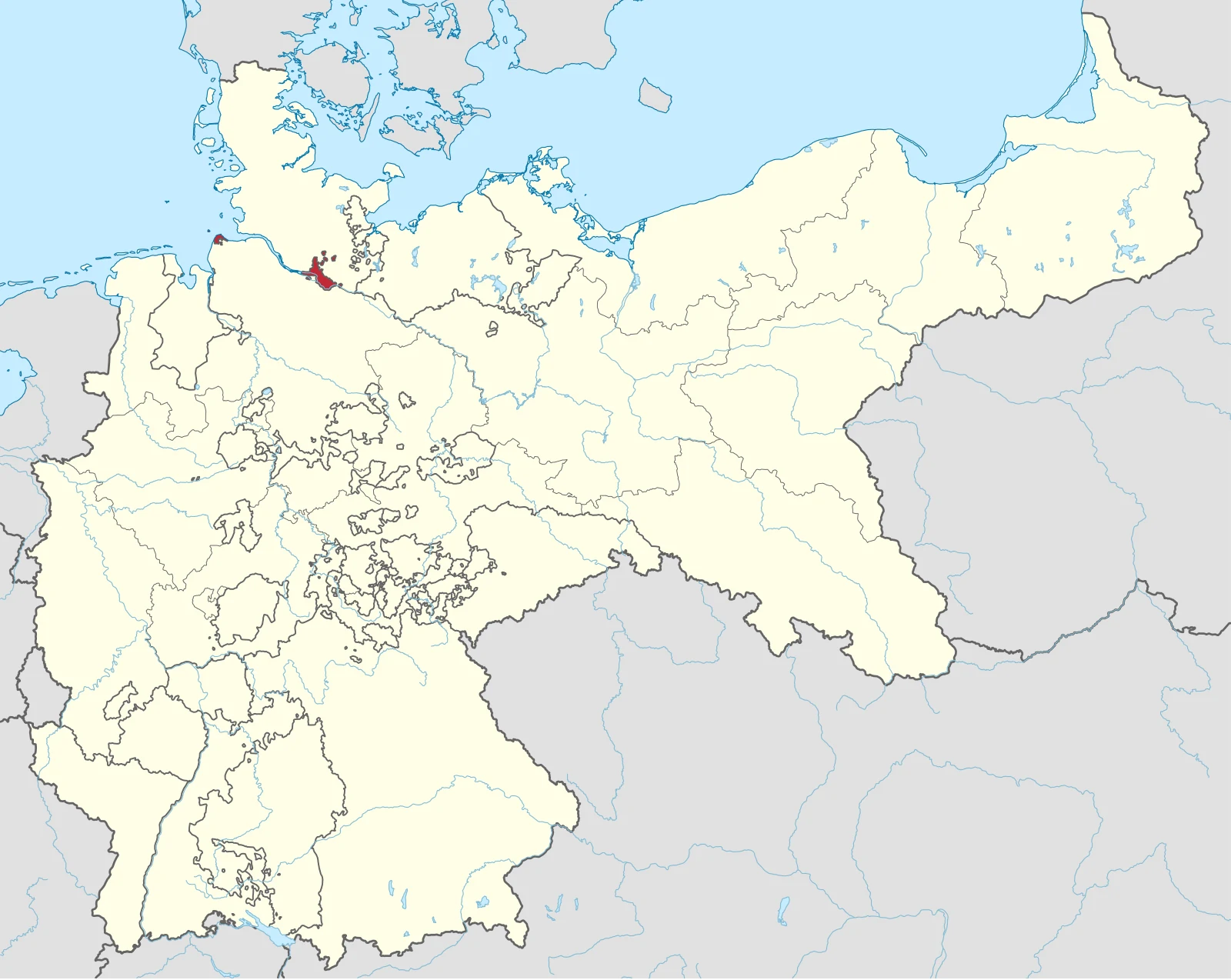
Her childhood did not begin in uninterrupted poverty. Near the turn of the century, Albert owned or managed the Rathaus Hotel in Altona, close to the town hall. Photographs and business recollections describe a substantial establishment with employees and an all-woman orchestra. The family occupied the respectable middle-class world of hospitality, servants, commercial display, and social aspiration. That position later became the “before” in Hanka’s account of a prolonged fall. 2121Scharlau, Anarchy, chap. 8.
No single cause accounts for the decline. Family memory emphasized Albert’s concern with status and his interest in horse racing. The records and recollections also point to disadvantageous leases, alleged fraud by others, Anna’s medical expenses, the First World War, economic crisis, and inflation. After the hotel came a rented tavern and, from about 1911, a tourist café on the Süllberg above the Elbe. Albert sometimes returned to wage work as a waiter during winter. The contrast between receiving guests as proprietor and serving them as an employee carried particular force in family recollection, but it should not be converted into a scene whose witnesses and words are unknown.
The household contracted as the enterprises failed. During the inflationary period Albert obtained a concession connected with shoe-shine stands and public lavatories at Hamburg’s railway station, then lost it. He took short-lived work as a guard, packer, painter, and waiter, and later sold fish with one of his sons. A successful legal claim eventually provided enough compensation to buy a modest property in Fuhlsbüttel. His career was irregular, but it was not simply a story of personal ruin. It also belonged to the destruction of small businesses, savings, and social positions in Germany through war and monetary collapse. 2222Scharlau, Anarchy, chap. 8.
Anna’s experience is harder to recover independently. Hanka’s novel depicted a sensitive woman worn down by illness, pregnancy, domestic labor, diminishing resources, and a difficult marriage. A nephew later remembered her with respect but offered little detail. The novel is indispensable for how Hanka came to understand her mother; it cannot prove every incident or assign blame. In particular, later speculation about a sexual dimension in the relationship between Hanka and her father is unsupported and unnecessary. It does not belong in a factual narrative. 2323Scharlau, Anarchy, chap. 8.
The economic decline affected Hanka’s education. She attended a lyceum but left when the fees could no longer be sustained. At seventeen she began training as a kindergarten teacher and did not finish. Beyond those facts, her motives become less secure. Eine Frau represented an early estrangement from family authority, dissatisfaction with bourgeois convention, periods of travel, acting lessons, poems, prose, and plans connected with the artists’ colony at Worpswede. These details may follow her experience closely; they were still shaped by a writer looking backward. No single humiliation or parental conflict should be assigned as the cause of her politics. 2424Scharlau, Anarchy, chap. 11.
Reform circles and the stage
Her search crossed several institutions rather than following one ideological line. The Freideutsche Jugend offered one form of generational and cultural revolt. The Fichte-Hochschule, an adult-education setting with a nationalist as well as reformist environment, provided another. Hanka met artists, teachers, religious dissenters, and political activists. She experimented with ways of living before she acquired a stable party affiliation, and Scharlau’s research states that she never became a member of the German Communist Party. Her later anarchist milieu should not be projected backward as if every earlier association were a step toward it. 2525Scharlau, Anarchy, chap. 11.
Around 1920 and 1921, she took part in Lothar Schreyer’s experimental Kampfbühne. Schreyer’s later memoir remembered “Hannah Grothendiek,” misspelling the name, performing a sustained maternal lament in his expressionist work Kreuzigung. This independent recollection places her in a documented theatrical enterprise. The Kampfbühne treated voice, rhythm, mask, gesture, and spiritual conflict as material, rejecting ordinary naturalistic representation. Hanka’s participation does not make her a major figure in Expressionism. It establishes that the ambition to write and perform, later so prominent in family memory, had a public basis. 2626Scharlau, Anarchy, chap. 11.
The theater connected her to one of the period’s attempts to invent new forms of collective life. It also exposed the risks of reading art as autobiography. A performed lament does not tell us what the performer felt. An expressionist role does not reveal an inner essence. The historical claim concerns employment, participation, and artistic milieu. Interpretation begins only after those facts and must remain bounded by them.
Der Pranger
Hanka’s work with Der Pranger brought another kind of public record. The Hamburg weekly was associated with women subjected to the city’s regulation of prostitution and was founded by the communist activist Ketty Guttmann. It addressed police and medical control, exploitation, abortion, contraception, unemployment, violence, and the terms by which women were described as administrative problems. Hanka worked for the paper in an editorial and practical capacity. Because most articles were unsigned, the prose cannot be distributed among contributors merely by guessing at style. 2727Scharlau, Anarchy, chap. 11.
Scharlau reports that issue 15 in 1920 attributed the poem “Großstadtnächte” to Hanka and that publication led to confiscation and a prosecution ending in acquittal. The original issue and trial file have not been inspected for this chapter; the poem, unsigned prose, and courtroom language are therefore neither quoted nor independently attributed. 2828Scharlau, Anarchy, chap. 11.
The label “journalist,” if left unexplained, would make this precarious activity resemble a settled profession. The evidence supports intermittent editorial labor, advocacy, and publication. Scharlau reports that Hanka wrote to authorities on behalf of people in difficulty. It does not establish a continuous salary, newsroom position, or recognized career. Calling her a writer is faithful to an aspiration she repeatedly claimed, but the material conditions of writing—paper, postage, a room, time, food, and paid work—remained unstable.
Her relation to the women for whom Der Pranger spoke also requires proportion. Hanka entered as a young outsider, not as someone whose experience was identical to theirs. The paper contested a system in which police and medical authorities classified women and supervised their bodies. Her willingness to work there can be described as solidarity. The possibility of inexperience or self-dramatization does not erase that work, and admiration for it should not erase the distance between the reformer and women who survived the trade.
The difference between signed and unsigned writing is central here. An unsigned paper can document the concerns, vocabulary, and political environment in which an editor worked without proving that she composed a given sentence. Hanka’s attributed poem carries a narrower authorship claim and a clearer legal consequence. The rest of the issue belongs to a collective publication. Assigning its strongest articles to her because they fit a later portrait would repeat, on a smaller scale, the error by which the other Alexander Shapiro’s record was added to Sasha’s life.
The forms of theater and newspaper also answered different kinds of authority. Schreyer’s stage broke with naturalistic representation through disciplined sound, movement, and mask. Der Pranger challenged the administrative language imposed on women whose bodies were policed. Hanka participated in both undertakings at the level the sources permit. It is reasonable to see a continuity in her attraction to forms that contested respectable representation. It would be too strong to claim that she announced such a theory or followed a deliberate program from one institution to the other.
Her work belonged to the economic world already visible in her family’s decline. Cultural ambition did not remove the need for fees, rent, meals, clothes, travel, and time. The hotel’s collapse and the shrinking household were not decorative background to a rebellious personality; they narrowed available education and made artistic labor harder to sustain. Conversely, poverty does not explain every unfinished course or abandoned plan. Family resources, public crisis, temperament, relationships, and choice acted together, and the archive cannot assign each a percentage.
Hanka’s mother and the women of Der Pranger occupied very different social positions, but both histories exposed the legal and material constraints inside conventional accounts of female virtue. Anna’s work in a declining household was rendered largely private. The women addressed by the paper were made intensely public through registration and police control. Hanka’s own movement between family, stage, newspaper, and irregular lodging crossed those divisions without abolishing them. That movement helps locate her historically; it does not authorize claims about an inherited psychology.
Two archives, two corrections
The family’s Protestant records also require care. Correcting the unsupported assertion of maternal Jewish ancestry should not make baptismal affiliation into a full account of belief. A certificate shows how a church and civil system classified a person. It does not disclose private observance, doubt, or later conviction. Hanka’s eventual hostility to religious authority and Sasha’s reported atheism belong to their adult positions, but neither can be projected back into every member of the previous generation.
Albert’s erratic commercial career is similarly vulnerable to retrospective caricature. Hanka’s later account emphasized display, conflict, and failed enterprises. The documented sequence also shows repeated attempts to recover income after loss: hospitality, concessions, service work, small trades, and litigation. He eventually secured a modest property. Those actions do not invalidate the damage remembered by his family. They prevent the father from becoming only a bourgeois foil required by the daughter’s story.
The mother’s surviving profile is fainter because domestic labor generated fewer durable records. That archival imbalance must not be mistaken for a lesser role. Anna’s pregnancies, illness, household management, and dependence are present mainly through Hanka’s representation and a relative’s brief recollection. The biographer can state the scarcity and the conditions described. Furnishing her with thoughts, gestures, or a symbolic wisdom would conceal rather than repair the loss.
The two family archives therefore ask for different corrections. On the paternal side, political legend and mistaken identity can make a thin record look abundant. On the maternal side, regular civil documentation can make the record look complete while leaving domestic work, conflict, and aspiration largely unrecorded. Neither problem is solved by increasing narrative confidence. The first requires subtraction; the second requires an explicit account of what certificates do not contain.
Chronology supplies another correction. Sasha’s childhood, imprisonment, release, armed activity, first family, and flight survive with wide or disputed dates. Hanka’s line contains more exact births, marriages, businesses, and public undertakings. Placing the two in parallel should not imply that events with different precision occurred at matching intervals or caused one another. The chapter alternates between them because both histories are needed before their meeting, not because their lives advanced toward it in synchrony.
The difference is visible in the endpoints. Hanka met Alf around 1921 within a Hamburg milieu for which organizations and civil identities can be named. Sasha reached Berlin during 1921 after a route whose order is clearer than its dates. The sources even contain tension over whether his arrival preceded or followed a reported November encounter in Minsk. “By the end of 1921” is therefore more responsible than a month or half-year. A narrative transition should not conceal a chronological conflict. 2929Scharlau, Anarchy, chaps. 5–7. Exact route dates and the Minsk/Berkman episode remain unverified.
Precision also has an ethical dimension. A false exact date can make later inferences appear stronger than they are, especially when used to calculate age, responsibility, or sequence. An approximate date openly marked as such preserves what the sources support.
This distinction is already relevant to the child who had not yet been born. Later biographies often compress the parents into a pair of attributes: Russian-Jewish anarchist father, German Protestant writer mother. Both descriptions contain truth, but each hides changes of name, interrupted relationships, uneven evidence, and the practical work of survival. A category can orient the reader without exhausting the person it classifies. That proposition is historical before it is philosophical.
Papers, helpers, institutions
In 1921 the legal positions of the two adults could hardly have been more different. Hanka could reject German bourgeois norms while remaining legible to the German state through a birth record and family name. Sasha could profess a universal politics while presenting a document that concealed his origin and depended on officials accepting its surface. One crossed social boundaries within a state that recognized her; the other crossed territorial boundaries after states had made recognition precarious. Their later household would join these unequal forms of exposure.
The evidence also prevents a simple opposition between freedom and constraint. Hanka chose institutions that challenged convention, but economic decline repeatedly limited those choices. Sasha rejected coercive authority, but prisons and borders shaped his body and route. Both relied on networks of assistance. Comrades, relatives, editors, performers, and unnamed helpers supplied money, introductions, papers, or places to sleep. The biographies are not stories of autonomous individuals moving alone.
Those helpers must remain unnamed where the sources leave them unnamed. A phrase such as “a comrade altered the papers” or “a student assisted the escape” can tempt the narrator to provide a motive, a relationship, or a later fate. The source supports an act and a role, not a completed character. Preserving anonymity is part of factual accuracy, especially when clandestine activity and later persecution may explain why the record is thin.
Institutions, by contrast, often appear with names but not with neutral purposes. A prison register, police declaration, church certificate, theater memoir, and prosecution file were created to do different kinds of work. They classified, punished, admitted, remembered, or defended. Their official status does not make every statement equally complete, just as the literary status of Eine Frau does not make every statement useless. Source criticism begins with purpose as well as date.
That principle will govern the chapters ahead. When a later document contradicts an earlier one, the book will not silently choose the form closest to the familiar biography. It will ask which institution created each form, what fact the form was designed to establish, and whether the records can refer to the same person. The discipline is already necessary before Alexander’s birth because his parents’ lives entered the archive through unequal systems.
By keeping those networks visible, the narrative avoids another retrospective distortion: the famous son need not confer significance on every person who preceded him. Rachil, Dodek, Anna, Albert, Nora, and participants in Hanka’s theater and newspaper worlds had histories not reducible to preparing Alexander Grothendieck. Their inclusion is not genealogical ornament. It identifies the obligations, dependencies, and institutions that made the later family possible.
One reported crossing in this milieu points far ahead but cannot bear too much weight. Wilhelm Heydorn, a pastor in conflict with his church, may have appeared as a defense witness in proceedings connected with the paper. More than a decade later, the Heydorn household would receive Hanka’s son. Scharlau found support for Heydorn’s presence at a hearing but not for a continuous friendship between him and Hanka. The record permits an earlier institutional crossing, not a providential chain prepared for the child. 3030Scharlau, Anarchy, chap. 11 and 17.
By 1921, Hanka had moved through family decline, incomplete training, youth and reform circles, experimental theater, and an advocacy weekly. The sequence reveals repeated actions against expected roles. It does not disclose a single stable program. Artistic work and political work were not separate stages so much as overlapping attempts to find a form of speech that ordinary respectability denied. That interpretation is grounded in the institutions she joined; it is not a claim to know what she privately intended.
Hamburg and Berlin, 1921
In the same Hamburg milieu she met Johannes “Alf” Raddatz, born there on January 7, 1897. His father owned a machine-parts business and held Social Democratic convictions. Alf trained as a machinist and automobile mechanic, served in the First World War, and wrote occasional political or comic verse. His later affiliations and conduct belong to the next chapter, where the relationship became a household. At the 1921 boundary, the necessary fact is that Hanka had encountered the man she would marry, while Sasha was moving toward Germany under another man’s name. 3131Scharlau, Anarchy, chap. 12.
By the end of 1921, Sasha had reached Berlin. The city had become a major point of passage for refugees from the former Russian Empire: writers, artists, former officials, political exiles, and activists moved through a metropolis already destabilized by military defeat, revolution, and inflation. Anarchist networks organized meetings, publications, and aid for prisoners. Famous participants in those networks left clear documentary trails. Sasha’s place among them remains thinner. The existence of the milieu must not be turned into proof that he attended every conference or knew every prominent exile. 3232Scharlau, Anarchy, chap. 5 and 7.
His refugee status depended on the document he carried. A state might regard him as a victim of Bolshevik persecution, a political risk, a bearer of false papers, or a person entitled to temporary protection. These classifications were not philosophical abstractions. They governed registration, work, and the ability to cross the next border. His opposition to state authority did not free him from state categories. On the contrary, stateless or precariously documented people met those categories at every office and checkpoint.
For Hanka, papers had so far performed a different function. They recorded birth, baptismal background, education, a father’s businesses, theatrical participation, and a prosecution. Even when the family descended economically, it remained visible within German civil and commercial systems. Sasha’s archive consisted more often of aliases, police attention, a declaration made under an assumed identity, and stories carried by people. The asymmetry between those archives is part of the history. It reflects unequal relations to citizenship, antisemitism, political policing, and border control.
That asymmetry also explains why “before the name” cannot mean before identity. Both lives were already crowded with names and classifications. Schapiro linked Sasha to Jewish origin but lacks a surviving birth record in the available record. Tanaroff enabled movement and became the name under which officials recognized him. Sasha was familiar usage; Sasha-Piotr would become a political byline. Johanna, Hanna, and Hanka marked different public and intimate forms within one documented family name. None is false in the same way, and none by itself tells the whole history.
Two prehistories
No principle of inheritance joins these two prehistories to algebraic geometry. The father’s forged papers do not explain the son’s later concern with objects and their presentations. The mother’s resistance to convention does not explain mathematical abstraction. Such parallels are available only after the fact and can easily become a myth of destiny. The proper work of these pages is prior and more modest: to establish which people and institutions existed, which sources speak, where their claims conflict, and what remains unknown.
Nor do the parents’ later reputations settle their earlier lives. Sasha’s endurance under imprisonment cannot absolve choices that imposed costs on Rachil and Dodek. The absence of a military record does not prove that his family invented every revolutionary episode. Hanka’s unfinished projects do not cancel her verified participation in theater and print. Her literary shaping does not make Eine Frau useless; it determines the questions the book can answer. Evidence remains strongest when each source is asked to carry no more than its form allows.
At the end of 1921, the two routes had not met. Sasha had crossed out of the former Russian Empire and reached Berlin with an assumed surname, a missing arm, a reported history of prison and civil war, and a wife and child left behind. Hanka remained within a German legal identity but had stepped away from the family’s expectations through performance, advocacy, irregular work, and a new relationship. One life had been forced across borders; the other repeatedly tested the borders of class, gender, and respectability. These are descriptions of action and circumstance, not diagnoses.
The next movement would take place inside the same unstable geography. Sasha did not remain in Berlin after his first arrival. Paris and Belgium offered work, expulsion, political print, and further uncertainty before he returned. Hanka and Alf would marry, have a daughter, and move east into the poor edge of Berlin’s cultural world. When the two paths finally crossed, they did so through networks of people who lent rooms, papers, money, work, and protection. The house that emerged from those networks would possess an address without acquiring security.
注释
- Winfried Scharlau, Who Is Alexander Grothendieck? Anarchy, Mathematics, Spirituality, Solitude. Part 1: Anarchy, trans. Melissa Schneps (n.d.), chap. 1, https://webusers.imj-prg.fr/~leila.schneps/grothendieckcircle/Scharlau/Anarchy.pdf. ↩
- Scharlau, Anarchy, chap. 1. ↩
- Scharlau, Anarchy, chap. 1. ↩
- Scharlau, Anarchy, chap. 2; Ching-Li Chai and Frans Oort, “Life and Work of Alexander Grothendieck,” Notices of the International Congress of Chinese Mathematicians 5, no. 1 (2017): sec. 1.3, https://www2.math.upenn.edu/~chai/AG/ChaiFO9-AG.pdf. ↩
- Scharlau, Anarchy, chaps. 3–6. ↩
- Alexandre Grothendieck, Récoltes et Semailles: Réflexions et témoignage sur un passé de mathématicien, ed. Mateo Carmona (1985), 603–8, Manuscript, https://webusers.imj-prg.fr/~leila.schneps/grothendieckcircle/RetSbis.pdf. These are retrospective family accounts, not a contemporaneous judicial file. ↩
- Scharlau, Anarchy, chap. 3. ↩
- Scharlau, Anarchy, chap. 4. Prison particulars derive principally from later family testimony. ↩
- Scharlau, Anarchy, chap. 4. Prison particulars derive principally from later family testimony. ↩
- Scharlau, Anarchy, chap. 4. Prison particulars derive principally from later family testimony. ↩
- Scharlau, Anarchy, chap. 4. Prison particulars derive principally from later family testimony. ↩
- Scharlau, Anarchy, chap. 4 and 7. ↩
- Scharlau, Anarchy, chaps. 4–5. ↩
- Scharlau, Anarchy, chap. 5. No contemporaneous roster or operational record was identified. ↩
- Scharlau, Anarchy, chap. 6; Centre for Grothendieckian Studies, “Correspondence,” https://csg.igrothendieck.org/correspondence/. ↩
- Scharlau, Anarchy, chap. 6; Centre for Grothendieckian Studies, “Correspondence”. ↩
- Scharlau, Anarchy, chaps. 5–7. ↩
- Scharlau, Anarchy, chap. 8. ↩
- Scharlau, Anarchy, chap. 8. ↩
- Scharlau, Anarchy, chap. 11. ↩
- Scharlau, Anarchy, chap. 8. ↩
- Scharlau, Anarchy, chap. 8. ↩
- Scharlau, Anarchy, chap. 8. ↩
- Scharlau, Anarchy, chap. 11. ↩
- Scharlau, Anarchy, chap. 11. ↩
- Scharlau, Anarchy, chap. 11. ↩
- Scharlau, Anarchy, chap. 11. ↩
- Scharlau, Anarchy, chap. 11. ↩
- Scharlau, Anarchy, chaps. 5–7. Exact route dates and the Minsk/Berkman episode remain unverified. ↩
- Scharlau, Anarchy, chap. 11 and 17. ↩
- Scharlau, Anarchy, chap. 12. ↩
- Scharlau, Anarchy, chap. 5 and 7. ↩