Moabit, March 28, 1928
Grothendieck was born in Berlin on March 28, 1928. Scharlau’s transcription reports that Moabit Hospital notified the civil authorities of a birth at 11:45 to Johanna Raddatz, née Grothendieck, wife of the writer Johannes Raddatz, resident at Brunnenstraße 165. It further reports the given name Alexander and the initial registration Alexander Raddatz. The original civil entry was not inspected for this account. 11Scharlau, Anarchy, chap. 15; Chai and Oort, “Life and Work of Alexander Grothendieck,” sec. 1.1.
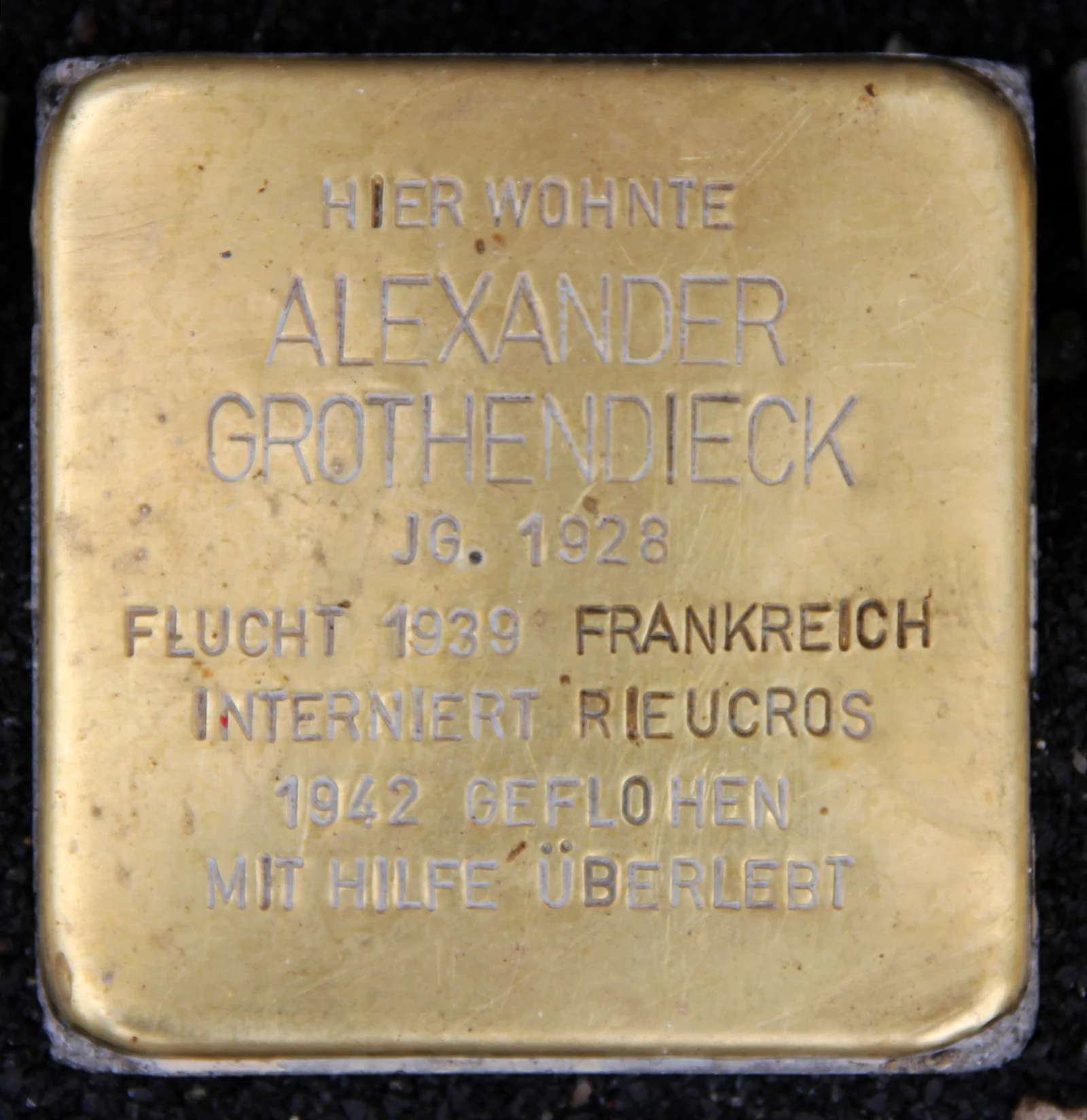
The transcription supports a documentary opening, not a reconstructed scene. It reports an institution, time, maternal identity, marital relation, address, and name; it does not establish the room, people present, labor, expressions, the biological father’s location, or the infant’s condition. None of those missing details may be furnished from convention.
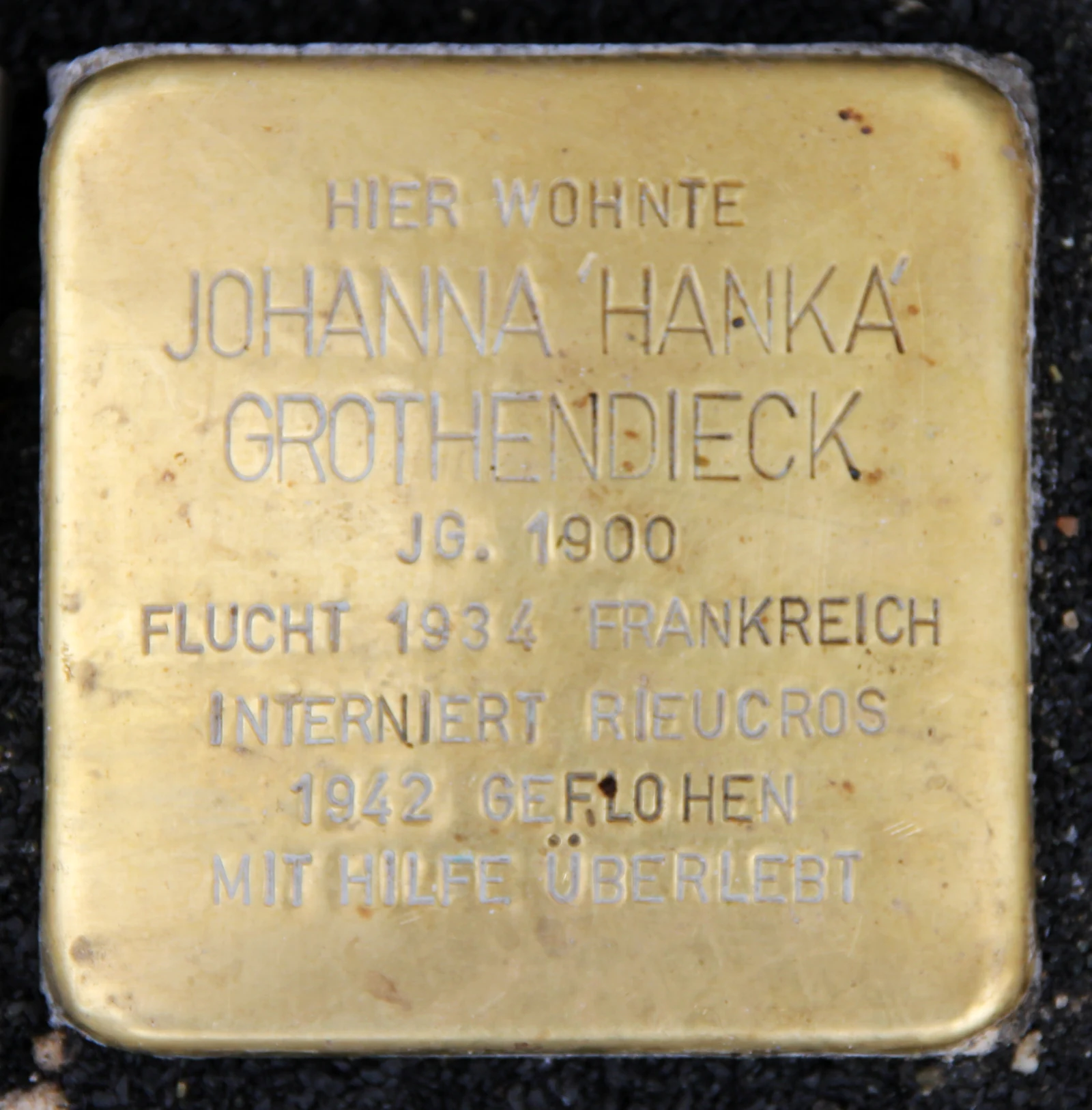
If Scharlau’s transcription is accurate, Raddatz was not an error waiting for a biographer to correct. It recorded the legal effect of Hanka’s undissolved marriage, while the absence of Sasha Tanaroff from the entry did not establish his physical absence or emotional relation. Later proceedings changed the child’s legal position; they do not permit the familiar surname Grothendieck to be projected backward into the original entry.
The exact birth time, reporting language, registry number, marginal annotations, and wording remain unresolved until the German object is consulted. Chai and Oort corroborate the date, place, and initial surname at secondary-source level, but neither secondary account can substitute for the page when the chapter analyzes its physical or legal details. 22Scharlau, Anarchy, chap. 15; Chai and Oort, “Life and Work of Alexander Grothendieck,” sec. 1.1.
Scharlau’s transcription also uses “writer” for Johannes Raddatz and later for Alexander Tanaroff. Such an administrative occupation can record self-presentation without proving regular publication or income. Brunnenstraße 165 likewise links the birth report to the studio history but does not establish each adult’s continuous residence or resolve the later Spandauer Straße address. 33Scharlau, Anarchy, chap. 15.
Moabit Hospital functions similarly. It is a verified institutional location for the birth. It does not provide a visual setting unless hospital records, plans, or photographs are separately introduced and sourced. Later descriptions of the infant being moved to a children’s hospital or refusing nourishment come from retrospective texts, not from the birth entry. The documentary line must remain visible between the event the registry confirms and the story the adult son later assembled.
The mother named in the certificate was twenty-seven. Hanka had lived with Sasha for roughly two years while remaining married to Alf. She and Sasha had taken over the photographic studio and dwelling at Brunnenstraße 165 during the previous autumn, according to the reconstructed business history. That brief context is necessary to understand the mismatch among residence, partnership, and surname; the full convergence belongs to Chapter 2 and is not repeated here. 44Scharlau, Anarchy, chap. 13 and 15.
The birth introduced no new clarity about Sasha’s status. He was using the surname Tanaroff, had worked under Hanka’s trade authority, and remained vulnerable to police attention. Later in 1928, a Berlin identity card would give him a more secure documentary presence. On the day of the birth, the supplied evidence places him in the family but not on the birth notice. The record’s silence is institutional, not proof of physical absence or emotional distance.
Alexander, Raddatz, Schurik
The given name Alexander connected child and father without proving why it was chosen. Both the biological father and the newborn bore that name. The family called the father Sasha, and would call the child Schurik, another diminutive form within Russian usage. It is reasonable to observe the pattern. It would be speculative to claim that the name honored the father, asserted paternity, or expressed a particular hope unless Hanka or Sasha documented that intention. 55Scharlau, Anarchy, chap. 15.
The familiar spelling “Alexandre” belongs mainly to the child’s later life in French. The 1928 record summarized by Scharlau uses Alexander. A biography written in English needs a stable form. This one uses Alexander, while preserving Alexandre in French titles, quotations, and documents. Orthographic consistency in the book should not be mistaken for evidence that one spelling governed every language and period.
The nickname Schurik presents a different problem. Family photographs and later testimony establish its use for the young child and its persistence among relatives and close acquaintances. The available record does not provide a dated 1928 object showing the first occasion on which it was used. It is therefore safe to say that he was known in the family as Schurik during childhood; it is not safe to stage the act of naming or assign it to a particular adult. 66Scharlau, Anarchy, chap. 15.
Four forms now coexist: Alexander as the registered given name; Raddatz as the initial civil surname; Schurik as family usage; and, soon, Grothendieck as the surname established after legal proceedings. Alexandre would become a linguistic variant in France. They do not all have the same authority or date. A name can be official, intimate, translated, chosen, imposed, or retrospective. Collapsing those functions would destroy the chapter’s central fact.
Nor is the central fact that the child possessed a hidden essence beneath the names. Biography cannot step outside every record and pronounce a metaphysically true label. It can establish a continuing human subject through dates, relationships, documents, photographs, and later actions. The task is evidentiary: demonstrate why these forms refer to the same person, mark when each was used, and avoid importing properties from one context into another.
That task is especially necessary because the father’s history had already shown how names could be confused. Schapiro linked Sasha to an original family account; Tanaroff governed his administrative life; Sasha-Piotr appeared in political print; another Alexander Shapiro possessed a separate and much larger archive. The son’s naming sequence was better documented, but it too required proof rather than familiarity. The later fame of “Grothendieck” cannot serve as proof of what the registry said in March 1928.
Early stories, later sources
In La Clef des Songes, written more than fifty years later, Grothendieck recounted a family-derived story that he refused nourishment as an infant and received hospital care. He described the reconstruction as drawing on family reports, writings, letters, and dreams. It is evidence for his late self-interpretation, not a contemporaneous clinical history. 77Scharlau, Anarchy, chap. 15. The account is a late self-interpretation, not a contemporaneous medical record.
No medical chart, discharge record, or contemporary letter examined here establishes the transfer, diagnosis, treatment, duration, infant intention, or maternal motive. The chapter therefore makes no claim that the infant tried to die, that nurses restored a will to live, or that maternal rejection caused the episode. The documentary record establishes a birth; the later text establishes how the adult author came to narrate it.
Photographs from the Berlin years provide another kind of evidence. Scharlau refers to a picture of Hanka with the newborn in a baby sleeping sack and to a series of images of the children. Such objects can confirm bodies, approximate age, clothing, and photographic practice when the originals, dates, and captions are verified. They cannot prove harmony, attachment, fear, or early mathematical ability. A portrait is an arranged exposure, not an emotional test.
One later recollection claimed that the young Schurik counted unusually early. The source was a partner from Grothendieck’s adult life, not a contemporaneous witness to infancy. Without an early record or a clearly identified family transmission, the claim belongs to the mythology of precocity and is excluded from this account. The future mathematician does not require an infant prodigy story. 88Scharlau, Anarchy, chap. 15. The early-counting claim is late testimony and is excluded from the factual chronology.
The little family
Maidi’s presence in the household is more firmly relevant. Her maternal grandmother Anna Grothendieck died on October 3, 1928. Scharlau’s reconstruction suggests that Maidi, who had spent long periods with her grandparents, came to live with Hanka and Sasha around the time of Alexander’s birth or after Anna’s death. The exact move is not established. It should be described as probable rather than dated to a particular day. 99Scharlau, Anarchy, chap. 8 and 15.
The four-person grouping later called the “little family” consisted of Hanka, Sasha, Maidi, and Alexander. The phrase came from Grothendieck’s later meditations and may not have been a household term in 1928. It is useful only if its retrospective character remains visible. The group contained two children with different legal fathers, a mother whose marriage was ending, and a man whose relation to each child differed biologically and legally. 1010Scharlau, Anarchy, chap. 15, retrospective testimony only.
Maidi’s surname, Raddatz, matched the infant’s first surname, but the similarity concealed different situations. Alf was Maidi’s biological and legal father. In Alexander’s case, the marriage supplied the legal connection while Sasha was the biological father. Sasha later acted toward Maidi in a paternal capacity and formally acknowledged Alexander. The household cannot be mapped by surname alone. 1111Scharlau, Anarchy, chap. 15.
The grandparents’ role did not disappear when Maidi returned. Years of care had made them part of the structure through which Hanka’s Berlin life was possible. Anna’s death changed that structure. The record does not disclose how the child understood the move or bereavement. It shows a transfer of daily care at a time when the studio household had just added an infant.
A studio and its names
Brunnenstraße 165 joined residence and work. The family’s rooms were associated with a photographic atelier, and Berlin address books listed Hanka’s business in 1929 and 1930. The address on the birth record confirms the household’s connection to the building in March 1928. It does not identify which rooms were used for portraits, sleeping, processing, or writing. Those details require a plan, inventory, or direct testimony not present in the available record.
The address stood near working-class and immigrant districts north of central Berlin, including areas shaped by eastern European Jewish settlement. This social geography helps explain why exile networks and small trades could overlap there. It does not authorize a cinematic description of the street. No source in the available record supplies the weather on March 28, the sounds outside the hospital, or what could be seen from the studio windows.
The studio’s existence matters because it created the appearance of settlement. The family had a place where clients could find it and where an official directory could list a proprietor. That public stability remained conditional. Sasha’s papers, the unresolved marriage, the cost of rent, and the dependence on irregular customers continued. A fixed address reduced mobility without eliminating precarity.
It also distributed names across documents. The birth notice used Raddatz for Hanka and the child. The address-book entry later used Grothendieck-Raddatz for Hanka’s atelier. Sasha’s own identity papers used Tanaroff. A customer might have known only the studio name, a comrade only Sasha-Piotr, and a relative the diminutive Schurik. The household had no single documentary surface.
This multiplicity should not be romanticized as freedom from borders. Each name belonged to an institution or relation with the power to include and exclude. A license allowed work. A surname created legal presumptions. A refugee document enabled movement while exposing its bearer to scrutiny. A family nickname conveyed intimacy but had no force at court. The house was crossed by these borders even when none was visible in its rooms.
Divorce and an identity card
Scharlau reports that Hanka’s marriage to Alf ended in divorce in July 1928 and summarizes a judgment that referred to her relationship with Alexander Tanaroff. The original German judgment and its legal wording have not been inspected. If Scharlau’s chronology is accurate, the marriage still governed the March registration and had ended by July. 1212Scharlau, Anarchy, chap. 15.
Divorce did not automatically rewrite the child’s birth entry into the later familiar form. Nor did it erase Alf’s relation to Maidi or the years of practical connection among the adults. It changed one legal status at a dated moment. The temptation to narrate it as a final separation is contradicted by later assistance and continuing family links. A judgment can terminate a marriage without terminating every relation created during it.
Scharlau reports that Hanka often used the compound form Grothendieck-Raddatz after the divorce while some later official documents still used Raddatz. The uncollated examples suggest that name usage did not change cleanly on the date of judgment, but they do not establish a first use. 1313Scharlau, Anarchy, chap. 15.
Scharlau reports that Berlin police issued an identity card to Tanaroff on October 30, 1928. The card itself has not been consulted for this account, so its wording and legal effect remain unresolved; the report does not establish how earlier irregularities were resolved or whether residence was secure. 1414Scharlau, Anarchy, chap. 13.
That distinction is easy to lose. A forged or altered origin does not mean that every later document issued on its basis is itself fictitious. Institutions can recognize an identity repeatedly until it becomes the stable legal route through a life. Tanaroff was the name under which Sasha worked, appeared before offices, and would later be persecuted. Calling it an alias is accurate only if the word does not suggest an optional mask he could remove without consequence.
The paternity proceedings of 1929
Scharlau reports that Alf sought a change in Alexander’s legal status and that a Berlin family-court action followed on April 17, 1929. The original file and precise legal category remain unconsulted; the chapter therefore does not quote the judgment or treat its terminology as settled. 1515Scharlau, Anarchy, chap. 15. The April 17, 1929 family-court file and legal category remain unconsulted.
It is tempting to describe the proceeding as the discovery of biological truth. The record was more institutional. A court acted on a claim concerning legitimacy and altered the legal relation. Biological paternity was part of the background, but the source summary does not provide scientific evidence, testimony, or reasoning. The biographer should state the order and outcome, not reconstruct the hearing.
According to Scharlau’s transcription, on June 28, 1929 Tanaroff appeared before the Berlin-Center youth welfare service and acknowledged paternity of Alexander Grothendieck. The transcription describes him as a writer, gives an undertaking of 120 Reichsmarks four times a year until age sixteen, and records a Spandauer Straße address. The original acknowledgment has not been inspected. 1616Scharlau, Anarchy, chap. 15.
On Scharlau’s reading, the undertaking would total 480 Reichsmarks a year. It is not a payment ledger, and the transcribed address does not establish permanent residence, separation from Hanka, or falsity. Payment history and address use remain unknown. 1717Scharlau, Anarchy, chap. 15.
Several explanations for the address are possible. He may have lived elsewhere for a period, used a reliable mailing address, stayed with a comrade, or supplied an address suited to his documentary circumstances. None is established. A biography must not choose the explanation that makes the family most dramatic. The discrepancy should remain a discrepancy until residence records or correspondence resolve it.
Scharlau also summarizes a youth-welfare guardianship, but its powers and duration require the original case file and legal context. The only safe conclusion is that his reconstruction gives the welfare service an administrative role; its exact scope is unresolved. 1818Scharlau, Anarchy, chap. 15.
By the middle of 1929, the familiar name Alexander Grothendieck appears in Scharlau’s reconstructed documentary chain. The reported transition involved divorce, a family-court action, acknowledgment, a support undertaking, and youth-welfare oversight. Until the originals are consulted, that sequence remains an attributed reconstruction rather than an documented close reading. 1919Scharlau, Anarchy, chap. 15; Chai and Oort, “Life and Work of Alexander Grothendieck,” sec. 1.1.
Much later, Grothendieck’s mathematics repeatedly emphasized structures that remain meaningful under transformations.2020Chai and Oort, “Life and Work of Alexander Grothendieck,” 11–12. This note supports only the nontechnical historical statement about his mature mathematical practice. That mature work belongs to later chapters.
Work in the directory
Scharlau reports 1929 and 1930 address-book entries for a photographic atelier at Brunnenstraße 165 under Hanka’s compound name. The pages have not been directly consulted here; even if confirmed, a listing would not prove profitability, continuous occupancy, or division of labor. 2121Scharlau, Anarchy, chap. 15.
The listing also gives Hanka a documentary presence not dependent on being named as wife or mother. She appeared as the person associated with the atelier. This did not necessarily reflect who made most photographs, and it did not cancel the work of Sasha or any assistant. It shows how legal capacity and commercial attribution intersected. The woman whose married status had named the child Raddatz could use a compound surname to name the business after divorce.
Sasha remained attached to photography, whether at the studio or on the street. The 1929 paternity declaration called him a writer, not a photographer. Occupational labels shifted with the form and the self-description supplied to it. Neither label should be treated as fraudulent. He had published political articles and aspired to a major written work; he also earned money with a camera. A person could have a vocation, a trade, and an administrative occupation that did not coincide. 2222Scharlau, Anarchy, chaps. 7, 13, and 15.
Hanka likewise occupied several categories. She had worked in theater and advocacy print, wrote prose, helped operate the photographic enterprise, cared for an infant, and negotiated a household containing Maidi. “Writer,” “photographer,” “mother,” and “divorced wife” named real functions without providing a complete portrait. The record becomes misleading only when one category is allowed to erase the others.
A destroyed file
In 1929, Hanka applied for support from the German Schiller Foundation, an organization assisting writers and their dependents. Scharlau reports that the file created for her was later selected for destruction and that she was listed as Grothendieck-Raddatz. The application establishes an institutional claim to literary work. The outcome is uncertain, and no surviving file in the available record allows the contents or merits of the application to be described. 2323Scharlau, Anarchy, chap. 15. The Schiller Foundation file was reportedly selected for destruction; contents and outcome remain unknown.
The destroyed file is a reminder that archival silence can be produced administratively. No failure of preservation should be converted into a failure of effort. At the same time, an application is not evidence that a grant was awarded or a manuscript completed. The secure statement lies between those errors: Hanka sought recognition and material support as a writer in 1929 under the compound surname.
Destruction also changes the balance among surviving voices. If an application contained Hanka’s own account of her work, its loss leaves the later novel and other people’s summaries carrying more weight. That imbalance is contingent, not proof that she had nothing more precise to say. A note that the file was selected for destruction records an archival event; it does not license reconstruction of what was inside.
Four kinds of record
The business directory survives for the opposite reason. Directories were produced systematically and preserved in runs, so a small commercial entry can outlast intimate papers. Its survival makes the atelier easy to locate but tells little about the children or the couple’s writing. Archives favor repeated administrative forms. Biography must recognize that advantage without confusing regular preservation with greater human importance.
Court and youth-welfare records occupy a middle position. They concern intimate relations but translate them into legal categories. The paternity declaration can state an obligation more exactly than a memoir, yet it says nothing about daily care. The divorce judgment can establish legal dissolution, yet its findings were framed for a proceeding rather than for a complete family history. These documents are strong within their purpose and partial beyond it.
Photographs are partial in another direction. Once authenticated, they can show who appeared together and how a studio represented its subjects. Captions may preserve names unavailable elsewhere. But the decision to take or keep a picture selects a moment. Family albums often survive because someone curated them. The absence of conflict from an album does not prove an idyllic year, and the absence of a person from one image does not prove absence from the household.
The four documentary classes can therefore check one another. The birth record fixes the initial civil identity. The address book confirms the commercial address. Court and welfare actions show changes in legal relations. Photographs and later testimony establish family usage such as Schurik and the presence of Maidi. No one class supplies all answers. Agreement increases confidence; disagreement identifies a question rather than an opportunity for invention.
The 1929 sequence also demonstrates why a chronology needs dates finer than a general “Berlin childhood.” March 1928, July 1928, October 1928, April 1929, and June 1929 mark different institutional states. If they are compressed, Sasha’s acknowledgment can appear to precede the birth name, or the divorce can seem to have removed the need for a court action. Ordering the documents is itself an explanatory act.
The sequence should not be mistaken for steady progress toward truth. Each proceeding answered a practical legal problem, but later history does not confer moral superiority on the final form. The name Grothendieck became enduring and famous; that does not make every earlier relation an obstacle destined to be cleared away. Raddatz records the marriage that existed, and Tanaroff records the father who acknowledged the child.
A child without memories
For the infant, none of these proceedings can be narrated as remembered experience. The child was present as the subject of decisions made by adults and institutions. A biographer may describe the changes that affected him, not assign surprise, relief, confusion, or recognition. Those emotions would be plausible inventions and therefore impermissible.
The ethical limit is more than stylistic. Childhood biography often treats later personality as a source for imagined early reactions. Grothendieck’s eventual concern with names, responsibility, or parental memory cannot be projected into 1928. Adult reflection may testify to later significance, but significance is not recollection, and recollection is not contemporaneous observation.
The same limit protects the adults from retrospective roles. Hanka is not yet “the mother of a mathematician” in any meaningful social sense; she is a writer, photographer, partner, former spouse, and mother managing immediate conditions. Sasha is not yet the legendary absent father; he is present in the legal record of 1929 and undertakes support. Alf is not only an incorrect surname; his marriage creates the initial status and his court action changes it. History proceeds through what they did then, not what the son later became.
The adults’ occupations also resist a hierarchy imposed by later fame. Photography paid for at least part of the household. Writing supplied ambition, identity, and occasional publication. Care work, much of it unrecorded, sustained the children. Administrative work—applications, licenses, court appearances, registrations—made the other activities possible. A biography centered on intellectual achievement can easily treat these as background, but in 1928 and 1929 they were the substance of family life.
The chronology reveals no moment when those forms of work were reconciled. A studio client, a grant application, a court appointment, and an infant’s needs would have drawn on the same limited time, but the archive does not provide a calendar. It would be plausible to describe exhaustion or tension; plausibility is not enough. The narrative can state the concurrent demands and leave their daily arrangement unknown.
Similarly, the child-support undertaking should not be made into a moral verdict by itself. Formal acknowledgment and a specified amount show responsibility accepted before an office. Without receipts, they do not show performance. The existence of the obligation neither proves devoted fatherhood nor proves neglect. Later chapters may add evidence of presence, letters, or separation; this chapter records only what the 1929 document can bear.
The legal action initiated by Alf deserves the same neutrality. It changed a status that did not match biological paternity. The source summary does not reveal whether his primary concern was accuracy, money, personal conflict, or another consideration. Assigning motive would turn a procedural fact into private drama. His continuing role as Maidi’s father must remain separate from the decision concerning Alexander. 2424Scharlau, Anarchy, chap. 15.
Hanka’s use of a compound surname shows that a legal transition need not produce a clean social one. Grothendieck connected her to the family of birth and to the name her son would carry. Raddatz connected her to a marriage and to Maidi. The compound form could function commercially and personally even when agencies continued to use a simpler official form. No evidence in the available record records a single declaration of what the name meant to her.
For Alexander, the result was a surname derived from the maternal line rather than either father’s working name. That fact later became so familiar that it can appear inevitable. In 1928 it was not. It arose from a particular configuration of marriage, divorce, court action, and acknowledgment. A different legal sequence could have left another documentary result. Recognizing contingency does not diminish the name; it restores its history.
How this book names him
The chapter’s archive is thus an archive of acts more than scenes. Someone notified a registry. A court dissolved a marriage. Police issued a card. Another court altered a legal relation. A father appeared before youth welfare. A directory listed a studio. A writer applied for assistance. These verbs provide movement without invented atmosphere. They also show that early life can be narrated closely even when the infant’s consciousness is inaccessible.
They also determine the book’s naming practice. In narration after the 1929 proceedings, “Grothendieck” can become the default surname because it is the stable historical and project form. “Raddatz” remains necessary whenever the initial registration or Alf’s legal relation is at issue. “Schurik” belongs to documented family usage, not to an intimate narrator pretending familiarity. “Alexandre” belongs to French contexts. Stating these rules prevents stylistic variation from turning into an unsupported claim about identity.
The rules must remain revisable if original records alter the dates of first use. A photograph caption might move Schurik earlier; a marginal registry note might specify the surname change; a letter could show which form Hanka used before a court acted. Until such objects are consulted, the text marks secure ranges rather than announcing a first utterance. Authority control is not clerical decoration. It keeps later chapters from giving one person several accidental biographies.
This discipline is particularly important for indexing and quotation. A reader searching Raddatz must be led to the birth and legal proceedings without being directed into Alf’s separate history indiscriminately. A quotation using Alexandre must retain its language while the surrounding prose identifies the same subject. 2525Scharlau, Anarchy, chap. 15. First dated uses of the name variants remain unresolved.
Writing, photography, politics
The pair reportedly continued to revise prose and imagined a book that might establish their literary standing. Grothendieck later wrote of sponsorship consumed without the promised work being produced. That recollection belongs to a later family judgment and lacks a financial ledger in the available record. It can show the adult son’s view of recurring ambition and noncompletion. It cannot determine how the money was spent or which person was responsible. 2626Scharlau, Anarchy, chap. 15. Retrospective family interpretation only.
Writing and photography shared material conditions. Both required time, equipment, a place to work, and some protection from immediate need. The studio offered rooms and a commercial base, but also rent, clients, chemical work, and infant care. To say that the couple failed because they lacked discipline would ignore those pressures. To say that circumstances alone prevented completion would ignore choices and conflict. The evidence supports repeated aspiration under unstable conditions, not a complete allocation of cause.
The household’s political life during 1928 and 1929 is less visible than the earlier exile networks. Scharlau found no tangible evidence of major revolutionary activity by Sasha in these years. Lack of evidence does not show that he abandoned anarchism; his 1927 donation and later commitments argue against such a simple conclusion. It does prevent the studio from being represented as a political headquarters without records of meetings, publications, or organizational roles. 2727Scharlau, Anarchy, chap. 15.
The ordinary administrative acts may have consumed more attention than political legend suggests. A birth registration, divorce, identity card, legitimacy action, paternity acknowledgment, support obligation, business listing, and grant application all occurred within roughly eighteen months. These documents show a family engaged repeatedly with institutions it could criticize but not ignore. The state entered through the child’s name, the father’s papers, the mother’s marriage, and the terms of work. 2828Scharlau, Anarchy, chap. 15.
The surviving photographs create a quieter record. Images of the children indicate that the family’s own craft was turned toward its members. Once provenance is checked, inscriptions and dates may help establish when Maidi joined the household and when Schurik became common usage. Until then, the photographs should not be mined for expressions or relationships. A child looking away from the camera is not evidence of alienation; an adult holding an infant is not proof of ease. 2929Scharlau, Anarchy, chap. 15.
Berlin remembered
Later Grothendieck remembered the Berlin years as containing deep identification with his father and great admiration for both parents. That recollection describes how he organized early memory as an adult. He had been under two throughout the period covered here. It should not be used to supply thoughts to the infant in 1928 or to settle conflicts reported by others. The chronological distance must accompany the testimony. 3030Scharlau, Anarchy, chap. 15, retrospective testimony only.
The same principle applies to later accounts of the parents’ quarrels. Their relationship was conflictual in Hanka’s novel and in Grothendieck’s reflections, but the surviving novel stops before this period, and no contemporaneous diary in the available record records a particular dispute in 1928–1929. Generalizing backward from later testimony may identify a pattern; it cannot produce scenes, dates, or an infant witness.
By the end of 1929, Alexander Grothendieck existed in records under the name familiar to history. That documentary settlement did not settle the household. Hanka’s surname remained variable. Sasha’s legal identity remained Tanaroff. Alf’s relation to Maidi continued even after divorce, while his legal relation to Alexander had been disclaimed. The youth welfare service stood within the father–child relation through support and guardianship. One name had stabilized while the surrounding relations remained distributed.
This is why a close reading of the records matters more than a symbolic story about naming. The documents did things. The birth notice placed a child within a marriage. The divorce ended that marriage. The court action removed one legal presumption. The paternity declaration created an acknowledged relation and monetary obligation. The address book made a business findable. The identity card made a refugee legible under an assumed surname. None simply described an independent reality; each altered the field in which the family could act.
The records also show their own limits. They classify without narrating care. They state money without showing payment. They give addresses without proving continuous residence. They identify relationships without measuring affection. They can be more reliable than memory for dates and less informative than memory about meaning. A factual biography needs both kinds of source while refusing to make either answer questions beyond its reach.
The year 1929 closes without a scene. There is no verified evening on which the family adopted its final arrangement and no document that announces the end of uncertainty. The child had moved from Raddatz to Grothendieck through law; the father had acknowledged him as Tanaroff; the mother operated under forms of Grothendieck and Raddatz; the family called the child Schurik. That plurality is not a puzzle to solve. It is the historical result.
The next chapter begins when residence and presence start to separate. Its subject is the father’s movement away from Berlin in the years leading to 1933 and the evidence by which absence can be measured. This chapter delivers only the state reached in 1929: a named child, an acknowledged father, a documented studio, and no warrant for imagining that documentary order produced domestic security.
注释
- Scharlau, Anarchy, chap. 15; Chai and Oort, “Life and Work of Alexander Grothendieck,” sec. 1.1. ↩
- Scharlau, Anarchy, chap. 15; Chai and Oort, “Life and Work of Alexander Grothendieck,” sec. 1.1. ↩
- Scharlau, Anarchy, chap. 15. ↩
- Scharlau, Anarchy, chap. 13 and 15. ↩
- Scharlau, Anarchy, chap. 15. ↩
- Scharlau, Anarchy, chap. 15. ↩
- Scharlau, Anarchy, chap. 15. The account is a late self-interpretation, not a contemporaneous medical record. ↩
- Scharlau, Anarchy, chap. 15. The early-counting claim is late testimony and is excluded from the factual chronology. ↩
- Scharlau, Anarchy, chap. 8 and 15. ↩
- Scharlau, Anarchy, chap. 15, retrospective testimony only. ↩
- Scharlau, Anarchy, chap. 15. ↩
- Scharlau, Anarchy, chap. 15. ↩
- Scharlau, Anarchy, chap. 15. ↩
- Scharlau, Anarchy, chap. 13. ↩
- Scharlau, Anarchy, chap. 15. The April 17, 1929 family-court file and legal category remain unconsulted. ↩
- Scharlau, Anarchy, chap. 15. ↩
- Scharlau, Anarchy, chap. 15. ↩
- Scharlau, Anarchy, chap. 15. ↩
- Scharlau, Anarchy, chap. 15; Chai and Oort, “Life and Work of Alexander Grothendieck,” sec. 1.1. ↩
- Chai and Oort, “Life and Work of Alexander Grothendieck,” 11–12. This note supports only the nontechnical historical statement about his mature mathematical practice. ↩
- Scharlau, Anarchy, chap. 15. ↩
- Scharlau, Anarchy, chaps. 7, 13, and 15. ↩
- Scharlau, Anarchy, chap. 15. The Schiller Foundation file was reportedly selected for destruction; contents and outcome remain unknown. ↩
- Scharlau, Anarchy, chap. 15. ↩
- Scharlau, Anarchy, chap. 15. First dated uses of the name variants remain unresolved. ↩
- Scharlau, Anarchy, chap. 15. Retrospective family interpretation only. ↩
- Scharlau, Anarchy, chap. 15. ↩
- Scharlau, Anarchy, chap. 15. ↩
- Scharlau, Anarchy, chap. 15. ↩
- Scharlau, Anarchy, chap. 15, retrospective testimony only. ↩