March 1944 in a later account
Shortly before his sixteenth birthday, Grothendieck later wrote, Friedel spoke at the children’s home in March 1944. The report first appears in the spiritual manuscript Grothendieck wrote in 1987. No contemporaneous record or independent witness has yet corroborated the event or its effect. The chapter therefore treats it as a retrospective account and analyzes what the surviving text argues rather than presenting a reconstructed scene.11Grothendieck, La Clef des Songes (1987), 102–6.
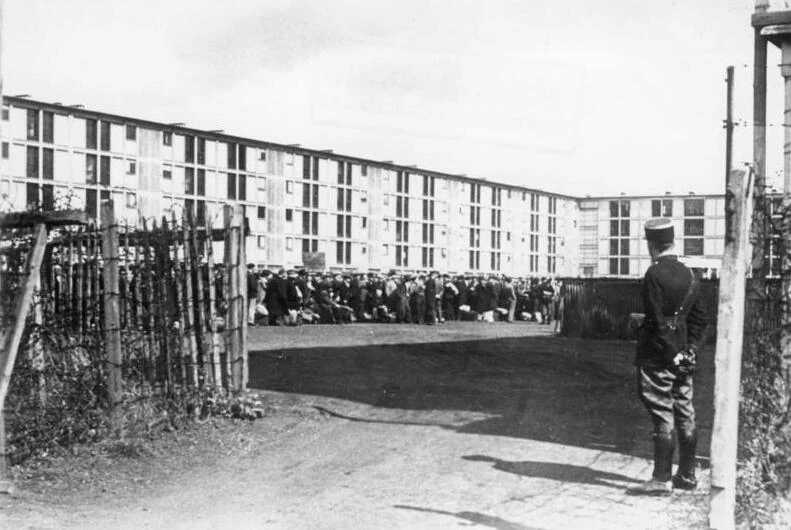
The title A Child of War identifies historical exposure rather than a complete identity. Grothendieck was born five years before his parents left Germany and lived nearly seven decades after 1945. Between 1939 and 1944, state policy classified him in several ways: foreign child, internee, refugee resident, and pupil. War altered those positions without exhausting them.
The phrase is useful only if kept historical. Nazi rule separated the family from Germany. The Spanish Civil War drew his parents away and ended in defeat. The Second World War activated French enemy-alien internment. Vichy intensified exclusion and helped deliver foreign Jews to deportation. German occupation brought direct danger to the southern zone. Relief and resistance networks formed in response. Alexander’s childhood passed through that sequence.
The sequence can tempt a clinical narrative. This chapter does not diagnose him or describe unrecorded psychological mechanisms. A retrospective diagnosis would require evidence and professional judgment that this account does not have.
Restraint does not minimize harm. It specifies it. At five he ceased living with his parents. At eleven he rejoined them in France. Within months his father was interned. At eleven or twelve he entered Rieucros with his mother. Later sources associate him with a children’s home and the Collège. Schapiro’s post-Le Vernet sequence and the family’s wartime knowledge are not stated because the required evidence has not been inspected. These are documented disruptions with a deliberately open archival boundary.
Three timelines
From 1940 the family’s history is clearest when written on three lines.
On the first, Alexander and Hanka were together at Rieucros. He left for the lycée and returned; she remained an internee. The institution ceased operating in February 1942, followed by a general transfer of the women’s camp. No inspected person-level leaf establishes Hanka’s or Alexander’s later camp movement, any Brens/Gurs sequence, or a release. Their individual line therefore stops at the closure.22Archives départementales de la Lozère, Fonds relatifs au camp de Rieucros; Archives départementales du Tarn, Fonds relatifs au camp de Brens.
On the second, Alexander lived in a Secours Suisse home and attended the Collège Cévenol. In his later account, warnings sometimes sent small groups into the woods, and he read ahead and worked on geometry. The La Guespy note, whose provenance is incomplete, is not used for further personal characterization.33Grothendieck, Récoltes et Semailles (Université des Sciences et Techniques du Languedoc and Centre National de la Recherche Scientifique, 1986), 14–15; “Note by the director of the La Guespy children’s home on Alexander Grothendieck”.
On the third, Schapiro’s line stops at Le Vernet. The checked Klarsfeld/Stroweis online memorial/index reports later transport and fate fields under the linked Schapiro/Tanaroff names. The Arolsen item inspected for this account is a collection description rather than the exact person leaf, and no underlying death record has been opened or documented. This edition therefore does not adopt his transfer sequence, convoy, dates, destination, arrival, or death as archival fact.44Klarsfeld and Stroweis, “Mémorial de la déportation”; Arolsen Archives, “Deportation Lists from France”.
The timelines do not include a family-knowledge band. No contemporaneous family record or official notice has been inspected, and a retrospective account cannot fix what Alexander or Hanka knew, when they knew it, or how they responded.
This evidentiary limit affects phrasing. The chapter records Schapiro’s absence after internment and Alexander’s attributed school association without supplying a parallel fate or notification chronology.
Hanka’s line also ends at Rieucros’s closure. General finding aids establish the institutional transfer, not her movement. A timeline must not draw even a dotted person-level route from conflicting secondary or retrospective references.
His father in memory
Schapiro’s life before Alexander’s birth was already marked by imprisonment, revolution, exile, aliases, and physical injury. Grothendieck later studied his parents’ papers intensely and wrote about his father with admiration and judgment. He emphasized solidarity with poor and dispossessed people, literary gifts that went unrealized, revolutionary courage, and failures of self-knowledge. Those assessments belong to the son’s mature moral project.55Grothendieck, La Clef des Songes (1987), 88–94; Winfried Scharlau, Wer ist Alexander Grothendieck? Anarchie, Mathematik, Spiritualität, Einsamkeit. Teil 1: Anarchie (Books on Demand, 2011).
For the child, the father was first present, then absent. Jackson reports that the Blankenese household received no word from Schapiro, but the underlying correspondence record has not been checked for this account and does not meet the corroboration needed for an unqualified claim. The documented reunion in 1939 was brief, and no inspected source proves contact after internment or a final meeting date. To construct Schapiro as the commanding ideological teacher of Alexander’s childhood would ignore absence. To construct him as irrelevant would ignore the father’s later place in his son’s thought and surroundings.
For years, colleagues recalled, a portrait of Schapiro hung in Grothendieck’s office. It had been painted by a fellow detainee at Le Vernet. Pierre Cartier described a shaved head and intense eyes; Grothendieck himself also shaved his head for long periods. The object crossed from the father’s confinement into the son’s later workplace. Its current provenance does not establish when Grothendieck received it or what significance he assigned to it.66Jackson, “As If Summoned from the Void, I”.
Persecutory databases restore one kind of presence while reducing a person to fields. The checked Klarsfeld/Stroweis memorial/index links Schapiro to Tanaroff, but that index witness cannot replace the missing original person leaf or establish a final movement for this edition. It does not contain the revolutionary life, relationships, literary ambition, or fatherhood.
There is an ethical risk in converting a database field into a narrated end. Until the field’s person-level documentary basis is inspected, the edition excludes it and supplies no transfer, arrival, gesture, thought, or final scene.
Hanka after Rieucros
Hanka’s person-level chronology stops at Rieucros’s closure in this edition. No inspected movement or release file establishes her later camp, date, destination, or onward route.
Institutional summaries and retrospective references conflict or compress this period. They are not used to construct a reunion or to bridge Hanka’s missing individual record.
The same evidence rule excludes an uncorroborated private medical attribution.
The son’s later writing about Hanka combines praise and severe criticism. Those judgments belong to his retrospective text and cannot serve as independent character evidence. The chapter identifies their source without deciding the family case.
Sixteen
In the 1987 account, Grothendieck places Friedel’s evolution talk in March 1944, shortly before his sixteenth birthday. He describes it as a survey of the cooling Earth, early seas, microorganisms, multicellular life, movement onto land, plants and animals, birds and mammals, and finally human beings. His description, written in 1987, extends across several pages and folds the lesson into a mature account of God, creation, and knowledge.77Grothendieck, La Clef des Songes (1987), 102–6.
Grothendieck’s text identifies Friedel as a believer and says that the lecture changed his own self-description from atheist to deist. This is a single retrospective account, not an independently verified conversion scene.88Grothendieck, La Clef des Songes (1987), 102–6.
The date is unusually precise within the childhood record, but the later account also supplies its interpretation. In that text, Grothendieck distinguishes a creator inferred from living complexity from the personal God of biblical promise and love.
The adult text goes further. Grothendieck rejects an explanation based on chance alone and treats creative intelligence as evident. Modern evolutionary biology does not propose chance alone as an agent assembling organisms; it studies variation, heredity, selection, drift, constraint, development, ecology, and deep time. His later account of chance therefore does not represent modern evolutionary theory or constitute a scientific refutation.
That distinction prevents an autobiographical conviction from being silently endorsed as biological fact. Friedel’s exact account is not preserved; Grothendieck reconstructed it after more than forty years through his own spiritual vocabulary. The source supports analysis of that reconstruction, not reproduction of the lecture or separation of every adolescent thought from later elaboration.
Proof and conviction
Grothendieck’s 1987 text compares the certainty he retrospectively assigned to the experience with the certainty of a mathematical proposition established by proof. That comparison belongs to his spiritual autobiography and does not turn the conclusion into a theorem.99Grothendieck, La Clef des Songes (1987), 105.
The comparison belongs at the intersection of his mathematical and philosophical lives. It does not make the theological conclusion a theorem. Mathematical proof operates within explicit definitions, assumptions, and rules of inference. Other trained readers can inspect the steps. Metaphysical interpretation draws on experience, intuition, explanatory judgment, and commitments whose premises may not be shared or formalized.
Consider a mathematical implication:
The symbol means that, under stated premises , a valid derivation yields . Disagreement can concern a premise, a definition, or a step. The proof makes its dependence available.
Grothendieck’s response to evolution had a different form:
- living structure appeared to him extraordinarily intricate;
- the history of life appeared to display coordinated innovation;
- he judged chance inadequate;
- he inferred creative intelligence.
The inference depends on what counts as an explanation and on an incomplete representation of evolutionary mechanisms. Another observer can accept the first two observations and reject the final conclusion. The two conclusions have different epistemic forms.
He used the language of proof because, in the extant text, first-hand certainty organizes both mathematical and spiritual knowledge. He valued the moment when a proposition ceased to be external information and became directly seen. The Mende geometry episode had already supplied a negative image: a teacher unable, in Grothendieck’s judgment, to assess a proof without a book. Friedel’s talk supplied a positive one: an explanation that made an essential relation visible.
The biographer should neither mock nor ratify the equivalence. Its importance is autobiographical: Grothendieck later represented a spiritual conclusion through the force he associated with mathematical proof. His text says that the change of label in 1944 had little immediate consequence.
Religion among rescuers
The retrospective change is set in a region where Protestant belief was publicly connected to aid. Grothendieck’s text had already described pastors, Cimade workers, and local assistance while denying that believers possessed superior human qualities as a class.1010Grothendieck, La Clef des Songes (1987), 100–102.
This skepticism matters because later narratives can make Le Chambon an environment of collective evangelization. Survivor testimony in the Usach dossier describes Jewish observance at La Guespy, which does not support a forced-conversion narrative.1111Comité français pour Yad Vashem, “Juliette Usach, dossier 4186”.
In Grothendieck’s later account, Friedel’s influence came through an extracurricular talk on evolution rather than a demand to accept religious authority. Other private assertions in that source are left out of the narrative because nothing independent corroborates them.
The contrast should not be generalized to religion versus science. Friedel taught natural history and physics. Grothendieck’s inference from evolution would be contested on scientific grounds. The historical point is that a particular believer gave a talk the adolescent found conceptually alive, while a particular mathematics teacher had earlier seemed unable to judge an unfamiliar argument.
La Clef des songes interprets the event from the standpoint of a later spiritual system. The claim that it was a first opening belongs to that later map of his life.
Statelessness
IHÉS later calls Grothendieck stateless; when that status began and by what legal mechanism remain unresolved without the original records.1212Institut des Hautes Études Scientifiques, “The Scientific Heritage of IHÉS”.
Memory without determinism
This account does not infer adult political, relational, or mathematical traits from childhood sequence alone.
A direct causal claim would need evidence beyond sequence. Many displaced refugees did not become mathematicians; many mathematicians who rebuilt foundations were not interned as children. Mathematical ideas emerged from technical problems, existing work, seminars, collaborators, and institutional conditions. Schemes cannot be derived from Rieucros, and topoi cannot be derived from hiding.
The adult Grothendieck himself created continuity by choosing which memories opened Récoltes et Semailles: rhyme and numbers, the rejected proof, the Collège textbooks, questions of measure, and solitary Montpellier work. That authorial construction shows how he wished his mathematical life to be understood: as repeated contact with things at first hand rather than the accumulation of expert instruction.
His spiritual autobiography constructed another continuity: parents’ faith and failure, camp as harsh schooling, religious helpers, Friedel’s lecture, the first breach, and later dreams. Again, the construction is evidence. It does not make the past infinitely malleable, but it means Chapter 11 has two dates at once: March 1944, when an event occurred, and 1987, when he assigned it a place in a spiritual history.
The most accurate formulation keeps both dates visible: in 1987 Grothendieck reported an event in March 1944 and interpreted it as an early change from atheism to deism. No contemporaneous source yet separates the 1944 response from its later meaning.
The scale of persecution
Schapiro was one person subjected to the French internment system and antisemitic persecution. The scale must enter without making him anonymous. The historical system was not a private family tragedy detached from the Holocaust; nor is a person exhausted by a statistic.
The family’s route shows the convergence of persecutions. Schapiro was first vulnerable as an anarchist and foreign detainee, then increasingly as a Jew. Hanka was confined as a German foreigner and political suspect; she was not Jewish. Alexander was confined with her, then sheltered among mostly Jewish children because paternal descent and Nazi/Vichy persecution placed him in danger. Categories overlapped but were not identical.
French and German responsibilities also converged. French authorities built and operated internment camps, classified foreign Jews, and participated in transfers. German authorities directed deportation and mass murder at Auschwitz-Birkenau. Local rescuers and relief workers acted within the same national territory against those processes. “France” cannot serve as a single moral subject.
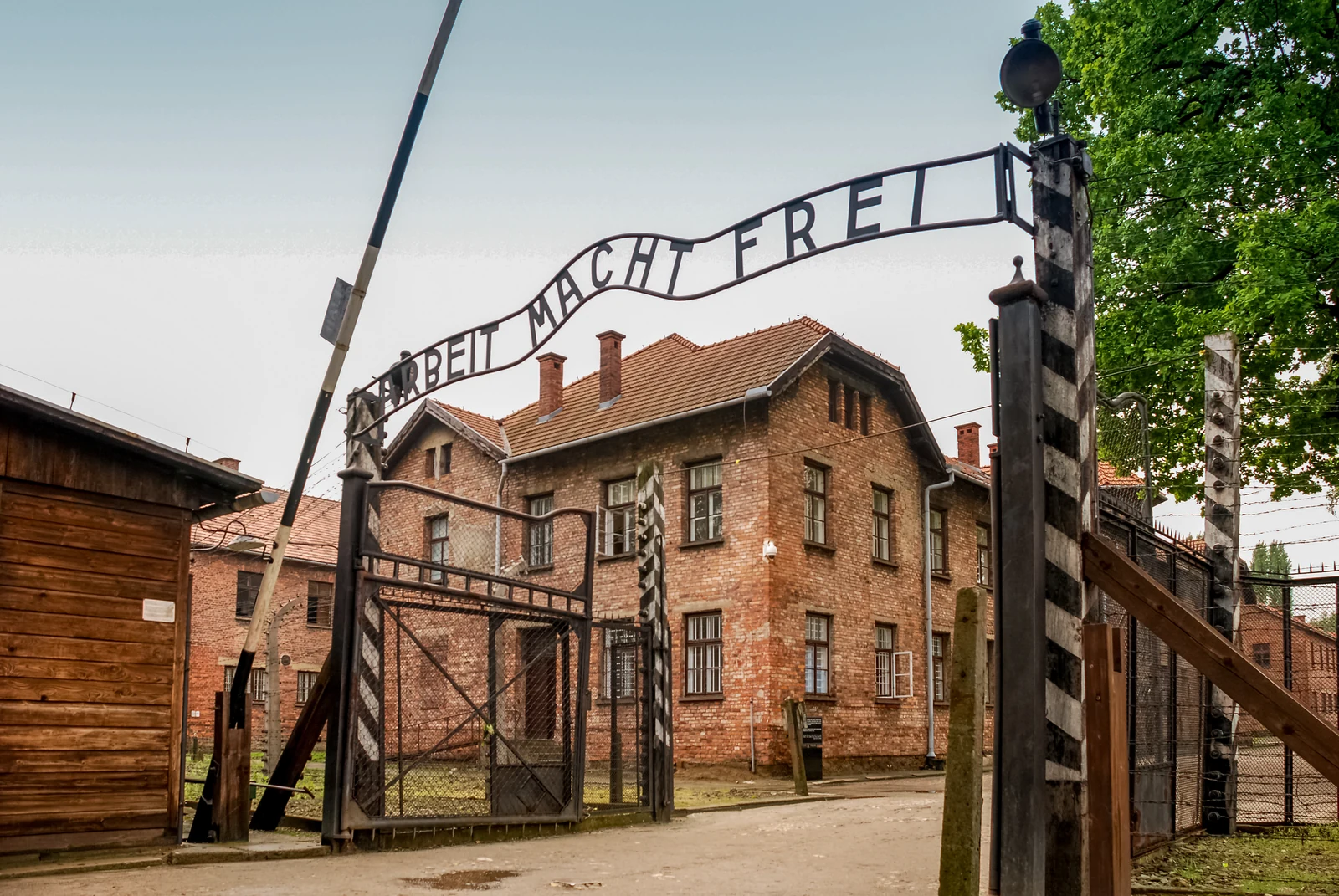
The phrase “child of war” should therefore direct attention outward as well as inward. His experience depended on laws, police, schools, camps, churches, relief groups, railways, and households. A purely psychological account would shrink history to effects inside one famous mind.
What survival did not settle
By 1944 Alexander had survived Nazi Germany, family separation, French internment, and the danger of roundups. Survival did not settle nationality, home, or future study. In Grothendieck’s later account, his deism remained distant from a personal God and had little immediate effect.
The region’s liberation would remove one danger without restoring a prewar life. There was no family home to return to in Berlin. Hanka’s post-Rieucros chronology and Schapiro’s post-Le Vernet chronology remain outside this edition. The Heydorn household belonged to an earlier phase and another country. “Liberation” would mean an opening in political time, not a reversal of biography.
This is why triumphal structure is dangerous. A chapter might move from woods to freedom, ignorance to insight, and child victim to future genius. The evidence instead shows unresolved lines. The woods were a precaution, not a rite. Friedel’s talk opened a question rather than completing a creed. Mathematics problems remained unfinished. The family-knowledge chronology is not supplied.
The future was possible because people had preserved it, but possibility is not resolution. The Collège could prepare him for the baccalauréat. Montpellier could admit him. Neither resolved the legal-status question in the inspected records or undid the camps.
Autobiography as a second event
Grothendieck’s childhood is known chiefly through two extensive later projects with different purposes. Récoltes et Semailles begins from a mathematical life and expands into relations, creation, responsibility, and the ethics of a community. La Clef des songes begins from dreams, God, spiritual knowledge, and family history. The same wartime years appear under different lights.
In Récoltes et Semailles, Rieucros and Le Chambon lead into school mathematics. The road to Mende frames a rejected proof. The Collège frames textbook dissatisfaction and questions of measure. Hiding appears briefly within an account of education. The narrative direction is toward a survey of his work.
In La Clef des songes, the camps belong to an examination of his parents’ faith and failure. Protestant helpers lead into reflection on believers. Friedel’s lecture becomes an early opening toward God. The same teacher who appears in the mathematical memoir as intellectually gifted but overwhelmed appears in the spiritual work as the bearer of a decisive talk.
Neither arrangement is deception. Autobiography selects relations according to its question. A chronological biography uses both and must resist adopting either architecture whole. Mathematics was not the only truth of the camp; spirituality was not the only truth of Friedel.
The late date is a limitation and also permits comparison across his life. Distance allowed Grothendieck to compare events across a life and to study family papers unavailable to the child. It also allowed later convictions to reorganize memory. The proper source label is therefore “retrospective primary”: primary evidence for his testimony and interpretation, not an automatically exact contemporaneous record.
Memory can preserve vivid small facts while altering sequence. Leaking shoes and a poor geometry mark may be accurate because they were repeatedly remembered. Conflicting post-Rieucros references show why person-level movement needs registers. A mature text may round two years or compress transfers.
The form of his writing matters. Grothendieck often adds long footnotes that revise, deepen, or contest the main text. One such note contains a post-Rieucros claim that this account leaves out in the absence of an individual record. A quotation detached from the note can lose qualification.
The works also contain judgments of other people who cannot answer within the text: parents, teachers, colleagues. Quoting those judgments as neutral description would give one witness final authority. This chapter attributes verbs carefully—he remembered, believed, judged, later interpreted.
There is a moral symmetry here. Grothendieck objected to a teacher who, in his memory, judged proof by the book rather than by reasoning. The biographer should not judge his childhood solely by his later book. His account is evidence to examine alongside records, not an authority that abolishes them.
Evolution, chance, and later language
Grothendieck’s reconstruction of Friedel’s talk ranges from the cooling Earth to the first cell, land plants, animals, and humanity. Some details reflect scientific views and timescales available or remembered later; others are expressed through his 1987 cosmology. The passage cannot be treated as a verbatim 1944 lecture.
The scientific concept most in need of clarification is chance. In evolutionary theory, random mutation means that variation does not arise because an organism needs a particular adaptation. Natural selection is nonrandom differential reproduction under environmental conditions. Drift is stochastic change in populations. Developmental and physical constraints limit possible forms. Historical contingency interacts with lawful processes.
Reducing the whole account to chance collapses these mechanisms. A complex adaptation can arise through cumulative selection without each component appearing simultaneously. The first origin of life is a distinct research question from biological evolution after heredity exists. Grothendieck’s later argument blends them in a metaphysical response to order.
This clarification does not establish what Friedel said. A school talk in 1944 may itself have used teleological language or simplified Darwinian theory. Grothendieck says Friedel was a believer and that the talk’s religious perspective enlarged the subject. Without notes, the teacher’s position cannot be separated from the pupil’s reception.
The passage is historically relevant because Grothendieck’s 1987 text treats living form as evidence for creative intelligence. It does not establish that the adolescent used the same explanatory method in biology and mathematics.
Mathematics can prove consequences of definitions without explaining why the world instantiates a structure. Science evaluates models against observation and revises causal accounts. Metaphysics asks broader questions about being, explanation, and purpose. Grothendieck crossed their vocabularies when he described creative intelligence as having the certainty of a mathematical proposition.
His confidence also needs temporal qualification. In 1987 he wrote that the understanding remained with him throughout life without doubt. Such a claim summarizes continuity from the endpoint. Diaries or letters from 1944 onward could test how often he articulated it. No such continuous record has been examined here.
The text reports a limited immediate consequence: a change in self-description without a claim of personal divine intervention in daily events. No contemporaneous statement to Friedel has been located.1313Grothendieck, La Clef des Songes (1987), 105–6.
The absence of a contemporaneous record prevents the narrative from casting Friedel as a conscious spiritual guide.
Family objects after war
The family survived in objects unevenly. Schapiro’s portrait came out of Le Vernet. Letters from earlier decades remained among papers. Hanka wrote an unpublished autobiographical novel. Grothendieck later spent months studying what his parents had left, reconstructing choices made before his birth and during his absence.
These objects changed the available record. Later letters and papers allowed Grothendieck to compare childhood chronology with documents about decisions made by adults. The archive added evidence unavailable during childhood and did not serve as simple confirmation of retrospective memory.
Objects also carry survival bias. Papers preserved by Hanka or Grothendieck represent what was kept, not the whole relation. Maidi’s perspective is less present in this part of the archive, although the 1933 separation affected her too.
The biography must not use Alexander’s later fame to turn family papers into supporting characters in a genius narrative. Hanka and Schapiro had lives and political commitments independent of the son’s mathematics. Maidi’s institutional placement and later life deserve their own evidence, not a passing function as “the sister also left.”
The 2017 Stolpersteine at the Berlin address perform another archival act. They place names in public space and connect separate fates to a household. Their small scale resists monumental abstraction, but captions must not imply that every biographical detail engraved is uncontested. Memorial objects summarize research available at installation.
A three-object documentary spread—Schapiro’s transport line, the La Guespy note, and a postwar student record—could show how institutions described family members. It should be accompanied by prose explaining that persecutory, protective, and educational records had different purposes. Visual similarity among forms must not imply moral equivalence.
Adolescence, not archetype
Alexander entered Le Chambon at about fourteen and turned sixteen in March 1944. The terms child and adolescent should both be used with their institutional meanings clear: relief records treated him as a child, while his secondary schooling documents adolescent capacity and dependence.
The La Guespy note and the separate personal material in Grothendieck’s account of Friedel are not independently corroborated. Their claims about character, sexuality, friendship, and emotion are therefore left out of this account. Grothendieck’s criticism of classmates remains visibly attributed to his later memoir rather than treated as a fact about them.
Uncertainty as a lived condition
Uncertainty in this history is not only a modern research gap. It also shaped action under persecution. The duration of danger on the Plateau was unknown. A warning indicated a possible raid without revealing exactly what would happen. Postwar residence and documentation were unsettled.
Historical writing often resolves uncertainty too soon because the ending is known. Dates in a margin can make events appear as a path. No inspected source shows that the Heydorns anticipated French internment or that La Guespy staff possessed complete warning information.
This does not mean people knew nothing. Refugees assessed danger, organizations gathered information, and officials made plans. Uncertainty coexisted with practical knowledge. Small-group hiding was an action under incomplete information, not blind panic.
Schapiro’s later chronology is the most consequential evidence boundary. The narrative neither supplies the missing person-level route nor constructs what relatives knew or how they responded.
Uncertainty also structures the belief account. In his 1987 text, deism supplies an explanation of creative intelligence while leaving divine involvement in present life unresolved.
In mathematics, uncertainty takes another form: proof can transform an open problem into a justified conclusion. No source connects that structure psychologically to wartime uncertainty.
Missing individual records limit what this account can claim; they do not prove any person’s contemporary knowledge. General transfer files and database fields cannot be promoted into family routes.
A synchronized timeline can encode these layers with separate symbols: a solid line for an event established now, a shaded field for knowledge reported by the subject, and a dotted line for present research uncertainty. Such design would make epistemology visible rather than burying it in notes.
What “child of war” can mean
The phrase can mean a child whose development occurred during war, a child displaced by war, or a child directly targeted by its regimes. Alexander fits all three in different measures. The Nazi racial state endangered him through his father; French policy interned him as a foreign child; rescue networks protected him from deportation.
It should not mean that war owns the explanation of his adult life. He also inherited parents’ political cultures, German and French education, individual curiosity, relationships, and postwar mathematical institutions. Causal plurality is not evasiveness; it is the form of a life.
The phrase can also connect him to a generation without making his route representative of every child sheltered on the Plateau.
His survival imposes an archival responsibility rather than a redemptive plot. Records should name the systems that endangered him and the people who helped. Gaps should remain gaps. Later achievement should not be used to claim that suffering had a purpose.
The ethics of interpretation
Interpretation is unavoidable. Choosing “abandonment” or “placement,” “refuge” or “hiding,” already frames an event. The ethical requirement is not neutrality without words but traceability: readers should be able to see which source supports the event and whose judgment shapes the term.
Grothendieck himself used severe language for his parents. The book can quote it in short, verified form when necessary, but should not adopt it as prosecutorial voice. Hanka and Schapiro cannot be reduced to defendants in their son’s spiritual autobiography.
The reverse is equally important. Biographers sympathetic to revolutionary commitment should not explain away the effect on children. Political context makes choices intelligible; it does not erase consequence.
Interpretation of rescue needs similar balance. Calling Le Chambon heroic can honor risk and obscure uneven participation. Calling the story a myth can correct simplification and sound as if documented rescue did not happen. Specific verbs are safer than total labels.
Mathematical interpretation carries its own temptation. Later work makes early questions appear destined. The chapter uses “continuity” only when Grothendieck’s own retrospective arrangement supports it and marks where analogy stops.
Spiritual interpretation is most delicate because La Clef des songes speaks with conviction about God, reincarnation, dreams, and his parents’ inner states. These claims are part of his life of thought. They are not independent evidence for supernatural causation or another person’s unspoken mind.
The biography’s voice therefore moves among four modes:
- archival assertion: a dated record establishes an event;
- attributed testimony: Grothendieck or another witness remembers;
- contextual inference: historical conditions make a limited conclusion reasonable;
- open interpretation: the narrative proposes a theme and states its limit.
Keeping the modes visible is especially important when the subject wrote with unusual authority and scale. Literary force does not change source type.
Politics inherited and revised
Alexander inherited anti-authoritarian politics as family history rather than a coherent childhood curriculum. Schapiro and Hanka were anarchists; the Heydorns opposed Nazism through Christian humanism; Le Chambon joined pacifism, Protestant conscience, and multiple resistance forms.
Later Grothendieck became a forceful critic of militarism, nuclear danger, ecological destruction, and scientific institutions. Childhood war plainly belonged to the life from which those positions emerged. Exact causal claims require his later writings on why he acted.
It would be too simple to say he “inherited his father’s anarchism.” He entered elite research institutions, exercised intense intellectual authority, and later criticized revolutionary ideologies as well as states. His politics developed through postwar events, Vietnam, 1968, IHÉS funding, and Survivre et Vivre.
No wartime declaration by Grothendieck supports a claim that his later pacifism came from the Collège. The chapter therefore records political contexts without constructing an inherited synthesis.
This chapter records the materials, not a finished synthesis of their psychological effect.
Counterfactual restraint
Scharlau observed that Grothendieck’s survival was not assured, but no source permits calculation of a personal probability or ranking of a single saving act. The records instead identify stages: departure from camp, reception by a children’s home, school attendance, warnings, and liberation.
Nor should the book imagine the mathematics “lost to the world” had he died. That language values the child through future output and turns countless other murdered children into unnamed lost potential. The primary moral loss would have been his life.
The verified facts are institutional: people received refugee children and warnings sometimes prompted concealment. This account does not quantify the counterfactual.
Three political biographies
It is easy to narrate the family as a unit persecuted by war. Their political positions and vulnerabilities were not identical.
Jackson and the Berlin memorial describe Schapiro as a Russian Jewish anarchist and stateless foreigner known to police through revolutionary activity and Spain. Political internment and antisemitic persecution converged in that account. His alias complicates archival recovery.1414Jackson, “As If Summoned from the Void, I”; Koordinierungsstelle Stolpersteine Berlin, “Alexander Schapiro”.
Scharlau and Grothendieck’s later account describe Hanka as coming from a German Protestant family, breaking with its conventions, joining radical circles, and supporting the Spanish struggle. French authorities confined her as a German foreigner and political suspect. She was not targeted through the same Jewish classification as Schapiro, though her partnership and family placed their histories together.
Alexander inherited consequences without having chosen either politics. French authorities attached him to Hanka for internment. Nazi and Vichy antisemitism endangered him through his father. Grothendieck later connected some camp aid contacts with his mother’s Protestant background.
These distinctions matter because “political family” can imply shared doctrine. A five-year-old did not consent to anarchism by parentage. A teenager may have formed views, but the evidence does not provide a wartime manifesto.
The distinctions also prevent retrospective national sorting. Schapiro’s birthplace is now located in a border region whose state names changed. Hanka’s German origin did not make her Nazi. Alexander’s German birth did not make French internment protective. National adjectives must be attached to legal or geographic claims, not character.
Grothendieck’s later text joined the three lines by interpreting both parents’ revolutionary faith. That mature family philosophy belongs to the extant work, not to the documented consciousness of 1944.
The limit on psychological claims
The evidence consulted does not support a direct claim about the psychological effect of repeated separation. Jackson relays Grothendieck’s later treatment of abandonment, but the underlying pages and an independent contemporaneous source were not checked for this account. The body therefore records the separations and attributes later judgments without using psychoanalytic or clinical language to connect them to adult behavior.
Character beyond the evidence
The Heydorn memoir has not been directly inspected, and the La Guespy note lacks complete provenance and independent corroboration. Both contain personal descriptions, but neither is secure enough to support a portrait of his childhood character. Grothendieck’s own later claims about intellectual appetite remain attributed memories. This account does not combine those records into labels such as independent, difficult, fearless, nervous, or solitary.
Missing voices
This chapter is dominated by Grothendieck’s later voice because his writings survive and are accessible. The family and school were not silent in life; they are uneven in the available record.
Hanka’s letters and unpublished novel could correct or complicate her son’s judgments. Schapiro’s surviving fragments could restore his own account of revolution and fatherhood. Maidi’s records could show how the separation looked from the sibling placed in Berlin. The Heydorns’ memoir provides a foster-household view but still requires direct page inspection.
At La Guespy, the directress’s note and survivor testimonies create other perspectives. Collège classmates and Friedel’s papers could answer the school portrait. Camp women’s memoirs could place Alexander’s unusual lycée access within collective life.
Seeking these voices is not a ritual demand for false balance. Some actors had more power; some claims are better documented; a persecuting official’s report does not morally balance an inmate’s testimony. The purpose is to distinguish perspective from fact and recover relations.
The absence of Schapiro’s later voice is absolute in another way. Persecutory records contain administrative fields, not what he thought. No narrator should fill that silence. The limit is part of the biography’s witness.
Translation adds another filter. Hanka’s principal papers are German; Schapiro wrote in Russian and other languages; Alexander’s mature account is French; this account is English. Tone and family vocabulary can change at every crossing. Direct quotations require original-language verification, not translation from a translation.
Names are part of voice. “Sascha,” “Sasha Piotr,” “Schapiro,” and “Tanaroff” belong to different relations and records. Editorial standardization should help readers follow him while allowing each source to retain its form.
A later discovery may change chronology or challenge motive rather than add color alone. An account of these years must remain revisable until those collections are checked.
A chronology of event and knowledge
The family chronology becomes clearer when event date is separated from the date and position of the surviving source. The 1933 placement is described in late autobiographical writing and researched biography. Grothendieck’s manuscript dates the Paris reunion to May 1939. The early 1940 internment is remembered by Grothendieck and situated within a documented French camp system. These claims concern events that occurred before the principal first-person texts were written by roughly four decades. The distinction matters. These claims concern events that occurred before the principal first-person texts were written by roughly four decades.
Schapiro’s post-Le Vernet chronology has a different evidence structure. The checked Klarsfeld/Stroweis memorial/index reports person-level transport and fate fields; the Arolsen collection description establishes only the existence of grouped French deportation lists. The exact Schapiro/Tanaroff leaf and the record underlying the death field remain unopened, so the edition excludes the sequence and makes no family-knowledge claim.1515Klarsfeld and Stroweis, “Mémorial de la déportation”; Arolsen Archives, “Deportation Lists from France”.
Hanka’s post-Rieucros chronology belongs to another excluded category. General finding aids establish institutional history, not her person-level movement or release. The edition adopts no date, camp, destination, or onward route.
The Friedel talk is still more sensitive. Grothendieck dates it to March 1944 and assigns it a place in his religious development in a manuscript written in 1987. No lecture notice, school diary, Friedel paper, or independent pupil account has been located. The text is strong evidence for Grothendieck’s later spiritual self-interpretation and incomplete evidence for the precise 1944 event.
Private matters, attributed
Three subjects in this chapter are private and sensitive: family separation and its psychological effect, Grothendieck’s religious experience, and descriptions of his character in the Heydorn and La Guespy records. None has the independent corroboration that an unqualified statement would require.
This account therefore separates event from effect. The placement at Blankenese and later camp separations are narrated as movements. Their psychological consequences are not diagnosed. Grothendieck’s later moral language is identified as his judgment rather than adopted by the narrator.
The private medical attribution concerning Hanka is excluded. No symptom, diagnosis, causation, caregiving, employment, or household role is inferred from it.
The religious account is analyzed as an extant text. Its argument can be summarized in the present tense, and the reported 1944 event remains in attributed past tense. Neither Grothendieck’s certainty nor the narrator’s explanation can substitute for corroboration of the lecture.
The La Guespy note presents the sharpest provenance problem. Its public copy names Grothendieck and lists personal traits, but the author, exact date, holder, and original object are missing. Until those fields and an independent source are secured, the note can guide research and image discovery but cannot define the adolescent’s character.
These restrictions reduce narrative intimacy and increase accuracy. They also leave a clear research path: locate the Heydorn pages and letters, Hanka’s person-level files, La Guespy’s intake and staff records, Friedel’s papers, and testimony from another pupil. Even then, relevance and harm would have to be weighed before any private detail could be told.
Visible exclusion is part of that protection. The post-Rieucros route, release date, medical attribution, and La Guespy character material do not appear as biographical conclusions. The religious change remains the attributed argument of Grothendieck’s 1987 text.
Independent corroboration must also be independent in fact. Two biographies that repeat Grothendieck’s memoir do not create a second witness. A memorial page that cites Scharlau and a biography that cites the same family interview belong to one dependency chain.
Corroboration alone would not settle the question. Medical, religious, and family material must pass relevance, necessity, and harm-minimization tests. Historical availability does not by itself justify publication.
The minimum-necessary rule matters especially here because the chapter’s purpose is historical and intellectual, not clinical. A private detail belongs only if it clarifies internment, education, or Grothendieck’s documented later thought. Curiosity about temperament or family pain is not an independent reason to publish it.
Where evidence is insufficient, omission is not concealment. This keeps future research possible without converting an uncertain private claim into narrative atmosphere.
The same discipline applies to translation. A French phrase may be accurately transcribed and still have an unverified English rendering. The phrase is therefore not quoted.
Source distance should also appear in the notes. A 1987 manuscript recalling 1944 needs both dates; a postwar memorial database needs its underlying transport list; an undated home note needs provenance before personal descriptors return. Readers should not have to infer these differences from bibliography alone.
This layered notation still permits the chapter to discuss memory without treating memory as error. A later account can preserve an event, interpret it, and compress it at the same time. Corroboration determines which function supports each sentence.
Names across the three timelines
Names provide another way to distinguish event, record, and later memory. A memorial links Schapiro and Tanaroff in one individual entry, but alias linkage alone does not prove the later person-level sequence. The reasons and emotional meanings attached to each usage require separate sources.
Alexander appears under family, German, and French forms. Schurik belongs to reported family usage; Alexander is the English and German public form used in this book; Alexandre appears in French records and titles. Grothendieck is the stable narrative surname, while any future facsimile must preserve the spelling on the object.
The La Guespy note illustrates the risk of allowing one field to answer too much. Its uncertain nationality wording is evidence of how one home recorded him, not a legal determination of citizenship or a complete account of identity. A university file may later record another category. The differences should be compared rather than silently normalized.
Names also determine whether records can be found. A search only for Grothendieck would miss a father recorded as Tanaroff; a search only for Schapiro could miss transliteration variants. The authority file therefore needs aliases, original spellings, dates of use, and source-specific forms.
This documentary care limits symbolism. A changed name does not by itself prove a changed allegiance, hidden self, or psychological break. It proves that different relationships and administrations used different forms. The biographical consequence lies in traceability and legal treatment.
What the 1944 record can and cannot close
By the close of 1944, the regional political situation had changed, but four personal lines remained incomplete for this account. Hanka’s post-Rieucros record and Schapiro’s post-Le Vernet record were not established by the required person-level documents. The Collège enrollment and eventual baccalauréat lacked registers.
The Friedel account adds a fifth line of a different kind. It supplies a precise month and a mature spiritual interpretation, but no contemporaneous witness or document. It can anchor analysis of La Clef des songes and cannot yet anchor an independently verified scene.
Closing the chapter with those limits avoids two false resolutions: liberation as the restoration of family and religious change as the completion of a creed. The available evidence supports a change in political conditions, continued schooling, and several retrospective claims awaiting direct records.
Open records
By the end of 1944, German and Vichy power on the Plateau had receded. This edition leaves Schapiro’s later journey and the family’s knowledge unstated.
Hanka’s person-level chronology remains closed at Rieucros’s institutional end. Grothendieck described his own schoolwork as continuing. In his 1987 text, he applied the label deist to his reported 1944 position.
The synchronized timeline closes with two person-level archival gaps and Grothendieck still in school. The reported 1945 transition to university occurred without a homecoming.
注释
- Grothendieck, La Clef des Songes (1987), 102–6. ↩
- Archives départementales de la Lozère, Fonds relatifs au camp de Rieucros; Archives départementales du Tarn, Fonds relatifs au camp de Brens. ↩
- Grothendieck, Récoltes et Semailles (Université des Sciences et Techniques du Languedoc and Centre National de la Recherche Scientifique, 1986), 14–15; “Note by the director of the La Guespy children’s home on Alexander Grothendieck”. ↩
- Klarsfeld and Stroweis, “Mémorial de la déportation”; Arolsen Archives, “Deportation Lists from France”. ↩
- Grothendieck, La Clef des Songes (1987), 88–94; Winfried Scharlau, Wer ist Alexander Grothendieck? Anarchie, Mathematik, Spiritualität, Einsamkeit. Teil 1: Anarchie (Books on Demand, 2011). ↩
- Jackson, “As If Summoned from the Void, I”. ↩
- Grothendieck, La Clef des Songes (1987), 102–6. ↩
- Grothendieck, La Clef des Songes (1987), 102–6. ↩
- Grothendieck, La Clef des Songes (1987), 105. ↩
- Grothendieck, La Clef des Songes (1987), 100–102. ↩
- Comité français pour Yad Vashem, “Juliette Usach, dossier 4186”. ↩
- Institut des Hautes Études Scientifiques, “The Scientific Heritage of IHÉS”. ↩
- Grothendieck, La Clef des Songes (1987), 105–6. ↩
- Jackson, “As If Summoned from the Void, I”; Koordinierungsstelle Stolpersteine Berlin, “Alexander Schapiro”. ↩
- Klarsfeld and Stroweis, “Mémorial de la déportation”; Arolsen Archives, “Deportation Lists from France”. ↩