Two dates on a seminar page
The first page of Grothendieck’s second exposé in the 1956–57 Cartan Seminar carries two dates: February 4 and 11, 1957. Below the title Sur les faisceaux algébriques et les faisceaux analytiques cohérents, its opening sentence states a purpose—to generalize certain theorems of Serre—and an obligation—the essential use of Serre’s techniques.11Grothendieck, “Sur les faisceaux algébriques et les faisceaux analytiques cohérents,” 2–01.
The surviving object is a written seminar text, not a transcript. It does not reveal how Grothendieck stood at a blackboard, which passages filled each day, or what questions came from the audience. It records how he framed the work when it entered the seminar archive. Serre’s results were the explicit point of departure, not background to be made invisible.
By then Grothendieck had returned from Kansas and again held CNRS support, spending most of his time in Paris. The Tôhoku work written in 1955 was appearing in print during 1957. Cartan and Eilenberg’s Homological Algebra had been published in 1956. Serre’s FAC and GAGA had established coherent sheaves and their cohomology as working tools in algebraic geometry. The February exposé brought these currents together.22Jackson, “As If Summoned from the Void, I,” 1044–45; Cartan and Eilenberg, Homological Algebra; Serre, “Faisceaux algébriques cohérents”; Serre, “Géométrie algébrique et géométrie analytique”.
The language of functors did not enter as a philosophical preface. It appeared in definitions and proofs. In the abelian sheaf categories used here, enough injectives made right-derived constructions available. Global sections and direct image are left exact in the relevant settings; their right derived functors define cohomology and higher direct images. When the composite-functor acyclicity hypotheses hold, these constructions yield Grothendieck’s spectral sequence. Natural maps compared algebraic sheaves with associated analytic sheaves. A theorem could be formulated as the assertion that one of these natural maps was an isomorphism.33Grothendieck, “Sur les faisceaux algébriques et les faisceaux analytiques cohérents,” sec. 3.
A language begins here when inherited words become the shortest faithful way to state the mathematics.
Serre’s coherent sheaves
An algebraic variety can be described locally by polynomial equations. Its regular functions form rings on open subsets. A sheaf of modules over the structure sheaf allows algebraic data to vary across the variety. Among all such sheaves, coherent sheaves satisfy a finite-presentation condition stable enough for kernels and cokernels in noetherian settings.44Serre, “Faisceaux algébriques cohérents”.
Serre’s 1955 paper Faisceaux algébriques cohérents, universally abbreviated FAC, related coherent sheaves on affine varieties to finitely generated modules, proved finiteness and vanishing results in projective geometry, and developed algebraic sheaf cohomology.55Serre, “Faisceaux algébriques cohérents”; Serre, “Faisceaux algébriques cohérents,” 197–278.
The importance of coherence is easy to miss when every later text assumes it. Arbitrary sheaves can be too large and unstable for finite-dimensional conclusions. Coherence ensures that local relations among finitely many generators are themselves finitely generated. It is a condition allowing algebraic information to be patched without losing finite control.
The category is also closed under the operations exact sequences require. The kernel, cokernel, image, and coimage of a morphism between coherent sheaves remain coherent under the standard hypotheses. Thus an exact sequence does not leave the geometric world one is trying to study. Homological algebra can act internally.
This stability made a new style of theorem possible. Instead of proving a result separately for functions, divisors, and vector bundles, formulate it for all coherent sheaves. Special cases follow by choosing the sheaf. The generality is not decorative: exact sequences let one reduce complicated sheaves to simpler ones and transport results among them.
Grothendieck’s February exposé begins with reminders about coherent modules and their exact behavior. The opening is not a leap away from technical detail. It prepares the category in which dévissage, derived functors, and comparison can operate.
An affine module becomes a sheaf
The affine case gives a concrete anchor for coherent sheaves. Let be a noetherian ring and a finitely generated -module. In modern scheme notation, localization assigns a sheaf on . Over the distinguished open set , its sections are the localized module .66Serre, “Faisceaux algébriques cohérents”.
The construction translates algebra into geometry. If , the sheaf is the structure sheaf. If for , the sheaf is supported at the origin; away from the origin, localization kills it. A submodule gives a subsheaf, a quotient module gives a quotient sheaf, and an exact sequence of modules gives an exact sequence of associated sheaves.
Conversely, the global sections of a quasi-coherent sheaf on an affine scheme recover the module under the standard equivalence. Higher cohomology of quasi-coherent sheaves on an affine scheme vanishes: This is a model case in which local algebra controls the global object.
The projective case supplies the boundary. A coherent sheaf on projective space cannot in general be recovered from one ring of global functions, and higher cohomology can be nonzero. Twisting by and using graded modules restores a controlled algebraic description, but the geometry is no longer affine.
For example, the projective line has while sufficiently positive twists have vanishing higher cohomology. The contrast explains why Serre’s projective finiteness and vanishing theorems were substantive rather than formal consequences of sheaf notation.77Serre, “Faisceaux algébriques cohérents”.
FAC predates the mature scheme terminology used in this explanation. Serre formulated the affine and projective results for algebraic varieties and coherent algebraic sheaves. The modern language is disclosed as a later standard form, not placed silently into the 1955 paper.
Historically, the affine equivalence made coherent sheaves calculable through modules, while the projective theory showed how cohomology measures the failure of a single global module description. Grothendieck’s homological machinery then organized this failure through derived functors.
Biographically, the affine/projective contrast explains why Serre’s work mattered to Grothendieck. It joined concrete commutative algebra to a category of sheaves and supplied the finiteness theorems that a general formalism could extend. The chapter needs the mathematics here because the 1957 exposé explicitly began by generalizing Serre rather than by announcing an autonomous categorical program.88Grothendieck, “Sur les faisceaux algébriques et les faisceaux analytiques cohérents”.
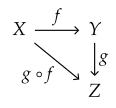
GAGA and a natural comparison
Serre’s GAGA paper, published in the 1955–56 volume of the Annales de l’Institut Fourier and conventionally dated 1956, compares algebraic geometry over the complex numbers with complex analytic geometry. An algebraic variety over has an associated analytic space . An algebraic coherent sheaf has an associated analytic coherent sheaf .
For projective , GAGA proves that this passage preserves cohomology, that morphisms between coherent algebraic sheaves correspond to morphisms between their analytic counterparts, and that every coherent analytic sheaf on arises from a unique algebraic coherent sheaf up to the appropriate isomorphism. The algebraic and analytic categories are equivalent in this proper projective setting.99Serre, “Géométrie algébrique et géométrie analytique”, introduction and §§12–18.
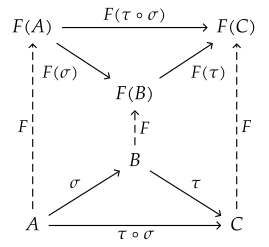
The qualifications matter. GAGA is not a claim that every holomorphic phenomenon is algebraic or that arbitrary noncompact analytic spaces have algebraic models. Projectivity and coherence do work. The theorem’s power comes from stating a precise border across which two languages agree.
The comparison is naturally functorial. A sheaf map induces maps on cohomology. The analytification operation sends algebraic morphisms to analytic ones. The theorem supplies canonical maps and proves that they are isomorphisms, a stronger conclusion than equality of two vector-space dimensions. Naturality ensures compatibility across every sheaf morphism.
This difference separates a structural theorem from a numerical coincidence. If two cohomology groups have equal dimensions, a chosen isomorphism may tell nothing about how constructions interact. A natural isomorphism commutes with maps and can be inserted into larger diagrams. Subsequent arguments may use it without choosing bases.
Serre’s own bibliography cites Grothendieck’s 1955 Kansas report on fiber spaces with structure sheaf. That citation does not assign the GAGA theorems to the report. It confirms that the Kansas work belonged to the literature in which algebraic and analytic bundles, sheaves, and gluing were being compared.1010Serre, “Géométrie algébrique et géométrie analytique”, bibliography (10); Grothendieck, A General Theory of Fibre Spaces with Structure Sheaf.
Grothendieck’s February 1957 exposé sought broader forms of Serre’s comparison and finiteness results. The move was characteristic: identify the exact categorical content, then ask how much of the theorem depends on projectivity, smoothness, or a particular presentation.
Analytification is an operation, not a resemblance
For a complex algebraic variety, the associated analytic space begins with its complex points but changes the topology. Zariski-open sets are large and algebraically defined. The analytic topology has far more open sets and supports holomorphic functions. The regular functions of the variety determine holomorphic functions after analytification, but most local holomorphic functions on a small analytic open set need not be restrictions of global algebraic functions.
This makes GAGA surprising. The analytic category is locally richer, yet on a projective variety its coherent sheaves do not produce extra global coherent objects beyond those coming from algebraic geometry. Projectivity forces a form of global rigidity. The theorem does not identify the structure sheaves on every open set; it proves equivalence at the coherent categorical level and compatibility of cohomology.
The operation must preserve exact sequences to support this conclusion. A presentation of an algebraic coherent sheaf by finite free modules becomes an analytic presentation. Kernels and cokernels correspond. Morphisms analytify.1111Serre, “Géométrie algébrique et géométrie analytique”.
These categorical words state distinct mathematical burdens. A functor is faithful if different maps remain different; full if every map between images comes from a map upstairs; essentially surjective if every target object is isomorphic to an image. Together they give an equivalence of categories.1212Serre, “Géométrie algébrique et géométrie analytique,” secs. 12–18.
The cohomology comparison adds another layer. There is a natural map GAGA proves it is an isomorphism for coherent on projective . The map is constructed before it is proved invertible. This order is characteristic of functorial reasoning: first identify the canonical comparison; then determine the hypotheses under which no information is lost.1313Serre, “Géométrie algébrique et géométrie analytique”, theorem 1 and §§12–18.
A dimension count could not replace the map. Equal finite dimensions would allow some vector-space isomorphism, but not one compatible with sheaf morphisms, cup products, long exact sequences, or subsequent constructions. The natural map carries provenance. It says why the two groups can be identified.
Analytification also illustrates how one object can live in two categories. The algebraic variety is not discarded when its analytic space is formed. A functor connects worlds with different local functions and different open sets. Questions can be moved across the functor when comparison theorems permit. The border remains visible even when a theorem crosses it.
Grothendieck’s 1957 generalization worked within this inherited bridge. His homological machinery could reorganize Serre’s proof, extend statements to broader maps or supports, and identify derived comparison functors. It did not make the analytic side a mere shadow. The strength of a comparison theorem depends on how different the compared categories are.
Finiteness as a geometric theorem
Derived functors exist under broad categorical hypotheses, but their values can be enormous. For a coherent sheaf on a projective variety, cohomology groups are finite-dimensional under Serre’s hypotheses. For a proper morphism, coherence of higher direct images requires a geometric theorem.1414Serre, “Faisceaux algébriques cohérents,” 197–278; Grothendieck, “Sur les faisceaux algébriques et les faisceaux analytiques cohérents”.
This division of labor appears throughout the 1957–58 texts. Homological algebra guarantees . Geometry proves that the resulting sheaves have the finite type required to remain meaningful in algebraic geometry. Projectivity allows reduction to projective space; twists by , finite resolutions, and vanishing theorems make calculations possible. Exact sequences carry the conclusion from generators to arbitrary coherent sheaves.
Properness functions as an algebraic analogue of compactness in many of these results, but the analogy has limits. A proper morphism is defined algebraically through a universal base-change property. Over , the notions correspond in important finite-type settings; over arbitrary fields the algebraic definition still makes sense.1515Borel and Serre, “Le théorème de Riemann–Roch”.
The universal character of properness suits functorial language. If is proper, every base change yields a proper map . The condition is designed to survive change of base. A theorem about proper pushforward can therefore aspire to compatibility in families rather than hold only over one field.
Grothendieck’s later geometry would make “relative” statements—statements about —more fundamental than absolute statements about alone. In 1957 this program was not yet fully published. The finiteness results already exerted pressure in that direction. Coherent higher direct images live on the target and vary with it. A map carries a family of cohomology groups as a sheaf.
Finiteness also makes Euler characteristics possible. If each is finite-dimensional and only finitely many are nonzero, one can define Riemann–Roch calculates this alternating sum through characteristic classes. The move from an individual cohomology group to an Euler characteristic loses information but gains additivity on exact sequences.
The K-group would capture that additivity before taking dimensions. A coherent sheaf maps to its class; an exact sequence becomes an equation. Proper pushforward takes the alternating class of higher direct images. Finiteness and coherence are what keep that class inside the target’s geometric K-group.
Thus the functorial language does not float above finiteness. It tells where finiteness must be proved and how a finiteness theorem propagates through exact sequences and composition. The general machine and the projective calculation are complementary forms of understanding.
Covariant, contravariant, and composed
A functor’s direction is part of its meaning. A covariant functor sends to a map . A contravariant functor reverses direction. The distinction is not notation. Pulling functions back along a map reverses arrows: a function on becomes a function on by composition with . Pushing geometric or cohomological data forward goes with the map under additional conditions.
For sheaves, a continuous map has a direct-image functor from sheaves on to sheaves on . Sections over an open are sections over . The inverse-image functor travels the other way. The tensor product adjusts the coefficients to the structure sheaf on .1616Grothendieck, “Sur les faisceaux algébriques et les faisceaux analytiques cohérents,” sec. 3.
Pullback and pushforward are related by adjunction under the appropriate definitions: naturally in and . An adjunction says that two apparently different mapping problems are canonically the same. It is a categorical version of changing perspective without losing information.
The word naturally carries the theorem. The bijection must commute when either sheaf is mapped to another. Without that compatibility, one has a family of coincidences; with it, one has an adjunction that can generate units, counits, and derived relations.
Grothendieck’s geometric language increasingly organized itself around pairs such as and , then their derived functors. A map of spaces induced a traffic of sheaves and cohomology beyond the relation between point sets.
This did not make every functor exact. Pullback can preserve some exactness and lose other parts depending on flatness. Direct image is left exact but generally has higher derived functors. The language’s value lies partly in locating the failure: flatness controls tensor exactness; controls direct-image exactness.
Variance and the shape of an invariant
The same geometric object can support functors in opposite directions. Ordinary cohomology is contravariant: a map pulls a class on back to . Homology is covariant for suitable maps. Proper maps in algebraic geometry support cycle pushforward; flat maps support a well-behaved pullback.1717Borel and Serre, “Le théorème de Riemann–Roch,” secs. 5–7.
An invariant’s variance is part of its identity. Cohomology requires composable pullback, while pushforward requires conditions such as properness or flatness according to the theory.1818Borel and Serre, “Le théorème de Riemann–Roch,” secs. 5–7.
Some theories are bivariant. They carry products, pullbacks, and pushforwards simultaneously under different hypotheses. Intersection theory later developed this systematically. Grothendieck–Riemann–Roch already depends on the coexistence: K-classes pull back and push forward; Chow classes do likewise; the Chern character must respect multiplication and corrected pushforward.
Variance determines the direction of natural transformations. The functor of points is contravariant in . A map induces a natural transformation from to . Reversing one arrow incorrectly reverses the theorem.
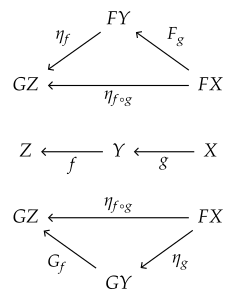
This precision became especially important in correspondence and seminar redaction. Long formulas can conceal a variance error until composition is tested. Diagrammatic notation makes source and target visible. A square that cannot be drawn consistently often signals a malformed construction.
Derived functors add grading without changing the underlying variance. remains tied to a map and is covariant under composition in a derived sense. Ext is contravariant in its first variable and covariant in its second. A duality statement must account for both reversals.
The discipline also has historical force. Classical formulas often compare numbers and therefore hide direction. Replace the number by the functor from which it came, and variance reappears. Grothendieck’s recasting of Riemann–Roch restored the map that the Euler characteristic to a point had concealed.
This is why “language” is not a synonym for terminology. Knowing the word functor is easy. Keeping every construction’s variance, exactness, and composition compatible across a forty-page proof is mathematical work.
Adjunction as an engine
The Hom isomorphism defining an adjunction says that maps correspond naturally to maps when is left adjoint to . This relation produces canonical transformations called the unit and counit. They satisfy triangular identities expressing that moving across the adjunction and back changes nothing essential.1919Eilenberg and Mac Lane, “General Theory of Natural Equivalences”; Marquis, “Category Theory”.
For sheaves on ringed spaces, pullback is left adjoint to pushforward in the standard module setting. The unit maps a sheaf on the target toward the pushforward of its pullback; the counit maps the pullback of a pushed-forward sheaf toward the original sheaf.
An open inclusion gives an elementary example. Restriction to the open subset has adjoints related to extension by zero and direct image, with distinctions depending on the category of sheaves. A closed inclusion behaves differently. The formal position of the functor predicts which limits, colimits, and exactness properties it preserves: left adjoints preserve colimits; right adjoints preserve limits.
This general theorem is useful only when the adjunction has been correctly identified. A functor that looks like pullback but omits the tensor adjustment of structure sheaves may fail to be the desired adjoint on modules. Category theory forces the coefficients into the definition.
Adjunction also explains why universal constructions recur. Free objects, tensor products, and sheafification are characterized by natural mapping relations rather than by the materials used in one construction.
Grothendieck did not invent adjunction, and the February exposé should not be turned into a survey of all later categorical formalism. The relevance lies in a working style. When two operations repeatedly occur together—pullback and pushforward, tensor and Hom—ask for their natural relation. The relation often dictates the correct definition more securely than coordinates do.
Derived functors complicate the picture. A functor may be adjoint before derivation, while its derived versions require resolutions and boundedness conditions. Later Grothendieck duality would express a right adjoint to a derived pushforward through an extraordinary inverse-image functor. That mature six-functor formalism belongs to later parts of the book. The 1957 duality work is one of its sources, not its completed form.
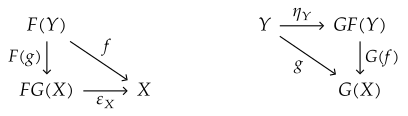
The historical caution clarifies rather than weakens the arc. In 1956–57, pullback, direct image, Hom, tensor product, and derived functors were being aligned. Once the alignments were stable, later theories could add further adjoints and prove compatibilities. A language begins by fixing the grammar in which expansion will be possible.
A base-change square
A cartesian square gives a concrete test of functorial compatibility: The space is the fiber product . It is the family viewed after the base has changed from to .
For a sheaf on , there is a comparison between pulling the higher direct image back to and first pulling the sheaf to , then taking higher direct image: The direction and exact form depend on the sheaf category and hypotheses. The natural map exists before a theorem declares it an isomorphism.
Take to be a point of . The left side becomes the fiber of the higher-direct-image sheaf at that point. The right side becomes cohomology on the geometric fiber under favorable conditions. A base-change theorem identifies them when properness, flatness, and coherence conditions are adequate.
This gives a true use of naturality. A sheaf is intended to encode how fiber cohomology varies across the base. Without base-change compatibility, its stalks may fail to have the expected geometric meaning. The theorem states the conditions under which the intended interpretation is correct.
The boundary matters. Properness alone does not make every base-change map an isomorphism for every sheaf. Nonflat coefficients or jumping cohomology can produce failure. The language does not hide the failure; it supplies the canonical map whose failure can be measured.
GAGA has a comparable form. Analytification produces a natural comparison map between algebraic and analytic cohomology. Projectivity and coherence make that map an isomorphism. In both cases, the construction of a natural arrow precedes the geometric theorem.
The historical terminology must be controlled. The displayed square and modern base-change notation summarize a direction that EGA developed systematically after 1958. They are not attributed verbatim to Grothendieck’s February 1957 exposé. That exposé already used direct images, derived functors, and natural comparisons, which made the later square intelligible.2020Grothendieck, “Sur les faisceaux algébriques et les faisceaux analytiques cohérents,” sec. 3; Serre, “Géométrie algébrique et géométrie analytique”.
The example also clarifies the biographical role of functorial language. Grothendieck’s turn toward relative geometry required more than studying each fiber separately. It required a statement about how constructions behave when the base changes. The move from isolated cohomology groups to a higher-direct-image sheaf is one step in that direction.
The square therefore connects the chapter’s two scales. At the local scale, it compares a stalk with fiber cohomology. At the programmatic scale, it asks every theorem to survive a change of base. The first is a calculable claim under hypotheses; the second became a governing principle of the geometry Grothendieck and Dieudonné began to write in 1958.2121Jackson, “As If Summoned from the Void, I,” 1047–50.
A square that must commute
The basic visual unit of functorial language is a commutative diagram. Suppose are functors and is a natural transformation. For every object , there is a morphism . must commute.2222Eilenberg and Mac Lane, “General Theory of Natural Equivalences,” 231–94.
The equation says that transforming and then moving gives the same result as moving and then transforming. It is the defining compatibility of a natural transformation.2323Eilenberg and Mac Lane, “General Theory of Natural Equivalences,” 231–94.
Examples surround the 1956–57 work. An algebraic sheaf has an analytic counterpart; cohomology of the algebraic sheaf maps to cohomology of the analytic one. A map of sheaves produces a square comparing the induced cohomology maps. Proving the horizontal maps are isomorphisms for every coherent sheaf yields a comparison of functors, not an unrelated list of isomorphisms.
The identity morphism gives the first check. If , both vertical arrows in the naturality square are identities, so the two paths reduce to the same component . For a composite , functoriality requires the large rectangle to agree with the two smaller squares.
These checks appear elementary because they are built into the definitions. Their role is diagnostic: a proposed family of maps that fails either check is not a natural transformation. A basis-dependent isomorphism between each pair of vector spaces can fail even when every individual component is an isomorphism.
In GAGA, the components are comparison maps between algebraic and analytic cohomology. Their naturality permits an exact sequence of sheaves to be compared across the two categories and keeps connecting maps compatible. The theorem’s force lies in this system of maps, not in isolated equality of dimensions.2424Eilenberg and Mac Lane, “General Theory of Natural Equivalences”; Serre, “Géométrie algébrique et géométrie analytique,” secs. 12–18.
The square is also a safeguard against coordinate dependence. Coordinates can be useful for constructing a map, but if the result is natural it survives coordinate changes. Conversely, a formula that cannot be made natural may encode an arbitrary choice rather than geometry.
Naturality does not guarantee uniqueness unless paired with a universal property or other condition. Nor does every desirable mathematical operation form a natural transformation between fixed functors. The language is not an automatic test for truth. It asks a precise question about compatibility.
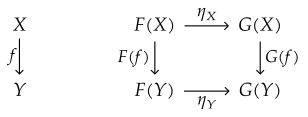
This precision helps explain why Grothendieck’s generality differed from verbal breadth. To say “everything is related” is empty. To exhibit two functors and a natural transformation, then prove its components are isomorphisms under named hypotheses, is a theorem.
A functor is not a metaphor
“Functorial” has become a term of praise, sometimes meaning only that a construction feels canonical. In the mathematics of this chapter it has a testable definition. Every morphism must induce a morphism in the target. Identities must remain identities. Composites must remain composites. If the functor is contravariant, the reversal must be consistent.
These conditions can fail. Choosing a basis and returning its first vector is not functorial on vector spaces because a linear isomorphism need not carry the chosen first vector to the chosen first vector. Choosing one root of a polynomial is not naturally compatible with field automorphisms. Selecting a representative of an isomorphism class generally requires choices that do not commute with maps.
The failures show that a proposed selection contains information absent from the objects themselves. A functorial construction uses only information preserved by the category’s arrows.2525Marquis, “Category Theory,” sec. 1.
This is why canonical maps often matter more than canonical representatives. A quotient may have no preferred system of coset representatives, but it has a canonical projection. A cohomology class may have no preferred cocycle, but maps of spaces induce canonical maps of classes. A derived object may require a resolution, but comparison theorems make its isomorphism class functorial.
Grothendieck’s practice repeatedly traded representatives for maps. The trade can make a theory look less explicit. One loses a formula for “the” chosen object and gains compatibility across every object. Whether that is a gain depends on the problem. For geometry in families, it usually is.
There are also levels of canonicity. An object may be unique up to some isomorphism, up to unique isomorphism, or only up to nonunique equivalence. A universal property often gives uniqueness up to unique isomorphism; moduli problems with automorphisms do not.2626Marquis, “Category Theory,” sec. 1.
In 1957, this hierarchy was not yet expressed through all the higher-categorical terms now available. The discipline of naturality was already sufficient to change theorem statements. It demanded that comparison, duality, and pushforward maps belong to coherent families.
The biographical parallel should be resisted. A life is not a functor, and movement between countries is not categorical base change. The mathematical language can illuminate Grothendieck’s intellectual choices without turning his statelessness into an equation. Functoriality belongs here because it is on the seminar page and in the proofs.
From sections to higher sections
Grothendieck’s February exposé includes a compact development of sheaf cohomology through injective resolutions. Let be a topological space and let be the category of sheaves of abelian groups on . The global-sections functor is left exact. Its right derived functors are the groups .2727Grothendieck, “Sur les faisceaux algébriques et les faisceaux analytiques cohérents,” sec. 3.
For a continuous map , direct image is also left exact. Its right derived functors are sheaves on . Because , the composite-functor spectral sequence gives Leray: 2828Grothendieck, “Sur les faisceaux algébriques et les faisceaux analytiques cohérents,” sec. 3; Weibel, “History of Homological Algebra”.
The exposé’s text explicitly notes that direct image sends injective sheaves to injective sheaves in the situation considered, allowing the spectral sequence to follow. The statement is not a poetic invocation of machinery. It checks the acyclicity condition needed for composition.
This was the Tôhoku language entering an active geometric seminar. The abstract paper and the geometric application were not separate careers. Within months of publication, injective resolutions and derived direct images appeared in a talk whose stated aim was to generalize Serre.
The sequence also rearranged the labor of proof. Instead of constructing a Leray spectral sequence anew for each type of sheaf, invoke the composite-functor theorem after verifying its hypotheses. The geometry moves into those hypotheses and into calculations of . The formal mechanism remains stable.
Stability made further generalization possible. Change the category of coefficients or the notion of space; if the categories have enough injectives and the functors satisfy the conditions, the same spectral sequence exists. The language forecasts extension without asserting that every extension has already been achieved.
Coherent and quasi-coherent
Coherent sheaves provided finiteness. A broader class, quasi-coherent sheaves, allowed algebraic geometry to behave well under localization and arbitrary direct sums. In modern scheme language, a module on an affine scheme gives a sheaf by localization.2929Serre, “Faisceaux algébriques cohérents,” 197–278.
The mature theory of quasi-coherent sheaves belongs to the scheme framework developed around and after 1958. It should not be inserted whole into the February 1957 seminar. Yet the pressure toward it was already present. Homological algebra benefits from categories closed under infinite colimits and containing enough injectives. Coherent sheaves alone may not remain closed under those operations. One often calculates in a larger category and recovers finiteness by theorem.
The later scheme framework calculates in a large ambient category with good formal properties and recovers coherent outputs under finiteness hypotheses. This modern formulation is not attributed to the February 1957 text without qualification.3030Grothendieck, “Sur les faisceaux algébriques et les faisceaux analytiques cohérents,” secs. 3–7.
The strategy separates existence from finiteness. Injective resolutions may require very large sheaves. A finiteness theorem may then show that the cohomology of a coherent input is finite-dimensional or coherent. Demanding that every intermediate object remain small would obstruct the construction; abandoning finiteness entirely would make the geometric conclusion useless.
Serre’s theorems supplied many of the finiteness conclusions. Grothendieck’s homological language supplied a way to organize the large ambient constructions. Their interaction was more fruitful than either a purely finite or purely formal theory.
Dévissage
The French word dévissage literally evokes taking apart. In mathematics it describes reducing an object through exact sequences to simpler pieces and reassembling an extension-stable result.3131Grothendieck, “Sur les faisceaux algébriques et les faisceaux analytiques cohérents,” sec. 2.
Grothendieck’s February exposé contains a dévissage theorem early in its argument. Coherent sheaves supported on subvarieties are organized by dimension and support, allowing induction through quotients.3232Grothendieck, “Sur les faisceaux algébriques et les faisceaux analytiques cohérents,” sec. 2.
Dévissage requires more than a filtration. The invariant or property under study must respond predictably to short exact sequences. Cohomological functors provide long exact sequences. K-groups impose additivity. Euler characteristics take alternating sums. The language determines which form of reassembly is possible.
This method would be central to Riemann–Roch. A coherent sheaf can be resolved by locally free sheaves under smooth quasi-projective hypotheses. Its class in -theory is the alternating sum of the classes in a resolution. Prove a formula on generating cases, then extend by exact-sequence additivity.
Again, chronology matters. The February exposé did not yet publish the full Grothendieck–Riemann–Roch theorem. It displayed a method and category that the theorem would soon use. The later result makes the significance of dévissage visible; it does not move the result backward in time.
Dévissage also reveals that generality and reduction are partners. A general category allows one theorem to encompass many objects. A filtration reduces each object to a manageable set of generators. Generality without generators can be uncomputable; reduction without a stable general language must be repeated case by case.
The calculus of an exact sequence
Take a short exact sequence of coherent sheaves At the level of local sections, the last map need not be surjective over a large open set even though it is surjective on stalks. Applying global sections gives but the final arrow may fail to hit every global section of .3333Grothendieck, “Sur les faisceaux algébriques et les faisceaux analytiques cohérents,” secs. 2–3.
The connecting map sends an unliftable section into . The long exact sequence continues through every degree. This one formal construction permits induction. If the cohomology of two sheaves is known, the third is constrained. If higher cohomology vanishes for generators after twisting, resolutions propagate the result.
The Euler characteristic is additive: The proof uses the long exact sequence and cancellation of dimensions. K-theory abstracts the equation before dimensions are taken: Any invariant defined on sheaves and additive on exact sequences factors through this group.3434Borel and Serre, “Le théorème de Riemann–Roch,” secs. 3–5.
This is why exact sequences became a language rather than a technique. They link local algebra, global cohomology, induction, and characteristic classes. One short sequence can be read at several levels, with functors transporting it into new sequences.
The price is that each functor has an exactness profile. Hom is left exact in one variable and contravariant in the other. Tensor product is right exact and becomes exact when a factor is flat. Global sections is left exact. Proper pushforward on coherent sheaves has higher derived images. A mathematician fluent in the language learns to ask immediately where exactness breaks.
Grothendieck’s generality often consisted in refusing to conceal this profile. If pullback fails to preserve a sequence, name flatness. If pushforward fails, retain all . If a sheaf is not locally free, resolve it. If a singularity blocks duality, replace an ordinary dual sheaf by a derived object. The correction is not patched onto the theorem from outside; it becomes part of the correct statement.
The February exposé shows this calculus at work in finiteness and comparison. The May exposé extends it to duality. The November Riemann–Roch letter would use it to define pushforward in K-theory. Over the year, exact sequences served as joints connecting distinct structures.
Duality through Ext
In May 1957, a few months after the Cartan Seminar talks, Grothendieck presented Théorèmes de dualité pour les faisceaux algébriques cohérents in the Bourbaki Seminar. Its first paragraph dates the results to the winters of 1955 and 1956, says they were inspired by Serre’s algebraic duality theorem, and names projective-space cohomology and Cartan–Eilenberg homological algebra as the proof’s tools.3535Grothendieck, “Théorèmes de dualité pour les faisceaux algébriques cohérents,” 149–01.
Classical duality pairs a vector space with its linear dual. Poincaré duality pairs homology and cohomology degrees on an oriented compact manifold. Serre duality pairs coherent-sheaf cohomology in complementary degrees under its hypotheses.3636Grothendieck, “Théorèmes de dualité pour les faisceaux algébriques cohérents,” secs. 5–8.
Grothendieck’s formulation sought a functorial and derived framework broad enough to handle singular varieties and sheaf Ext. Instead of one pairing written for locally free sheaves, construct derived Hom objects and identify a dualizing object or complex capable of representing the relevant functor.
The mature theory of dualizing complexes developed later; it would be wrong to place its final form in the 1957 exposé. The seminar text nevertheless moves decisively toward it. Ext groups replace ordinary Hom. Spectral sequences relate local and global Ext. Cohen–Macaulay conditions appear in the treatment of singularities. Duality becomes a statement about functors rather than a numerical symmetry alone.
Functoriality is what makes duality usable under maps. A pairing should be compatible with morphisms of sheaves. Trace maps should compose. Restriction and pushforward should interact with the duality transformation according to stated diagrams. The object called “dual” is characterized by the functor it represents.
This last sentence points toward representability, one of Grothendieck’s greatest later themes. In 1957 it is safest to call it a horizon rather than a completed program. The working habit is already present: ask whether a functor of test objects is represented by a geometric or derived object. If it is, a family of groups or maps acquires a single source.
Representability on the horizon
Given an object in a category, the assignment is a contravariant functor to sets. It records all maps from test objects into . The Yoneda principle says, in effect, that an object is determined up to unique isomorphism by this functor together with its natural structure. Maps correspond to natural transformations between the associated Hom functors in the appropriate direction.3737Eilenberg and Mac Lane, “General Theory of Natural Equivalences,” 231–94; Marquis, “Category Theory,” sec. 1.
This statement does not erase . It says the network of every way to probe contains enough information to recover it. In geometry, the probes can be varieties or schemes over varying bases. A -valued point of is a map , rather than an element of a fixed underlying set.
The mature functor-of-points method became central in Grothendieck’s scheme theory and representability work after the period of this chapter. It would be wrong to attribute its full program to the February 1957 exposé. The horizon is visible because the working language already privileges natural families of maps and objects characterized by the functors they represent.
Fiber-space classification offers an early motivation. Suppose isomorphism classes of bundles on vary contravariantly when changes. One can ask whether there is a classifying object such that bundles correspond naturally to maps . In topology, classifying spaces supplied examples. In algebraic geometry, representability often fails or requires a more flexible object. The question itself becomes precise only in functorial language.
Moduli problems have the same form. To each base , assign families of curves, bundles, or other objects over , with pullback along . The future theory of schemes and stacks would make representability a central question.
Duality can also be read through representability. Fix a proper map and a coefficient object. A functor sending a test sheaf to a Hom or cohomology group may be represented by a dualizing object. If represented, all pairings arise from one universal map. Trace and adjunction become parts of the representing relation.
Grothendieck’s 1957 duality exposé does not contain the complete later six-functor answer. It moves from separate pairings toward functors and Ext, seeking an object inside the category whose Hom behavior produces duality.
Representability supplied a criterion for when an idea had become geometry. A set-valued rule may list data, but if a geometric object represents it, the rule acquires coordinates, topology, and universal families. Conversely, failure of representability can expose automorphisms, nonseparated behavior, or missing enlargement of the category.
This criterion would help Grothendieck turn algebraic geometry “relative.” A variety over a field becomes one member of a family over a base. Test schemes vary. Base change becomes unavoidable. The chapter stops before that foundation is built, but the functorial language has already made the need legible.
Duality as a transformation, not a mirror
The everyday image of duality is a mirror: one object has a reversed counterpart. Homological duality is less static. It connects functors of sheaves and degrees, often through a pairing followed by a trace. The compatibility of those maps is the theorem.
For a smooth projective variety of dimension , Serre duality relates, under appropriate hypotheses, the groups as dual spaces. The canonical bundle and the trace on top cohomology supply the pairing. If is not locally free, Ext gives the correct replacement.3838Grothendieck, “Théorèmes de dualité pour les faisceaux algébriques cohérents,” secs. 5–8; Serre, “Faisceaux algébriques cohérents”.
On a singular variety, the canonical bundle may not carry enough information. Grothendieck’s exposé investigated Cohen–Macaulay conditions, local and global Ext, and projective embeddings.3939Grothendieck, “Théorèmes de dualité pour les faisceaux algébriques cohérents,” sec. 6.
The embedding into projective space is auxiliary. One resolves a sheaf by sums of twists of the structure sheaf, computes where cohomology is known, and defines or identifies dual objects. A satisfactory final statement must not depend arbitrarily on the embedding. Functoriality and comparison control that dependence.
The derived viewpoint later compressed the many Ext groups into a derived Hom object and the duality data into an adjunction. In 1957 the full derived-category notation was unavailable; Verdier’s work came later. Grothendieck nevertheless reasoned with complexes, Ext, and spectral sequences in a way that pressed toward the later compression.
This chronology prevents two opposite errors. Grothendieck duality was not complete in May 1957, and the exposé exceeded a classical pairing while still requiring later reformulation.
The episode also shows how functorial language grows by dissatisfaction with its own partial forms. Once duality is seen as a natural relation, unproved compatibilities become visible: composition of trace, behavior under base change, and the correct inverse-image functor. The language generates a program by making missing diagrams explicit.
Serre and Grothendieck: asymmetry without a fable
The correspondence between Serre and Grothendieck does not support a simple division between concrete problems and general theories. FAC and GAGA were conceptual reorganizations, while Grothendieck’s arguments also required projective calculations.4040Jackson, “As If Summoned from the Void, I,” 1044–45.
Serre possessed broad knowledge of the literature and a fast sense for examples. Grothendieck often rebuilt material rather than learn it in inherited order. Serre could point to a theorem and convey why it contained more than its statement. Grothendieck could enlarge the setting until the hidden substance became an architecture.
The February 1957 exposé names Serre’s techniques and the theorems it generalizes. That direct acknowledgment sets the attribution boundary.4141Grothendieck, “Sur les faisceaux algébriques et les faisceaux analytiques cohérents,” 2–01.
The relation also involved correction. Grothendieck’s lack of classical algebraic geometry was real. He asked elementary and advanced questions in the same exchange. Serre’s answers could identify a known fact or direct him toward an open problem.
Nor should the collaboration be idealized as frictionless. The correspondence contains differences of judgment, compressed criticism, and unequal knowledge. A productive mathematical bond need not resemble personal harmony at every moment. What the evidence establishes for this period is sustained exchange and mutual mathematical consequence.
Grothendieck’s later writings contested questions of credit and community, but those disputes do not establish a hidden trajectory in 1956–57. His published texts in this period acknowledge Serre and Cartan–Eilenberg, while Borel and Serre explicitly attributed the new Riemann–Roch results to him.
What formalism cannot supply
Functorial language can organize a theorem but cannot decide it. Finiteness, vanishing, flatness, and properness require geometric proof; a natural transformation may exist and fail to be an isomorphism.4242Serre, “Géométrie algébrique et géométrie analytique,” secs. 12–18; Borel and Serre, “Le théorème de Riemann–Roch,” secs. 7–16.
GAGA is a model. Analytification is a natural functor before the comparison theorems are proved; Serre’s argument uses projective geometry, coherent sheaves, Cartan’s analytic theorems, and cohomology.4343Serre, “Géométrie algébrique et géométrie analytique”, introduction and §§12–18.
The same is true of duality. Ext functors and spectral sequences specify possible relations. The existence of a dualizing object, the trace map, and nondegeneracy of pairings are geometric results. Formalism shows how these results fit together and what consequences follow once they hold.
Formalism cannot choose the level of abstraction automatically. A small category may lack needed colimits or injectives, while a large one may lose coherence or representability. Grothendieck enlarged settings to the extent needed and recovered finite objects by theorem.
Later critics worried that categorical fashion displaced other methods. That debate belongs to a later period, although any dominant language can narrow what practitioners see.
Grothendieck himself still depended on examples supplied by Serre and on calculations in projective space. The general theory did not abolish the concrete. It reordered the relation: calculate generators and local cases; let functoriality and exactness propagate the result.
This balance explains the unusual clarity later witnesses found in his lectures. He could state a formal structure cleanly and recall prerequisites, yet move rapidly because the structure compressed many cases. The testimony chiefly concerns later IHÉS years, so it should not be used to stage the February 1957 talks. It does suggest what the written exposé already displays: formal architecture and technical detail were not separate voices.
The language’s success came from accountable compression. A symbol such as contains a category, a functor, injective resolutions, and a proof of independence. A commutative square contains four maps and an equality of composites. Compression saves repetition only because foundations have been paid for.
A vocabulary that generates questions
Once a functor is named, its adjoints, exactness, derived functors, and behavior under composition become questions. A natural transformation raises the problem of its isomorphism locus and compatibility in larger diagrams.
For a morphism , preservation of coherence, exactness of pullback, and compatibility of higher direct images with base change each require separate hypotheses.4444Grothendieck, “Sur les faisceaux algébriques et les faisceaux analytiques cohérents,” sec. 3; Borel and Serre, “Le théorème de Riemann–Roch,” secs. 2–5.
For analytification, ask whether Hom is preserved, whether every analytic coherent sheaf algebraizes, and whether cohomology commutes. GAGA answers these under projectivity. For duality, ask what functor represents the dual, whether traces compose, and how singularities alter the object.
This generative quality helps explain Grothendieck’s pace. A successful abstraction exposes an array of related problems at once. It also creates the danger of an unbounded program. Every compatibility can demand a theorem; every theorem can require a new foundation.
The February and May 1957 exposés show the early stage of such expansion. A result of Serre is generalized. Its proof requires derived functors. Derived functors suggest spectral sequences. Duality suggests representing objects and trace. Proper maps suggest coherent higher images. These are not unrelated ambitions added to a list; each is adjacent in the functorial grammar.
The grammar also regulates notation across collaborators. If , , , Hom, and Ext have fixed variance and composition laws, a seminar can distribute proofs without losing the whole architecture. Later SGA seminars would rely on this possibility. In 1957 the collective machinery was smaller, but the notation was already becoming shareable infrastructure.
Shareability is not neutrality. The person who chooses the categories and functors shapes the field’s agenda. A language can privilege relative and cohomological questions over explicit equations. Grothendieck’s choices proved extraordinarily fertile, but their fertility should not be confused with inevitability.
Serre’s presence supplied a counterweight. Examples and established theorems tested whether the abstraction retained substance. Cartan’s seminar supplied an audience trained in sheaves and topology. Bourbaki supplied habits of structural exposition. The language grew within institutions and conversations, not from syntax alone.
By the time Riemann–Roch entered, Grothendieck could ask which natural transformation should commute with proper pushforward, a question the older statement did not advertise. It already contains K-theory, characteristic classes, higher direct images, and Todd correction as missing pieces. Formulation becomes a map of the proof.
The next chapter’s theorem is therefore not an application pasted onto category theory. It is evidence that the vocabulary could generate the right hard question and hold all of its answers in one diagram.
When a language becomes teachable
A research language becomes shareable when another reader can reconstruct the definitions, check the arrows, and apply the theorems. Seminar redaction was one mechanism for that transition.4545Grothendieck, “Sur les faisceaux algébriques et les faisceaux analytiques cohérents”, exposé 2; Grothendieck, “Théorèmes de dualité pour les faisceaux algébriques cohérents”, exposé 149.
The Cartan and Bourbaki seminar texts have a compressed style, but they record dates, definitions, numbered results, and references. They make oral work citable. A listener’s understanding becomes a document that can travel beyond the room.
Grothendieck’s February exposé begins with reminders rather than assuming every reader already inhabits the new category. It defines coherence, recalls exact behavior, and introduces derived-functor material before using it. The architecture acknowledges that generalization must provide its own entrance.
Teaching also tests notation. If inverse image and direct image are confused, a student’s diagram will not compose. If analytic and algebraic sheaves use indistinguishable symbols, comparison maps become unreadable. Redaction forces distinctions that rapid discovery may leave implicit.
The process is collective. Seminar organizers choose schedules. Participants ask for missing steps. Redactors turn lectures into text. Earlier papers supply conventions. Later readers find errors or better formulations. The finished page carries more social labor than its single author line displays.
This does not diminish Grothendieck’s control of the architecture. It explains how that control became a school rather than an individual technique. A powerful formalism needs people able to speak it back, criticize it, and extend it.
The first page dates the two sessions to February 4 and 11, 1957; the written exposé gathers them into one archival unit.4646Grothendieck, “Sur les faisceaux algébriques et les faisceaux analytiques cohérents,” 2–01.
EGA and SGA later enlarged this method across volumes and collaborators. In 1957 the more limited principle is already documented: exposition participates in construction, and a seminar can generate a publication.
The biographer also benefits. A dated seminar page can support a chronology where memory cannot. It tells what Grothendieck publicly acknowledged and which machinery he was prepared to teach. It cannot supply tone or private motive. Teachable language leaves exact traces and still leaves the person partly inaccessible.
From objects to morphisms
The language of functors changes the natural subject of a theorem. A property attached to each object may be the shadow of a transformation compatible with every morphism. Once the transformation is identified, the theorem can be asked in families and under composition.
Riemann–Roch provides the decisive example. Grothendieck formulated a compatibility for a proper morphism , with K-theoretic and cycle-theoretic pushforwards mediated by the Chern character and Todd class.4747Borel and Serre, “Le théorème de Riemann–Roch,” secs. 5–7.
That formulation depends on the language assembled here. A proper map induces a functor on coherent sheaves and higher derived images. Composition of proper maps yields a spectral sequence. Exact sequences yield additive relations in the K-group. Characteristic classes form natural transformations. The theorem is a commutative relation among operations.
To say that the theorem is “about morphisms” does not mean varieties disappear. Source and target must satisfy hypotheses; tangent bundles and cycle groups belong to them. The morphism organizes how their invariants interact.
This is the broader philosophical force of functoriality. An isolated object can carry many accidental descriptions. A morphism tests which descriptions survive change. A natural transformation tests which constructions survive every allowed morphism. Mathematical language becomes less dependent on presentation and more accountable to relation.
The accountability is strict. If a square fails to commute, the proposed transformation is not natural. If pushforward fails to compose, the proposed invariant is malformed or missing correction terms. If a comparison depends on a basis, it may not descend to geometry. Functorial language exposes failure and success under the same test.
By the middle of 1957, Grothendieck possessed a machinery that could impose this accountability on a classical theorem. The first Arbeitstagung in Bonn would provide a public setting for the result. A November letter to Serre would outline the proof. A Princeton seminar would turn the outline into a published exposition. The language was ready to be tested by Riemann–Roch.
The test mattered because success on an easy formal example would have shown little. Riemann–Roch carried geometry, topology, characteristic classes, cohomology, and a century of prior meaning. If functorial language could improve its statement without dissolving its content, abstraction had demonstrated explanatory force. The next theorem would not end debate over method. It would make the new method impossible to dismiss as notation alone.
The sequence of chapters also corrects the image of generality arriving before substance. Grothendieck first encountered demanding examples, inherited strong theorems, and learned where existing formulations broke. Only then could a functorial statement preserve what mattered and discard what was accidental. The arrows were powerful because the objects had resisted simpler treatment.
That order remains visible in the sources. FAC precedes the generalization. GAGA precedes the broader comparison. Cartan–Eilenberg precedes Tôhoku’s extension. Hirzebruch precedes Grothendieck–Riemann–Roch. A new language does not abolish these debts; it makes their relations part of the theorem.
The Paris seminars of 1957 record the language as public practice. Their pages preserve dates, acknowledgments, definitions, and applications, without supplying an interior declaration about historical importance.
注释
- Grothendieck, “Sur les faisceaux algébriques et les faisceaux analytiques cohérents,” 2–01. ↩
- Jackson, “As If Summoned from the Void, I,” 1044–45; Cartan and Eilenberg, Homological Algebra; Serre, “Faisceaux algébriques cohérents”; Serre, “Géométrie algébrique et géométrie analytique”. ↩
- Grothendieck, “Sur les faisceaux algébriques et les faisceaux analytiques cohérents,” sec. 3. ↩
- Serre, “Faisceaux algébriques cohérents”. ↩
- Serre, “Faisceaux algébriques cohérents”; Serre, “Faisceaux algébriques cohérents,” 197–278. ↩
- Serre, “Faisceaux algébriques cohérents”. ↩
- Serre, “Faisceaux algébriques cohérents”. ↩
- Grothendieck, “Sur les faisceaux algébriques et les faisceaux analytiques cohérents”. ↩
- Serre, “Géométrie algébrique et géométrie analytique”, introduction and §§12–18. ↩
- Serre, “Géométrie algébrique et géométrie analytique”, bibliography (10); Grothendieck, A General Theory of Fibre Spaces with Structure Sheaf. ↩
- Serre, “Géométrie algébrique et géométrie analytique”. ↩
- Serre, “Géométrie algébrique et géométrie analytique,” secs. 12–18. ↩
- Serre, “Géométrie algébrique et géométrie analytique”, theorem 1 and §§12–18. ↩
- Serre, “Faisceaux algébriques cohérents,” 197–278; Grothendieck, “Sur les faisceaux algébriques et les faisceaux analytiques cohérents”. ↩
- Borel and Serre, “Le théorème de Riemann–Roch”. ↩
- Grothendieck, “Sur les faisceaux algébriques et les faisceaux analytiques cohérents,” sec. 3. ↩
- Borel and Serre, “Le théorème de Riemann–Roch,” secs. 5–7. ↩
- Borel and Serre, “Le théorème de Riemann–Roch,” secs. 5–7. ↩
- Eilenberg and Mac Lane, “General Theory of Natural Equivalences”; Marquis, “Category Theory”. ↩
- Grothendieck, “Sur les faisceaux algébriques et les faisceaux analytiques cohérents,” sec. 3; Serre, “Géométrie algébrique et géométrie analytique”. ↩
- Jackson, “As If Summoned from the Void, I,” 1047–50. ↩
- Eilenberg and Mac Lane, “General Theory of Natural Equivalences,” 231–94. ↩
- Eilenberg and Mac Lane, “General Theory of Natural Equivalences,” 231–94. ↩
- Eilenberg and Mac Lane, “General Theory of Natural Equivalences”; Serre, “Géométrie algébrique et géométrie analytique,” secs. 12–18. ↩
- Marquis, “Category Theory,” sec. 1. ↩
- Marquis, “Category Theory,” sec. 1. ↩
- Grothendieck, “Sur les faisceaux algébriques et les faisceaux analytiques cohérents,” sec. 3. ↩
- Grothendieck, “Sur les faisceaux algébriques et les faisceaux analytiques cohérents,” sec. 3; Weibel, “History of Homological Algebra”. ↩
- Serre, “Faisceaux algébriques cohérents,” 197–278. ↩
- Grothendieck, “Sur les faisceaux algébriques et les faisceaux analytiques cohérents,” secs. 3–7. ↩
- Grothendieck, “Sur les faisceaux algébriques et les faisceaux analytiques cohérents,” sec. 2. ↩
- Grothendieck, “Sur les faisceaux algébriques et les faisceaux analytiques cohérents,” sec. 2. ↩
- Grothendieck, “Sur les faisceaux algébriques et les faisceaux analytiques cohérents,” secs. 2–3. ↩
- Borel and Serre, “Le théorème de Riemann–Roch,” secs. 3–5. ↩
- Grothendieck, “Théorèmes de dualité pour les faisceaux algébriques cohérents,” 149–01. ↩
- Grothendieck, “Théorèmes de dualité pour les faisceaux algébriques cohérents,” secs. 5–8. ↩
- Eilenberg and Mac Lane, “General Theory of Natural Equivalences,” 231–94; Marquis, “Category Theory,” sec. 1. ↩
- Grothendieck, “Théorèmes de dualité pour les faisceaux algébriques cohérents,” secs. 5–8; Serre, “Faisceaux algébriques cohérents”. ↩
- Grothendieck, “Théorèmes de dualité pour les faisceaux algébriques cohérents,” sec. 6. ↩
- Jackson, “As If Summoned from the Void, I,” 1044–45. ↩
- Grothendieck, “Sur les faisceaux algébriques et les faisceaux analytiques cohérents,” 2–01. ↩
- Serre, “Géométrie algébrique et géométrie analytique,” secs. 12–18; Borel and Serre, “Le théorème de Riemann–Roch,” secs. 7–16. ↩
- Serre, “Géométrie algébrique et géométrie analytique”, introduction and §§12–18. ↩
- Grothendieck, “Sur les faisceaux algébriques et les faisceaux analytiques cohérents,” sec. 3; Borel and Serre, “Le théorème de Riemann–Roch,” secs. 2–5. ↩
- Grothendieck, “Sur les faisceaux algébriques et les faisceaux analytiques cohérents”, exposé 2; Grothendieck, “Théorèmes de dualité pour les faisceaux algébriques cohérents”, exposé 149. ↩
- Grothendieck, “Sur les faisceaux algébriques et les faisceaux analytiques cohérents,” 2–01. ↩
- Borel and Serre, “Le théorème de Riemann–Roch,” secs. 5–7. ↩