The arrow beside the object
The characteristic image of the new geometry is not a shape but an arrow:
The scheme is considered over a base scheme . A point of may select a fiber; a map may change the base; properties may belong to the morphism rather than to alone. This notation is now so ordinary that its historical force is easy to miss. It reorganized questions once separated by fields, parameters, and specializations.11Grothendieck and Dieudonné, “Éléments de géométrie algébrique II: Étude globale élémentaire de quelques classes de morphismes”.
The arrow does not mean merely that has been labeled with a ground space. It means that every construction is asked relative to . Products become fiber products over . Dimension can be measured in fibers. Differentials are relative differentials . Smoothness, properness, finiteness, and projectivity become properties of the map. A section is a morphism whose composite with is the identity. The base enters the grammar of every noun.
By December 1959, Grothendieck could use this language freely in a Bourbaki lecture on descent. The first page credits André Weil with introducing descent into algebraic geometry as descent of the base field, restricted there to finite separable field extensions. It credits Pierre Cartier with treating radicial extensions of height one. Grothendieck then argues that schemes, especially rings with nilpotents, reveal the essential identity between the two cases and permit a general technique.22Grothendieck, “Technique de descente et théorèmes d’existence en géométrie algébrique. I. Généralités. Descente par morphismes fidèlement plats,” 299.
This page is a model of attribution and transformation. Weil supplied the earlier method in one setting. Cartier extended it into an inseparable setting. Grothendieck did not erase those origins; he claimed that his broadened language exposed a common form they could not previously state. The resulting theory of faithfully flat descent went beyond both cases. The originality lies in unification, generalization, and systematic use.
The problem of variation
Suppose a polynomial equation depends on a parameter :33Grothendieck and Dieudonné, “Éléments de géométrie algébrique II: Étude globale élémentaire de quelques classes de morphismes”.
For each value , one may study a curve. But the curves do not form only a list. They arise as fibers of the single scheme44Grothendieck and Dieudonné, “Éléments de géométrie algébrique II: Étude globale élémentaire de quelques classes de morphismes”.
The map remembers how equations vary. It can distinguish generic behavior from special behavior. Pulling the family back along a map substitutes a new parameter scheme, not only a new numerical value.
The human problem is to reason about all members at once. The central issues are the smoothness of fibers, extension of a line bundle, constancy of cohomology dimension, descent after scalar extension, and the gluing of compatible local families. Treating each fiber as an isolated object obscures those issues.
The word “family” provides faithful intuition but needs limits. A smooth proper morphism over the complex numbers can sometimes be pictured as continuously varying compact manifolds. An arbitrary scheme morphism may have fibers that change dimension, acquire nilpotents, lose components, or carry residue fields not visible as coordinate points. The total scheme is not generally a fiber bundle, and the map contains more information than the set-theoretic union of its fibers.
The relative viewpoint therefore asks readers to replace one stable image with a diagram. The diagram may feel less geometric at first. In return, it can state operations exactly and survive changes of characteristic.
The base as context
A base scheme acts like mathematical context. Over , an object carries a -structure. Over a parameter scheme, it forms a family. Over , it may connect characteristic zero with every prime characteristic. Over an infinitesimal scheme, it may encode a deformation.55Grothendieck and Dieudonné, “Éléments de géométrie algébrique II: Étude globale élémentaire de quelques classes de morphismes”.
The analogy with context illuminates dependence: change the base and the object can change. It fails if context sounds external or optional. A morphism is data. The same underlying scheme may support different maps to , and relative properties can differ with the map.66Grothendieck and Dieudonné, “Éléments de géométrie algébrique II: Étude globale élémentaire de quelques classes de morphismes”.
For example, has its standard map to . It also maps to itself by , and the relative behavior of that map is not the behavior of the structure morphism. “Smooth scheme” is shorthand that suppresses a base; the precise statement is smooth over something.
The base also controls functions. An -morphism must commute with the structure maps to . An -scheme includes its structure map as mathematical data, rather than as a marginal note. Its morphisms are constrained triangles.
The relative language replaces “absolute” properties when dependence matters, but it does not ban absolute statements. One can define a regular scheme through its local rings. One can discuss connectedness or dimension. The discipline is to know which claims are intrinsic to and which belong to .
Fiber products
Given maps and , the base change of to is77Grothendieck and Dieudonné, “Éléments de géométrie algébrique II: Étude globale élémentaire de quelques classes de morphismes”.
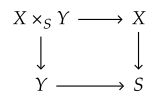
It comes with maps to and making a Cartesian square:88Grothendieck and Dieudonné, “Éléments de géométrie algébrique II: Étude globale élémentaire de quelques classes de morphismes”.
The square has a universal property: any scheme mapping compatibly to and factors uniquely through . This property, not the drawing, defines the fiber product.
In affine form, if , , and , then
The tensor product incorporates changes of coefficients, residue fields, and infinitesimal effects. Because it may contain nilpotents, the scheme category’s willingness to keep them is essential.
For a point , the scheme-theoretic fiber is
where is the residue field. If one wants a geometric fiber, one further extends to an algebraic or separable closure . The distinction matters. A fiber over may be irreducible while its geometric fiber splits; it may be reduced while a purely inseparable extension makes nonreduced behavior visible, or conversely require geometric qualifiers.
Composition and repeated base change behave coherently:
Such canonical isomorphisms make “change the base twice” equivalent to “change it once along the composite.” EGA’s insistence on functoriality turns this expected compatibility into reusable formal structure.
A family is not its fibers
Two morphisms can have isomorphic fibers over every ordinary point and still differ globally. Gluing data may differ. Nilpotent structure on the base may affect the total space. Monodromy may permute components. A torsor can be locally trivial and globally nontrivial. The relative object includes how fibers fit.99Grothendieck and Dieudonné, “Éléments de géométrie algébrique II: Étude globale élémentaire de quelques classes de morphismes”.
Consider a line bundle. On an open cover of the base or total space it may look trivial, but transition functions on overlaps determine a global class. Listing the fiber vector spaces does not recover those transitions. Descent theory formalizes when compatible local objects and isomorphisms glue to a global one.1010Grothendieck, “Technique de descente et théorèmes d’existence en géométrie algébrique. I. Généralités. Descente par morphismes fidèlement plats”.
Similarly, a morphism’s flatness cannot be read as a casual statement that fibers have the same shape. Flatness is an algebraic condition on modules. Under finiteness hypotheses it often controls variation of Hilbert polynomials and prevents certain jumps, which is why it becomes central to moduli. But flat families can still have singular special fibers, and non-flat families can have superficially similar point sets.
The whole relative viewpoint can be summarized as an objection to pointwise reasoning. Fibers are indispensable tests; they are not the entire morphism.
Flatness: continuity without a metric
Let be a ring map. The -module is flat if tensoring with preserves exact sequences. A morphism of schemes is flat at a point under the corresponding local condition, and flat if it is flat everywhere.
For a general reader, flatness is often described as algebraic continuity of fibers. The phrase is valuable because flatness excludes abrupt losses caused by torsion and supports controlled variation. It is dangerous because no metric continuity is involved and because flatness alone does not force fibers to be isomorphic, smooth, or even reduced.1111Grothendieck, “Technique de descente et théorèmes d’existence en géométrie algébrique. I. Généralités. Descente par morphismes fidèlement plats”; The Stacks Project Authors, The Stacks Project (2026), https://stacks.math.columbia.edu, tag 01U2.
The elementary family
shows torsion. The class of is killed by , so the module is not flat over . Away from , the equation forces ; at , the whole affine line appears. A component materializes in the special fiber.
By contrast,
is finite free of rank two as a -module, hence flat. Its special fiber at is a nonreduced doubled point while generic fibers are reduced after suitable field extension. Flatness preserves a numerical size, not reducedness or smoothness.
This distinction matters for Hilbert schemes. A parameter space of subschemes must select families whose Hilbert polynomial remains controlled. Flatness is the condition that makes the assignment functorial and rules out arbitrary vertical components. Grothendieck’s representability theorem would build flatness into the Hilbert functor, not treat it as an aesthetic preference.
Serre, Grothendieck, and their contemporaries did not invent flat modules in this moment. The relative scheme program made flatness geometrically central and joined it to descent. Grothendieck’s December 1959 lecture treated descent along faithfully flat quasi-compact morphisms; in modern initials, the fpqc topology.1212Grothendieck, “Technique de descente et théorèmes d’existence en géométrie algébrique. I. Généralités. Descente par morphismes fidèlement plats,” 299–327.
Smoothness: a property of a map
Serre’s annotation to the October 1958 correspondence notes that the period term for the morphism was later replaced by smooth. The change warns against projecting the finished dictionary backward.1313Grothendieck and Serre, Correspondance Grothendieck–Serre, 73–74.
A modern noncircular criterion says that a morphism is smooth when it is flat, locally of finite presentation, and has geometrically regular fibers. Equivalent formulations use infinitesimal lifting or relative differentials under the corresponding hypotheses. The key word is relative. A scheme may be regular as an absolute object but fail to be smooth over a given field because of inseparability. Conversely, smoothness behaves well under base change.1414Grothendieck and Dieudonné, “Éléments de géométrie algébrique II: Étude globale élémentaire de quelques classes de morphismes”; The Stacks Project Authors, The Stacks Project, tag 01V4.
The infinitesimal lifting picture is especially characteristic. Given a square-zero closed immersion , a smooth morphism locally allows an -map to lift to . The dual-number tests from the previous chapter become probes of a morphism.
An analogy with a road without sudden corners helps little unless qualified. Smoothness here is not differentiability of a plotted curve. It is an algebraic condition that works over arbitrary bases and characteristics. Relative differentials and lifting replace calculus coordinates.
Grothendieck’s program did not simply rename nonsingularity. It disentangled local regularity, geometric regularity, separability, and variation over a base. This disentangling became indispensable in arithmetic geometry.
Properness without compact pictures
Projective varieties over a field behave like compact spaces in several algebraic respects. The relative language sought a property preserving the useful part of compactness without requiring a chosen projective embedding. A morphism is proper if it is separated, of finite type, and universally closed in the standard Noetherian-era formulation, with finite presentation refinements in broader settings.
“Universally” means after every base change. A map is not accepted as closed only over its present base; must remain closed for all . The relative viewpoint builds robustness under change of context into the definition.1515Grothendieck and Dieudonné, “Éléments de géométrie algébrique II: Étude globale élémentaire de quelques classes de morphismes”; The Stacks Project Authors, The Stacks Project, tag 01W0.
The valuative criterion offers a precision window. Under suitable hypotheses, properness says that a map from the generic point of a valuation ring extends uniquely over its closed point. The diagram tests whether a family approaching a limit acquires a unique limit in . This is the algebraic echo of compactness and Hausdorffness together.
The analogy has boundaries. Proper schemes have no metric boundedness, and not every topological compactness intuition transfers. Properness is a morphism property. A scheme is called proper only after its base is understood.
EGA II, published in 1961, systematically studied affine, projective, proper, integral, and finite morphisms, homogeneous spectra, ample sheaves, valuative criteria, blow-ups, and projective closure. Its title—“global elementary study of some classes of morphisms”—announces that morphisms, not isolated spaces, organize the chapter.1616Grothendieck and Dieudonné, “Éléments de géométrie algébrique II: Étude globale élémentaire de quelques classes de morphismes”, contents and §§1–8.
EGA II and the grammar of maps
EGA I established the language; EGA II examined classes of morphisms. The sequence is conceptually exact. Once schemes are admitted, the broad noun no longer hides the distinctions among affine, finite, separated, proper, and projective maps. Those adjectives control which algebraic and cohomological methods apply.
Affine morphisms generalize affine schemes over a base. If is affine, can be recovered as the relative spectrum of a quasi-coherent -algebra. The construction turns an algebra living on into a scheme over .1717Grothendieck and Dieudonné, “Éléments de géométrie algébrique II: Étude globale élémentaire de quelques classes de morphismes”.
Projective morphisms arise from relative Proj and closed immersions into projective bundles. Ample invertible sheaves encode when a scheme has enough homogeneous coordinates. Proper morphisms widen the class while retaining universal closedness. Finite morphisms are affine and correspond locally to finite algebras.
The definitions form a hierarchy with implications that require hypotheses. Projective morphisms are proper; finite morphisms are proper. Proper does not always mean projective. Quasi-projective and quasi-affine occupy intermediate positions. EGA’s labor consisted not only in naming classes but proving their stability under composition and base change and relating local algebra to global geometry.
The final section on blow-ups shows relative geometry altering a classical construction. Blowing up an ideal sheaf produces a projective morphism that modifies a scheme along a closed subscheme. It can separate directions near a center and is central to resolving or analyzing singularities. The scheme-theoretic construction works over general bases and retains nonreduced centers.
EGA II says that many early results are global counterparts of EGA I’s affine results and provide convenient language for what follows. “Convenient” understates their future reach but accurately describes their role in the architecture. The authors were building dependable interfaces for cohomology and construction.1818Grothendieck and Dieudonné, “Éléments de géométrie algébrique II: Étude globale élémentaire de quelques classes de morphismes,” 5.
The arithmetic family
Let be defined by equations with integer coefficients. Its generic fiber lies over ; its closed fibers lie over finite fields . A single theorem about a proper smooth morphism can then have consequences in many characteristics, provided the hypotheses hold at the relevant primes.1919Grothendieck and Dieudonné, “Éléments de géométrie algébrique II: Étude globale élémentaire de quelques classes de morphismes”.
The phrase “provided the hypotheses hold” carries the mathematics. A model over may have bad reduction at finitely many primes. A fiber can become singular or reducible. Denominators may force one to replace by an open subscheme . Relative geometry makes the exceptional set geometric rather than pretending it away.2020Grothendieck and Dieudonné, “Éléments de géométrie algébrique II: Étude globale élémentaire de quelques classes de morphismes”.
For an elliptic curve given by a Weierstrass equation, the discriminant identifies primes of bad reduction. Over the open base where the discriminant is invertible, the family is smooth. At excluded primes, special fibers require separate analysis. The example demonstrates how one object can organize a theorem and its failures.
Grothendieck inherited the arithmetic-geometric analogy from Weil and a much larger tradition. His contribution was to provide a category in which the analogy became a network of literal morphisms and base changes. could serve as a base without being forced into the definition of a variety over a field.
The relative viewpoint also reverses the common order of thought. One need not begin with a generic variety and later choose models at primes. One can treat the integral model as primary and its fibers as related manifestations. Neither order is always superior; the language permits both and makes passage between them explicit.
Descent: returning from a cover
Descent begins with a practical question. Suppose an object becomes easy to construct after passing from to a cover . When does the object on , equipped with compatibility on , come from an object on ?
For a field extension , this resembles asking whether an object defined over has a model over . Weil developed base-field descent in a finite separable setting. Cartier treated a radicial height-one setting. Grothendieck’s scheme language placed separable and inseparable changes inside morphisms of bases and used faithful flatness as the common algebraic condition.2121Grothendieck, “Technique de descente et théorèmes d’existence en géométrie algébrique. I. Généralités. Descente par morphismes fidèlement plats,” 299.
Let . Pull an object over back to over . Pull it back again along the two projections
The two resulting objects are canonically isomorphic, and on
the isomorphisms satisfy a cocycle condition. A descent datum abstracts this pattern. It is effective if it actually comes from an object on .
The train-ticket analogy is useful only in part. Local tickets that agree where routes overlap might be assembled into one itinerary. This conveys compatibility. It fails because descent data include isomorphisms, not equalities, and because effectiveness can depend on the category of objects and the topology. A cocycle is not automatically a global object.
Grothendieck’s lecture proves descent results for modules and schemes under faithfully flat hypotheses and treats applications. The method became one of the foundations of later Grothendieck topologies. But the December 1959 text should not be read as the completed theory of sites and topoi; those will emerge in the next period.
Descent exemplifies the relative viewpoint at its most active. The base participates in the object’s construction. Covering it changes the object, creates overlap spaces, and imposes coherence. Geometry becomes the study of how data survive movement among bases.
Faithfully flat is not a metaphor
A ring map is faithfully flat if is flat as an -module and tensoring with detects nonzero modules, equivalently under standard formulations if the induced spectrum map is surjective as well as flat. The corresponding morphisms supply fpqc covers when quasi-compactness is included.2222Grothendieck, “Technique de descente et théorèmes d’existence en géométrie algébrique. I. Généralités. Descente par morphismes fidèlement plats”; The Stacks Project Authors, The Stacks Project, tag 01U2.
Flatness preserves exactness; faithfulness ensures information is not annihilated. Together they make passage to a reliable test. If a sequence becomes exact after faithfully flat base change, it was exact before. This algebraic conservativity supports gluing.2323Grothendieck, “Technique de descente et théorèmes d’existence en géométrie algébrique. I. Généralités. Descente par morphismes fidèlement plats”; The Stacks Project Authors, The Stacks Project, tag 01U2.
In the finite separable field case, is faithfully flat. Purely inseparable field extensions are faithfully flat too. Non-field examples and covers by open affines enter the same formalism. The unification is not that separable and inseparable extensions are identical. It is that a common descent mechanism applies at the level needed for many constructions.
Nilpotents matter because overlaps and tensor products in inseparable situations can be nonreduced. If the category silently discards them, the cocycle space is altered. Grothendieck’s epigraph claim is therefore mathematically concrete, not a general celebration of invisible structure.
Faithfully flat descent does not make every kind of object descend without conditions. Quasi-coherent modules descend effectively; affine schemes do; more general schemes require hypotheses and careful formulation. Quotients and moduli create further obstacles. The history of descent is a history of exact scope, not a single universal gluing theorem.
Formal geometry is relative too
Formal completion studies a scheme along a closed subscheme . If is over a base , the completion often records a family through all infinitesimal neighborhoods of a special fiber. Grothendieck’s 1959 and 1960 Bourbaki lectures joined formal geometry to existence questions.
Suppose for a complete local ring with ideals . The thickenings2424Grothendieck, “Géométrie formelle et géométrie algébrique”; Grothendieck, “Technique de descente et théorèmes d’existence en géométrie algébrique. II. Le théorème d’existence en théorie formelle des modules”.
form an inverse system. A compatible family of coherent sheaves or schemes over all is formal data. The algebraization problem asks whether it comes from an object over .
The relative base organizes the approximation. Each is a change of base, and compatibility across is functorial. Properness supplies finiteness strong enough for Grothendieck’s existence theorem for coherent modules in the relevant setting.
The theorem does not say every formal object is algebraic. Its hypotheses and category matter. The precision is historically important because later retellings often turn “formal geometry becomes algebraic” into an unrestricted principle. The original program is powerful because it identifies a bridge and the load it can bear.
Formal geometry, descent, and representability converge. Formal completion can construct a candidate near a point; descent can glue it across covers; representability can turn a functor of such families into a global parameter scheme. Grothendieck’s October 1959 letter to Serre explicitly connected descent and formal existence to characterizing functors of the form .2525Grothendieck and Serre, Correspondance Grothendieck–Serre, 101.
Relative language and philosophical restraint
It is tempting to turn the relative viewpoint into a philosophy that nothing has identity outside relation. The mathematics supports a narrower claim. Many important geometric properties are properties of morphisms, and base change is an essential operation. It does not prove a universal doctrine about persons, knowledge, or reality.2626Grothendieck and Dieudonné, “Éléments de géométrie algébrique II: Étude globale élémentaire de quelques classes de morphismes”.
Even within mathematics, absolute and relative perspectives coexist. The local ring of a scheme, its underlying topology, and regularity can be studied without choosing a new base in every sentence. Categories themselves have objects as well as arrows. Grothendieck’s innovation was not to abolish objects but to make arrows carry more of the theory.2727Grothendieck and Dieudonné, “Éléments de géométrie algébrique II: Étude globale élémentaire de quelques classes de morphismes”.
The relative viewpoint also introduces accountability. A statement such as “ is smooth” is incomplete until the base is known. A fiber claim must specify ordinary or geometric fiber. A property stable under base change must be distinguished from one that is not. The notation forces hidden assumptions into view.
This accountability has historical consequences. Earlier theorems over algebraically closed fields cannot be described as already relative over arbitrary schemes. Serre’s FAC and GAGA supplied indispensable tools in their settings; Grothendieck extended and reorganized them. Weil’s descent and Cartier’s inseparable case were not disguised instances of a later theory. The common language was the later achievement.
The cost of universality
To demand stability under every base change can make definitions look excessively strong. Universal closedness is harder than closedness. Geometric reducedness is stronger than reducedness. A statement over arbitrary carries more cases than one over a field. The cost therefore requires an explanation.2828Grothendieck and Dieudonné, “Éléments de géométrie algébrique II: Étude globale élémentaire de quelques classes de morphismes”.
One answer is reuse. A theorem stable under base change can be applied after extension of scalars, to fibers, and in moduli problems without rebuilding its proof. Another is detection: failures under base change reveal that an apparently intrinsic property depended on the ground field. A third is construction: fiber products and descent require a category that tolerates the outputs of changing bases.
But universality is not automatically virtuous. Hypotheses can become so broad that a theorem loses sharpness or proof becomes unreadable. Grothendieck and Dieudonné’s EGA balances by developing classes of morphisms and finiteness conditions rather than asserting everything for all maps. Serre’s correspondence supplied pressure from another direction: examples, corrections, and impatience with plans that outran proof.
The resulting style is layered. State a construction in maximal natural generality; identify properties stable under the central operations; then impose Noetherian, finite-type, proper, or projective hypotheses where theorems require them. The general category and the specialized theorem are partners, not rivals.
Four kinds of base change
“Change of base” can sound like one operation repeated mechanically. In practice it includes several distinct moves. The first is extension of a field. Given a -scheme and an extension , one forms2929Grothendieck and Dieudonné, “Éléments de géométrie algébrique II: Étude globale élémentaire de quelques classes de morphismes”.
This may reveal geometric components or points that were not defined over . It can also expose inseparability. A property asserted only after passing to an algebraic closure is geometric; a property already over may encode descent.
The second move selects a fiber. A point gives , and base change gives . This is not simply substitution into equations when the residue field is nontrivial or when scheme structure matters, though substitution often computes the affine tensor product.
The third move restricts the base to an open subset . A theorem may hold over a dense open set even when special fibers fail. In arithmetic, inverting finitely many primes replaces by . In a parameter space, removing a discriminant locus isolates smooth fibers.
The fourth move thickens rather than selects. A closed point can be replaced by an infinitesimal neighborhood . Pulling back to these thickenings records how the fiber sits in the family to increasing order. Formal completion takes their inverse system.
These moves share a fiber-product formula but answer different questions. Field extension tests geometric structure; fibers test specialization; open restriction identifies loci; infinitesimal base change probes deformation. The relative language unifies the operation without confusing its uses.
The distinction is especially useful for claims about invariance. A property can be stable under arbitrary base change, detectable after faithfully flat base change, open on the base, or preserved only under field extension. Those are different theorems. EGA’s vocabulary was built to state them separately.
Stability as a design criterion
Consider a property of morphisms. Relative geometry tests its preservation under base change and composition, whether it is local on the source or target, whether it descends along a cover, and how it appears on fibers.3030Grothendieck and Dieudonné, “Éléments de géométrie algébrique II: Étude globale élémentaire de quelques classes de morphismes”; Grothendieck, “Technique de descente et théorèmes d’existence en géométrie algébrique. I. Généralités. Descente par morphismes fidèlement plats”.
Separated, finite-type, finite-presentation, affine, finite, proper, projective, flat, and smooth morphisms each have a pattern of answers. The pattern is part of the concept’s value. Base-change stability lets a theorem be transported; composition lets constructions be chained; descent lets a property be checked after a cover.
This is one reason definitions in EGA may look engineered. Properness includes universal closedness because ordinary closedness need not survive base change. Smoothness includes finite-presentation and lifting behavior because smooth fibers without controlled variation are insufficient. Geometric connectedness asks for connectedness after field extension because ordinary connectedness may conceal splitting.
The engineering metaphor illuminates robustness but has a limit. Definitions were not chosen arbitrarily to pass a checklist. They emerged from inherited concepts, examples, counterexamples, and desired theorems. “Natural” meant that multiple mathematical demands converged.
There is also no universal master property. Properness does not imply smoothness; smoothness does not imply properness; flatness does not imply either. Relative geometry works by combining hypotheses. A smooth proper morphism supports conclusions unavailable from the two properties separately.
The scheme category makes this combinatorial discipline possible. Instead of one overloaded word such as “good family,” a theorem names exactly which stability mechanisms it uses.
Fiberwise truth and neighborhood truth
When a property holds for one fiber , relative geometry studies the locus in where it continues to hold. Under suitable finiteness assumptions, the set of points where a morphism is smooth is open. Flatness can be open in families under appropriate hypotheses. Fiber dimension is upper semicontinuous in standard finite-type settings. Cohomology dimensions also exhibit semicontinuity for proper morphisms and coherent sheaves.3131Grothendieck and Dieudonné, “Éléments de géométrie algébrique II: Étude globale élémentaire de quelques classes de morphismes”.
The word “nearby” here means in the Zariski topology unless another topology is specified. A Zariski neighborhood can be very large. An open-locus theorem says that failure is confined to a closed subset, not that numerical values vary continuously in a metric.
Generic freeness offers a characteristic pattern. Over an integral Noetherian base, a finite-type module becomes free after restricting to a nonempty open subset under standard hypotheses. Thus complicated variation can simplify generically. The generic point tells where to begin; the open neighborhood says how far the good behavior spreads.
But a fiberwise property need not determine the total map. Every fiber might have one dimension while the family fails to be flat. Every geometric fiber might be reduced while global nilpotents pulled back from the base remain. Descent data can twist an apparently constant family.
The difference between fiberwise and relative statements guards against a common narrative error. One cannot define a family solely by saying what each member is. The gluing, module structure, and response to non-point base changes carry additional information.
Grothendieck’s relative framework made these distinctions routine. A large part of EGA’s later power lies in statements of the form: under hypotheses , a property of the fibers is equivalent to or implies a property of the morphism. The hypotheses are not technical debris; they are where the equivalence becomes true.
Relative dimension
Classical geometry assigns dimension to a variety. Relative geometry asks how fiber dimensions relate to the total space and base. If is smooth of relative dimension , every geometric fiber is smooth of dimension , and locally behaves in a controlled -dimensional way.3232Grothendieck and Dieudonné, “Éléments de géométrie algébrique II: Étude globale élémentaire de quelques classes de morphismes”.
Without smoothness or flatness, dimensions can jump. In the family , the generic fiber is a point while the special fiber is a line. The total equation occupies a fixed affine plane over the base, but the fiber dimension changes because a component lies vertically over .
The words “horizontal” and “vertical” became useful relative metaphors. A component dominating the base is horizontal; one mapping into a proper closed subset is vertical. The analogy with a drawn base line works for simple diagrams and fails in higher dimension or nonclosed generic behavior. The definitions depend on images and dominance.
Dimension formulas relate local rings of source, fiber, and base under suitable conditions. They reveal that “dimension of total equals dimension of base plus dimension of fiber” is not a universal arithmetic identity. Catenarity, finite type, flatness, and equidimensionality enter.
This is another way the relative viewpoint resists mythology. It did not replace complicated geometry with one elegant arrow. The arrow generated a more exact inventory of possible failures.
Sections, rational points, and families
For , a section is a map with . If , sections are -rational points. Over a general base, a section chooses one compatible point in every fiber, including compatibility with infinitesimal and generic structure.
A family of elliptic curves is often defined with a section serving as the identity. Without a section, a smooth proper genus-one curve may be a torsor under its Jacobian rather than an elliptic curve. The relative distinction separates an object from an object equipped with a marked point.
Sections behave under base change: a section over pulls back to one over . The converse is descent. A section appearing after a field extension need not descend to the original field. Thus rational points become instances of a relative gluing problem.
Grothendieck’s August 1960 letter to Serre discusses principal homogeneous spaces, group schemes, and functors over arbitrary bases. The letter ranges beyond what had been written and includes heuristic plans, but it shows the relative idiom operating naturally: groups, torsors, Jacobians, and Picard objects are to vary with the base rather than be reconstructed field by field.3333Grothendieck and Serre, Correspondance Grothendieck–Serre, 118–24.
Serre’s contributions to algebraic groups and class field theory form part of that conversation. The letter comments on Serre’s Rosenlicht–Lang course and proposes reorganizations; it does not make the underlying theorems Grothendieck’s. The relative reformulation and representability program are his intervention in an existing field.
Relative differentials
Given a morphism , the module of Kähler differentials represents -derivations from . Geometrically, a morphism has a sheaf . The notation records what is held constant.3434Grothendieck and Dieudonné, “Éléments de géométrie algébrique II: Étude globale élémentaire de quelques classes de morphismes”; The Stacks Project Authors, The Stacks Project, tag 01V4.
If , then is free on . If , relations from constrain the differentials. Jacobian criteria for smoothness arise from this presentation under appropriate hypotheses.
The exact sequence
for composable maps expresses relative change of context. Absolute differentials over separate into those coming from the base and those along the fibers, though the sequence need not split.
This is the algebraic counterpart to distinguishing total and vertical directions in a bundle. The analogy is faithful for smooth manifolds and smooth morphisms; it fails if singularities or inseparability make behave differently from a vector bundle.
The sheaf of differentials connects the scheme, its morphism, and its infinitesimal probes. A tangent vector relative to is a derivation killing functions from . Square-zero liftings test whether maps can move along the fibers. The relative viewpoint is therefore built into infinitesimal geometry, not added after it.
Descent of a line bundle
A concrete line bundle illustrates descent. Let be a faithfully flat cover and let be an invertible sheaf on . On the overlap , pull back by the two projections to obtain and . A descent datum is an isomorphism3535Grothendieck, “Technique de descente et théorèmes d’existence en géométrie algébrique. I. Généralités. Descente par morphismes fidèlement plats”; Alexandre Grothendieck, “Techniques de construction et théorèmes d’existence en géométrie algébrique. III. Préschémas quotients,” Exposé 212, Séminaire Bourbaki, vol. 6 (1960–1961), 1961, 99–118, https://www.numdam.org/item/SB_1960-1961__6__99_0/.
satisfying a cocycle condition after pullback to .
Faithfully flat descent for quasi-coherent modules says that such compatible data come from a quasi-coherent module on ; invertibility descends as well. The global line bundle may be nontrivial even if is trivial on . Its twisting is stored in the transition isomorphism.
For an open cover, this recovers familiar gluing by invertible functions on overlaps. Faithfully flat covers enlarge the available localizations. A field extension can trivialize a bundle or torsor that has no trivialization over the original field.
The example shows why equality is the wrong language. The two pullbacks are not required to be literally the same sheaf; they are isomorphic in a coherent way. Categories and isomorphisms are essential. Higher categorical difficulties later arise because isomorphisms themselves can have automorphisms and coherence.
Grothendieck’s general descent method did not invent transition functions. It identified a broad topology in which familiar gluing and field descent were manifestations of one categorical pattern, then tied that pattern to existence theorems.
Effective and ineffective data
Not every descent datum in every category is effective. For affine schemes, faithfully flat descent works strongly because algebras and quasi-coherent modules descend. For schemes with additional conditions, one must check that the descended object remains a scheme and retains the desired properties. Quotients can fail to exist as schemes even when an equivalence relation is perfectly meaningful.
The February 1961 Bourbaki exposé on quotient preschemes makes this boundary explicit. It describes effectiveness of descent as a quotient problem for a flat equivalence relation and notes unresolved quotient questions. It also connects quotient constructions to Picard schemes and moduli.3636Grothendieck, “Techniques de construction et théorèmes d’existence en géométrie algébrique. III. Préschémas quotients,” 99–118.
This chronology prevents a triumphalist account. By 1959 Grothendieck had a powerful descent technique. By 1961 he was publicly listing obstacles to quotient constructions, including an obstacle to constructing moduli schemes over the integers for curves and polarized abelian varieties in the form then sought. The relative language clarified both theorem and obstruction.
Later algebraic spaces would permit quotients not representable by schemes, and stacks would treat groupoid-valued moduli. Those solutions should not be folded into the 1961 exposé. The period achievement was to make failure precise and to identify where the category needed extension.
A sound foundation includes its ineffective descent data. They show that relation has outrun object: compatible local information may exist even when no object of the chosen category represents it globally.
Base change and cohomology
Sheaf cohomology assigns groups to a scheme and sheaf. In a family , one seeks relative objects on the base and asks how they behave after . There is a natural comparison between pulling back to and computing cohomology after base change.3737Alexander Grothendieck and Jean Dieudonné, “Éléments de géométrie algébrique III: Étude cohomologique des faisceaux cohérents, première partie,” Publications Mathématiques de l’IHÉS 11 (1961), https://www.numdam.org/item/PMIHES_1961__11__5_0/.
This comparison is not always an isomorphism. Properness, flatness, coherence, and local freeness enter cohomology-and-base-change theorems. When the conditions are right, fiber cohomology varies predictably and can itself form a vector bundle. When they fail, dimensions may jump.
The human problem is familiar: solve a global equation in every member of a family without starting over for each one. Relative cohomology packages the answers on . The precise theory belongs to EGA III and subsequent work.
The first part of EGA III appeared in 1961. It treated coherent sheaf cohomology and included preliminary material on representable functors. Its place after EGA II was structural. Proper and projective morphisms supplied the finiteness setting; relative spectra and sheaves supplied the objects; base change supplied the tests.
This sequence also honors Serre’s role. FAC established coherent cohomology on algebraic varieties, and GAGA supplied comparison over complex projective varieties. Grothendieck and Dieudonné built a relative theory on schemes. The later theory contains Serre’s results in broadened form; containment is not retroactive authorship.
The diagonal: relation turned inward
A morphism has a diagonal3838Grothendieck and Dieudonné, “Éléments de géométrie algébrique II: Étude globale élémentaire de quelques classes de morphismes”.
It sends a point to the pair consisting of itself twice, but its scheme-theoretic meaning is richer. The diagonal measures when two -points of coincide and encodes infinitesimal information.
The morphism is separated if is a closed immersion. Under the standard local finite-type hypothesis, it is unramified when the diagonal is an open immersion. Affineness is a different condition: is affine when the inverse image of every affine open in is affine, equivalently when is a relative spectrum over . Group schemes, equivalence relations, and descent are naturally expressed through diagonals.
The diagonal is an emblem of the relative method because it cannot be formed without the fiber product over . Whether two points coincide depends on their sharing a base. A property that classical geometry expressed through coordinate separation becomes a statement about one canonical map.
For the doubled-origin line, the diagonal fails to be closed, exposing nonseparation. For a scheme with infinitesimal automorphisms, the diagonal of a moduli stack later records stabilizers. The second example belongs to later theory, but the conceptual path begins with making diagonals ordinary.
The map also illustrates how EGA replaced analogy with criterion. “Separated resembles Hausdorff” guides intuition; “the diagonal is a closed immersion” is the definition that works algebraically and under base change.
Universal constructions and their limits
The relative viewpoint frequently turns a desired construction into a universal property. The fiber product represents compatible pairs of maps. Relative Spec represents quasi-coherent algebras. Relative Proj organizes graded algebras and invertible quotients. A quotient, when it exists suitably, represents invariant maps.3939Grothendieck and Dieudonné, “Éléments de géométrie algébrique II: Étude globale élémentaire de quelques classes de morphismes”; Grothendieck, “Technique de descente et théorèmes d’existence en géométrie algébrique. II. Le théorème d’existence en théorie formelle des modules”; Grothendieck and Dieudonné, “Éléments de géométrie algébrique III: Étude cohomologique des faisceaux cohérents, première partie”.
Universal properties are stable because they describe behavior with respect to every test object. They also determine objects up to unique isomorphism. This reduces dependence on coordinates and supports base change.
But “universal” has several meanings. A universal family over a fine moduli scheme is stronger than a coarse parameter space. A categorical quotient is not automatically a geometric quotient with desired fiber behavior. A representing object may exist only after restricting the category or sheafifying a functor.
Grothendieck’s writing sometimes used confident programmatic language before all these distinctions had mature solutions. The correspondence and Bourbaki exposés preserve that exploratory state. Biography should not polish every hope into the later theorem bearing a related name.
Universality is a demand placed on an object, not evidence that the object exists. The next chapter’s representability method makes this separation explicit.
A chronology in arrows
The relative program can be followed through a short documentary sequence. In October 1958, the letter to Serre discusses a proper scheme , geometric fibers, and a condition later called smoothness. The vocabulary is already relational, though terminology remains unsettled.4040Grothendieck and Serre, Correspondance Grothendieck–Serre, 73–74.
In May 1959, the Bourbaki lecture on formal geometry starts from general schemes and studies completions along closed subschemes. The object is examined relative to infinitesimal neighborhoods.4141Grothendieck, “Géométrie formelle et géométrie algébrique”.
In October 1959, Grothendieck writes that descent and formal existence should characterize functors . The base , variable test scheme , and desired representing occur in one sentence.4242Grothendieck and Serre, Correspondance Grothendieck–Serre, 101.
In December 1959, exposé 190 states general descent along faithfully flat morphisms and explicitly unifies earlier separable and radicial cases.4343Grothendieck, “Technique de descente et théorèmes d’existence en géométrie algébrique. I. Généralités. Descente par morphismes fidèlement plats”.
In February 1960, exposé 195 begins from representable functors and formal existence. In 1961, EGA II organizes global classes of morphisms, while the quotient and Hilbert-scheme exposés apply relative methods to construction.4444Grothendieck, “Technique de descente et théorèmes d’existence en géométrie algébrique. II. Le théorème d’existence en théorie formelle des modules”; Grothendieck, “Techniques de construction et théorèmes d’existence en géométrie algébrique. III. Préschémas quotients”; Alexandre Grothendieck, “Techniques de construction et théorèmes d’existence en géométrie algébrique. IV. Les schémas de Hilbert,” Exposé 221, Séminaire Bourbaki, vol. 6 (1960–1961), 1961, 249–76, https://www.numdam.org/item/SB_1960-1961__6__249_0/; Grothendieck and Dieudonné, “Éléments de géométrie algébrique II: Étude globale élémentaire de quelques classes de morphismes”.
The sequence is not a straight line from insight to finished theory. Topics overlap, anticipated chapters migrate, and terminology changes. What accumulates is a style: formulate over , vary , pull back, descend, represent.
Relative Spec: algebra living on a base
If is a quasi-coherent -algebra, one can construct
Over an affine open where corresponds to an -algebra , the construction is . These affine pieces glue.
Relative Spec represents a useful functor and establishes an equivalence between quasi-coherent -algebras and affine -schemes in the contravariant direction. It turns algebra that varies on into geometry over .
Vector bundles arise this way from symmetric algebras. If is a locally free sheaf, a conventionally chosen relative spectrum of gives its total space. Sections correspond to suitable -linear data.
The construction makes “coefficients depending on the base” precise. One does not need a single global ring when is nonaffine; quasi-coherent algebras supply local rings with gluing.
EGA II begins with affine morphisms and relative spectra because they are the bridge from EGA I’s local algebra to global relative geometry.4545Grothendieck and Dieudonné, “Éléments de géométrie algébrique II: Étude globale élémentaire de quelques classes de morphismes,” sec. 1.
Relative Proj performs an analogous task for graded algebras, producing projective bundles and projective morphisms. These constructions show that the arrow contains data beyond an object and its context. It is generated from algebra internal to the base.
Changing the base changes equations
Let
over . For an -algebra , base change gives
where coefficients map into . This familiar operation is the affine face of the fiber product.4646Grothendieck and Dieudonné, “Éléments de géométrie algébrique II: Étude globale élémentaire de quelques classes de morphismes”.
If , one restricts to a closed subscheme of the base. If , one restricts to an open. If , one takes a fiber. If is faithfully flat, one may test or descend properties.
The same formula can have qualitatively different effects. Modulo a prime, coefficients can vanish and singularities appear. Under a field extension, an irreducible polynomial can split. Under a nonreduced base, new infinitesimal solutions appear.
This variability is why claims must specify “stable under base change.” The equation’s written shape can remain while its geometry changes.
For projective schemes, homogeneous equations base-change similarly, but global embeddings and ample sheaves must also be pulled back. For arbitrary schemes, affine charts and gluing replace one formula.
Base change therefore preserves construction, not necessarily every descriptive adjective. EGA’s project is to identify which adjectives do survive and under what hypotheses.
The valuative picture in detail
Let be a valuation ring with fraction field . The spectrum of has a generic point mapping from and at least one closed special point in the rank-one picture. A commutative square
asks whether a generic family point extends over a specialization.
For a proper morphism , the valuative criterion says, under the usual finite-type and separation hypotheses, that an extension exists uniquely. Existence expresses completeness; uniqueness expresses separation.
For , the map determined by from does not extend to , because . The affine line is not proper.
For , the same generic point extends by using the chart near infinity. Projective space is proper. The two coordinate charts capture the limiting direction that affine space omitted.
The example makes “compactness” algebraic without a sequence or metric. A valuation ring records a generic point together with a possible specialization. Properness promises the limit after every base change.
It also demonstrates why separatedness is part of properness. On the line with doubled origin, a generic map can have two distinct extensions to the two origins. Existence without uniqueness would not give a well-defined limit.
EGA II’s valuative criteria convert universal properties into tests with local rings. They connect the relative global definition to one-dimensional specialization data.4747Grothendieck and Dieudonné, “Éléments de géométrie algébrique II: Étude globale élémentaire de quelques classes de morphismes,” sec. 7.
Descent of morphisms and equations
Suppose is faithfully flat and an -module is unknown. A -module , together with an isomorphism between its two pullbacks to satisfying the cocycle condition over , can descend to .
For an algebra, the multiplication and unit must descend as morphisms of modules. For an affine scheme, descending the algebra descends the spectrum. Thus effective descent for modules builds effective descent for affine schemes.
For a morphism between descended objects, equality can be tested after faithfully flat base change. Faithfulness ensures two maps that agree over the cover agree below. This makes the category stack-like in the later language.
General schemes require gluing affine pieces or separate descent theorems. Quasi-compactness and separation conditions can enter. The fact that affine descent works does not prove every quotient relation has a scheme quotient.
The December 1959 exposé develops this formalism through faithfully flat morphisms and gives applications. Its opening historical paragraph ensures that the general theory is read as extension of Weil’s and Cartier’s cases, not as their replacement by renaming.4848Grothendieck, “Technique de descente et théorèmes d’existence en géométrie algébrique. I. Généralités. Descente par morphismes fidèlement plats,” 299–327.
The equation-level intuition is that coefficients and solutions known after a cover can return if overlap transformations satisfy consistency. The categorical precision is that objects and isomorphisms form descent data; invariants alone are insufficient.
Relative connectedness and geometric qualifiers
A fiber may be connected over but disconnect after extension to an algebraic closure. It is geometrically connected if4949Grothendieck and Dieudonné, “Éléments de géométrie algébrique II: Étude globale élémentaire de quelques classes de morphismes”.
is connected. Geometric irreducibility and geometric reducedness are defined similarly.
The qualifiers distinguish arithmetic from geometry. The real scheme is connected over , but after base change to ,
so the geometric fiber splits into two points.
Inseparable extensions can affect reducedness. A scheme reduced over a nonperfect field need not be geometrically reduced. The relative language makes the extension part of the definition.
These distinctions matter for fundamental groups, smoothness, and families of components. A theorem about connected fibers must say ordinary or geometric and state how the property varies.
They also illustrate the book’s attribution discipline. Weil and other arithmetic geometers had long confronted extension of fields. Grothendieck’s contribution was to integrate these qualifiers with schemes, base change, and morphism properties in a general architecture.
The relative viewpoint as compression
One theorem about can contain many theorems about fibers. A construction commuting with base change can be applied over extensions, residue fields, and localizations. This is mathematical compression.5050Grothendieck and Dieudonné, “Éléments de géométrie algébrique II: Étude globale élémentaire de quelques classes de morphismes”.
Compression is not deletion. The relative theorem often requires stronger hypotheses and a longer proof. Exceptional fibers remain. The base can carry its own singularities. A concise statement depends on a large dictionary.
The success of the style encouraged later algebraic geometers to formulate results over the most natural base. Sometimes this revealed an arithmetic theorem inside a geometric one. Sometimes it made an exposition harder than the immediate application required.
Serre’s and Grothendieck’s correspondence records the productive tension. Grothendieck repeatedly seeks the common bag or general formalism; Serre tests with specific examples and corrections. Neither style can be reduced to caricature. Serre used abstraction masterfully, and Grothendieck calculated examples; their emphasis differed.
The relative viewpoint became durable because compression paid for itself across a program. EGA, FGA, and SGA could reuse the same base-change grammar in cohomology, descent, group schemes, and moduli.
Cartesian squares as arguments
A Cartesian square is not only notation for a construction already performed. It can carry a proof. If a property is stable under base change, placing a morphism in a Cartesian square transports the property to the upper arrow. If a construction is universal, identifying two squares as Cartesian can give a canonical isomorphism.5151Grothendieck and Dieudonné, “Éléments de géométrie algébrique II: Étude globale élémentaire de quelques classes de morphismes”.
For example, let be a closed subscheme and any map. The pullback
is a closed subscheme. On affine charts, its ideal is extended by tensor product. The diagram simultaneously defines the inverse image and proves compatibility with further base change.
Likewise, a projective morphism remains projective after base change because its embedding into projective space pulls back to an embedding into relative projective space over the new base. Proper, finite, smooth, and flat morphisms have their own stability theorems.
The diagrammatic style shortens arguments once foundational results are trusted. It can also conceal them. A square labeled Cartesian assumes existence of the fiber product and correct identification of structure sheaves. A biography should not make the arrows mystical symbols of relation; they abbreviate proved universal properties.
Grothendieck’s use of diagrams was shared with category theory and the broader structural mathematics of the period. His distinctive contribution in algebraic geometry was the extent to which diagrams governed base change, descent, and representability.
The word “Cartesian” honors René Descartes only through a later terminological path and should not be turned into a claim about coordinate geometry. The operative meaning is pullback.
Diagrams also enforce attribution. A map labeled “Serre comparison,” “Weil restriction,” or “Cartier descent” can preserve a predecessor’s specific construction inside Grothendieck’s general square. Generality need not erase names.
At their best, the squares make scope visible. Every object has a base; every pullback names its map; every fiber uses a residue field. A hidden assumption becomes a missing arrow.
This is why the relative viewpoint became more than a philosophy. It supplied a calculus. One could transform a problem by changing the base, prove locally, compare overlaps, and descend. The arrows did work.
Relative does not mean arbitrary
Working over a general base does not mean refusing every special assumption. It means stating the base and making dependence explicit before specializing.5252Grothendieck and Dieudonné, “Éléments de géométrie algébrique II: Étude globale élémentaire de quelques classes de morphismes”.
A proof may begin over an arbitrary scheme , then require to be Noetherian. It may restrict to an open subset where a module is flat. It may extend the residue field to study a geometric fiber. Each move is a morphism or property recorded in the argument.
This discipline prevents a special case from masquerading as an intrinsic definition. Smoothness over a perfect field and regularity may coincide in familiar circumstances; the relative formulation remembers why.
It also prevents generality from becoming a performance. If a theorem needs a field, projectivity, or characteristic zero, the hypothesis remains. Grothendieck’s strongest constructions often combined broad categorical language with stringent finiteness conditions.
The relative method can therefore be read as controlled specialization. Start with the diagram that contains possible changes; impose exactly the conditions that make the conclusion stable.
Its historical novelty is not that mathematicians first considered parameters. Families, specialization, and extension of scalars were classical. The novelty is the systematic categorical integration of those practices over schemes.
Weil’s and Cartier’s descent results become named cases inside a larger mechanism. Serre’s coherent cohomology becomes a foundation for relative direct images. Grothendieck’s contribution is the mechanism and its reach, not prior ownership of the cases.
At the end, is both less and more than an image. Less, because it may not resemble a bundle. More, because every fiber, base change, section, and descent question can be read from the relationship.
Credit for the relative view
Relative geometry likewise has a layered history. Families, extension of scalars, and specialization predate EGA. Weil developed base-field descent in a separable setting, and Cartier treated a radicial case. Grothendieck’s schemes and faithfully flat method exposed their common mechanism and extended it. Serre’s work supplied cohomological and arithmetic problems that the relative language reorganized. Dieudonné’s redaction made classes of morphisms and their stability usable across EGA. The chapter therefore assigns no single inventor to variation itself. It assigns Grothendieck the systematic architecture in which base, fiber, base change, descent, and representability became one working calculus. This allocation lets the new calculus remain original without making every older family, fiber, or change of field a disguised theorem of EGA. It also separates modern terminology from the changing words used in letters and early fascicles during this period.5353Grothendieck and Dieudonné, “Éléments de géométrie algébrique II: Étude globale élémentaire de quelques classes de morphismes”; Grothendieck, “Technique de descente et théorèmes d’existence en géométrie algébrique. I. Généralités. Descente par morphismes fidèlement plats”.
The word relative finally names a discipline of memory. It remembers the base, the residue field, the pullback map, and the hypotheses that survive change. That memory lets one theorem travel. It also stops travel where a property fails. Generality becomes accountable because every movement is drawn as an arrow and every exception has a locus. The diagram remembers what an isolated object quietly forgets.
The relative notation also disciplines chronology. A later theorem stable under arbitrary base change cannot be inserted into a 1959 lecture simply because the lecture supplied its language. The source must establish the theorem, its hypotheses, and its date; otherwise the prose presents only the period program or a modern explanatory window. This boundary preserves both the early insight and the later proof.
What changed by 1961
EGA II’s publication in 1961 made the relative viewpoint systematic in print. Its contents move from affine morphisms through relative Proj and ample sheaves to quasi-projective, proper, finite, and integral morphisms, valuative criteria, blow-ups, and projective closure. The repeated phrase is not “a new kind of space” but “a class of morphisms.”5454Grothendieck and Dieudonné, “Éléments de géométrie algébrique II: Étude globale élémentaire de quelques classes de morphismes”.
In the same year, the first part of EGA III placed coherent cohomology over this relative architecture. Base change, properness, and finiteness would govern how cohomology behaved in families. The foundations were beginning to produce the machinery promised in Edinburgh.
The work was not done. Étale morphisms, the étale site, fundamental groups, descent at greater categorical depth, and the cohomology aimed at Weil’s conjectures belonged to the next phase. SGA 1’s 1960–1961 seminar already overlapped the chronological edge, but Part VI will follow that collective architecture.
By the end of this chapter’s period, the arrow had become a unit of thought. A scheme without a base remained meaningful, but a large part of geometry now asked how the scheme mapped, varied, and descended. The next problem asks whether data assigned compatibly to every base change come from one scheme.
The relative viewpoint therefore led to the representability problem: whether compatible families came from one scheme.
注释
- Grothendieck and Dieudonné, “Éléments de géométrie algébrique II: Étude globale élémentaire de quelques classes de morphismes”. ↩
- Grothendieck, “Technique de descente et théorèmes d’existence en géométrie algébrique. I. Généralités. Descente par morphismes fidèlement plats,” 299. ↩
- Grothendieck and Dieudonné, “Éléments de géométrie algébrique II: Étude globale élémentaire de quelques classes de morphismes”. ↩
- Grothendieck and Dieudonné, “Éléments de géométrie algébrique II: Étude globale élémentaire de quelques classes de morphismes”. ↩
- Grothendieck and Dieudonné, “Éléments de géométrie algébrique II: Étude globale élémentaire de quelques classes de morphismes”. ↩
- Grothendieck and Dieudonné, “Éléments de géométrie algébrique II: Étude globale élémentaire de quelques classes de morphismes”. ↩
- Grothendieck and Dieudonné, “Éléments de géométrie algébrique II: Étude globale élémentaire de quelques classes de morphismes”. ↩
- Grothendieck and Dieudonné, “Éléments de géométrie algébrique II: Étude globale élémentaire de quelques classes de morphismes”. ↩
- Grothendieck and Dieudonné, “Éléments de géométrie algébrique II: Étude globale élémentaire de quelques classes de morphismes”. ↩
- Grothendieck, “Technique de descente et théorèmes d’existence en géométrie algébrique. I. Généralités. Descente par morphismes fidèlement plats”. ↩
- Grothendieck, “Technique de descente et théorèmes d’existence en géométrie algébrique. I. Généralités. Descente par morphismes fidèlement plats”; The Stacks Project Authors, The Stacks Project (2026), https://stacks.math.columbia.edu, tag 01U2. ↩
- Grothendieck, “Technique de descente et théorèmes d’existence en géométrie algébrique. I. Généralités. Descente par morphismes fidèlement plats,” 299–327. ↩
- Grothendieck and Serre, Correspondance Grothendieck–Serre, 73–74. ↩
- Grothendieck and Dieudonné, “Éléments de géométrie algébrique II: Étude globale élémentaire de quelques classes de morphismes”; The Stacks Project Authors, The Stacks Project, tag 01V4. ↩
- Grothendieck and Dieudonné, “Éléments de géométrie algébrique II: Étude globale élémentaire de quelques classes de morphismes”; The Stacks Project Authors, The Stacks Project, tag 01W0. ↩
- Grothendieck and Dieudonné, “Éléments de géométrie algébrique II: Étude globale élémentaire de quelques classes de morphismes”, contents and §§1–8. ↩
- Grothendieck and Dieudonné, “Éléments de géométrie algébrique II: Étude globale élémentaire de quelques classes de morphismes”. ↩
- Grothendieck and Dieudonné, “Éléments de géométrie algébrique II: Étude globale élémentaire de quelques classes de morphismes,” 5. ↩
- Grothendieck and Dieudonné, “Éléments de géométrie algébrique II: Étude globale élémentaire de quelques classes de morphismes”. ↩
- Grothendieck and Dieudonné, “Éléments de géométrie algébrique II: Étude globale élémentaire de quelques classes de morphismes”. ↩
- Grothendieck, “Technique de descente et théorèmes d’existence en géométrie algébrique. I. Généralités. Descente par morphismes fidèlement plats,” 299. ↩
- Grothendieck, “Technique de descente et théorèmes d’existence en géométrie algébrique. I. Généralités. Descente par morphismes fidèlement plats”; The Stacks Project Authors, The Stacks Project, tag 01U2. ↩
- Grothendieck, “Technique de descente et théorèmes d’existence en géométrie algébrique. I. Généralités. Descente par morphismes fidèlement plats”; The Stacks Project Authors, The Stacks Project, tag 01U2. ↩
- Grothendieck, “Géométrie formelle et géométrie algébrique”; Grothendieck, “Technique de descente et théorèmes d’existence en géométrie algébrique. II. Le théorème d’existence en théorie formelle des modules”. ↩
- Grothendieck and Serre, Correspondance Grothendieck–Serre, 101. ↩
- Grothendieck and Dieudonné, “Éléments de géométrie algébrique II: Étude globale élémentaire de quelques classes de morphismes”. ↩
- Grothendieck and Dieudonné, “Éléments de géométrie algébrique II: Étude globale élémentaire de quelques classes de morphismes”. ↩
- Grothendieck and Dieudonné, “Éléments de géométrie algébrique II: Étude globale élémentaire de quelques classes de morphismes”. ↩
- Grothendieck and Dieudonné, “Éléments de géométrie algébrique II: Étude globale élémentaire de quelques classes de morphismes”. ↩
- Grothendieck and Dieudonné, “Éléments de géométrie algébrique II: Étude globale élémentaire de quelques classes de morphismes”; Grothendieck, “Technique de descente et théorèmes d’existence en géométrie algébrique. I. Généralités. Descente par morphismes fidèlement plats”. ↩
- Grothendieck and Dieudonné, “Éléments de géométrie algébrique II: Étude globale élémentaire de quelques classes de morphismes”. ↩
- Grothendieck and Dieudonné, “Éléments de géométrie algébrique II: Étude globale élémentaire de quelques classes de morphismes”. ↩
- Grothendieck and Serre, Correspondance Grothendieck–Serre, 118–24. ↩
- Grothendieck and Dieudonné, “Éléments de géométrie algébrique II: Étude globale élémentaire de quelques classes de morphismes”; The Stacks Project Authors, The Stacks Project, tag 01V4. ↩
- Grothendieck, “Technique de descente et théorèmes d’existence en géométrie algébrique. I. Généralités. Descente par morphismes fidèlement plats”; Alexandre Grothendieck, “Techniques de construction et théorèmes d’existence en géométrie algébrique. III. Préschémas quotients,” Exposé 212, Séminaire Bourbaki, vol. 6 (1960–1961), 1961, 99–118, https://www.numdam.org/item/SB_1960-1961__6__99_0/. ↩
- Grothendieck, “Techniques de construction et théorèmes d’existence en géométrie algébrique. III. Préschémas quotients,” 99–118. ↩
- Alexander Grothendieck and Jean Dieudonné, “Éléments de géométrie algébrique III: Étude cohomologique des faisceaux cohérents, première partie,” Publications Mathématiques de l’IHÉS 11 (1961), https://www.numdam.org/item/PMIHES_1961__11__5_0/. ↩
- Grothendieck and Dieudonné, “Éléments de géométrie algébrique II: Étude globale élémentaire de quelques classes de morphismes”. ↩
- Grothendieck and Dieudonné, “Éléments de géométrie algébrique II: Étude globale élémentaire de quelques classes de morphismes”; Grothendieck, “Technique de descente et théorèmes d’existence en géométrie algébrique. II. Le théorème d’existence en théorie formelle des modules”; Grothendieck and Dieudonné, “Éléments de géométrie algébrique III: Étude cohomologique des faisceaux cohérents, première partie”. ↩
- Grothendieck and Serre, Correspondance Grothendieck–Serre, 73–74. ↩
- Grothendieck, “Géométrie formelle et géométrie algébrique”. ↩
- Grothendieck and Serre, Correspondance Grothendieck–Serre, 101. ↩
- Grothendieck, “Technique de descente et théorèmes d’existence en géométrie algébrique. I. Généralités. Descente par morphismes fidèlement plats”. ↩
- Grothendieck, “Technique de descente et théorèmes d’existence en géométrie algébrique. II. Le théorème d’existence en théorie formelle des modules”; Grothendieck, “Techniques de construction et théorèmes d’existence en géométrie algébrique. III. Préschémas quotients”; Alexandre Grothendieck, “Techniques de construction et théorèmes d’existence en géométrie algébrique. IV. Les schémas de Hilbert,” Exposé 221, Séminaire Bourbaki, vol. 6 (1960–1961), 1961, 249–76, https://www.numdam.org/item/SB_1960-1961__6__249_0/; Grothendieck and Dieudonné, “Éléments de géométrie algébrique II: Étude globale élémentaire de quelques classes de morphismes”. ↩
- Grothendieck and Dieudonné, “Éléments de géométrie algébrique II: Étude globale élémentaire de quelques classes de morphismes,” sec. 1. ↩
- Grothendieck and Dieudonné, “Éléments de géométrie algébrique II: Étude globale élémentaire de quelques classes de morphismes”. ↩
- Grothendieck and Dieudonné, “Éléments de géométrie algébrique II: Étude globale élémentaire de quelques classes de morphismes,” sec. 7. ↩
- Grothendieck, “Technique de descente et théorèmes d’existence en géométrie algébrique. I. Généralités. Descente par morphismes fidèlement plats,” 299–327. ↩
- Grothendieck and Dieudonné, “Éléments de géométrie algébrique II: Étude globale élémentaire de quelques classes de morphismes”. ↩
- Grothendieck and Dieudonné, “Éléments de géométrie algébrique II: Étude globale élémentaire de quelques classes de morphismes”. ↩
- Grothendieck and Dieudonné, “Éléments de géométrie algébrique II: Étude globale élémentaire de quelques classes de morphismes”. ↩
- Grothendieck and Dieudonné, “Éléments de géométrie algébrique II: Étude globale élémentaire de quelques classes de morphismes”. ↩
- Grothendieck and Dieudonné, “Éléments de géométrie algébrique II: Étude globale élémentaire de quelques classes de morphismes”; Grothendieck, “Technique de descente et théorèmes d’existence en géométrie algébrique. I. Généralités. Descente par morphismes fidèlement plats”. ↩
- Grothendieck and Dieudonné, “Éléments de géométrie algébrique II: Étude globale élémentaire de quelques classes de morphismes”. ↩