The house was not yet at Bures
Between 1958 and the end of 1961, the Institut des Hautes Études Scientifiques did not occupy the estate with which its name later became inseparable. It had no premises of its own. Early seminars took place in two rooms lent by the Fondation Thiers in the sixteenth arrondissement of Paris. Léon Motchane bought the Bois-Marie property at Bures-sur-Yvette after advisers pressed for a site near the new scientific center at Orsay. The institute moved there in 1962.11Institut des Hautes Études Scientifiques, “The Scientific Heritage of IHÉS,” 1, “A direct link”.
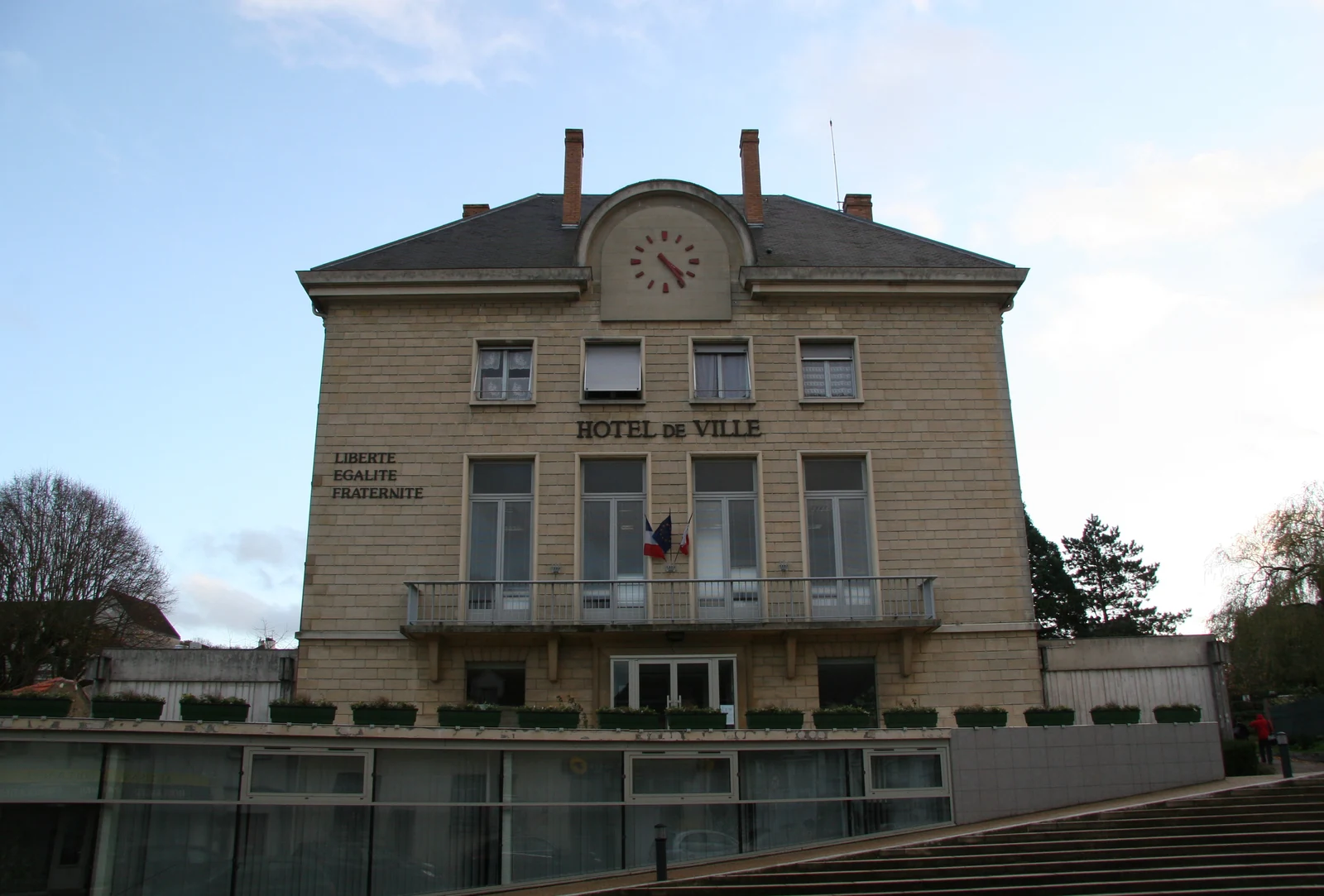
The chronology changes the chapter’s title from a setting into a promise. “The House at Bures” is not permission to place Grothendieck, Dieudonné, Serre, and visitors around a table at Bois-Marie in 1959. No source used here supports such a scene. The house that existed before the move was institutional: appointments, borrowed rooms, correspondence, a new journal, a seminar network, and permission to attempt work too long for an ordinary schedule.
This correction is more than pedantry. Places acquire legends by absorbing events that occurred before people entered them. Later SGA seminars did meet at Bois-Marie, on Tuesday afternoons in the music pavilion according to the IHÉS heritage exhibition. But that routine belongs after the 1962 move. In 1958–1961, the mathematical community was assembled across Parisian rooms, homes, Bourbaki sessions, letters, and visits.22Institut des Hautes Études Scientifiques, “The Scientific Heritage of IHÉS,” 4.
The temporary address printed on EGA I makes the point materially: 5, Rond-Point Bugeaud, Paris XVIe. A foundational treatise later associated with a secluded estate first appeared from an institute without its own building.33Grothendieck and Dieudonné, “Éléments de géométrie algébrique I: Le langage des schémas”, title page.
June 27, 1958
The official heritage exhibition dates the inaugural general meeting to June 27, 1958, in the office of Joseph Pérès, dean of the science faculty at Orsay and the institute’s first president. Motchane said he wanted to stop the French loss of scientific talent to the United States. Maurice Ponte of the Compagnie générale de télégraphie sans fil, Pierre Dreyfus and Fernand Picard of Renault, and other industrial supporters supplied early funds.44Institut des Hautes Études Scientifiques, “The Scientific Heritage of IHÉS,” 5.
Motchane did not fit the standard academic-founder profile. Born in Saint Petersburg in 1900, he had studied in Lausanne, worked briefly as a physics assistant, entered business, participated in Éditions de Minuit during the war, published essays under a pseudonym, and completed a mathematical thesis at fifty-four. These facts come from the institute’s own historical presentation and should be read as an institutional self-portrait as well as biography.55Institut des Hautes Études Scientifiques, “The Scientific Heritage of IHÉS,” 5.
His model was the Institute for Advanced Study in Princeton: a small number of permanent researchers, international visitors, few teaching obligations, and freedom to pursue fundamental work. Robert Oppenheimer, then the IAS director, joined the IHÉS scientific committee and served as adviser and advocate. The aim was European rather than simply French, at a moment when postwar scientific institutions and European political structures were being rebuilt.66Institut des Hautes Études Scientifiques, “The Foundation”; Institut des Hautes Études Scientifiques, “The Scientific Heritage of IHÉS,” 1 and 6.
The founding rhetoric joined disinterested inquiry to national power. In his 1959 note on fundamental research, Motchane argued that research must be cultivated and that abundant science brought prestige and political power. He also saw industrial leaders as necessary patrons of work whose applications could not be scheduled. This was not freedom outside institutions. It was freedom financed and administered through them.
The tension should remain visible. Industrial and public funding made long, autonomous work possible. Funding also connected the institute to economic and political structures. Later, military-linked funding would become central to Grothendieck’s 1970 departure, a story for Part VII. In 1958–1961, the immediate problem was survival and legitimacy: establish a European institute, recruit researchers, and build support.
Motchane recruits a program
The official IHÉS profile of Grothendieck says that Motchane asked Jean Dieudonné to become the first permanent professor and that Dieudonné accepted on condition that Grothendieck also be recruited. The institute lists Grothendieck as permanent professor from 1958 to 1970.77Institut des Hautes Études Scientifiques, “Alexander Grothendieck, Permanent Professor from 1958 to 1970”.
This account expresses the scientific strategy in a single recruitment. Dieudonné brought stature, Bourbaki experience, editorial capacity, and a close understanding of Grothendieck’s work. Grothendieck brought a program whose scale would define the institute’s mathematical identity. Their relation predated IHÉS—Dieudonné had helped guide Grothendieck at Nancy—but the institute gave their collaboration a new organizational form.
The recruitment story should not be retold as Motchane accidentally acquiring a dominant program through Dieudonné’s foresight. Motchane was deliberately building a model of fundamental research; Dieudonné set a condition; Grothendieck accepted a position; the resulting program shaped IHÉS. Each action had a different kind of agency.
Nor should an institutional profile be treated as a complete personnel archive. The adjacent Chapter 24 draft attributes a March 1959 formal appointment to Jackson, while the current IHÉS profile gives the retrospective range 1958–1970. These may refer to different clocks—recruitment or acceptance, contract, effective start, and later institutional service range—but no personnel record that reconciles them has been examined for this account. Part V therefore treats March 1959 as an attributed secondary date, not a firm boundary, and retains the official range only as IHÉS’s current wording.
The arrangement gave Grothendieck sustained research time. IHÉS separated its permanent professors from routine teaching, examinations, and departmental administration; EGA and the seminar developed under those documented conditions. The sources do not establish that the work would have been impossible in every other institutional arrangement.
Two rooms and a network
The Fondation Thiers rooms were small in comparison with the later estate, but the mathematics section developed there. The official exhibit says the lack of premises did not impede it, while physicists worried more about proximity to experimental laboratories. Their February 1959 meeting argued for a location near Orsay, which helped lead to the Bures purchase.88Institut des Hautes Études Scientifiques, “The Scientific Heritage of IHÉS,” 1.
One should not infer that mathematicians needed no material space. Their network could operate through blackboards, manuscripts, telephones, correspondence, and borrowed seminar rooms, but each medium mattered. Serre’s foreword to the published correspondence notes that when he and Grothendieck were both in Paris, the telephone was their usual means of communication; the surviving letters disproportionately represent periods when they were apart.99Grothendieck and Serre, Correspondance Grothendieck–Serre, foreword, p. vii.
This source limitation changes the apparent geography. Letters make Paris–Princeton exchanges visible because distance required writing. Daily Paris discussions leave fewer traces. A historian cannot count surviving pages and conclude that remote correspondence mattered more than local talk. The archive records media unevenly.
The network extended through Bourbaki. Grothendieck’s FGA exposés appeared in the Séminaire Bourbaki, not as internal IHÉS bulletins. Serre, Chevalley, Cartier, Dieudonné, and others moved through overlapping circles. The institute’s community was not bounded by its payroll or walls.
It extended internationally as well. The heritage exhibition records Oppenheimer visits in 1959 and 1961, the latter at Bures before the move. It quotes Jacques Tits in 1961 describing two visits to IHÉS as among the most productive periods of his career. Such testimony belongs to the institute’s curated memory and cannot stand for every visitor, but it shows the intended model already operating.1010Institut des Hautes Études Scientifiques, “The Scientific Heritage of IHÉS,” 6 and 8.
A journal as a room
In 1959 Motchane and Dieudonné created Publications Mathématiques de l’IHÉS. The institute’s official history of the journal names Dieudonné as first editor-in-chief, serving from 1959 to 1980. Early issues appeared at irregular intervals and accepted French, English, German, and Russian.1111Institut des Hautes Études Scientifiques, “The *Publications Mathématiques de l’IHES*: History of the Review”.
A journal can function like a room across distance and time. It sets standards, gathers work, provides a stable address, and lets readers enter a conversation after the participants have left. For IHÉS, the journal also established institutional seriousness before the permanent site was ready.
EGA fit this medium unusually well. Its planned chapters were too long and interconnected for ordinary journal articles, yet waiting for the entire treatise would have delayed publication indefinitely. The journal issued the language volume in 1960 and two further EGA fascicles in 1961; Chapter 30 supplies their titles, numbers, and mathematical sequence.1212Grothendieck and Dieudonné, “Éléments de géométrie algébrique I: Le langage des schémas”; Grothendieck and Dieudonné, “Éléments de géométrie algébrique II: Étude globale élémentaire de quelques classes de morphismes”; Grothendieck and Dieudonné, “Éléments de géométrie algébrique III: Étude cohomologique des faisceaux cohérents, première partie”.
The serial arrangement made incompletion manageable. An issued chapter could become a reference while later chapters remained in preparation. It also created cross-reference burdens and the possibility that plans would change. The authors declared chapters open to additions, and later editions revised material.
Dieudonné’s roles converged here. He was permanent professor, EGA collaborator and rédacteur, and editor-in-chief of the publishing vehicle. This concentration can be praised for efficiency only after recognizing its labor and authority. It helped determine what mathematical work looked like when it reached the public.
Grothendieck’s role remained different. He drove the program, supplied ideas and notes, taught, and revised. The journal did not make him editor of his own legend; it made his work part of an institutional series managed by a collaborator.
The collaboration at work
The October 17, 1958 letter to Serre says that Grothendieck was writing short papers and commentaries for Dieudonné, who had begun writing schemes. He hoped for four chapters by spring and publication by Motchane. A year later he reported that Dieudonné had sent Chapters 0 and I to press and was working forward, while Grothendieck developed descent and existence material.1313Grothendieck and Serre, Correspondance Grothendieck–Serre, 73 and 101–117.
This evidence supports a division of labor without making it absolute. Grothendieck produced notes, drafts, corrections, and lectures in addition to oral direction. Dieudonné organized a systematic treatise, checked dependencies, and rendered mathematics in a durable form. Serre was neither coauthor nor spectator; he read drafts, proposed corrections, and supplied mathematical sources.
The most faithful image is circulation. Notes move to Dieudonné. Chapters move to press and to Serre. Corrections move back. Bourbaki lectures release current pieces. Published fascicles stabilize some results while the program expands elsewhere.
Circulation is harder to dramatize than a moment of discovery, but it better explains the corpus. EGA’s authority arose from repeated transformation of ideas into proofs and proofs into a navigable reference.
The correspondence also preserves mismatch. Grothendieck’s schedules were repeatedly too optimistic. Projected chapters migrated to SGA or never appeared. Serre’s editorial notes identify incorrect claims and unfinished plans. The community did not work by unanimous foresight. It worked through criticism, repair, and redistribution.
The seminar as a collective instrument
The phrase “Grothendieck seminar” can suggest a lecture series owned by one speaker. SGA became a collective textual form. Grothendieck set agendas and delivered many talks, but collaborators, students, and visitors lectured, wrote exposés, checked proofs, and edited volumes. The full development belongs to Part VI; its edge is already visible in 1960–1961.
SGA 1, on étale coverings and the fundamental group, corresponds to the 1960–1961 seminar. Its later published volume names Grothendieck as director and includes multiple exposé authors. The seminar took questions anticipated in the October 1958 letter and gave them a collective architecture.1414Alexandre Grothendieck, ed., Revêtements étales et groupe fondamental (SGA 1), Lecture Notes in Mathematics 224 (Springer, 1971), https://doi.org/10.1007/BFb0058656.
The institutional form mattered mathematically. A long program could be divided into exposés. Definitions had to remain compatible from one speaker to the next. Participants could test arguments immediately. Written versions created an archive that outlived the meetings.
This was not egalitarian authorship in a simple sense. Grothendieck exercised extraordinary intellectual leadership. The seminar’s direction and conceptual vocabulary were his. Contributors’ specific exposés and proofs remain theirs. “Collective” should not erase hierarchy; “Grothendieck’s” should not erase collaborators.
The later image of weekly talks in Bois-Marie’s music pavilion belongs after the move. Before 1962, one can speak safely of the seminar program and Parisian institutional setting, not of a room the sources date later.
Tea, conversation, and evidence
The IHÉS heritage exhibition says the institute adopted from Princeton the practice of daily tea, intended to encourage conversation. It also presents later meeting areas—cafeteria, lounge, blackboards—as part of institutional life.1515Institut des Hautes Études Scientifiques, “The Scientific Heritage of IHÉS,” 1 and 2.
Tea is a plausible emblem of informal exchange, but it can become decorative myth. The sources used here do not establish who attended tea on a specified day in 1959 or what theorem emerged. No scene should be written around a cup without a dated photograph, diary, or testimony.
The verifiable institutional point is enough: IHÉS treated unplanned discussion as part of research infrastructure. Its model joined concentrated private work to recurring encounters. Offices, common areas, and visitor arrangements were not incidental amenities.
An August 4, 1962, letter from Grothendieck to Motchane, reproduced by the official exhibition, makes that argument explicitly at the moment of the move. Grothendieck objected to the idea that mathematicians did not need offices and said that without places to discuss, gathering them in Bures offered little advantage over leaving them isolated across Paris.1616Institut des Hautes Études Scientifiques, “The Scientific Heritage of IHÉS,” 2.
The letter lies just outside this Part’s date range and belongs here only as a coda. It confirms that the physical house did not automatically produce community. Rooms had to be allocated and the value of conversation defended.
Serre: near and independent
Jean-Pierre Serre did not become an IHÉS permanent professor. His place in this chapter is that of an external but central interlocutor whose work and criticism crossed the institute’s boundaries.1717Grothendieck and Serre, Correspondance Grothendieck–Serre; Grothendieck and Dieudonné, “Éléments de géométrie algébrique I: Le langage des schémas”; Grothendieck, “Technique de descente et théorèmes d’existence en géométrie algébrique. I. Généralités. Descente par morphismes fidèlement plats”.
EGA I names FAC as a fundamental influence. Grothendieck sent Serre plans and drafts; Serre returned corrections and questions. Their correspondence moved among cohomology, fundamental groups, schemes, descent, moduli, group schemes, and Weil’s conjectures. It also records differing tastes and priorities.
Calling Serre a member of “Grothendieck’s school” in these years would flatten the relationship. Serre had his own program, positions, students, and authority. He was younger than Dieudonné but already a Fields medallist and a major source for the new geometry. The exchange worked because neither mathematician was reducible to the other.
Institutionally, Serre shows that a research center’s community can exceed employment. IHÉS benefited from a Parisian and international mathematical world it did not own. The institute concentrated interactions; it did not create all of them.
His critical role also supplies an antidote to institutional commemoration. Official histories naturally emphasize success. The letters show errors, impatience, and abandoned plans. Both kinds of source are needed.
Cartier, Chevalley, and nearby work
Pierre Cartier and Claude Chevalley appear in the mathematical genealogy and the social network. Grothendieck’s 1958 letter mentions conversations with Chevalley inspiring a Bourbaki paper. The 1959 descent lecture credits Cartier’s work on radicial extensions. The correspondence asks Cartier about commutative groups while noting uncertainty in recalled claims.1818Grothendieck, “Technique de descente et théorèmes d’existence en géométrie algébrique. I. Généralités. Descente par morphismes fidèlement plats”; Grothendieck and Serre, Correspondance Grothendieck–Serre, 73 and 101–102.
These traces do not justify a composite scene in which all three jointly invent schemes. They document separate interactions around an emerging program. Chevalley’s local-ring constructions and Bourbaki role mattered. Cartier’s descent and group work mattered. Grothendieck reorganized and extended them.
The difference between “community” and “collective authorship” is crucial. A community supplies ideas, questions, standards, criticism, and people. A particular theorem or text still has authors. Historical generosity is not achieved by making every nearby mathematician coauthor; it is achieved by naming the form of contribution evidence supports.
The same rule applies to students and younger visitors. Later memories describe the magnetic force of Grothendieck’s seminar, but one should not retroactively list every future algebraic geometer as present in 1959. Dated seminar records and visitor files must govern.
Physics beside mathematics
Motchane founded IHÉS for mathematics and theoretical physics and their interactions. The choice of Bures was shaped partly by physicists’ desire for proximity to the experimental center at Orsay. Oppenheimer advised the institute and visited in 1959 and 1961. In 1961 he supported recruitment in theoretical physics, including Louis Michel and David Ruelle.1919Institut des Hautes Études Scientifiques, “The Scientific Heritage of IHÉS,” 1 and 6.
The mathematical story often treats physics as background until funding becomes controversial in 1970. That misses the institute’s founding conception. Theoretical sciences shared governance, patrons, space, and an international model.
There is no need to claim direct mathematical influence on schemes from every physicist associated with IHÉS. Institutional coexistence is itself a fact. Decisions about site, offices, and support were negotiated across disciplines.
The Bures property thus answered more than a search for picturesque quiet. It placed the institute near Orsay’s laboratories and new faculty. The official exhibit quotes a February 1959 desire for direct communication through gardens between future premises and the science faculty. The rural-academic image and the regional science strategy were joined.
This context keeps the “house” from becoming a monastery outside modernity. IHÉS depended on industry, public agencies, international committees, transport, and the expanding scientific landscape south of Paris.
Freedom has an address
“Freedom” was the institute’s central promise. Permanent professors would choose their research without courses or assigned projects. Visitors could stay long enough for serious work. Motchane’s note described research as something cultivated rather than commanded.2020Institut des Hautes Études Scientifiques, “Alexander Grothendieck, Permanent Professor from 1958 to 1970”; Institut des Hautes Études Scientifiques, “The Foundation”; Institut des Hautes Études Scientifiques, “The Scientific Heritage of IHÉS”; Institut des Hautes Études Scientifiques, “The *Publications Mathématiques de l’IHES*: History of the Review”.
Yet freedom required contracts, fundraising, editorial schedules, rooms, and relationships with universities. It also required judgments about whom to recruit. A small institute granting exceptional freedom to a few is selective by design.
Grothendieck’s work tests both sides. The absence of routine obligations enabled a program of almost unreasonable extent. His authority and productivity helped IHÉS establish prestige. In return, the institute’s journal and community amplified his program.
The relationship was not a gift flowing one way. Motchane needed scientists capable of making the new institute indispensable. Dieudonné and Grothendieck needed institutional protection and publication. Their aims aligned during these years without becoming identical.
The material language of cultivation is appropriate if its limits are observed. Research is not a crop whose output can be predicted from investment. Motchane’s own rhetoric acknowledged goals that might never be reached. EGA’s unfinished plan demonstrates both productivity and irreducible uncertainty.
The road to Bois-Marie
The Bois-Marie property in Bures-sur-Yvette belonged to Charles Comar before Motchane purchased it. IHÉS moved there in 1962. The estate offered buildings and grounds near Orsay, but it required adaptation to scientific use.2121Institut des Hautes Études Scientifiques, “The Scientific Heritage of IHÉS,” 1.
The 1961 Oppenheimer visit to Bures occurred before the institute moved, showing the prospective site already functioning in institutional representation. A visit is not residence. Captions and narrative must preserve that distinction.
Later photographs of the music pavilion, tea room, or scientists on the grounds cannot illustrate a 1959 scene without a date label. Image provenance must include creator, date, depicted people, and rights status. “IHÉS archive” alone is insufficient.
The same caution applies to the familiar IHÉS portrait of Grothendieck. The institutional page authenticates subject and holding site but does not, in the accessible metadata used here, identify photographer or date.
An original map can do what an uncertain photograph cannot: show Fondation Thiers in Paris, Orsay, and Bois-Marie with dates 1958, February 1959, and 1962. Such a diagram is interpretive, not documentary, and must be labeled as produced for the book.
A visitor’s measure
The heritage exhibit quotes Jacques Tits in 1961 accepting continued association with IHÉS and calling two visits among the most productive periods of his career. The quotation is brief institutional evidence for the visitor model.2222Institut des Hautes Études Scientifiques, “The Scientific Heritage of IHÉS,” 8.
Productivity here should not be translated into a count of papers without supporting records. Tits’s statement gives his assessment. It does not identify which results arose or which conversations caused them.
The visitor’s viewpoint also complicates the image of a single school. Tits worked in group theory and geometry with his own program. IHÉS could host mathematical excellence not subordinated to EGA. The institute’s identity was broader than Grothendieck even when algebraic geometry dominated its early legend.
International visits helped establish a European Princeton in practice. They also joined existing networks. A visitor did not enter an intellectual vacuum; he carried problems, collaborations, and institutional ties from elsewhere.
For Grothendieck, visitors enlarged the pool of possible seminar participants and correspondents. For Motchane, their presence validated the funding model. For the journal, they were authors and readers. These functions overlapped without becoming one metric.
The archive and the missing room
IHÉS has preserved historical, administrative, scientific, and photographic records from its foundation, with archival processing beginning in 2007 and later digitization. The official archive portal says parts remain to be processed.2323Institut des Hautes Études Scientifiques, Archives de l’IHÉS (Bures-sur-Yvette, n.d.), https://archives.ihes.fr/.
This incompleteness should shape confidence. The accessible exhibition offers authoritative dates and selected quotations, but it is curated. Personnel files, meeting minutes, office correspondence, and photograph metadata may refine the story.
The missing room is both literal and archival. Before 1962 the institute borrowed rooms; decades later, some traces of their use may be sparse. It would be easy to fill the absence with generic seminar imagery. This account does not make that substitution.
A responsible documentary window can instead juxtapose the EGA I title page’s Paris address, the heritage exhibit’s statement about two rooms, and the 1962 move date. Three records establish the transition without pretending to show what the room looked like.
The absence also offers a biographical lesson. Institutional history is not the decorative setting behind mathematics. It determines which evidence survives. Journals preserve finished texts; letters preserve distance; photographs preserve selected occasions; daily correction at a blackboard may leave no trace.
Community without a group portrait
By 1961 the emerging IHÉS community included permanent appointments, visitors, editors, seminar participants, correspondents, funders, administrators, and scientific advisers. They did not all occupy one place at one time. A group portrait would misrepresent the network even if every face were authentic.2424Institut des Hautes Études Scientifiques, “Alexander Grothendieck, Permanent Professor from 1958 to 1970”; Institut des Hautes Études Scientifiques, “The Foundation”; Institut des Hautes Études Scientifiques, “The Scientific Heritage of IHÉS”; Institut des Hautes Études Scientifiques, “The *Publications Mathématiques de l’IHES*: History of the Review”.
The mathematical roles were also noninterchangeable. Grothendieck supplied an organizing vision and formidable output. Dieudonné transformed and published. Serre tested and contributed independent results. Motchane built and defended the institution. Oppenheimer advised and lent international legitimacy. Visitors brought other programs. Administrators arranged the conditions that rarely appear in theorem statements.
The story becomes less mythic and more remarkable when these roles remain separate. A conceptual revolution required a publication budget. A general theorem required somebody to read a draft. A seminar required a room. International prestige required invitations, travel, and correspondence.
None of this reduces mathematics to sociology. The proof of the Hilbert-scheme theorem is not caused by tea or a salary. Institutional conditions explain how sustained attention, exchange, and dissemination became possible; mathematical arguments explain why the theorem is true.
The distinction protects both histories. Social explanation should not impersonate proof, and proof should not erase the conditions of its production.
Princeton as model, not duplicate
Motchane’s reference point was the Institute for Advanced Study, founded in Princeton in 1930 and operating from 1933. The comparison offered a recognisable formula: permanent scholars protected from routine duties, international visitors, and confidence that fundamental work could not be scheduled by immediate utility.
IHÉS was not an IAS branch. Its founders stressed a European identity, sought French industrial and public support, and built mathematics and theoretical physics in the rapidly changing Orsay region. The words “European Princeton” were aspiration and fundraising language, not legal affiliation.
Robert Oppenheimer’s role made the comparison concrete. As IAS director and lifelong member of the IHÉS scientific committee, he advised Motchane on people, disciplines, and institutional legitimacy. His visits drew public attention. The heritage exhibition says Motchane met him regularly to discuss decisions.2525Institut des Hautes Études Scientifiques, “The Scientific Heritage of IHÉS,” 6.
Advice was not direction from abroad. Motchane retained responsibility as founder and first director. The scientific committee, board, donors, professors, and French academic environment all shaped choices.
The comparison also reveals a postwar anxiety. American institutions had attracted European scientists and resources. The official exhibition reports that Motchane wanted to slow the French loss of scientists to the United States, framing IHÉS as a response to unequal scientific mobility.
Yet the remedy relied on transatlantic exchange rather than isolation. Oppenheimer advised; Serre wrote from Princeton; visitors moved in both directions; American institutional models supplied credibility. The institute sought to retain talent by being international.
For Grothendieck, this environment differed from a university chair. It offered concentration without requiring departure for a long American appointment. His correspondence still moved through Harvard and Princeton networks, but his program acquired a European base.
The model’s selectivity must not disappear. Freedom for a few depended on decisions about who counted as exceptional. An institute can reduce burdens for its permanent professors while relying on labor elsewhere to educate students and sustain the broader discipline. This is a structural observation, not an accusation found in the period documents.
Governance around free inquiry
The rhetoric of unrestricted research coexisted with committees and boards. Joseph Pérès served as first president. Motchane directed. Industrial figures secured money. Oppenheimer and others advised scientifically. Appointments required negotiation with universities and neighboring institutions.
The official exhibition records reluctance from some universities when IHÉS was created and efforts to build links with the CNRS and the Atomic Energy Commission. It also records disagreement around physics recruitment at Orsay.2626Institut des Hautes Études Scientifiques, “The Scientific Heritage of IHÉS,” 1 and 6.
Institutional freedom therefore meant protection after selection, not absence of selection. A permanent professor could choose problems, while the institute had to choose professors, funding sources, and a site.
Grothendieck’s recruitment through Dieudonné’s condition is one example of scientific judgment shaping administration. Oppenheimer’s advocacy for physicists is another. The board’s industrial connections are a third.
These decisions altered mathematical possibility without determining mathematical content. Hiring Grothendieck made EGA easier to sustain; it did not tell him how to define a scheme. Hiring Dieudonné provided redaction and editorial power; it did not mechanically produce a correct proof.
Governance also affected time. A conventional grant might require a defined project and report. IHÉS promised open-ended support. EGA’s changing plan shows why that mattered: the object of work expanded faster than an initial deliverables list could have allowed.
The modern term “research infrastructure” includes buildings and equipment. For theoretical mathematics, governance that protects unscheduled time is equally infrastructural. Its effects are difficult to photograph but visible in publication scale.
Money, disinterest, and political language
Motchane’s 1959 note joins very general, disinterested research to prestige and political power. The conjunction resists a simple opposition between pure mathematics and society. Research could be free in topic and valuable to a nation in his argument.
Industrial patrons accepted delayed and uncertain returns, at least within the institute’s founding narrative. Their support also gave them institutional presence. The fields named by the heritage exhibit—telecommunications, automobiles, and oil—belonged to postwar industrial power.
EURATOM support began in 1960 with Oppenheimer’s help, according to the exhibit. For a theoretical-sciences institute, European atomic-energy funding connected abstract inquiry to a politically charged technological project.2727Institut des Hautes Études Scientifiques, “The Scientific Heritage of IHÉS,” 6.
This chapter does not infer Grothendieck’s 1958–1961 opinion of each funding source. His later opposition to military funding is documented in another period and must not be projected backward as a hidden contemporary thought.
Nor may a biography make vague claims about “military money” without records. Funding categories, dates, and conditions require archive cards. Here the verified claim is EURATOM support from 1960 and early industrial backing.
The paradox of disinterested research funded for prestige was not unique to IHÉS. It is especially visible there because Motchane’s 1959 note joined researcher autonomy to long-term prestige and political power.
Grothendieck’s scheme theory illustrates unpredictable return. No industrial program could have specified its full content in advance. Its later applications spread across number theory, physics, and technology, but using hindsight to justify 1958 funding would rewrite Motchane’s risk as an investment calculation.
The historically faithful conclusion is narrower: institutional actors accepted uncertainty for mixed intellectual, national, and political reasons; mathematicians used the resulting freedom for work whose direction they controlled.
The Fondation Thiers as temporary infrastructure
The official exhibit gives only a spare account of the early premises: two rooms lent by the Fondation Thiers in Paris. That statement sets a boundary around reconstruction. Without floor plans, room photographs, or schedules, the book should not invent their appearance.2828Institut des Hautes Études Scientifiques, “Alexander Grothendieck, Permanent Professor from 1958 to 1970”; Institut des Hautes Études Scientifiques, “The Foundation”; Institut des Hautes Études Scientifiques, “The Scientific Heritage of IHÉS”; Institut des Hautes Études Scientifiques, “The *Publications Mathématiques de l’IHES*: History of the Review”.
Two rooms nevertheless imply practical constraints. Seminars had to be scheduled. Visitors could not all have private offices. Manuscripts and correspondence needed storage. The journal required an administrative address.
The mathematical section’s ability to develop under these conditions says something about its media. A blackboard, table, mail, and access to Parisian networks could support early seminars. The work did not require an experimental laboratory.
The physicists’ February 1959 concern about location demonstrates the disciplinary difference. Theoretical physics at IHÉS still needed contact with experimental centers. Proximity to Orsay affected the choice of Bures. Mathematics could begin in borrowed urban rooms while the permanent interdisciplinary site was negotiated.
The temporary location also placed IHÉS inside Paris’s existing mathematical ecology. École Normale Supérieure, Collège de France, Institut Henri Poincaré, universities, Bourbaki meetings, and private homes remained separate sites of work. The institute added a node rather than enclosing the network.
EGA’s Rond-Point Bugeaud imprint records a phase when institutional identity preceded property. The text supplied a durable institutional presence before Bois-Marie opened.
Publication as preservation
Mathematical seminars can be intense and ephemeral. A listener carries an argument away; a blackboard is erased. Publication turns part of the event into a durable object, but only through additional labor.2929Institut des Hautes Études Scientifiques, “The *Publications Mathématiques de l’IHES*: History of the Review”; Grothendieck and Dieudonné, “Éléments de géométrie algébrique I: Le langage des schémas”; Grothendieck and Dieudonné, “Éléments de géométrie algébrique II: Étude globale élémentaire de quelques classes de morphismes”; Grothendieck and Dieudonné, “Éléments de géométrie algébrique III: Étude cohomologique des faisceaux cohérents, première partie”.
FGA’s Bourbaki exposés preserve dated snapshots of Grothendieck’s program. Their concise style assumes expert context and can leave promises unresolved. EGA supplies systematic proofs. SGA later preserves collective seminar sequences, often after revision and delay.
These genres should not be treated as interchangeable sources. A letter records what a mathematician hoped or believed on a date. A seminar exposé records a public mathematical claim and sometimes open problems. EGA records a formal treatment. A later SGA volume may revise an earlier lecture.
Dieudonné’s journal created a preservation route for EGA. The Société Mathématique de France and Bourbaki preserved FGA. Springer’s later Lecture Notes volumes preserved much SGA. The future archive of Grothendieck’s program was institutionally plural.
The publication lag itself becomes evidence. A 1960–1961 seminar volume published in 1971 contains mathematics of the seminar period and revisions from later years. Claims about discovery must use exposé dates and editorial histories, not publication year alone.
IHÉS’s own journal helped reduce lag for EGA fascicles, though not eliminate revision. Issues could appear irregularly and accommodate long work. The serial format was an institutional form fitted to the program.
Preservation also affects credit. Exposé authors can be named; oral contributors are harder to recover. Editors who harmonize notation may be visible only in front matter. A biography must not equate what survives under a name with the entire conversation that produced it.
An ecosystem of three textual forms
EGA, FGA, and SGA formed a working ecosystem. EGA aimed at foundational sequence. FGA announced construction methods through Bourbaki. SGA organized collective research around problems that demanded extended seminars.3030Institut des Hautes Études Scientifiques, “Alexander Grothendieck, Permanent Professor from 1958 to 1970”; Institut des Hautes Études Scientifiques, “The Foundation”; Institut des Hautes Études Scientifiques, “The Scientific Heritage of IHÉS”; Institut des Hautes Études Scientifiques, “The *Publications Mathématiques de l’IHES*: History of the Review”.
One can track descent through all three. EGA’s plan reserved a chapter. FGA exposé 190 gave a general theory in 1959 and later exposés applied it. SGA would use descent throughout, eventually turning coverings into sites and topoi.
Representability likewise moves among forms. The October 1959 letter states the ambition. FGA exposé 195 defines representable functors. EGA III.1 installs the general categorical material. FGA 221 proves Hilbert representability.
The ecosystem allowed speed and depth to coexist imperfectly. A recent theorem could reach Bourbaki quickly; detailed foundations could follow in EGA; a seminar could divide a major architecture. No one form had to carry everything.
This division also explains why the 1958 EGA plan fragmented. Movement into seminar volumes was not simply abandonment. It was a change of production method. Yet material that moved ceased to be an EGA chapter, and the published corpus remained incomplete.
The institute sat at the center of part of this ecosystem but did not own it. Bourbaki and the SMF had their own structures. Correspondents worked at other institutions. The IHÉS school was interdependent with external channels.
A map of roles, not personalities
Grothendieck: program director, theorem prover, lecturer, source of drafts. Dieudonné: collaborator in redaction, editor, senior mathematician, recruiter. Serre: independent source, correspondent, critic, theorem prover.3131Institut des Hautes Études Scientifiques, “Alexander Grothendieck, Permanent Professor from 1958 to 1970”; Institut des Hautes Études Scientifiques, “The Foundation”; Institut des Hautes Études Scientifiques, “The Scientific Heritage of IHÉS”; Institut des Hautes Études Scientifiques, “The *Publications Mathématiques de l’IHES*: History of the Review”.
Motchane: founder, director, fundraiser, institutional strategist. Oppenheimer: scientific-committee member, external adviser, international advocate. Visitors such as Tits: independent researchers who used and validated the institute.
Chevalley and Cartier occupy mathematical-network roles through preceding constructions, Bourbaki, and conversations. Administrators and donors occupy enabling roles even when names are sparsely documented in mathematical texts.
Roles can overlap. Dieudonné was both mathematical collaborator and institutional editor. Grothendieck’s prestige aided IHÉS while IHÉS supported him. Serre was simultaneously critic and source.
The graph prevents a biographical shortcut in which every edge becomes friendship or discipleship. Correspondence proves communication, not emotional intimacy. Citation proves use, not agreement. Employment proves institutional relation, not ownership of work.
It also prevents the opposite shortcut, reducing people to functions. Personal styles affected the collaboration: Grothendieck’s expansion of programs, Dieudonné’s capacity for systematic exposition, Serre’s compressed questions. These characterizations must remain tied to documented work rather than invented psychology.
The visitor as institutional method
A visitor institute treats temporary presence as a research tool. The visitor brings a problem and a network; permanent professors supply continuity; unplanned discussions may redirect both.3232Institut des Hautes Études Scientifiques, “Alexander Grothendieck, Permanent Professor from 1958 to 1970”; Institut des Hautes Études Scientifiques, “The Foundation”; Institut des Hautes Études Scientifiques, “The Scientific Heritage of IHÉS”; Institut des Hautes Études Scientifiques, “The *Publications Mathématiques de l’IHES*: History of the Review”.
Jacques Tits’s 1961 statement about two productive visits is especially useful because it predates the Bois-Marie move. It shows the model working without the later landscape. Productivity attached to relationships and protected time, not only estate atmosphere.
The institute’s historical exhibit later associates tea, common rooms, and cafeteria conversation with this method. In 1958–1961, the precise locations differ, but the goal of bringing researchers together is documented.
Visitor programs also complicate authorship. A visitor may contribute an idea without joining a paper, hear a theorem before publication, or carry a technique elsewhere. Such influence is difficult to quantify and should not be invented from a visitor list.
Dated guest books, travel correspondence, and seminar programs would allow a more exact reconstruction. Until those are checked, this chapter names only visitors supported by the accessible official record.
The international circulation supported Motchane’s European ambition. It also exposed Grothendieck’s program to mathematicians who could adopt, resist, or transform it. Diffusion occurred person by person before textbooks made schemes routine.
Seminar discipline
A long seminar is not simply a sequence of lectures. Topics must be ordered, speakers assigned, notation harmonized, and gaps repaired. Participants need earlier exposés in order to understand later ones. Written versions must resolve what oral exposition could leave implicit.3333Grothendieck, Revêtements étales et groupe fondamental (SGA 1); Institut des Hautes Études Scientifiques, “The Scientific Heritage of IHÉS”.
Grothendieck’s leadership set the conceptual pace. The Cartan seminar tradition supplied a French model of collective exposition. Dieudonné’s and others’ editorial standards linked seminar work to a broader culture of rigorous write-up.
The SGA acronym eventually named several distinct seminar years and volumes. Each has a director, editors, and exposé authors. Blanket attribution to Grothendieck is bibliographically inadequate even when his direction is decisive.
For 1960–1961, SGA 1 concerns étale coverings and the fundamental group. The later book names Grothendieck as director. Detailed credit for individual exposés belongs to Part VI’s source audit.
The institutional community made such distributed work sustainable. A visitor could speak; a student could redact; a permanent professor could maintain continuity. But the hierarchy of a program led by a dominant mathematician could also shape which questions received attention.
No source used here supports a sociological verdict on every participant’s experience. The safe historical claim is the production form: directed, multi-author, seminar-based, and later edited.
The cost of entering the circle
Freedom for established researchers did not automatically make the new mathematics easy to enter. EGA required homological algebra, sheaf theory, commutative algebra, and categorical language. Seminar participation required proximity and confidence.
The concentrated IHÉS environment lowered the barrier for those present. They could ask authors, hear motivations, and see notation develop. For distant readers, fascicles and exposés were the route, often in French and without modern pedagogical examples.
This asymmetry helped form a school-like network. Students and visitors with direct access could absorb methods earlier. It does not imply deliberate exclusion; it is a material consequence of how advanced mathematics circulated.
Publication partly corrected the asymmetry. Numdam’s later digitization would widen access dramatically, but in 1960 distribution depended on print, libraries, and personal reprints.
Serre’s letters mention reprints and papers being sent. Grothendieck asks that Bourbaki materials reach Tate. These small logistics are the network’s bloodstream.3434Grothendieck and Serre, Correspondance Grothendieck–Serre, letter of October 17, 1958 and adjacent correspondence.
The institute’s journal sought international distribution and accepted four languages. That policy widened author participation while still presuming a multilingual specialist readership.
Bures before occupation
Bois-Marie existed in the story before mathematicians moved there. Motchane purchased it from Charles Comar. The 1961 Oppenheimer program included Bures. Planning for offices and relations with Orsay preceded occupation.3535Institut des Hautes Études Scientifiques, “Alexander Grothendieck, Permanent Professor from 1958 to 1970”; Institut des Hautes Études Scientifiques, “The Foundation”; Institut des Hautes Études Scientifiques, “The Scientific Heritage of IHÉS”; Institut des Hautes Études Scientifiques, “The *Publications Mathématiques de l’IHES*: History of the Review”.
A site in preparation can function symbolically. It reassures donors that the institute will have permanence, gives visitors a future image, and forces decisions about disciplinary space.
The heritage exhibit’s quoted desire for communication through the gardens with the science faculty captures the planned relation to Orsay. It should not be read as an architectural fact achieved exactly as imagined without plans and construction records.
Nor should Bois-Marie’s later quiet be treated as the sole reason for the location. Proximity to laboratories, land availability, and regional scientific development were documented considerations.
The pre-occupation period is precisely why Chapter 29 belongs in Part V. The institutional future was being designed alongside the mathematical future. Both had plans, open chapters, and construction delays.
A 1962 disagreement about offices
Grothendieck’s August 1962 letter to Motchane objects to reserving available offices for physicists on the assumption that mathematicians were used to discussing outside their homes. He says he would share an office with visitors and asks what benefit Bures offers if mathematicians remain isolated.3636Institut des Hautes Études Scientifiques, “The Scientific Heritage of IHÉS,” 2.
The letter corrects two later simplifications. Moving to the estate did not solve space allocation, and Grothendieck’s own argument treated discussion space as necessary for mathematical work.
It also shows a permanent professor advocating for invited researchers’ working conditions. The argument is practical: visitors need a place besides home for discussion.
No broader claim about his management style should be inferred from one letter. It documents one dispute and one stated value. The institute’s exhibition selected it to illustrate meeting areas; that curatorial context should remain noted.
Used as coda, the letter confirms the chapter’s thesis: the community preceded Bures, and Bures had to be made into a community through decisions.
Against the pastoral legend
Photographs of Bois-Marie’s trees and pavilions invite a pastoral story: great mathematics emerges when exceptional people retreat from ordinary life. The setting did support concentration. The story becomes false when it erases urban networks, money, administration, print, and conflict.3737Institut des Hautes Études Scientifiques, “Alexander Grothendieck, Permanent Professor from 1958 to 1970”; Institut des Hautes Études Scientifiques, “The Foundation”; Institut des Hautes Études Scientifiques, “The Scientific Heritage of IHÉS”; Institut des Hautes Études Scientifiques, “The *Publications Mathématiques de l’IHES*: History of the Review”.
Grothendieck’s geometry was not generated by landscape. It was developed through proofs, correspondence, lectures, and collaboration before the move. Later seminars benefited from Bures without making place a mathematical cause.
The retreat image can also conceal connectivity. Trains linked Paris and Bures. Orsay’s laboratories were nearby. International visitors arrived through wider travel networks. The estate was a node, not isolation.
An accurate image program should therefore combine place with documents: a dated exterior, the Paris imprint of EGA I, a map, and a seminar page. No single picturesque photograph should stand for the birth of schemes.
The philosophical theme is material but not deterministic. Environments make certain rhythms possible; they do not select theorems in advance.
The invisible administrative layer
A visiting mathematician encounters an invitation, a desk, mail, lodging information, and a seminar schedule. Each requires administrative work. The theorem carries no record of the person who found a room or typed a letter.3838Institut des Hautes Études Scientifiques, “Alexander Grothendieck, Permanent Professor from 1958 to 1970”; Institut des Hautes Études Scientifiques, “The Foundation”; Institut des Hautes Études Scientifiques, “The Scientific Heritage of IHÉS”; Institut des Hautes Études Scientifiques, “The *Publications Mathématiques de l’IHES*: History of the Review”.
The accessible 1962 office letter mentions Miss Rolland in connection with allocation, a trace of staff mediation in an argument remembered mainly for Grothendieck’s words. The source does not supply enough information here for a biographical account of her role, and this account will not invent one.
This caution points to a larger imbalance. Institutional narratives foreground founders and permanent professors because their papers and reputations are preserved. Secretarial, library, maintenance, and logistical work can disappear. Absence of names in the mathematical sources is not evidence that the labor was absent.
A full archive pass could recover staff rosters, correspondence, budgets, and job descriptions. Until then, the text names the category of labor and marks the evidentiary gap.
The same applies to families and domestic arrangements. Mathematicians’ ability to travel or work long hours can depend on others, but no private scene should be inferred from professional correspondence. Biography must prefer a gap to a generic spouse-at-home narrative.
Institutional history becomes more accurate when it distinguishes documented person, necessary function, and unknown performer. The rule against invented detail matters most where traditional archives are uneven.
Library, reprints, and working memory
The later Bois-Marie music pavilion doubled as library and seminar room, according to the official exhibition. Before the move, the precise library arrangement requires further documentation. Yet references and reprints were already central to the program.3939Institut des Hautes Études Scientifiques, “Alexander Grothendieck, Permanent Professor from 1958 to 1970”; Institut des Hautes Études Scientifiques, “The Foundation”; Institut des Hautes Études Scientifiques, “The Scientific Heritage of IHÉS”; Institut des Hautes Études Scientifiques, “The *Publications Mathématiques de l’IHES*: History of the Review”.
EGA I’s introduction directs readers to Cartan–Eilenberg, Godement, Samuel, Zariski, Serre, Weil, Nagata, and seminar texts. The foundation was built through a working library, whether volumes sat at IHÉS or circulated personally.
Grothendieck’s letters ask about sending papers, proofs, and reprints. Serre comments on pages by number. Dieudonné holds a definitive chapter copy. These are forms of distributed memory.
Before searchable digital archives, a missing fascicle or delayed reprint could slow work. Personal correspondence acted as discovery service; seminars acted as oral index; bibliographies guided entry.
The new journal strengthened this memory by issuing work under stable volume and page numbers. Its international library distribution, later emphasized by IHÉS, made the institute present where its people were absent.
The metaphor of a journal as a room can now be made precise. Readers share references and can answer an argument years later. But a printed room lacks immediate questions; pedagogy and correction still require people.
Four languages and one notation
Early Publications Mathématiques de l’IHÉS accepted French, English, German, and Russian. The policy matched the institute’s international ambition and the linguistic reality of mid-century mathematics.4040Institut des Hautes Études Scientifiques, “The *Publications Mathématiques de l’IHES*: History of the Review”.
EGA appeared in French, with mathematical notation carrying part of its portability. A commutative diagram can cross language boundaries more easily than prose, but definitions still depend on words such as préschéma, propre, and fidèlement plat.
Translation can create historical errors. Préschéma in early EGA does not map to modern “prescheme” without explanation; modern English usually says “scheme.” Simple in a letter later becomes “smooth.”
Multilingual publication widened reach while setting demands. Readers needed technical languages; editors needed consistency; references crossed national conventions.
Dieudonné’s role in notation matters here. A stable symbolic language allowed the serial treatise and later seminar volumes to be cited internationally. This is intellectual work, not typography alone.
The institute’s European identity was enacted partly through such circulation. It did not require one national mathematical language, even though French dominated the Grothendieck corpus.
The institutional meaning of a long proof
A long proof imposes different conditions from a short insight. Definitions must remain available, notation cannot drift, intermediate results need verification, and errors must be repairable without restarting the whole project.4141Institut des Hautes Études Scientifiques, “Alexander Grothendieck, Permanent Professor from 1958 to 1970”; Institut des Hautes Études Scientifiques, “The Foundation”; Institut des Hautes Études Scientifiques, “The Scientific Heritage of IHÉS”; Institut des Hautes Études Scientifiques, “The *Publications Mathématiques de l’IHES*: History of the Review”.
EGA’s fascicles provided checkpoints. FGA exposed methods to expert criticism. Seminar work distributed sections. IHÉS supplied continuity of personnel.
This production system resembles a large collaborative experiment only at a high level. Mathematics does not reproduce an empirical apparatus, and proof remains deductive. The useful comparison is organizational: complex work requires version control, specialized roles, and records.
Grothendieck’s program was unusually dependent on coherence across years. A change in the definition of scheme or properness could affect cohomology, descent, and moduli. Dieudonné’s systematic writing and Serre’s detailed reading acted as quality controls.
The system did not prevent errors. The correspondence and later errata prove that. Reliability came from making correction possible and visible, not from infallibility.
This is another reason the single-moment discovery model fails. The foundational achievement is not one moment when the right definition appears. It is sustained maintenance of a mathematical world.
Independence and concentration
IHÉS concentrated a program without making every participant dependent on Grothendieck. Serre remained at external institutions. Bourbaki retained collective autonomy. Visitors came with their own work. Physics developed beside algebraic geometry.4242Institut des Hautes Études Scientifiques, “Alexander Grothendieck, Permanent Professor from 1958 to 1970”; Institut des Hautes Études Scientifiques, “The Foundation”; Institut des Hautes Études Scientifiques, “The Scientific Heritage of IHÉS”; Institut des Hautes Études Scientifiques, “The *Publications Mathématiques de l’IHES*: History of the Review”.
Concentration can produce common vocabulary and rapid progress. It can also make one program appear equivalent to a field. The official phrase “golden age of algebraic geometry” reflects retrospective institutional pride and should be identified as such, not treated as neutral period terminology.
The best evidence for intellectual concentration is textual: EGA fascicles, FGA exposés, SGA programs, and correspondence repeatedly share definitions and problems. The best evidence for independence is equally textual: named authors, divergent projects, criticisms, and results outside the program.
Grothendieck’s generosity in sharing ideas is often recalled by participants in later sources, while conflicts over credit also appear in his later writings. Those retrospective disputes belong to later Parts and cannot determine every interaction of 1958–1961.
For this chapter, “community” means documented exchange and common infrastructure. It does not imply harmony, common ownership, or a single voice.
A dated institutional timeline
On June 27, 1958 the founding meeting took place. In 1958 the institute recruited its first permanent mathematicians according to its official profiles. Early seminars used Fondation Thiers rooms.4343Institut des Hautes Études Scientifiques, “Alexander Grothendieck, Permanent Professor from 1958 to 1970”; Institut des Hautes Études Scientifiques, “The Foundation”; Institut des Hautes Études Scientifiques, “The Scientific Heritage of IHÉS”; Institut des Hautes Études Scientifiques, “The *Publications Mathématiques de l’IHES*: History of the Review”.
In February 1959 physicists discussed the permanent location near Orsay. In 1959 Motchane and Dieudonné founded the journal; Oppenheimer visited; Grothendieck gave the formal-geometry exposé.
In 1960 EGA I appeared, and EURATOM support began according to the heritage exhibit. Descent and formal-existence exposés were in circulation. The seminar leading to SGA 1 entered its 1960–1961 year.
In 1961 EGA II and III.1 appeared. Grothendieck lectured on quotients and Hilbert schemes. Oppenheimer visited Bures before the move. Tits recorded the productivity of two IHÉS visits.
In 1962 the institute moved to Bois-Marie. Grothendieck’s August office letter records practical disagreement during the transition.
This timeline is deliberately sparse. It gives every institutional claim a date and prevents the later estate from swallowing the Paris phase.
Place as a promise of continuity
A permanent site signals that an institution expects to outlive a project. Bois-Marie would house programs after EGA, professors after Grothendieck, and disciplines beyond algebraic geometry.4444Institut des Hautes Études Scientifiques, “Alexander Grothendieck, Permanent Professor from 1958 to 1970”; Institut des Hautes Études Scientifiques, “The Foundation”; Institut des Hautes Études Scientifiques, “The Scientific Heritage of IHÉS”; Institut des Hautes Études Scientifiques, “The *Publications Mathématiques de l’IHES*: History of the Review”.
For the 1958–1961 community, the purchase offered anticipated continuity while daily work remained elsewhere. The new journal offered another kind of permanence already in use.
Buildings and publications solve different continuity problems. A building preserves rooms for changing people. A journal preserves arguments for changing readers. IHÉS invested in both.
The mathematical program also pursued continuity through functoriality: constructions should survive base change and reuse. The resemblance is suggestive but not explanatory. Institutional permanence does not prove a theorem, and categorical stability does not design a campus.
What can be said without metaphor is that both projects rejected short-term improvisation. Motchane planned a lasting institute; Grothendieck and Dieudonné planned a lasting reference. Both plans remained open and exceeded initial schedules.
The house at Bures therefore closes the chapter as a threshold, not an origin. It gives a future address to a community whose mathematical and textual practices had already formed.
Institute, school, and community
The words institute, school, and community name different things. IHÉS was a legal and administrative institution. A Grothendieck school, if the phrase is used, describes a lineage of problems, methods, seminars, and students. The mathematical community includes independent peers and visitors who belonged to neither category.4545Institut des Hautes Études Scientifiques, “Alexander Grothendieck, Permanent Professor from 1958 to 1970”; Institut des Hautes Études Scientifiques, “The Foundation”; Institut des Hautes Études Scientifiques, “The Scientific Heritage of IHÉS”; Institut des Hautes Études Scientifiques, “The *Publications Mathématiques de l’IHES*: History of the Review”.
Conflating them creates errors. Serre was central to the community and to the mathematics but not an IHÉS permanent professor or Grothendieck student. Dieudonné was an IHÉS professor and collaborator, not a disciple. Motchane belonged to the institute’s history but did not author scheme theory.
An institution can host multiple schools. IHÉS included theoretical physics and mathematics beyond algebraic geometry. A school can extend across institutions through correspondence, seminars, and migration. A community can contain criticism and rivalry.
The distinction also clarifies credit. Institutional support can be acknowledged without adding IHÉS as mathematical coauthor. Seminar direction can be acknowledged without erasing exposé authors. Intellectual influence can be acknowledged without assigning a theorem.
During 1958–1961, the three formations overlapped unusually strongly around Grothendieck’s program. Recruitment, journal, FGA, EGA, and the emerging SGA architecture reinforced one another. This concentration explains later association with Bures.
But the overlap was not total. Bourbaki supplied another collective; universities trained students; Princeton and Harvard hosted correspondents; the SMF published seminar texts. The relative world had more than one base.
That last metaphor should not be pressed into sociology. Its limited use is to prevent institutional closure. Mathematical ideas traveled along multiple routes, and no building contained every relation.
The official IHÉS exhibition understandably narrates continuity from Grothendieck to later professors. A biography must place that institutional memory beside external archives and named publications. Commemoration is a source, not the final analysis.
The same applies to later participant recollections. They can describe atmosphere and influence with unique authority, while dates and attributions still need documentary checks.
“Community” is therefore the most inclusive word in this chapter and the least sentimental. It means a traceable web of work: someone sends a draft, reads a proof, funds a position, arranges a visit, edits a journal, or challenges a claim.
The house at Bures mattered because it concentrated that web. It did not make the web begin.
A house made of records
The early institute can be reconstructed through objects rather than an invented group scene. A founding-meeting record fixes June 27, 1958. A heritage exhibit fixes the two Fondation Thiers rooms. A title page fixes the Paris address. Letters fix drafts moving among Grothendieck, Dieudonné, and Serre.4646Institut des Hautes Études Scientifiques, Archives de l’IHÉS.
Journal volumes fix publication. Visitor testimony fixes one researcher’s assessment. A property record and move date fix Bois-Marie’s entry. The 1962 office letter fixes a dispute about how the new site should work.
No single record tells the whole story. Institutional webpages compress; letters omit local conversation; publications suppress administration; photographs select moments. Their overlap provides confidence.
This source architecture resembles the chapter’s community without turning it into mathematics. Separate records carry separate functions and must be related carefully.
It also guides illustration. Each image should answer a factual question: who is depicted, where, when, by whom, under what rights. An attractive object that cannot answer them remains a lead.
The house made of records is less picturesque than reconstructed dialogue. It is more durable.
A biography must likewise survive outside the circumstances of its writing, just as EGA sought to make a seminar program survive its blackboards.
At the threshold of 1962, records show a community ready to occupy Bois-Marie. They do not show that community complete. New offices, visitors, seminars, and conflicts would continue to make the place.
What the institute contributed
IHÉS enabled mathematics without authoring it. Motchane founded, directed, raised support, recruited, and planned a permanent site. Dieudonné conditioned his recruitment on Grothendieck’s, collaborated on EGA, and led the journal. Grothendieck supplied a program that gave the young institute unusual mathematical identity. Serre remained an independent external interlocutor. Oppenheimer advised and supported institutional legitimacy, especially in physics. Visitors brought their own work. Staff performed essential administration that the accessible sources only partly identify. The Fondation Thiers housed early seminars; Bois-Marie became the institute’s home only in 1962. Keeping these roles distinct prevents a later landscape from receiving credit for earlier proofs and prevents institutional history from disappearing behind mathematical fame. The community becomes visible through dated actions rather than an imagined gathering: a contract, a letter, an editorial decision, a visit, a correction, and a move. This evidence gives place its proper weight while leaving proofs with mathematicians and institutional labor with documented workers and records where known.4747Institut des Hautes Études Scientifiques, “Alexander Grothendieck, Permanent Professor from 1958 to 1970”; Institut des Hautes Études Scientifiques, “The Foundation”; Institut des Hautes Études Scientifiques, “The Scientific Heritage of IHÉS”; Institut des Hautes Études Scientifiques, “The *Publications Mathématiques de l’IHES*: History of the Review”.
The chapter therefore refuses two opposite reductions. Mathematics was not a product dispensed by an institution, and the institution was not scenery around disembodied thought. IHÉS altered time, proximity, publication, and mobility. Mathematicians supplied definitions and proofs. Administrators, patrons, editors, advisers, and visitors supplied other forms of continuity. Their effects met in documents that can be dated. The Bois-Marie move made the meeting more visible, but visibility is not origin. Parisian rooms, postal routes, telephones, presses, and existing seminars had already carried the community. Bures gave those relations a durable center and immediately generated new practical questions about how shared space should be used. The community’s history lies precisely in that meeting of unlike labors, not in a photograph of effortless collective brilliance.
No administrative record can prove a theorem, but those records establish the time, space, editorial labor, and mobility within which proofs were produced. The roles remain separate. The distinction remains part of the historical explanation rather than decorative context.
The threshold of 1962
At the end of 1961, EGA I, II, and the first part of III were in print. FGA exposés had developed formal geometry, descent, quotients, and Hilbert schemes. The 1960–1961 seminar had opened the path to étale coverings and fundamental groups. IHÉS had a site waiting at Bures and an international reputation beginning to form.4848Institut des Hautes Études Scientifiques, “Alexander Grothendieck, Permanent Professor from 1958 to 1970”; Institut des Hautes Études Scientifiques, “The Foundation”; Institut des Hautes Études Scientifiques, “The Scientific Heritage of IHÉS”; Institut des Hautes Études Scientifiques, “The *Publications Mathématiques de l’IHES*: History of the Review”.
The physical move in 1962 would gather more of this activity at Bois-Marie. It would not create the program ex nihilo. The foundational years in borrowed Paris rooms had already established working relationships and publication channels.
Grothendieck’s August 1962 office letter provides the appropriate coda. He insisted that gathering mathematicians at Bures made sense only if they had places for discussion. The argument translates the relative viewpoint into institutional terms without requiring a philosophical claim: proximity had value through the maps it enabled among people.
The analogy should stop there. Mathematicians are not schemes, conversation is not a fiber product, and an institute is not a universal object. What the two histories share is attention to infrastructure. Relations need a place to occur.
The Bures site entered after the foundational work had begun in Paris. Its rooms then supported longer seminars, a growing visitor program, and the collective cohomological work of the next period. The move gave an existing community a permanent address.
注释
- Institut des Hautes Études Scientifiques, “The Scientific Heritage of IHÉS,” 1, “A direct link”. ↩
- Institut des Hautes Études Scientifiques, “The Scientific Heritage of IHÉS,” 4. ↩
- Grothendieck and Dieudonné, “Éléments de géométrie algébrique I: Le langage des schémas”, title page. ↩
- Institut des Hautes Études Scientifiques, “The Scientific Heritage of IHÉS,” 5. ↩
- Institut des Hautes Études Scientifiques, “The Scientific Heritage of IHÉS,” 5. ↩
- Institut des Hautes Études Scientifiques, “The Foundation”; Institut des Hautes Études Scientifiques, “The Scientific Heritage of IHÉS,” 1 and 6. ↩
- Institut des Hautes Études Scientifiques, “Alexander Grothendieck, Permanent Professor from 1958 to 1970”. ↩
- Institut des Hautes Études Scientifiques, “The Scientific Heritage of IHÉS,” 1. ↩
- Grothendieck and Serre, Correspondance Grothendieck–Serre, foreword, p. vii. ↩
- Institut des Hautes Études Scientifiques, “The Scientific Heritage of IHÉS,” 6 and 8. ↩
- Institut des Hautes Études Scientifiques, “The *Publications Mathématiques de l’IHES*: History of the Review”. ↩
- Grothendieck and Dieudonné, “Éléments de géométrie algébrique I: Le langage des schémas”; Grothendieck and Dieudonné, “Éléments de géométrie algébrique II: Étude globale élémentaire de quelques classes de morphismes”; Grothendieck and Dieudonné, “Éléments de géométrie algébrique III: Étude cohomologique des faisceaux cohérents, première partie”. ↩
- Grothendieck and Serre, Correspondance Grothendieck–Serre, 73 and 101–117. ↩
- Alexandre Grothendieck, ed., Revêtements étales et groupe fondamental (SGA 1), Lecture Notes in Mathematics 224 (Springer, 1971), https://doi.org/10.1007/BFb0058656. ↩
- Institut des Hautes Études Scientifiques, “The Scientific Heritage of IHÉS,” 1 and 2. ↩
- Institut des Hautes Études Scientifiques, “The Scientific Heritage of IHÉS,” 2. ↩
- Grothendieck and Serre, Correspondance Grothendieck–Serre; Grothendieck and Dieudonné, “Éléments de géométrie algébrique I: Le langage des schémas”; Grothendieck, “Technique de descente et théorèmes d’existence en géométrie algébrique. I. Généralités. Descente par morphismes fidèlement plats”. ↩
- Grothendieck, “Technique de descente et théorèmes d’existence en géométrie algébrique. I. Généralités. Descente par morphismes fidèlement plats”; Grothendieck and Serre, Correspondance Grothendieck–Serre, 73 and 101–102. ↩
- Institut des Hautes Études Scientifiques, “The Scientific Heritage of IHÉS,” 1 and 6. ↩
- Institut des Hautes Études Scientifiques, “Alexander Grothendieck, Permanent Professor from 1958 to 1970”; Institut des Hautes Études Scientifiques, “The Foundation”; Institut des Hautes Études Scientifiques, “The Scientific Heritage of IHÉS”; Institut des Hautes Études Scientifiques, “The *Publications Mathématiques de l’IHES*: History of the Review”. ↩
- Institut des Hautes Études Scientifiques, “The Scientific Heritage of IHÉS,” 1. ↩
- Institut des Hautes Études Scientifiques, “The Scientific Heritage of IHÉS,” 8. ↩
- Institut des Hautes Études Scientifiques, Archives de l’IHÉS (Bures-sur-Yvette, n.d.), https://archives.ihes.fr/. ↩
- Institut des Hautes Études Scientifiques, “Alexander Grothendieck, Permanent Professor from 1958 to 1970”; Institut des Hautes Études Scientifiques, “The Foundation”; Institut des Hautes Études Scientifiques, “The Scientific Heritage of IHÉS”; Institut des Hautes Études Scientifiques, “The *Publications Mathématiques de l’IHES*: History of the Review”. ↩
- Institut des Hautes Études Scientifiques, “The Scientific Heritage of IHÉS,” 6. ↩
- Institut des Hautes Études Scientifiques, “The Scientific Heritage of IHÉS,” 1 and 6. ↩
- Institut des Hautes Études Scientifiques, “The Scientific Heritage of IHÉS,” 6. ↩
- Institut des Hautes Études Scientifiques, “Alexander Grothendieck, Permanent Professor from 1958 to 1970”; Institut des Hautes Études Scientifiques, “The Foundation”; Institut des Hautes Études Scientifiques, “The Scientific Heritage of IHÉS”; Institut des Hautes Études Scientifiques, “The *Publications Mathématiques de l’IHES*: History of the Review”. ↩
- Institut des Hautes Études Scientifiques, “The *Publications Mathématiques de l’IHES*: History of the Review”; Grothendieck and Dieudonné, “Éléments de géométrie algébrique I: Le langage des schémas”; Grothendieck and Dieudonné, “Éléments de géométrie algébrique II: Étude globale élémentaire de quelques classes de morphismes”; Grothendieck and Dieudonné, “Éléments de géométrie algébrique III: Étude cohomologique des faisceaux cohérents, première partie”. ↩
- Institut des Hautes Études Scientifiques, “Alexander Grothendieck, Permanent Professor from 1958 to 1970”; Institut des Hautes Études Scientifiques, “The Foundation”; Institut des Hautes Études Scientifiques, “The Scientific Heritage of IHÉS”; Institut des Hautes Études Scientifiques, “The *Publications Mathématiques de l’IHES*: History of the Review”. ↩
- Institut des Hautes Études Scientifiques, “Alexander Grothendieck, Permanent Professor from 1958 to 1970”; Institut des Hautes Études Scientifiques, “The Foundation”; Institut des Hautes Études Scientifiques, “The Scientific Heritage of IHÉS”; Institut des Hautes Études Scientifiques, “The *Publications Mathématiques de l’IHES*: History of the Review”. ↩
- Institut des Hautes Études Scientifiques, “Alexander Grothendieck, Permanent Professor from 1958 to 1970”; Institut des Hautes Études Scientifiques, “The Foundation”; Institut des Hautes Études Scientifiques, “The Scientific Heritage of IHÉS”; Institut des Hautes Études Scientifiques, “The *Publications Mathématiques de l’IHES*: History of the Review”. ↩
- Grothendieck, Revêtements étales et groupe fondamental (SGA 1); Institut des Hautes Études Scientifiques, “The Scientific Heritage of IHÉS”. ↩
- Grothendieck and Serre, Correspondance Grothendieck–Serre, letter of October 17, 1958 and adjacent correspondence. ↩
- Institut des Hautes Études Scientifiques, “Alexander Grothendieck, Permanent Professor from 1958 to 1970”; Institut des Hautes Études Scientifiques, “The Foundation”; Institut des Hautes Études Scientifiques, “The Scientific Heritage of IHÉS”; Institut des Hautes Études Scientifiques, “The *Publications Mathématiques de l’IHES*: History of the Review”. ↩
- Institut des Hautes Études Scientifiques, “The Scientific Heritage of IHÉS,” 2. ↩
- Institut des Hautes Études Scientifiques, “Alexander Grothendieck, Permanent Professor from 1958 to 1970”; Institut des Hautes Études Scientifiques, “The Foundation”; Institut des Hautes Études Scientifiques, “The Scientific Heritage of IHÉS”; Institut des Hautes Études Scientifiques, “The *Publications Mathématiques de l’IHES*: History of the Review”. ↩
- Institut des Hautes Études Scientifiques, “Alexander Grothendieck, Permanent Professor from 1958 to 1970”; Institut des Hautes Études Scientifiques, “The Foundation”; Institut des Hautes Études Scientifiques, “The Scientific Heritage of IHÉS”; Institut des Hautes Études Scientifiques, “The *Publications Mathématiques de l’IHES*: History of the Review”. ↩
- Institut des Hautes Études Scientifiques, “Alexander Grothendieck, Permanent Professor from 1958 to 1970”; Institut des Hautes Études Scientifiques, “The Foundation”; Institut des Hautes Études Scientifiques, “The Scientific Heritage of IHÉS”; Institut des Hautes Études Scientifiques, “The *Publications Mathématiques de l’IHES*: History of the Review”. ↩
- Institut des Hautes Études Scientifiques, “The *Publications Mathématiques de l’IHES*: History of the Review”. ↩
- Institut des Hautes Études Scientifiques, “Alexander Grothendieck, Permanent Professor from 1958 to 1970”; Institut des Hautes Études Scientifiques, “The Foundation”; Institut des Hautes Études Scientifiques, “The Scientific Heritage of IHÉS”; Institut des Hautes Études Scientifiques, “The *Publications Mathématiques de l’IHES*: History of the Review”. ↩
- Institut des Hautes Études Scientifiques, “Alexander Grothendieck, Permanent Professor from 1958 to 1970”; Institut des Hautes Études Scientifiques, “The Foundation”; Institut des Hautes Études Scientifiques, “The Scientific Heritage of IHÉS”; Institut des Hautes Études Scientifiques, “The *Publications Mathématiques de l’IHES*: History of the Review”. ↩
- Institut des Hautes Études Scientifiques, “Alexander Grothendieck, Permanent Professor from 1958 to 1970”; Institut des Hautes Études Scientifiques, “The Foundation”; Institut des Hautes Études Scientifiques, “The Scientific Heritage of IHÉS”; Institut des Hautes Études Scientifiques, “The *Publications Mathématiques de l’IHES*: History of the Review”. ↩
- Institut des Hautes Études Scientifiques, “Alexander Grothendieck, Permanent Professor from 1958 to 1970”; Institut des Hautes Études Scientifiques, “The Foundation”; Institut des Hautes Études Scientifiques, “The Scientific Heritage of IHÉS”; Institut des Hautes Études Scientifiques, “The *Publications Mathématiques de l’IHES*: History of the Review”. ↩
- Institut des Hautes Études Scientifiques, “Alexander Grothendieck, Permanent Professor from 1958 to 1970”; Institut des Hautes Études Scientifiques, “The Foundation”; Institut des Hautes Études Scientifiques, “The Scientific Heritage of IHÉS”; Institut des Hautes Études Scientifiques, “The *Publications Mathématiques de l’IHES*: History of the Review”. ↩
- Institut des Hautes Études Scientifiques, Archives de l’IHÉS. ↩
- Institut des Hautes Études Scientifiques, “Alexander Grothendieck, Permanent Professor from 1958 to 1970”; Institut des Hautes Études Scientifiques, “The Foundation”; Institut des Hautes Études Scientifiques, “The Scientific Heritage of IHÉS”; Institut des Hautes Études Scientifiques, “The *Publications Mathématiques de l’IHES*: History of the Review”. ↩
- Institut des Hautes Études Scientifiques, “Alexander Grothendieck, Permanent Professor from 1958 to 1970”; Institut des Hautes Études Scientifiques, “The Foundation”; Institut des Hautes Études Scientifiques, “The Scientific Heritage of IHÉS”; Institut des Hautes Études Scientifiques, “The *Publications Mathématiques de l’IHES*: History of the Review”. ↩