A word in a letter
The correspondence catalog description identifies a letter to Serre dated August 8, 1964 as the earliest surviving written mention of motives presently known to the edition. That date is an archival foothold, not a birthday for the idea. The exact page and wording have not been checked for this account, so the chapter makes no claim about how much of the later theory the letter contained.11Grothendieck and Serre, Correspondance Grothendieck–Serre, metadata.
Three years later, the program had a public address. An IHÉS poster announced that on Tuesday, April 25, 1967, Grothendieck would continue “Esquisse d’une théorie des motifs.” The word esquisse, or sketch, belongs to the documented title. The poster supplies a time, place, train departure, and subject; it does not supply definitions or a transcript. Every mathematical explanation later in this chapter comes from published sources and modern exposition, not a reconstruction of that talk.22Institut des Hautes Études Scientifiques, Archives de l’IHÉS, poster, “Esquisse d’une théorie des motifs,” April 25, 1967, J6.1.7/1.
Between the letter and the poster lies an unusual historical situation. Grothendieck had shown, through EGA, that a broad program could become an extensive written foundation. Motives did not take that form. The idea passed through correspondence, recalled lunch conversations, seminar talks, short published formulations, and other mathematicians’ work. Yuri Manin published an early development in 1968. Steven Kleiman’s contemporary exposition of algebraic cycles and the Weil conjectures organized another part of the framework. Grothendieck’s seven-page paper on the standard conjectures appeared in the proceedings of the 1968 Bombay colloquium.33Grothendieck, “Standard Conjectures on Algebraic Cycles”; Steven L. Kleiman, “Algebraic Cycles and the Weil Conjectures,” in Dix Exposés Sur La Cohomologie Des Schémas, Advanced Studies in Pure Mathematics 3 (North-Holland; Masson, 1968); Yuri I. Manin, “Correspondences, Motifs and Monoidal Transformations,” Mathematics of the USSR-Sbornik 6, no. 4 (1968): 439–70, https://doi.org/10.1070/SM1968v006n04ABEH001070; Illusie and et al., “Reminiscences of Grothendieck and His School”, for recalled conversations.
This fact has two consequences for biography. First, no single document can be made to carry a theory it does not contain. Second, the absence of a complete treatise does not make motives a rumour. The correspondence date, seminar poster, published articles, and technically exact work of contemporaries establish a robust historical object. Its boundaries were unsettled; its force was not.
Many instruments, one thing measured
The problem can be approached through measurement. An algebraic variety may be studied through equations, but the equations alone do not make its global structure transparent. Cohomology turns aspects of that structure into algebraic data—often graded vector spaces, groups, operations, and pairings. Different cohomology theories are adapted to different settings. Betti cohomology uses the topology of complex points. De Rham cohomology uses differential forms. -adic étale cohomology works over fields where ordinary topology cannot provide the required invariants and was central to the attack on the Weil conjectures. Crystalline cohomology would address characteristic through a different infinitesimal language.
These theories were not interchangeable copies. Their coefficients differed; their constructions differed; some existed only under particular hypotheses. Comparison theorems and repeated analogies suggested related structure. Dimensions matched where they ought to match. Cycle classes appeared in several realizations. Products, duality, and functoriality followed parallel patterns. The recurring compatibility invited a reversal of viewpoint: the search for an algebraic object from which the theories emerged as realizations.44Kleiman, “Algebraic Cycles and the Weil Conjectures,” 359–61; Cartier, “A Mad Day’s Work,” 405–7.
The word motive names the conjectural object sought by the program. A common intuition compares it to a musical theme that appears under different orchestrations. The image is useful because a theme is not identical to any one performance and can remain recognizable through changes of timbre. The same word in French, motif, can also mean a reason or something that sets action in motion. Later commentators emphasize this double resonance; this account does not attribute an exact explanation of the name to the unverified 1964 letter or 1967 talk.
The analogy has strict limits. A melody can often be written as a sequence of notes independent of an instrument. No comparably elementary score of a general motive was available in the 1960s. Nor were Betti, de Rham, and -adic cohomology merely aesthetic arrangements of identical data. Each contained structures and constraints not automatically visible in the others. Motives were a program for organizing their common algebraic content, not a proof that all distinctions had vanished.
The ambition was enormous precisely because the proposed object was meant to be less arbitrary than any chosen measuring theory. A cohomological invariant depends on coefficients and construction. The motive should be attached to the algebraic variety itself, together with a relation of correspondence rich enough to produce the desired realizations. If successful, the program would explain why comparisons existed rather than recording them one at a time.
It would also reorganize Galois theory. Classical Galois theory studies symmetries of roots of equations or field extensions. Grothendieck’s larger vision suggested symmetry groups governing how realizations of motives relate. Later Tannakian formalism would give a precise and powerful language for motivic Galois groups in important settings. That later clarity must not be imported wholesale into the April 1967 seminar. The germ of the Galois ambition belongs to the program; its mature categorical machinery belongs to a longer history.55Cartier, “A Mad Day’s Work”; Pierre Deligne, “Quelques idées maîtresses de l’œuvre de A. Grothendieck,” in Matériaux pour l’histoire des mathématiques au XXe siècle, Séminaires et Congrès 3 (Société Mathématique de France, 1998).
The geometric pieces
To see why motives required algebraic cycles, begin with a simple act of formal addition. On a variety , an algebraic cycle of codimension is a finite sum
where the are irreducible subvarieties of codimension and the coefficients are integers, or rational numbers after extending coefficients. The expression permits subtraction and multiplicity. It turns geometric pieces into elements of an abelian group.66Kleiman, “Algebraic Cycles and the Weil Conjectures,” sec. 1.
Cycles become more than static pieces when placed on a product. A suitable cycle on can be treated as a correspondence from to . It need not be the graph of an ordinary function. It may relate several points of to several points of , or encode a geometric relation that acts on cohomology. In a simplified formula, one pulls a cohomology class from to , intersects it with the class of the correspondence, and pushes the result to . A geometric relation has become an operator.77Manin, “Correspondences, Motifs and Monoidal Transformations”.
This enlargement of arrows was characteristic of the program. If ordinary morphisms were the only maps allowed, important decompositions and operations would remain external. Correspondences let geometry imitate linear algebra. They can be added and composed. Under suitable hypotheses, the composition of a correspondence from to with one from to is obtained by moving to , intersecting the pulled-back cycles, and pushing to . The sentence suppresses serious intersection theory. Its point is structural: cycles on products form a calculus of generalized maps.
But the raw group of cycles is too fine. Geometrically different cycles can have the same effect for the purpose at hand. One therefore chooses an equivalence relation. Rational equivalence identifies cycles connected by algebraic families of a specified kind and leads to Chow groups. Algebraic equivalence is another relation. Homological equivalence identifies cycles with the same class in a chosen cohomology theory. Numerical equivalence identifies cycles that have the same intersection numbers against all complementary cycles.88Kleiman, “Algebraic Cycles and the Weil Conjectures,” secs. 1–3.
Each choice carries a price. Rational equivalence retains rich geometric information but can be difficult to control. Homological equivalence risks making the resulting category depend on the cohomology theory selected to define it. Numerical equivalence is intrinsic and coarse, but its relation to cohomological information was conjectural. Grothendieck’s standard conjectures would connect these levels. The theory of motives and the standard conjectures were therefore not adjacent topics by accident. The conjectures supplied conditions under which the proposed category would have the independence and structure the vision required.
The word “adequate,” used for suitable equivalence relations on cycles, is technical. It means that the relation behaves well under operations needed for intersection and correspondence, not that it is philosophically sufficient. The biographical temptation is to hear in the hierarchy of equivalences a metaphor for human identity: two actions judged the same by consequences, origins, or memory. That metaphor adds little and easily distorts the mathematics. Here equivalence is a precise rule determining which cycles represent one class and which compositions are well defined.
Once cycles modulo an adequate relation become arrows, varieties can enter a category of correspondences. Yet one more enlargement is needed. Linear algebra teaches that an idempotent operator , satisfying , projects a vector space onto a direct summand. A correspondence on can act idempotently on cohomology. The hoped-for category of motives should contain the image of such a projector as an object even when no ordinary variety has exactly that cohomology. In modern terminology, formally adding these images produces a pseudo-abelian or Karoubian completion; this wording is explanatory and is not attributed to the April 1967 talk.99Manin, “Correspondences, Motifs and Monoidal Transformations”.
This step can sound like a license to invent objects. It is better understood as a demand for closure. If the allowed algebraic operations naturally isolate part of an object, the category should not force that part to remain unnamed inside the whole. A cohomological degree, for example, ought to correspond to an algebraically defined piece if the relevant Künneth projector is algebraic. That “if” is one of the points at which the standard conjectures enter.
Tate twists supply another part of the formalism. They adjust degrees and weights so that correspondences of different codimensions can be handled within a tensor category. The notation may look like decorative bookkeeping, but without it the proposed composition and duality structures would not align. A twist is not a physical deformation of a variety. It is a calibrated change in how a motivic object is placed relative to cohomological degree and Frobenius weight.1010Manin, “Correspondences, Motifs and Monoidal Transformations”.
With varieties, correspondences, equivalence relations, projectors, and twists in place, one obtains versions of a category of pure motives. The plural versions is essential. Different equivalence relations produce different categories. In modern categorical language, a chosen cohomology theory can give a realization functor from motives to graded vector spaces with additional structure. Under the strongest hoped-for compatibilities, one category would mediate among several realizations rather than being defined by one of them.
Pure motives concern the cohomology of smooth projective varieties in a setting where a notion of weight is controlled. Mixed motives, which should also capture open or singular varieties and extensions between pure pieces, present a harder problem. Later mathematicians constructed several powerful categories and triangulated frameworks. Those achievements belong to the afterlife of Grothendieck’s vision. A faithful account of 1967 should say that the mixed theory was an ambition and a source of questions, not a completed object available to seminar participants.
The diagonal and the hidden decomposition
One of the most revealing geometric objects is the diagonal . As a correspondence, the diagonal acts as the identity on the cohomology of . Cohomology itself is graded:
Linear algebra therefore decomposes the identity into projectors onto the separate degrees. The motivic question asks whether these projectors come from algebraic cycles on . If they do, the cohomological grading is already cut out by algebraic correspondences rather than imposed only after applying a measuring theory.1111Kleiman, “Algebraic Cycles and the Weil Conjectures,” 360.
The visual intuition is a prism. White light contains components that a prism separates. The diagonal contains the identity action, and algebraic Künneth projectors would separate its cohomological degrees. But the analogy must stop there. A physical prism is available and its spectrum visible. Algebraicity of the projectors is precisely what was not known. One cannot use the metaphor as if it supplied the missing cycles.
If the projectors exist algebraically, each piece —a variety, an idempotent correspondence, and a twist—can be treated as a motive. Realization sends it to the corresponding part of cohomology. The construction explains why the category has objects not equal to varieties while remaining anchored in algebraic geometry. Motives are made from varieties by allowing correspondences, quotients by equivalence, direct summands, and twists.
This precision also corrects a common overstatement. A motive is not simply “the essence” of a variety. Essence is a metaphysical word with no test. The proposed object retains certain information and discards distinctions according to an equivalence relation. Two nonisomorphic varieties may share motivic pieces; one variety may decompose into several motives. The theory is universal relative to a class of cohomological invariants, not a container for everything true about the variety.
Nor is a motive the cause of the variety. The English resonance of motive can suggest causal priority: as if the motive produces its realizations in time. In category-theoretic language, realization is a functor, not a historical event. The common source is formal. The different cohomology theories may have been invented before the motivic object they were later expected to realize.
Serre, conversation, and origin
Grothendieck’s program did not arise in intellectual isolation. In Récoltes et Semailles he traced the way Serre had made the Weil conjectures compelling to him by presenting them in cohomological terms. He also acknowledged Serre’s Kählerian analogues as a stimulus for the standard conjectures. Jackson and Herreman draw on those passages to emphasize a recurrent pattern: ideas reached Grothendieck through a conversation or another mathematician’s formulation, then underwent a radical enlargement.1212Grothendieck, Récoltes et Semailles (Université des Sciences et Techniques du Languedoc and Centre National de la Recherche Scientifique, 1986), 210, 840; Jackson, “As If Summoned from the Void, I,” 1046–48; Alain Herreman, Découvrir et transmettre: La dimension collective des mathématiques dans *Récoltes et Semailles* d’Alexandre Grothendieck, IHÉS preprint M/00/75 (Institut des Hautes Études Scientifiques, 2000), https://archives.ihes.fr/document/M_00_75.pdf, around pp. 492–496 of transcript.
Acknowledging a stimulus is not the same as dividing a theory by percentage. Serre did not thereby become the hidden author of motives, and Grothendieck did not become an isolated creator merely because the resulting architecture was distinctively his. Mathematical origin is often a chain of transformations: a conjecture, a reformulation, an analogy, a new category, a name, a program, a proof supplied elsewhere. Accurate attribution preserves the chain instead of demanding one owner.
The correspondence between Grothendieck and Serre is unusually valuable because it exposes thinking before textbook polish. Letters carry questions, objections, announcements, and compressed sketches. They also carry the asymmetries of survival and selection. The published correspondence is a large but incomplete portion of what two mathematicians exchanged. A dated mention establishes that a word was written; it does not document every conversation at lunch in Bois-Marie or every idea tried and abandoned.
Illusie remembered those lunches as places where conversations about motives passed over the heads of younger listeners. That recollection locates the theory socially. Some knowledge was written. Some was spoken among Serre, Tate, Grothendieck, and others. Some was absorbed partially by students who would understand its significance later. Oral mathematics can move quickly and respond to questions; it can also leave an uneven archive.1313Illusie and et al., “Reminiscences of Grothendieck and His School,” 2–3.
Herreman’s analysis reports Grothendieck’s later claim that the essential motivic vision had not entered his written pages and that few listeners had received it fully. This is evidence only of Grothendieck’s retrospective assessment. It does not establish Deligne’s or anyone else’s actual understanding and cannot reconstruct the missing theory.1414Herreman, Découvrir et transmettre: La dimension collective des mathématiques dans *Récoltes et Semailles* d’Alexandre Grothendieck.
The distinction matters because later debates about credit often turn on invisible content. If the deepest part of an idea was oral, a later author may believe that a published theorem is an independent construction while the originator believes it realizes a communicated plan. Neither belief can be adjudicated by assertion alone. Dates, letters, seminar notes, and explicit bylines become indispensable, but they may not settle the content of conversations.
During the summit years, this ambiguity was productive more often than adversarial. Grothendieck spoke with mathematicians able to carry parts of the program into their own work. He did not insist on publishing every component first. Witnesses repeatedly describe an open circulation of questions and ideas. The ethic was one of abundance: there was more terrain than one person could explore, and giving a problem to someone enlarged the common construction.
Abundance does not erase power. When the field’s dominant mathematician calls a direction fundamental, a younger colleague’s decision to pursue it is not made on level ground. Named participants later described honor, intellectual change, pressure, and original work arising from assignments. Those A2 accounts differ by witness and are not combined into one psychological portrait of the school.1515Jackson, “As If Summoned from the Void, I”; Illusie and et al., “Reminiscences of Grothendieck and His School”; Artin et al., “Alexandre Grothendieck 1928–2014, Part 1”; Artin et al., “Alexandre Grothendieck 1928–2014, Part 2”.
Manin gives the program another form
Yuri Manin’s 1968 paper, “Correspondences, motifs and monoidal transformations,” is a crucial piece of the record. Its existence refutes two opposite simplifications. Motives were not an unpublished private fantasy known only through Grothendieck’s later memoir. Nor were they already a finished Grothendieck theory to which Manin merely added examples. Manin gave public mathematical form to correspondences and motivic decompositions, working within a program associated with Grothendieck and making it his own.1616Manin, “Correspondences, Motifs and Monoidal Transformations”.
The paper’s treatment of monoidal transformations—blow-ups—showed how motives could organize a familiar geometric operation. Blowing up a variety replaces a subvariety with the projectivized normal directions around it. In classical geometry the operation resolves or modifies singular configurations. Motivically one seeks a decomposition relating the motive of the blow-up to the motives of the original variety and the center, with suitable twists. Such formulas demonstrate that motives are not only philosophical placeholders. Even before a universal theory is complete, the calculus can predict and encode concrete relations.
Manin’s role also makes the program international in a way different from Grothendieck’s travel or fame. A concept proposed in Bures was reworked in Soviet mathematics, in a paper with its own definitions and arguments. The Iron Curtain did not prevent mathematical texts and ideas from crossing, even as Grothendieck’s political refusal kept him from the Moscow congress. The same person could object to a state and participate in a transnational mathematics that included scholars living under it.
The paper belongs to a broader history of correspondence categories, Chow groups, and algebraic cycles. Nothing in it appeared from a void. Earlier work by Weil, Severi, Samuel, and others had developed relations among cycles and correspondences. Grothendieck’s contribution was to see how these materials could support a universal cohomological architecture. Manin’s was to make significant parts of that architecture mathematically operative in print.
This distribution of work complicates the phrase “Grothendieck’s motives.” The possessive can indicate origin of the program, much as “Weil conjectures” indicates a formulation. It should not annex every theorem later proved in motivic language. A responsible sentence asks what the possessive is doing. If it names the vision, it is apt. If it suppresses Manin, Kleiman, and later constructors, it is not.
The choice of equivalence
The theory’s most technical uncertainty was also its conceptual center: the equivalence relation on cycles used to define the category. Homological equivalence risks dependence on the selected cohomology theory. Numerical equivalence is intrinsic and later proved to have powerful semisimplicity properties, but it may discard information needed for realizations. Rational equivalence retains more geometry and leads to Chow motives, but its groups can be extraordinarily complicated.
Grothendieck’s standard conjecture D proposed, in its setting, that homological and numerical equivalence coincide. This would make a category defined through cohomology agree with one defined by intersection numbers. Other standard conjectures would make Lefschetz operators and Künneth projectors algebraic and impose positivity. Together they promised that the motivic category was not an arbitrary formal enclosure. It would be controlled by cycles whose crucial cohomological operations were geometric.1717Kleiman, “Algebraic Cycles and the Weil Conjectures,” 359–61.
The dependency is sometimes hidden by popular descriptions. Motives are presented as if Grothendieck simply defined the universal cohomology object and mathematics proceeded. In fact, the most desirable properties depended on conjectures that were—and in full generality remain—unproved. Different categories of motives can be and have been defined unconditionally, but the equivalences and structures connecting them are exactly where the hard mathematics lies.
This does not make the program empty. Mathematics often advances by constructing conditional architectures. A conjecture can identify which missing statement would make several known patterns cohere. It can separate formal consequences from geometric difficulty. The standard conjectures did both. They allowed Kleiman and others to show that once certain algebraic and positivity statements were granted, major parts of the Weil program followed through a controlled formalism.
The word standard must therefore be heard historically. It did not mean easy, routine, or accepted without proof. It meant that analogues of familiar properties from classical topology and Hodge theory were expected to govern any satisfactory Weil cohomology. These were standards in the sense of structural requirements. Calling them standard was a wager on unity.
Adequate equivalence as controlled forgetting
The choice of equivalence relation can be understood as a decision about which distinctions the category retains. Rational equivalence remembers more than numerical equivalence. Homological equivalence identifies cycles after applying a selected cohomology theory. Numerical equivalence identifies cycles when every complementary intersection number agrees. None is a loose assertion that two subvarieties look alike.
Divisors provide a concrete anchor. On a smooth projective variety, a divisor determines intersection numbers and, through its line bundle, a class in cohomology. Classical results give strong control in codimension one. Higher-codimension cycles do not inherit all of that control. The success of divisor theory therefore supports the program without serving as a general proof.1818Kleiman, “Algebraic Cycles and the Weil Conjectures,” secs. 1–3.
Passing to numerical equivalence forgets every distinction invisible to all intersection pairings. That loss buys an intrinsic relation not defined by a chosen realization. Passing to homological equivalence keeps precisely the distinction seen by the selected cohomology, but then the category can appear to depend on that selection. Standard conjecture D addresses the gap by predicting equality in the stated setting.
This is why the word adequate must retain its technical role. An adequate equivalence behaves well enough with pullback, pushforward, products, and composition of correspondences to support the category. It does not mean that historians or mathematicians have judged the relation philosophically complete.
The controlled forgetting can create new objects. After cycles become correspondences modulo an adequate relation, an idempotent correspondence can isolate a summand. The pseudo-abelian completion admits that summand as an object. A motive is thus constructed through both retention and loss: the category keeps operations needed for realizations while discarding cycle distinctions declared irrelevant by the chosen equivalence.
The projective-line decomposition is a true example because its degree-zero and degree-two projectors are algebraic. A general variety presents the boundary. Cohomology always has degree projectors as linear maps, but their realization by algebraic cycles is conjectural in the required generality. The example and the boundary belong in the same explanation.
Historically, this structure made motives usable before the broadest conjectures were proved. Chow motives use rational equivalence. Numerical motives use numerical equivalence. A category tied to a cohomology can use homological equivalence. Mathematicians could establish results inside each version and state exactly which conjecture would identify them.
This plurality should not be narrated as terminological disorder. It was a way to separate unconditional construction from conjectural comparison. The program remained one because the versions addressed the same recurring problem: how algebraic correspondences could underlie different cohomological realizations.
The biographical consequence is equally precise. Grothendieck’s contribution included defining the level at which the alternatives became visible. Manin, Kleiman, and later mathematicians supplied constructions and theorems within those alternatives. The incomplete universal category did not prevent distributed, citable work.
Realizations also impose a discipline on historical claims. If a morphism of motives becomes zero in one realization, that fact does not automatically prove that the motivic morphism is zero unless the realization is known to be faithful in the relevant category. The mathematical caveat parallels no rule of biography; it belongs to the formalism itself.
The caveat explains the force of standard conjecture D. A category defined through one homological realization has built the chosen kernel into its morphisms. Numerical equivalence offers an intrinsic relation, but comparison with homological equivalence remains a theorem only in known cases and a conjecture in general.1919Kleiman, “Algebraic Cycles and the Weil Conjectures,” secs. 1–3; Uwe Jannsen, “Motives, Numerical Equivalence, and Semi-Simplicity,” Inventiones Mathematicae 107 (1992): 447–52, https://doi.org/10.1007/BF01231898.
This boundary prevents the phrase common source from doing more work than the theory supports. The program sought a source whose realizations recover cohomological structures. It did not prove that every realization detects every motivic relation or that all versions of the category already coincide.
Historically, stating the limitation made partial theories useful. Mathematicians could specify the chosen equivalence and realization, prove results there, and mark the additional conjecture needed for transfer. The program’s breadth depended on such qualifications rather than on treating universality as completed fact.
That explicitness also made collaboration easier. A mathematician could state a theorem for Chow motives, numerical motives, or a selected realization without claiming that every comparison problem had been solved. Readers could identify the hypothesis and transfer the result only when another theorem permitted it. Incompletion did not suspend rigor; it required an exact account of the category, equivalence relation, and realization used by each argument.
That precision was itself part of the program’s historical discipline.
A theory made of futures
Motives drew power from the future tense. There should be a category. Cohomology theories should be realizations. Künneth components should be algebraic. A Galois group should govern the symmetries. Such sentences can sound less mathematical than a theorem, but they acquire mathematical content when each “should” is tied to a precise construction or conjecture. Grothendieck’s gift was not vague aspiration. It was the ability to turn an aspiration into a network of exact demands.
That network opened several possible futures. One led through pure motives and algebraic cycles. Another led toward mixed motives. Another connected motives with automorphic representations and what became the Langlands program. Another produced motivic cohomology and new categories decades later. These developments do not prove that the 1960s vision already contained every later theorem. Retrospective genealogy must avoid making an ancestor omniscient. The fair claim is that the program supplied questions and organizing expectations under which later constructions became intelligible.
It also supplied a vocabulary of realization. The term disciplines historical writing. A later theory may realize one aspect of a program without completing it. Deligne’s work on weights realized crucial pieces of the envisioned structure. Jannsen’s 1992 theorem showed that numerical motives form a semisimple abelian category under a precise condition. Voevodsky’s later triangulated categories realized other ambitions. None can simply be equated with “the category Grothendieck meant,” because the archival program was plural and changing.2020Jannsen, “Motives, Numerical Equivalence, and Semi-Simplicity”.
For Grothendieck, however, the future tense had a personal risk. A vast program entrusted to a community depends on continuing relations. If the originator leaves, others decide which questions to pursue, which manuscripts to edit, which names to use, and which debts to make explicit. The work acquires a life not controlled by its source. That is a normal condition of mathematics, intensified here by the unusual breadth of the vision and the unusual authority of the person who articulated it.
His later Récoltes et Semailles would describe motives among the construction sites left unfinished or, in his view, neglected and appropriated. Those accusations belong to the 1980s and will receive fuller treatment in a later part of this biography. In the 1960s record, motives demonstrate generosity and dependence before they demonstrate grievance. Grothendieck was willing to speak a theory that he had not yet written and to see others develop it. The historical record should not punish that willingness by treating the absence of his monograph as absence of his contribution. Nor should it reward it by turning everyone else into an amanuensis.
The philosophical language Grothendieck later used—vision, discovery, naming, the child’s attention—can make motives seem the purest expression of an individual style. He looked for the object beneath several manifestations and chose a name with suggestive resonance. The object became mathematically meaningful through collective tests: composition of cycles, algebraicity of projectors, blow-up formulas, and construction of realizations. A program that no one else can work with remains private. Motives survived because others could work with parts of it.
From a motive to an -function
The motivic program also promised a common source for arithmetic functions. A variety over a number field or finite field gives rise to cohomological representations, and those representations contribute local factors to zeta or -functions. If the cohomology groups are realizations of motivic pieces, the corresponding factors should belong to those pieces rather than to an arbitrary choice of cohomology.
The finite-field case supplies the clearest anchor. Frobenius acts on -adic cohomology, and its characteristic polynomials enter the zeta function. Algebraic Künneth projectors would separate the degree factors. A pure motive associated with one projector should carry the corresponding factor across realizations.2121Kleiman, “Algebraic Cycles and the Weil Conjectures,” 359–86; Deligne, “Quelques idées maîtresses de l’œuvre de A. Grothendieck”.
The statement is a program, not a complete definition of motivic -functions in every setting. Local factors can require good-reduction hypotheses, inertia data, and choices of convention. Global analytic continuation and functional equations involve further conjectures. The chapter uses the connection to explain historical ambition, not to claim a finished 1967 theory.
This arithmetic direction helps explain the word universal. A motive was not meant only to provide a prettier category for known cohomology groups. It was expected to organize Galois actions, weights, cycle classes, and -functions through one algebraic source.
The connection also extends attribution beyond IHÉS. Tate’s conjectures, Manin’s constructions, Serre’s cohomological framing, and later Langlands–Deligne relations entered the history through distinct papers and conversations. Grothendieck’s program gave them a possible common habitat without owning every result.
For pure motives, the hoped-for weight controls the size of Frobenius eigenvalues. The standard conjectures offered one route to that control through algebraic cycles and positivity. Deligne’s later proof of the Weil conjectures established the eigenvalue bounds by another route. The motivic expectation survived because it addressed the source of the grading, not only the numerical estimate.
The true example of an elliptic curve keeps the scale manageable. Its degree-one realization gives a two-dimensional Galois representation and a degree-two local polynomial. The curve’s point counts, periods, and de Rham filtration are not identical data, but they arise from the same algebraic curve and motivate a common piece.
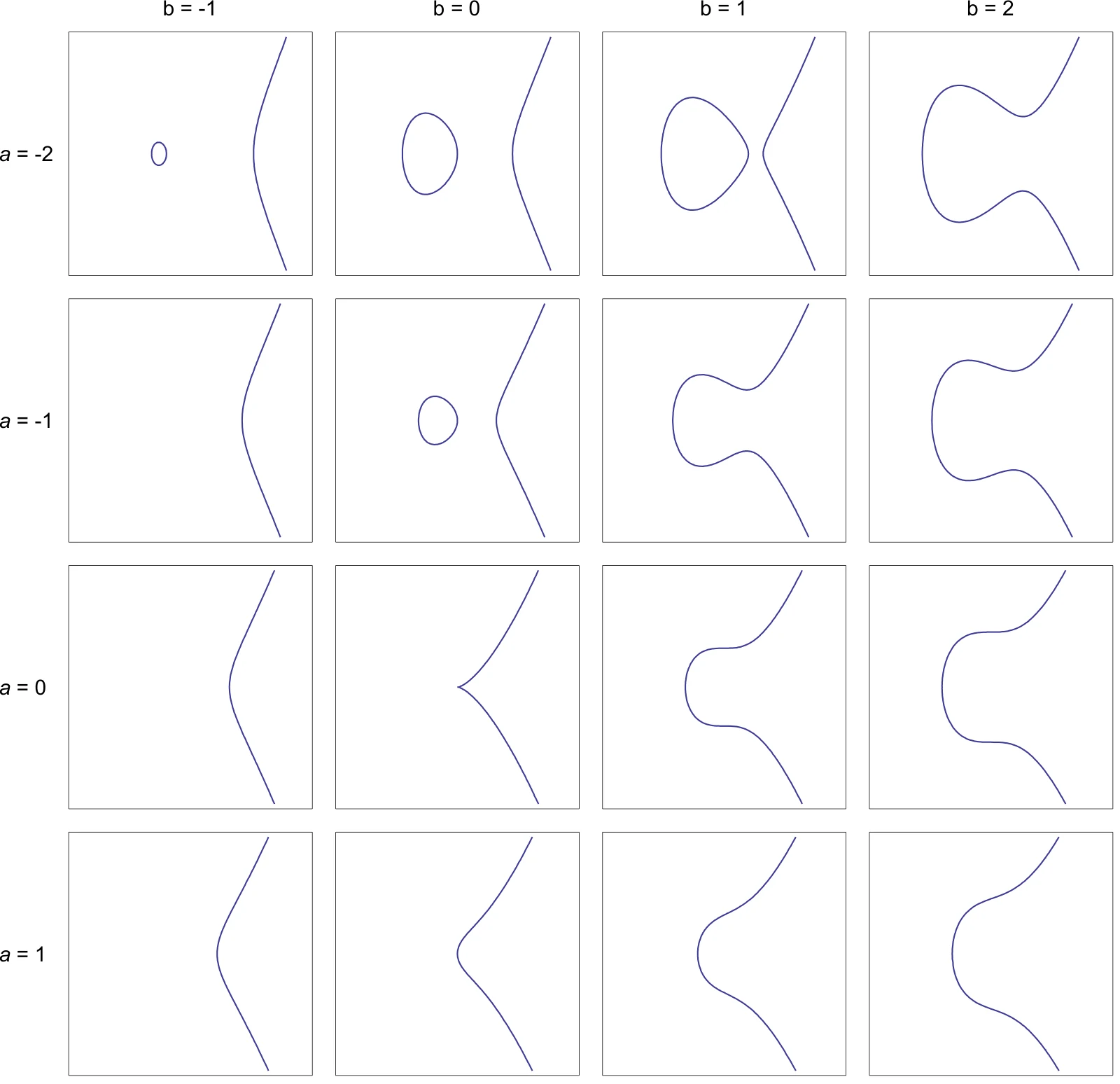
The boundary is equally important. A general mixed motive and its global -function remain more difficult than the pure smooth-projective example suggests. No finished modern formalism should be projected into the April 1967 exposition.
Biographically, the arithmetic direction shows why motives could attract mathematicians working on apparently different problems. It offered a program in which geometry, Galois theory, and number theory met. That breadth increased both its influence and the difficulty of complete redaction.
Motive and motive
Biography cannot use the mathematical idea as a machine for discovering psychological causes. It is tempting to say that, just as a motive lies behind its realizations, one true motive lay behind Grothendieck’s coming departure: pacifism, exhaustion, childhood displacement, moral disgust, conflict with Motchane, or a loss of faith in science. The analogy fails. A mathematical motive is proposed within a formal category and tested by realizations and compatibilities. A human action may have several causes, reasons articulated at different times, and meanings that change in memory. There is no theorem ensuring they descend from one object.
The name can nevertheless teach a discipline of observation. Different documents are not transparent substitutes. A board minute, a financial statement, a resignation letter, a colleague’s memory, and a retrospective spiritual account are distinct realizations of a historical episode, each shaped by its medium. The task is not to invent a hidden essence but to compare them, note compatibilities, and keep contradictions visible.
That discipline begins with motives themselves. The 1964 letter establishes a named thought in correspondence. The 1967 poster establishes public exposition. Manin establishes an early published development. Kleiman establishes a precise bridge from cycles to the Weil conjectures. Grothendieck’s 1969 article establishes a compact declaration of standard conjectures. Later testimony establishes how participants remembered the oral program. No one source contains the whole.
The program was therefore already collective in its form. It traveled because it was incomplete enough to invite construction and exact enough to constrain it. This combination distinguishes a fertile conjectural language from a slogan. Mathematicians could disagree about definitions and still know which phenomena demanded explanation. They could build categories under different equivalence relations and still recognize the same pressure toward a common cohomological source.
The April 25 poster can now be read without either exaggeration. It was not the announcement of a finished universal theory. It was not a vague lecture later inflated by legend. “Esquisse d’une théorie des motifs” accurately described a program whose sketch would organize decades of work. A sketch can determine proportions, relations, and direction before every wall is built.
At the summit, Grothendieck’s strongest monument was EGA, where a vision had become exhaustive written architecture. Motives were the complementary achievement: a vision that remained dispersed and therefore exposed the social conditions of mathematical creation. The next problem was whether the missing structural assertions about algebraic cycles were true. Those assertions would be called the standard conjectures. Their name sounded settled. Their content marked the frontier.
Three small motives
The program becomes less vaporous through elementary cases. Begin with a point over a field . Its motive is the unit object. A reasonable cohomology theory assigns the coefficient field in degree zero and nothing in higher degrees. The example is almost empty, but it fixes the tensor unit from which twists and products can be calibrated.
The projective line already decomposes. Its cohomology has a degree-zero part and a degree-two part. Motivically one writes, according to convention,
where is the Lefschetz motive; in a dual convention the corresponding Tate twist may be written differently. The notation is less important here than the fact of decomposition. An ordinary irreducible variety can yield more than one motivic piece because its cohomology has algebraically projectable degrees.
The formula is an ideal example of the prism image from the previous section. The point-like contribution and the top-degree contribution are cut out by algebraic correspondences. No unproved standard conjecture is needed for this simple case. The decomposition demonstrates on a small object what the general Künneth conjecture asks for every smooth projective variety.
A smooth projective curve offers a richer pattern:
The middle motive carries information related to the Jacobian of the curve. Different realization functors send it to the first Betti, de Rham, or -adic cohomology. The dimensions agree—twice the genus—but the realizations carry different additional structures.
For an elliptic curve, the middle piece is two-dimensional under familiar realizations. Over the complex numbers, periods arise by integrating differential forms over topological cycles. Over a finite field, -adic cohomology carries Frobenius, whose characteristic polynomial controls point counts. The motivic hope says these are not unrelated coincidences. They are different views of one algebraic piece.
The example is genuine and deliberately limited. It does not identify a complex period with a Frobenius eigenvalue, since they live in different realizations and coefficient systems. It says that the same elliptic curve supplies both structures and that a motivic framework seeks their common algebraic origin. This distinction supplies the boundary step that the musical-theme analogy alone cannot provide.2222Manin, “Correspondences, Motifs and Monoidal Transformations”; Deligne, “Quelques idées maîtresses de l’œuvre de A. Grothendieck”.
Historically, curves and abelian varieties offered evidence because their correspondences and divisor theory were better controlled than higher-codimension cycles on general varieties. Success there did not settle the general category.
Even this example must be handled carefully. The motive does not let a reader compute every period from point counts by a simple dictionary. Comparison occurs after choices and within precise categories. The common object organizes why several theories attach compatible rank-two data; it does not abolish arithmetic difficulty.
Products add another test. The motive of should be the tensor product of motives of and . Realization then recovers a Künneth decomposition of cohomology. A category that failed this compatibility would not explain the repeated product formulas already known across cohomology theories.
Blow-ups show motives responding to geometric transformation. If a smooth variety is blown up along a smooth center of codimension , the expected pure-motive formula relates the blow-up to and several twists of :
up to covariant/contravariant and twist conventions. Manin’s early work made transformations of this kind central. The formula says that the exceptional divisor contributes controlled pieces derived from the center rather than arbitrary new cohomology.2323Manin, “Correspondences, Motifs and Monoidal Transformations”.
For biography, the example shows what it means to “develop” someone else’s program. Grothendieck supplied the vision and categorical setting. Manin’s paper gave definitions and proved relations in a significant geometric operation. Calling the formula only Grothendieck’s would erase the mathematical act that made it available. Calling motives only Manin’s would erase the program to which the title explicitly belongs.
These small cases also show why a universal object was plausible. Points, projective spaces, curves, abelian varieties, products, and blow-ups displayed decompositions compatible across cohomologies. The difficult question was not whether any motives could be defined. It was whether the full category had the independence, algebraic projectors, duality, and positivity expected in general.
Pure objects and mixed lives
The original pure theory is most comfortable with smooth projective varieties. Smoothness avoids singular complications; projectivity supplies compactness-like duality and hyperplane classes; purity gives cohomology a controlled weight. Much of algebraic geometry lies outside those conditions. An affine line is not projective. A punctured curve is not complete. Degenerating families produce singular fibers. Arithmetic geometry constantly encounters open schemes.
A theory of mixed motives was meant to incorporate these objects through extensions of pure pieces. The word mixed does not mean an informal blend. In Hodge theory and -adic cohomology, mixed structures carry filtrations whose graded pieces have pure weights. A mixed-motive category should explain those filtrations before realization.
Extensions matter because a mixed object can contain more information than the list of its pure graded pieces. Two objects with the same pieces may be glued differently. The gluing can encode periods, regulators, and arithmetic phenomena. A category that simply decomposed everything as a direct sum would miss this.
In the late 1960s no accepted general abelian category of mixed motives was available. It would be anachronistic to give Grothendieck a finished definition and then describe later work as filling details. The program contained desires: functorial cohomology, six operations, weights, realizations, and a Galois formalism. Later constructions answered portions under different hypotheses.
The purity boundary also explains why standard conjectures focus on smooth projective varieties and algebraic cycles. They address the foundation where Lefschetz and positivity can be stated most cleanly. A secure pure theory was expected to support the mixed extension. Difficulty at the foundation propagated upward.
Grothendieck’s later language of open construction sites fits this mathematical condition, but it should not become a romantic image of ruins. A chantier is active because tasks are specified. Projectors must be algebraic. Equivalence relations must coincide. Realizations must be compatible. Extensions must form a workable category. The program’s incompletion consisted of exact missing structures.
The mixed ambition also reveals why motives connected to number theory beyond the Weil conjectures. Special values of -functions, algebraic cycles, extensions, and periods repeatedly suggest motivic organization. Much of that history unfolded after 1970. This chapter names the direction without crediting the early sketch with every later conjecture.
Symmetry after realization
Classical Galois theory provides a template for reconstruction. A group can be studied through its representations on vector spaces. Under suitable conditions, the tensor category of representations, together with the forgetful functor to vector spaces, determines the group. Tannakian category theory makes that statement precise.
If motives form a tensor category and a realization supplies a fiber functor, automorphisms of that functor should form a motivic Galois group. Its representations would be the realized motives. The group would encode symmetries common to the cohomological data, extending the role of ordinary Galois groups.
The idea is powerful and chronologically treacherous. Grothendieck’s program sought a Galois theory for cohomology and motives. The mature neutral Tannakian formalism, including decisive work by Saavedra, Deligne, Milne, and others, developed later. A sentence saying that Grothendieck “constructed the motivic Galois group” in 1967 is false. He opened the program in which such groups became natural.
There is also no single motivic Galois group without choices. The base field, coefficient field, category of motives, equivalence relation, and realization matter. Mixed and pure settings behave differently. Some categories are neutral Tannakian only after conditions or modifications. General-reader prose should retain the plural possibilities rather than presenting one universal symmetry group as an established object.
The analogy to ordinary Galois theory illuminates Grothendieck’s style. Instead of asking only for individual invariants, reconstruct the hidden symmetry organizing all compatible invariants. Instead of treating comparison isomorphisms as accidents, make them representations of one group-like source. The same movement appears in his fundamental groups and categories: understand an object through the network of things mapping to or represented by it.
Motivic Galois language later became central to relations among periods, algebraic cycles, and automorphic forms. Those later successes explain why commentators call motives a broken or unfinished dream. The adjective broken should not imply inactivity. The dream generated working mathematics precisely because partial categories and realization functors could be studied before the universal form existed.
What the name accomplished
Grothendieck treated naming as part of discovery. A good name gathers examples without pretending to define them. Scheme, topos, crystal, and motive each supplied an image and a technical destination. The names were not interchangeable branding. They altered what mathematicians expected the object to do.
“Universal cohomology” would have described a function. “Motive” suggested a recurrent form behind several appearances and something that sets mathematical action in motion. The term was short, portable across languages, and open enough to survive changes in definition. That openness helped and endangered it.
It helped because mathematicians could recognize a shared program while constructing different categories. Chow motives, homological motives, numerical motives, mixed motives, and motivic cohomology all retained a family resemblance. It endangered because the word could be invoked without specifying which category or equivalence relation was meant.
A biography should therefore identify each use as pure or mixed, specify the equivalence relation, distinguish conjectural from constructed objects, and name whether the source is Grothendieck’s text or a later author’s. Precision does not drain the name’s imaginative force. It prevents imagination from substituting for mathematics.
The name also affected credit. Once “motives” became standard vocabulary, Grothendieck’s role could seem universally known and therefore uncited. Serre later defended that tacit knowledge. But vocabulary can outlive the community that remembers its origin. Explicit historical citation becomes more necessary as the term becomes ordinary.
Conversely, attaching Grothendieck’s name every time can erase the work that made a particular theory rigorous. “Grothendieck motives” is useful for the originating program. “Chow motives,” “numerical motives,” or “Voevodsky motives” identify different constructions and histories. Names can distribute credit if used at the right resolution.
The April 1967 poster shows an early public use before the terminology hardened. Its title calls the lecture an esquisse. A reproduction would let readers see a concept between private letter and textbook noun. The date and train time surround a word whose future importance no poster could certify.
A publication ecology
Sources offer several partial explanations for the absence of a motivic equivalent to EGA and no complete one. Grothendieck’s agenda was already extensive. Motives depended on unproved standard conjectures. Oral exposition allowed rapid development. Other mathematicians were publishing parts. The institutional break ended the seminar regime before a full redaction emerged.
The evidence does not identify one personal reason for the absence of an EGA-scale motives treatise. The documented differences are structural: the object and stage of theory, unproved conjectures, distributed publications, and the later institutional rupture.
EGA addressed foundational material much of which could be proved and ordered. Motives sat at the junction of known examples, desired categories, and open conjectures. Writing a complete treatise might have required deciding questions the program existed to pose. A sketch and network of papers were not necessarily a failed manuscript strategy; they matched a frontier.
Correspondence served one part of the ecology. A letter to Serre could state ideas compactly for a reader who knew the background and would answer critically. Seminar served another. A public talk could test a framework among specialists. Manin’s and Kleiman’s papers served others: formalization, exposition, proof, and international circulation.
The ecology was unequal in accessibility. A mathematician close to Bois-Marie heard more than one who saw only published pages. Herreman emphasizes Grothendieck’s later belief that essential content remained oral. That inequality may have contributed to later disagreement about what had been transmitted and what others independently created.
Publication would not have eliminated disagreement. A written program can be read differently. It would have fixed language and claims at a date. The absence of such a text makes archival modesty imperative. Historians should not reconstruct the “true theory” by choosing later mathematics that best fits their image of Grothendieck.
The incomplete ecology also challenges the idea that a scientific contribution must be a discrete paper. Grothendieck’s motivic contribution included naming, conjectures, letters, seminar direction, and a conceptual demand that others made precise. Evaluation systems built around authored articles undercount that form of work. Heroic biography can overcount it by absorbing all downstream results.
The right measure lies between: identify what the program made possible, and keep every downstream theorem with its author.
The archive of what was not written
An archive contains absences only indirectly. The 1967 poster shows that an exposition continued, which implies at least one earlier session, but the available record has not located notes. The 1964 letter identifies a term, but its printed page and exact phrasing remain to verify. Later testimony describes lunch conversations, but no recorder preserved them as minutes.
These gaps should be marked, not filled with plausible mathematics. One can infer that a talk called “Sketch of a theory of motives” addressed motives. One cannot infer that it contained the later definition a textbook now uses. The date secures chronology, not content.
The surviving mathematical papers provide bounds. Manin’s 1968 construction shows ideas available by then. Kleiman’s 1967 exposition shows the standard conjecture formalism. Grothendieck’s 1969 article shows his public formulation. If a later concept is absent from all three, attributing it to the April talk requires additional evidence.
Retrospective Récoltes et Semailles supplies another bound. Grothendieck remembered a broader vision, but memory after later developments can reorganize earlier thoughts. His testimony deserves serious attention and independent comparison. It cannot function as a time machine.
The archive also preserves unexpected material evidence. A poster can establish joint direction. A financial work inventory can establish bylines. Manuscript instructions can establish production practices. Histories of ideas become stronger when they admit such administrative and typographic sources alongside famous papers.
Motives are especially vulnerable to disembodied history because the concept itself concerns a hidden common source. The narrative can begin to imitate the mathematics, searching beneath documents for one pure vision. The responsible method is the opposite. Stay with the realizations that survive, identify their media, and refuse to claim the hidden object has been recovered.
That refusal does not impoverish the story. It reveals a program living through letters, rooms, paper, other minds, and future work. Incompletion becomes visible as a social fact rather than a romantic void.
What realizations preserve—and lose
A realization functor is useful only because it preserves specified structure. Betti realization retains graded rational vector spaces and topological operations for a complex variety. De Rham realization retains algebraic differential information and filtrations. An -adic realization carries a continuous Galois action when the variety is defined over a nonclosed field. These outputs are not bare vector spaces viewed under different names.
Comparison is therefore structured. For a smooth projective variety over a subfield of , Betti cohomology tensored with compares with algebraic de Rham cohomology tensored with . Period integrals mediate the relation. For -adic cohomology, comparison may require algebraic closures, embeddings, and -adic theories in settings developed later.
The motive is expected to preserve the part common enough to generate these outputs and not every analytic or arithmetic decoration automatically. A realization can add structure through the target category. Saying that the motive “contains all cohomologies” is shorthand and can be false if heard literally.
Faithfulness is another issue. A realization is faithful if different motivic morphisms remain different after realization. Fullness asks whether every target morphism of the required kind comes from a motivic one. The standard and Hodge/Tate conjectures can be expressed through such properties in appropriate categories. Universal vision becomes a question about functors.
This precision explains why equivalence relations matter. If motives are defined modulo homological equivalence for one realization, that realization is faithful by construction but independence is jeopardized. If defined modulo numerical equivalence, intrinsic semisimplicity improves while the path to a given realization requires D. There is no cost-free choice.
What motives deliberately lose can be valuable. Passing modulo an equivalence forgets distinctions among cycles. Projecting to one summand forgets the complement. Twisting normalizes degrees. Universality here is achieved by controlled forgetting, not maximal accumulation.
The language of essence hides this sacrifice. A better general-reader image is a common score written only for features every authorized performance must realize. Ornament specific to one instrument is not in the score, and some proposed notes are known only conjecturally. Even this image fails where realizations are not equally faithful.
Objections that sharpened the program
One objection to motives is circularity: a category built from cycles modulo homological equivalence appears poorly placed to explain cohomology. Grothendieck’s program sought intrinsic equivalence through standard conjecture D. The objection identifies why D matters.
Another objection concerns examples. A theory at extreme generality can become empty if it has no calculable objects. Projective spaces, curves, abelian varieties, and blow-ups supplied a test bed. Manin’s formulas and Kleiman’s consequences showed that the framework did work before its universal claims were settled.
A third concerns existence. Projectors visible in cohomology may not be algebraic. The category of pure motives can formally include projectors only when a cycle represents them. Standard conjecture C/B addresses this. The program did not simply decree every cohomological summand motivic.
A fourth concerns mixed objects. Smooth projective varieties are too narrow for geometry and number theory. Later theories of mixed motives show the force of the objection. In the 1960s it remained an expansion requirement, not a refutation of pure motives.
A fifth concerns excessive dependence on conjectures. Conditional categories can appear speculative. Yet unconditional variants—Chow motives, numerical motives, categories under chosen homological equivalence—permit theorems. Keeping variants separate lets mathematics proceed while recording what each conjecture would add.
These objections demonstrate an important feature of Grothendieck’s theory-building. Generality was not a fog protecting an idea from criticism. Each desired universal property generated a precise failure mode.
The program’s later durability came partly from this modularity. If one conjecture remained open, another version of the category could still be studied. If mixed motives resisted an abelian construction, triangulated approaches could capture operations. The name held a family of disciplined approximations.
A fair sentence about origin
Grothendieck named motives, framed them as a universal cohomological program, connected them to algebraic correspondences and Galois ideas, formulated standard conjectures needed for their desired structure, and transmitted the program through letters and seminars.
He did not publish a complete foundational treatise, construct every later category of motives, prove the standard conjectures, or supply the mature Tannakian and mixed formalisms.
Contemporaries performed other identifiable work. Serre supplied crucial cohomological stimuli and dialogue. Manin published foundational constructions. Kleiman systematized cycles and consequences. Lieberman and others proved cases. Deligne absorbed and transformed the program. The list is illustrative rather than exhaustive.
The fair sentence is necessarily compound because origin was compound. “Grothendieck invented motives” is acceptable as a headline only if the text immediately explains what invention means. Without that explanation it can imply a finished object made alone.
This standard also protects Grothendieck. Saying “motives were never completed” can sound as though his contribution was only a name. The exact conjectures, categorical moves, and realization problem show otherwise. Incompleteness belongs to the scale of the ambition, not absence of mathematics.
The same standard will govern motives in later chapters. When a construction appears after 1970, its author receives the theorem. The relation to Grothendieck is stated through documented program, terminology, or correspondence. Descent never substitutes for authorship.
The 1967 poster remains the right emblem because it says only what the evidence can bear: there was a continuing exposition, it concerned a sketch, Grothendieck gave it, and listeners could reach Bois-Marie by a particular train. From that bounded event, a long future opened.
A heuristic before a category
Motivic thinking could guide work even where the category was conjectural. If several realizations displayed the same decomposition, one could search for an algebraic projector. If zeta and -functions had compatible factors, one could ask which motivic pieces they belonged to. If a blow-up changed cohomology predictably, one could formulate the change at the level of motives.
This heuristic role is historically important. A program need not wait for foundations to influence questions. Physicists use unconstructed objects heuristically; mathematicians use conjectural categories with explicit care. The difference between heuristic and theorem is maintained by conditional language.
Grothendieck’s influence was strongest where the heuristic generated exact tasks. “Find the universal cohomology” is too broad for a thesis. “Show this projector is algebraic,” “construct this realization,” or “prove this blow-up decomposition” can organize work.
The standard conjectures converted heuristic confidence into named conditions. Manin’s paper converted it into examples and operations. Later theories converted other portions into definitions. This gradual embodiment explains why no date can mark the completion of motives.
It also explains why retrospective claims of abandonment are difficult to assess. A broad heuristic can have descendants that no longer use its original vocabulary or pursue its preferred foundations. One observer sees continuation; another sees diversion.
For historians, the test is not verbal resemblance alone. A later work belongs to the motivic lineage when sources show shared objects, conjectures, realization structures, or acknowledged influence. Calling every universal construction “Grothendieckian” empties the genealogy.
For mathematicians, the heuristic’s value appears in coherence across problems. Motives connected cycles, cohomology, Galois action, weights, and -functions. Even partial construction could reveal that a theorem in one area should have an analogue in another.
For Grothendieck, as later testimony suggests, the heuristic may have been more vivid than the surviving pages. That disparity between lived vision and public record is common in creative work. History honors it by reporting testimony and refuses to reconstruct it as fact.
Motives at the summit were therefore three things at once: defined objects in restricted settings, a conjectural category with desired properties, and a heuristic for future mathematics. Any sentence using the singular “the theory of motives” should disclose which one it means.
Where each claim is realized
The mathematical vocabulary suggests a useful editorial test, provided it remains an analogy. For every large claim about motives, ask through which document it is realized.
“Grothendieck had named the program by 1964” realizes in a dated letter record.
“He lectured publicly on it in 1967” realizes in an IHÉS poster.
The claim that the program had rigorous early constructions by 1968 is realized in Manin’s paper.
“It depended on algebraic-cycle conjectures” realizes in Kleiman and Grothendieck’s Bombay article.
“It was transmitted orally” realizes as Grothendieck’s later testimony and Illusie’s recollection, not as a transcript of the theory.
The test prevents a later textbook from becoming evidence of what an April 1967 audience heard. It also prevents archival gaps from reducing the program to nothing.
Unlike a mathematical realization functor, a document can distort, omit, and change genre. The analogy stops before claiming faithful reconstruction. Its value is procedural: attach every assertion to a medium.
The same procedure will govern later credit disputes. A remembered conversation is evidence that someone remembers a conversation. A published proof is evidence of a proof. A citation is evidence of acknowledged textual relation. None automatically realizes another.
Motives thus train the narrative in restraint. The strongest idea in this chapter is also the least embodied in one canonical text. Its history has to remain distributed.
That distribution is not an embarrassment to be solved at integration. It is part of what motives were between 1964 and 1969: a name moving faster than a treatise, exact enough to guide construction and open enough to require it.
Periods provide a final example of the vision’s reach. A period can arise by integrating an algebraic differential form over a topological cycle. Its definition mixes algebra, analysis, and topology; its numerical value can hide the geometry that produced it. A motivic account seeks to place such numbers inside comparison between Betti and de Rham realizations.
This direction became far more developed later and should not be assigned in finished form to the 1967 exposition. It illustrates why one common source mattered. Comparison isomorphisms assert more than agreement of dimensions: they create arithmetic numbers whose relations should reflect motivic relations.
The motive is therefore neither a number nor a cohomology group. It is the proposed algebraic object making several such outputs part of one story. That distinction closes the conceptual window and returns the chapter to its historical evidence: Grothendieck named the story, and a community began to write its separate chapters.
No later completion can retroactively make the sketch complete, and no archival gap can erase its organizing force. Between those limits lies the historical claim this chapter can defend: motives were already a shared mathematical program by the late 1960s, authored through unequal but identifiable acts.
注释
- Grothendieck and Serre, Correspondance Grothendieck–Serre, metadata. ↩
- Institut des Hautes Études Scientifiques, Archives de l’IHÉS, poster, “Esquisse d’une théorie des motifs,” April 25, 1967, J6.1.7/1. ↩
- Grothendieck, “Standard Conjectures on Algebraic Cycles”; Steven L. Kleiman, “Algebraic Cycles and the Weil Conjectures,” in Dix Exposés Sur La Cohomologie Des Schémas, Advanced Studies in Pure Mathematics 3 (North-Holland; Masson, 1968); Yuri I. Manin, “Correspondences, Motifs and Monoidal Transformations,” Mathematics of the USSR-Sbornik 6, no. 4 (1968): 439–70, https://doi.org/10.1070/SM1968v006n04ABEH001070; Illusie and et al., “Reminiscences of Grothendieck and His School”, for recalled conversations. ↩
- Kleiman, “Algebraic Cycles and the Weil Conjectures,” 359–61; Cartier, “A Mad Day’s Work,” 405–7. ↩
- Cartier, “A Mad Day’s Work”; Pierre Deligne, “Quelques idées maîtresses de l’œuvre de A. Grothendieck,” in Matériaux pour l’histoire des mathématiques au XXe siècle, Séminaires et Congrès 3 (Société Mathématique de France, 1998). ↩
- Kleiman, “Algebraic Cycles and the Weil Conjectures,” sec. 1. ↩
- Manin, “Correspondences, Motifs and Monoidal Transformations”. ↩
- Kleiman, “Algebraic Cycles and the Weil Conjectures,” secs. 1–3. ↩
- Manin, “Correspondences, Motifs and Monoidal Transformations”. ↩
- Manin, “Correspondences, Motifs and Monoidal Transformations”. ↩
- Kleiman, “Algebraic Cycles and the Weil Conjectures,” 360. ↩
- Grothendieck, Récoltes et Semailles (Université des Sciences et Techniques du Languedoc and Centre National de la Recherche Scientifique, 1986), 210, 840; Jackson, “As If Summoned from the Void, I,” 1046–48; Alain Herreman, Découvrir et transmettre: La dimension collective des mathématiques dans *Récoltes et Semailles* d’Alexandre Grothendieck, IHÉS preprint M/00/75 (Institut des Hautes Études Scientifiques, 2000), https://archives.ihes.fr/document/M_00_75.pdf, around pp. 492–496 of transcript. ↩
- Illusie and et al., “Reminiscences of Grothendieck and His School,” 2–3. ↩
- Herreman, Découvrir et transmettre: La dimension collective des mathématiques dans *Récoltes et Semailles* d’Alexandre Grothendieck. ↩
- Jackson, “As If Summoned from the Void, I”; Illusie and et al., “Reminiscences of Grothendieck and His School”; Artin et al., “Alexandre Grothendieck 1928–2014, Part 1”; Artin et al., “Alexandre Grothendieck 1928–2014, Part 2”. ↩
- Manin, “Correspondences, Motifs and Monoidal Transformations”. ↩
- Kleiman, “Algebraic Cycles and the Weil Conjectures,” 359–61. ↩
- Kleiman, “Algebraic Cycles and the Weil Conjectures,” secs. 1–3. ↩
- Kleiman, “Algebraic Cycles and the Weil Conjectures,” secs. 1–3; Uwe Jannsen, “Motives, Numerical Equivalence, and Semi-Simplicity,” Inventiones Mathematicae 107 (1992): 447–52, https://doi.org/10.1007/BF01231898. ↩
- Jannsen, “Motives, Numerical Equivalence, and Semi-Simplicity”. ↩
- Kleiman, “Algebraic Cycles and the Weil Conjectures,” 359–86; Deligne, “Quelques idées maîtresses de l’œuvre de A. Grothendieck”. ↩
- Manin, “Correspondences, Motifs and Monoidal Transformations”; Deligne, “Quelques idées maîtresses de l’œuvre de A. Grothendieck”. ↩
- Manin, “Correspondences, Motifs and Monoidal Transformations”. ↩