November 13, 2014
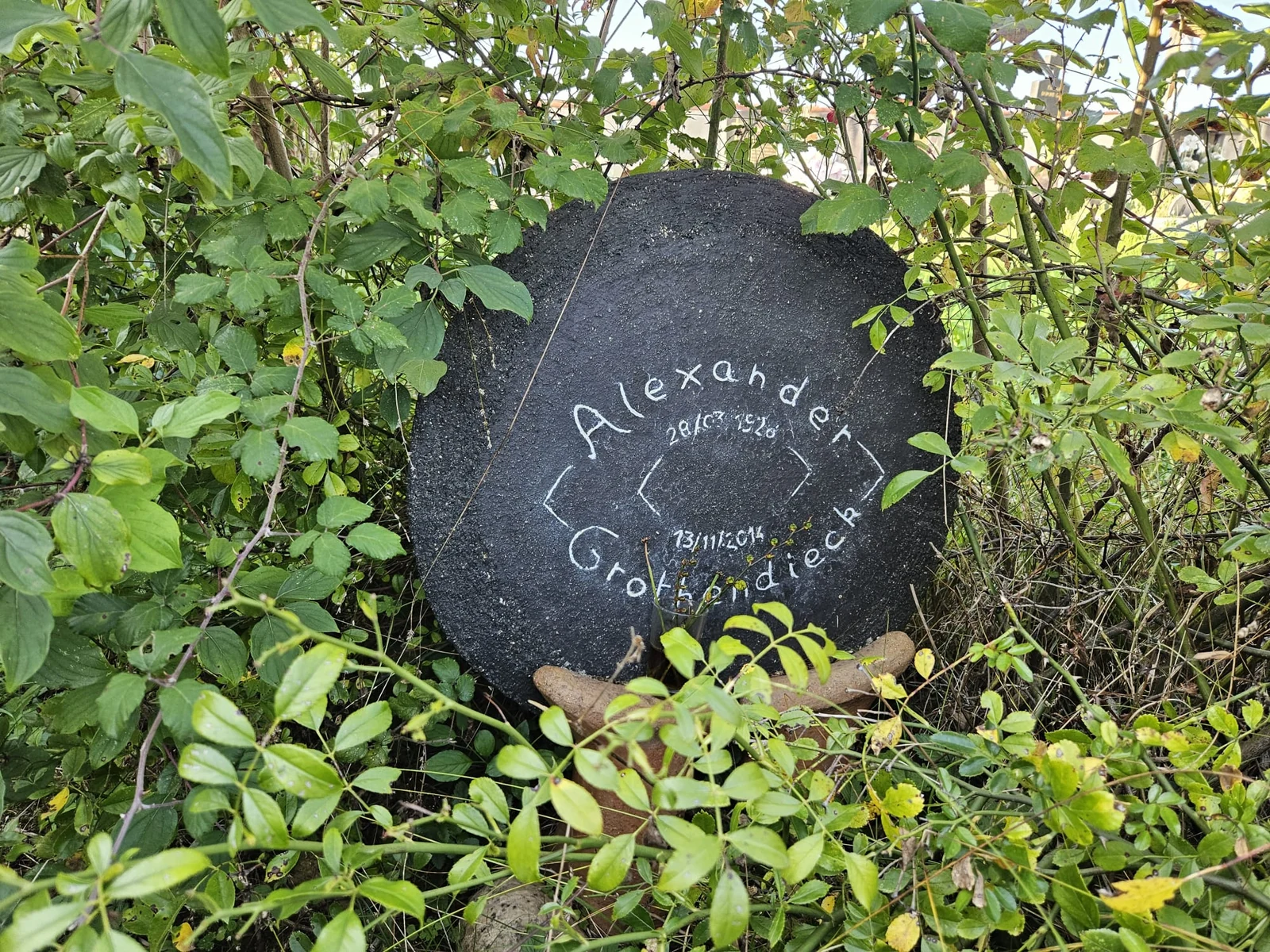
Alexander Grothendieck died at age eighty-six on Thursday, November 13, 2014, at the hospital reported as Saint-Girons, in Ariège. Hospital officials confirmed the death and did not disclose a cause, explicitly preserving medical privacy. 11Associated Press, “Alexander Grothendieck, Iconic Mathematician, Dies at Age 86”; Weber and Rehmeyer, “Alexander Grothendieck, Math Enigma, Dies at 86”; Université de Montpellier, “28 000 pages d’Alexandre Grothendieck”.
Those sentences are the complete verified scene. They contain date, age, institution, and boundary. No reliable source used here supplies last words. No one records a final mathematical remark. No bedside dialogue is needed. The room, light, weather, visitors, and state of mind remain outside the chapter. 22CNRS Le Journal, Disparition d’un génie des mathématiques; Associated Press, “Alexander Grothendieck, Iconic Mathematician, Dies at Age 86”; Weber and Rehmeyer, “Alexander Grothendieck, Math Enigma, Dies at 86”.
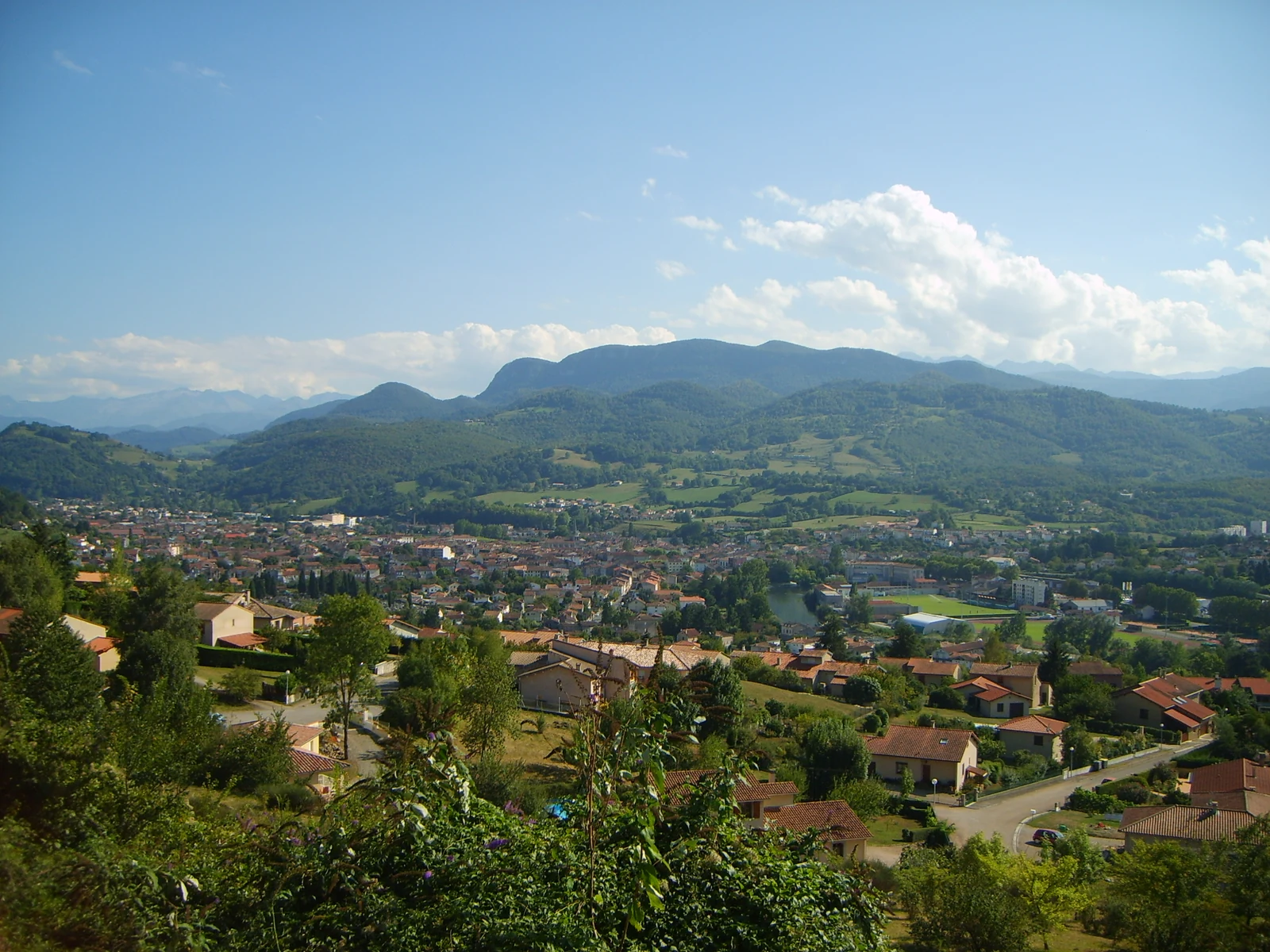
The title follows the place-name used by contemporary reports: Saint-Girons. It is not a claim about the technical municipal boundary of a hospital campus, nor an invitation to map a bed. The geographical scale required for biography is the Couserans region of Ariège: Lasserre, where he had lived since 1991, and the hospital serving the nearby center. 33Associated Press, “Alexander Grothendieck, Iconic Mathematician, Dies at Age 86”.
The date requires one small act of source criticism. A University of Montpellier archive overview gives November 14, while the university’s dedicated 2017 article gives November 13 and contemporary reports identify Thursday the 13th. The latter alignment controls. Institutional status does not make every date immune to error. 44Université de Montpellier, “Archives Grothendieck”; Université de Montpellier, “28 000 pages d’Alexandre Grothendieck”; Associated Press, “Alexander Grothendieck, Iconic Mathematician, Dies at Age 86”; Weber and Rehmeyer, “Alexander Grothendieck, Math Enigma, Dies at 86”.
Precision matters most at death because errors harden into inscriptions, captions, and chronologies. The documented record is March 28, 1928, to November 13, 2014. The following day belongs to public announcement, not to the life date.
A death record is not a death scene
The difference between a record and a scene is one of evidentiary form. A record identifies an event through institution, date, and named source. A scene supplies spatial relations, action, sensory detail, and often dialogue. The first can be established by hospital confirmation. The second requires witnesses willing and able to describe what they observed.
No such witnessed scene meeting the threshold is available here. The absence cannot be repaired by ordinary hospital imagery: a corridor, a window, machines, winter light. Those details would be generic inventions masquerading as specificity. The more plausible they sound, the more dangerous they are.
Nor should the chapter work backward from the cause of death. Hospital officials declined to specify it, and contemporary reporting respected that limit. A writer might infer from age or later anecdotes, but inference would violate both source and privacy. “He died in hospital at eighty-six” is not an incomplete medical sentence. It is the complete public fact.
The same restraint applies to presence. An obituary may report family relationships elsewhere, but it does not establish who was at the hospital at a particular hour. To add a vigil or solitary death would use private people as symbols. This account adds neither.
Last words are especially seductive. They seem to turn death into summary, and famous mathematicians are often assigned a final equation, joke, or insight. No verified last words appear in the sources. The absence should be visible. Grothendieck had already left tens of thousands of written pages across a lifetime; biography does not need one invented sentence to make them meaningful.
Even the exact time of death is unnecessary. The day suffices for chronology. An hour would add false precision unless supplied by a public civil record and needed for a historical question. It would not change the account.
Burial is also outside this chapter. No authoritative source establishes arrangements, and the location could create another site of intrusion. Part XI ends with the public death record, not a tour of private mourning.
This method may feel austere because death chapters often promise intimacy. Here austerity is fidelity. The hospital’s boundary and Grothendieck’s earlier boundary point in the same direction: record what became public, do not turn proximity to death into entitlement.
Why Saint-Girons
Place-names at death often carry several scales. A hospital may serve one town while standing near or across an administrative boundary. A news desk uses the name readers recognize. A civil record may use a commune. This chapter follows the contemporary hospital reporting and makes no finer claim than the source supports.
Saint-Girons also situates the end within the same Ariège region as Lasserre without exposing a residence. The map can show relation between communes and the regional center. It does not need an ambulance route, hospital entrance, or property pin.
The title is therefore documentary rather than symbolic. It does not suggest that Grothendieck returned to public urban life, that the town explained his death, or that a final journey completed an arc. It names the place attached to the reported event.
This caution contrasts with the use of “Lasserre” in legend. One place-name became shorthand for decades of privacy; the other can become shorthand for a final scene. Both must be returned to scale. A commune is not a diagnosis, and a hospital town is not a last word.
The regional map also corrects a vague phrase often used in international accounts: “somewhere in the Pyrenees.” By 2014, Lasserre and Saint-Girons were publicly named. Precision at commune scale is historical; precision at household scale remains unnecessary.
The map’s caption should explain this choice. It will say that Saint-Girons is the place-name used in contemporary reports and that no residential address is shown. Cartography then becomes an instrument of restraint rather than surveillance.
The following day
On November 14, CNRS published an institutional notice. It described Grothendieck as one of the greatest mathematicians of the twentieth century, recalled his Fields Medal, departures, activism, Montpellier and CNRS career, and withdrawal to an Ariège village from the early 1990s. Its president and mathematical officials spoke about the scale of his contribution. 55CNRS Le Journal, Disparition d’un génie des mathématiques.
The notice performed a familiar task: turn a long, discontinuous life into a public sequence within hours. Birth, war, mathematics, prize, protest, retreat, death. Every obituary must compress. The ethical question is which complexities compression erases.
In Grothendieck’s case, two erasures were especially tempting. One could make 1970 the end of mathematics and treat everything after as eccentric withdrawal. Or one could end with triumph, allowing schemes and cohomology to eclipse activism, conflict, religious writing, and refusal. Part XI has shown why neither summary is adequate.
The contemporary press knew that he had lived in Lasserre and described him as living in seclusion. It knew of unpublished notes at Montpellier in broad terms. It did not possess the 2023 BnF catalog, its forty-three boxes, or the component chronology of Réflexions sur la Vie et le Cosmos. Later knowledge must not be placed in reporters’ hands in 2014. 66Bibliothèque nationale de France, NAF 29093. Fonds Alexandre Grothendieck; Istituto Grothendieck, “Handover of Unpublished Manuscripts of A. Grothendieck to the BnF”; Bibliothèque nationale de France, “Les manuscrits du mathématicien Alexandre Grothendieck entrent à la BnF”; Associated Press, “Alexander Grothendieck, Iconic Mathematician, Dies at Age 86”.
This temporal discipline changes the obituary scene. The public was not looking at a complete archive and choosing to ignore it. Much of the late work was unknown or described through rumor. Reports repeated claims about destruction and seclusion because those were legible narratives. The cataloged survival would become visible later.
News traveled in layers
The first layer was local and institutional. The hospital confirmed a death. Regional reporting connected the patient to Lasserre and Montpellier. National scientific institutions connected him to CNRS, IHES, the Fields Medal, and algebraic geometry. International reports translated those summaries for readers who might know the name only through a theorem or not at all. 77CNRS Le Journal, Disparition d’un génie des mathématiques; Associated Press, “Alexander Grothendieck, Iconic Mathematician, Dies at Age 86”; “Grothendieck, célèbre mathématicien qui a enseigné à Montpellier, est mort,” Midi Libre, November 14, 2014, https://www.midilibre.fr/2014/11/14/grothendieck-celebre-mathematicien-qui-a-enseigne-a-montpellier-est-mort-4214943.php.
At each layer, context changed. A regional article emphasized that Grothendieck had taught in Montpellier and lived in Ariège. The CNRS emphasized scientific transformation and career. An international wire report emphasized the contrast between mathematical stature, rejected honors, activism, and seclusion. None was a complete biography; each answered an audience’s first question. 88CNRS Le Journal, Disparition d’un génie des mathématiques; Associated Press, “Alexander Grothendieck, Iconic Mathematician, Dies at Age 86”; Midi Libre, “Grothendieck, célèbre mathématicien qui a enseigné à Montpellier, est mort”.
Archive scale shifted even within contemporary reporting. Midi Libre referred to 20,000 pages of unpublished notes associated with Montpellier. After formal processing, the university described a fonds of about 28,000 pages, around 18,000 of which were made available online. The discrepancy is not evidence that 8,000 pages suddenly appeared. It reflects preliminary public knowledge, later inventory, and counting conventions. 99Université de Montpellier, “Archives Grothendieck”; Université de Montpellier, “28 000 pages d’Alexandre Grothendieck”; Midi Libre, “Grothendieck, célèbre mathématicien qui a enseigné à Montpellier, est mort”.
This example shows why numbers in obituaries should be dated. “At the time, reports spoke of 20,000 pages” is a fact about 2014 knowledge. “The Montpellier fonds is about 28,000 pages” is the later institutional description. Both can be true in their documentary contexts.
The Lasserre corpus was still less clear publicly. Its later transfer was years away. Headlines could call Grothendieck prolific or secretive without knowing the component chronology. The BnF’s forty-one-volume sequence should therefore appear as retrospective knowledge: papers that existed at death but were not yet publicly described in that form. 1010Bibliothèque nationale de France, NAF 29093. Fonds Alexandre Grothendieck; Istituto Grothendieck, “Handover of Unpublished Manuscripts of A. Grothendieck to the BnF”.
Official praise moved quickly too. The French presidency, quoted in contemporary reports, called him one of the country’s greatest mathematicians and an extraordinary figure in philosophy of life. Such language records national commemoration. It should not be made to endorse every late philosophical claim. 1111Associated Press, “Alexander Grothendieck, Iconic Mathematician, Dies at Age 86”.
News also standardized spellings and names. French institutions often used Alexandre; the English title of this book uses Alexander Grothendieck. The choice is editorial, not a claim that one language form invalidates the other. Citations preserve source titles.
Within hours, a person who had limited access for decades became the subject of reusable summaries. That change in information flow is part of death’s public history. The subject could no longer correct, refuse, or qualify the summary. Source criticism therefore becomes more, not less, important after the announcement.
Digital publication accelerated the process. One wire paragraph appeared on many sites; repetition could look like independent corroboration even when all versions shared one report. This account counts source independence by origin, not by number of URLs.
The strongest death fact rests on converging origins: hospital confirmation in a wire report, a reputable obituary identifying Thursday in Ariège, the university’s later dated article, and the CNRS announcement the following day. This convergence supports November 13 without depending on rumor.
What the public could and could not see
By November 2014, Grothendieck’s early and middle mathematical work was deeply public. EGA and SGA had complex publication histories, but they belonged to the working literature. His Fields Medal and departure from IHES were standard biographical landmarks. Esquisse d’un Programme, Pursuing Stacks, and Récoltes et Semailles circulated in narrower but influential ways.
The Montpellier papers were known as a significant unpublished resource. The university later reported a 2010 deposit associated with Malgoire; this chapter does not infer donation, ownership, or copyright from that description. Full public digitization and the detailed portal had not yet arrived. A reporter’s page estimate was therefore necessarily provisional. 1212Université de Montpellier, “Archives Grothendieck”; Midi Libre, “Grothendieck, célèbre mathématicien qui a enseigné à Montpellier, est mort”.
The Lasserre papers presented a different visibility. Some reports said that Grothendieck had continued writing, and individual texts circulated. No public EAD tree allowed a reader to see volumes 3 through 43, their dates, and their titles. The phrase “left thousands of pages” did not yet have an audited referent. 1313Bibliothèque nationale de France, NAF 29093. Fonds Alexandre Grothendieck; Jackson, “As If Summoned from the Void, I,” nos. 9–10.
This matters to the interpretation of seclusion. Later cataloging proves that a substantial body existed behind the boundary. It does not prove that contemporaries were negligent for failing to assess it. one cannot review an inaccessible and uncataloged corpus as though its contents were known.
The distinction also protects against retrospective prophecy. Later editors may identify a mathematically interesting passage. That does not mean the 2014 obituary should have announced its significance. Historical actors know only what their sources make available.
Public visibility varied within the late writings. One mathematical manuscript had specialist editors and an online presence; La Clef had summaries and partial circulation; Réflexions sur la Vie et le Cosmos was largely unavailable. “The late work” therefore had no single access status. 1414Maltsiniotis, “Les Dérivateurs (The Derivators)”; The Grothendieck Circle, “Grothendieck’s Non-Mathematical Writings”; Jackson, “As If Summoned from the Void, I,” nos. 9–10.
Rights varied as well. Grothendieck’s 2010 declaration addressed reproduction across the range. Correspondents held rights in their own letters. Physical owners controlled access to objects. Heirs would enter after death. A news report could mention titles without settling any of these.
The public could see one additional thing clearly: Grothendieck had chosen not to re-enter ceremonial mathematical life. There was no late interview accompanying the obituary, no authorized self-summary, no reconciliation staged for the press. Absence remained part of the announcement.
What the public could not see should not be filled with retrospective certainty. The correct November 2014 tableau contains known mathematical achievement, incomplete archive knowledge, an established history of seclusion, and a newly confirmed death. It does not contain the later BnF reading room.
What died, what did not
Death ended Grothendieck’s ability to grant permission, retract a declaration, answer a letter, revise a manuscript, or destroy a page. It did not end the validity of a theorem, the influence of a concept, the rights of correspondents, or the privacy interests of other people.
The distinction is ordinary and profound. Mathematical statements are not biographical organs. Once definitions and proofs enter collective practice, they can be checked and extended without the author. Grothendieck’s schemes did not depend on his continued approval. Étale cohomology did not cease when he left IHES. A topos did not become an obituary metaphor.
Later mathematics did not execute instructions he had left. Programs guide, but researchers choose problems, alter definitions, find counterexamples, and combine sources. Anabelian geometry, dessins, and higher categorical work all have histories involving many people. Chapter 69 will follow that legacy; this chapter records only the transition from living founder to historical author.
The manuscripts occupy an intermediate position. Their physical marks became fixed at death, but their texts were not necessarily settled editions. Pages had variants, corrections, provisional tables, and unfinished parts. Editors could make them legible, but could no longer ask the author which state he preferred.
The 2010 declaration also remained. It became evidence of his late intention and part of the ethical history of every edition. Death did not make the page disappear. Neither did it automatically answer the legal question of posthumous publication. Succession and repository records would have to do work the author could no longer do.
The mathematics named in mourning
Obituaries repeatedly named algebraic geometry, but the phrase can conceal the magnitude of Grothendieck’s reorganization. Classical algebraic geometry studied solution sets of polynomial equations, often over familiar fields. Grothendieck’s scheme language made it possible to treat geometric and arithmetic phenomena within one relative framework, including infinitesimal structure and change of base. The point was not abstraction as escape; it was a language in which operations and comparisons became natural.
The relative viewpoint changed the basic question. Instead of asking only what an object is in isolation, one studies a morphism and how the object varies over a base. Fibers, families, and base change become structural. This language entered large areas of modern geometry and number theory.
Topoi enlarged another classical idea. A space could be approached through the sheaves living on it and the logic of their relations, not only through points. The concept supported new cohomology theories and later connections far beyond the setting in which it arose. A death notice could name topoi; explaining them fully belongs to earlier mathematical chapters.
Étale cohomology addressed a central need in arithmetic geometry: a cohomological theory suited to algebraic varieties over fields where ordinary topology could not supply the required invariants. Together with -adic methods, it created machinery crucial to the Weil conjectures. Pierre Deligne later completed their proof. Credit must preserve both the architecture and the theorem proved by another mathematician. 1515CNRS Le Journal, Disparition d’un génie des mathématiques; Jackson, “As If Summoned from the Void, I,” nos. 9–10.
Motives represented a hoped-for universal cohomological structure, a way to understand common sources behind different theories. Grothendieck’s program remained conjectural in important respects and stimulated vast later work. It exemplifies the distinction between founding a language, proposing a program, and proving its deepest claims. 1616Jackson, “As If Summoned from the Void, I,” nos. 9–10.
These examples explain why public tributes reached for superlatives. They also show why superlatives are inadequate. Grothendieck’s contribution lay in definitions, problems, institutions, seminars, collaborators, and shifts of viewpoint. No single eponym captures it.
The late mathematical programs extended the same preference for foundations in different directions. Esquisse d’un Programme helped launch anabelian geometry and the study of dessins d’enfants, while Pursuing Stacks articulated a homotopical and higher-categorical vision. Each had its own reception and collaborators. 1717Jackson, “As If Summoned from the Void, I,” nos. 9–10.
At death, these were not relics. Researchers had developed, altered, and sometimes replaced their formalisms. A concept’s life included disagreement. That is a stronger form of continuity than reverence: ideas were used where useful and criticized where not.
The final obituary chapter should not claim that all modern algebraic geometry is Grothendieck’s creation. His work built on predecessors and was realized with contemporaries, students, editors, and successors. The “great man” compression that makes a short obituary legible becomes distortion at book length.
Nor should mathematical accomplishment be used as a shield around every biographical choice. A correct theorem does not settle an ethical conflict. Refusal of military funding, accusations against colleagues, spiritual writing, and publication control require their own evidence and judgment. The integrated life contains separate standards.
The point of recalling the mathematics at death is narrower. It shows what remained public and testable when the person became unavailable forever. Proofs and definitions could be taught without access to Lasserre. Programs could be judged by later work. This public mathematical body formed one inheritance before the legal archive moved.
Grothendieck’s own metaphors of seed and harvest fit this collective afterlife, but they should not become a prophecy that every seed was his. Mathematics grows by cross-pollination, failed approaches, independent discovery, and correction. The originator matters; possession is never total.
The obituary problem
Obituaries prefer a governing contrast. Grothendieck offered many: stateless child and universal mathematician, collective seminar leader and recluse, prizewinner and refuser, rigorous geometer and spiritual writer. Each contrast contains truth; each can become a trap when one side is made to explain the other.
The phrase “from genius to hermit” treats public sociability as a measure of intellectual worth and late privacy as decline. “The saint who abandoned mathematics” turns conflict into holiness and ignores the technical manuscripts. “The mad genius” uses an ungrounded diagnosis as narrative glue. None meets the evidence threshold of this book.
Against the conversion story
Biographical compression often turns a series of changes into one conversion. Grothendieck is said to have converted from mathematics to politics, from politics to mysticism, from society to seclusion. The verbs imply that each new identity replaced the earlier one.
The chronology shows overlap. Political ethics had influenced his choices before 1970. He continued teaching after activism. Mathematical manuscripts reappeared amid spiritual writing. The 1992–1999 corpus mixed geometry, physics, psyche, and theology rather than placing them in successive sealed phases.
Death makes conversion stories attractive because they create an arc with a destination. The final recluse appears to be the person he was becoming all along. This teleology misuses childhood exile, statelessness, parental loss, mathematical universality, and institutional conflict as causes whose meaning was predetermined.
A life can contain recurring concerns without being programmed. Belonging, authority, violence, simplicity, and creation mattered at many times. Their recurrence invites comparison, not causal certainty. The evidence for a decision remains local to its moment.
The village should therefore not be called the “logical end” of his life. It was a place he chose in 1991 and did not leave as a public figure. The choice followed earlier withdrawals but was not entailed by them. To say otherwise makes contingency disappear.
Nor was death the completion of the invisible work. The forty-one-volume sequence had already stopped, at least in the catalog, fifteen years earlier. The final years are not a prolonged final chapter of one manuscript. They remain less documented.
The conversion story also shapes moral judgment. If mathematical reason turned into spiritual irrationality, the reader is invited to mourn decline. If institutional compromise turned into pure refusal, the reader is invited to admire purification. The mixed record supports neither simple moral.
The appropriate ending is plural. A mathematician died whose early work remained foundational, whose political refusals remained debated, whose late beliefs remained his, whose archive remained largely unread, and whose privacy remained ethically relevant. Plurality is not indecision; it is the fact pattern.
Obituaries can be forgiven for compression under deadline. A full biography has no such excuse. It can allocate chapters to the village, dream manuscript, letters, archive, boundary, and death precisely so that one label does not consume the rest.
A better obituary would preserve chronology without pretending that chronology resolves character. Grothendieck transformed several areas of mathematics. He left IHES over institutional and ethical conflict. He engaged in ecological and antimilitarist activism. He taught at Montpellier, returned to major writing, developed mathematical programs, wrote autobiographical and spiritual works, retired, moved to Lasserre, produced a vast mixed archive, opposed unauthorized publication, and died in 2014. The sequence is complex because the life was.
Even this account remains selective. It says little about family, friendship, teaching encounters, or the reception of accusations in Récoltes et Semailles. Other Parts supply those histories under their own evidence. A final chapter should not swallow the book into one paragraph.
Obituary adjectives require discipline too. “Greatest” and “genius” record widespread judgments but do not replace explanation. Earlier Parts have shown the mathematical transformations. Here the relevant fact is that institutions used those words publicly. The chapter need not repeat them as incantation.
A mathematical life beyond a last theorem
Grothendieck’s mathematical biography has no verified final theorem at the bedside, and it does not need one. Earlier chapters own the technical programs; the later BnF sequence contains formal material whose status requires review.
The mathematical life can be seen instead in questions that survived changes of setting: the relative expression of geometry, the gluing of local data, cohomology suited to arithmetic spaces, the organization of homotopy without losing coherent diagrams, and programs that invite work beyond one proof.
These questions differ technically, and no single poetic formula should erase the differences. Their common biographical feature is the search for language before solution: enlarge the framework until a difficult phenomenon becomes natural. That habit could yield rigorous mathematics when definitions and proofs were collectively tested.
In the late mixed manuscripts, the habit crossed into psyche and cosmos. There the same appetite for structure did not guarantee evidence. Death does not settle that assessment. It transfers it to readers who must distinguish theorem, model, autobiography, and belief.
The most faithful mathematical tribute is therefore not to call every page profound. It is to read accurately. Check definitions. Trace dates. Credit editors and contemporaries. Identify independent work. Mark error. Preserve fertile conjecture without turning it into accomplished result.
Institutions at the endpoint
The institutional names in the obituary—CNRS, IHES, Montpellier—represent different relations to Grothendieck. CNRS employed him early and supported his return to research in the 1980s. IHES provided the setting for the most concentrated period of collective algebraic geometry and became the institution he left in conflict. Montpellier joined student years, later teaching, manuscripts, and archive.
No single institution can claim the whole life. The CNRS notice spoke from national science. IHES remembered a former permanent professor whose work helped define its reputation. Montpellier held papers and local history. Their tributes were acts of institutional memory, inevitably selective.
Institutional memory can repair and simplify at once. An organization may honor a dissenter after the conflict no longer threatens administration. It may emphasize scientific prestige while abbreviating the reasons for departure. A biography should preserve the original institutional disputes rather than treating later praise as resolution.
Grothendieck had also depended on institutions he criticized. Salaries, seminars, publication channels, students, and archives made work possible. Recognizing dependence does not invalidate criticism. It prevents a mythology in which creation occurred outside material support.
At death, institutions became crucial again. CNRS communicated public significance. Montpellier preserved one fonds. The BnF would later preserve another. The life of refusal ended not beyond institutions but at a point where institutions mediated nearly everything the public could know.
This return should not be called reconciliation without evidence. A collection can honor a writer who resisted publication; an obituary can praise a former employee; neither act reveals what Grothendieck would have accepted. They describe how institutions incorporated the loss.
The balance matters for this book as well. It must not imply endorsement by CNRS, IHES, Montpellier, or BnF only because their records support facts. Citation is not affiliation. Image permission, if granted, is not approval of interpretation.
Institutions also preserve errors, as the one-day discrepancy in a Montpellier overview shows. Reverence for a holding body cannot replace comparison. Authority is strongest within scope: a finding aid for containers, a hospital for death, a mathematical edition for notation. This chapter keeps those scopes distinct.
The ethics of an ending
An ending must decide where to stop information as well as time. This chapter could follow the body from hospital to burial, the news to memorials, the papers to Paris. Those events cross into different histories. Stopping on November 13–14 keeps Part XI centered on the living period and its immediate public close.
The stop is not absolute. The BnF catalog appears retrospectively because it verifies what Grothendieck wrote while alive. The later repository history is withheld because its protagonists and conflicts belong after death. Chronological writing sometimes needs later sources without narrating later events.
This distinction should be explicit for readers. A source date is not always the event date. An archive catalog created in 2023 can support a claim that a manuscript was written in 1993. It cannot be used to claim people in 2014 knew the catalog.
Endings also distribute emotional emphasis. A fabricated intimate scene asks readers to feel grief through proximity. A dates-only close asks them to feel the limit of knowledge. For Grothendieck, the latter is more truthful.
Restraint does not require emotional neutrality. The death of a person who survived persecution, transformed mathematics, broke with institutions, and spent decades apart from public life carries weight. But emotion should arise from established history, not invented atmosphere.
The chapter avoids a reconciliation ending. No source records a final peace with the mathematical community, family, religion, or self. Nor does it impose tragic estrangement. The unresolved state remains unresolved.
It avoids a revelation ending too. The archive did not open at the instant of death and explain him. Even after cataloging, papers cannot supply a single key to a life. La Clef des Songes itself demonstrates how an announced key can lead to a larger unfinished work.
Finally, it avoids immortality rhetoric. Mathematics can outlive an author, but authors die. Concepts persist through living people and institutions, not outside time. Manuscripts decay unless cared for. “Immortal” would obscure the material labor of preservation.
No invented epitaph
An epitaph compresses a life into a phrase, exactly the operation this Part has resisted. “Mathematician,” “recluse,” “visionary,” “activist,” and “mystic” each name something real and omit too much. Combining them produces a list, not a final truth.
The preferred closing visual therefore carries dates rather than a verdict. Its caption can identify Berlin and Ariège. The separate epigraph has a published French text, translation, and original Récoltes et Semailles page locator; it need not be repeated inside the image.
On November 13, 2014, one possibility closed: Grothendieck could no longer revise the record himself. 1818Associated Press, “Alexander Grothendieck, Iconic Mathematician, Dies at Age 86”; Université de Montpellier, “28 000 pages d’Alexandre Grothendieck”; Weber and Rehmeyer, “Alexander Grothendieck, Math Enigma, Dies at 86”.
Chapter 67 follows the posthumous paper routes; Part XI ends with the death record and no claim about later transfer.
注释
- Associated Press, “Alexander Grothendieck, Iconic Mathematician, Dies at Age 86”; Weber and Rehmeyer, “Alexander Grothendieck, Math Enigma, Dies at 86”; Université de Montpellier, “28 000 pages d’Alexandre Grothendieck”. ↩
- CNRS Le Journal, Disparition d’un génie des mathématiques; Associated Press, “Alexander Grothendieck, Iconic Mathematician, Dies at Age 86”; Weber and Rehmeyer, “Alexander Grothendieck, Math Enigma, Dies at 86”. ↩
- Associated Press, “Alexander Grothendieck, Iconic Mathematician, Dies at Age 86”. ↩
- Université de Montpellier, “Archives Grothendieck”; Université de Montpellier, “28 000 pages d’Alexandre Grothendieck”; Associated Press, “Alexander Grothendieck, Iconic Mathematician, Dies at Age 86”; Weber and Rehmeyer, “Alexander Grothendieck, Math Enigma, Dies at 86”. ↩
- CNRS Le Journal, Disparition d’un génie des mathématiques. ↩
- Bibliothèque nationale de France, NAF 29093. Fonds Alexandre Grothendieck; Istituto Grothendieck, “Handover of Unpublished Manuscripts of A. Grothendieck to the BnF”; Bibliothèque nationale de France, “Les manuscrits du mathématicien Alexandre Grothendieck entrent à la BnF”; Associated Press, “Alexander Grothendieck, Iconic Mathematician, Dies at Age 86”. ↩
- CNRS Le Journal, Disparition d’un génie des mathématiques; Associated Press, “Alexander Grothendieck, Iconic Mathematician, Dies at Age 86”; “Grothendieck, célèbre mathématicien qui a enseigné à Montpellier, est mort,” Midi Libre, November 14, 2014, https://www.midilibre.fr/2014/11/14/grothendieck-celebre-mathematicien-qui-a-enseigne-a-montpellier-est-mort-4214943.php. ↩
- CNRS Le Journal, Disparition d’un génie des mathématiques; Associated Press, “Alexander Grothendieck, Iconic Mathematician, Dies at Age 86”; Midi Libre, “Grothendieck, célèbre mathématicien qui a enseigné à Montpellier, est mort”. ↩
- Université de Montpellier, “Archives Grothendieck”; Université de Montpellier, “28 000 pages d’Alexandre Grothendieck”; Midi Libre, “Grothendieck, célèbre mathématicien qui a enseigné à Montpellier, est mort”. ↩
- Bibliothèque nationale de France, NAF 29093. Fonds Alexandre Grothendieck; Istituto Grothendieck, “Handover of Unpublished Manuscripts of A. Grothendieck to the BnF”. ↩
- Associated Press, “Alexander Grothendieck, Iconic Mathematician, Dies at Age 86”. ↩
- Université de Montpellier, “Archives Grothendieck”; Midi Libre, “Grothendieck, célèbre mathématicien qui a enseigné à Montpellier, est mort”. ↩
- Bibliothèque nationale de France, NAF 29093. Fonds Alexandre Grothendieck; Jackson, “As If Summoned from the Void, I,” nos. 9–10. ↩
- Maltsiniotis, “Les Dérivateurs (The Derivators)”; The Grothendieck Circle, “Grothendieck’s Non-Mathematical Writings”; Jackson, “As If Summoned from the Void, I,” nos. 9–10. ↩
- CNRS Le Journal, Disparition d’un génie des mathématiques; Jackson, “As If Summoned from the Void, I,” nos. 9–10. ↩
- Jackson, “As If Summoned from the Void, I,” nos. 9–10. ↩
- Jackson, “As If Summoned from the Void, I,” nos. 9–10. ↩
- Associated Press, “Alexander Grothendieck, Iconic Mathematician, Dies at Age 86”; Université de Montpellier, “28 000 pages d’Alexandre Grothendieck”; Weber and Rehmeyer, “Alexander Grothendieck, Math Enigma, Dies at 86”. ↩