A title that joined two problems
On the opening page of Bourbaki exposé 190, printed in 1960, Grothendieck placed two ambitions in one title: descent technique and existence theorems in algebraic geometry. The first exposé dealt with generalities and descent by faithfully flat morphisms. A second treated a formal existence theorem for modules. The sequence then crossed into quotient preschemes, Hilbert schemes, and two accounts of Picard schemes. Its sessions ran from 1959–60 through 1961–62; its printed parts appeared in 1960, 1961, and 1962. The chronology matters because “descent” did not suddenly arrive as the topic of a single year. It grew into the construction program that Part VI inherited.11Grothendieck, “Technique de descente et théorèmes d’existence en géométrie algébrique. I. Généralités. Descente par morphismes fidèlement plats”; Grothendieck, “Technique de descente et théorèmes d’existence en géométrie algébrique. II. Le théorème d’existence en théorie formelle des modules”; Grothendieck, “Techniques de construction et théorèmes d’existence en géométrie algébrique. III. Préschémas quotients”; Grothendieck, “Techniques de construction et théorèmes d’existence en géométrie algébrique. IV. Les schémas de Hilbert”; Grothendieck, “Technique de descente et théorèmes d’existence en géométrie algébrique. V. Les schémas de Picard: Théorèmes d’existence”; Grothendieck, “Technique de descente et théorèmes d’existence en géométrie algébrique. VI. Les schémas de Picard: Propriétés générales”.
The title’s conjunction was a claim. Local-to-global compatibility and geometric existence were not separate businesses, one formal and the other creative. A would-be moduli object was usually easier to describe after making a suitable change of base. Families might acquire coordinates, sections, or trivializations on a cover. If those local presentations could be compared on overlaps and proved to come from one object below, descent converted temporary simplification into a global construction. Theorems of existence would depend on the exact conditions under which that conversion worked.
There was an old geometric picture behind the method. A manifold can be assembled from coordinate patches when transition maps agree on double overlaps and satisfy consistency on triple overlaps. A vector bundle can be specified by trivial bundles on open sets and matrices of transition functions. Algebraic geometers knew such gluing. Grothendieck’s move was not to discover that local pieces can be joined. It was to detach the mechanism from ordinary open subsets, express it through fiber products and categories, and determine covers and classes of objects for which the mechanism was effective.
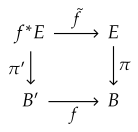
The word descent reverses the direction in which the construction is first seen. One begins below, with a base , and passes upward along a map . Upstairs an object may become simpler. To descend it is to prove that the upstairs object, supplied with the right compatibility, is pulled back from downstairs. The motion is not spatial in any metric sense. “Up” and “down” refer to maps and base change. Yet the language helps keep the asymmetry visible: pulling an object to a cover is usually easy; proving that data return is the theorem.
In Grothendieck’s program this asymmetry was everywhere. A group scheme might become a familiar split group after an extension. A line bundle might be described after choosing local trivializations. A family of subvarieties might be parameterized locally before a Hilbert scheme represented it globally. An étale cover might make a torsor visible. The descent question asked whether local form and global existence were two stages of one object or merely a persuasive resemblance.
That question suited Grothendieck’s relative viewpoint. An object was not fully understood by examining it over one field. It had to be followed under every change of base. Descent made the return journey part of the definition of control. If base change tested how geometry behaved when the ground moved, descent tested whether compatible behavior over a cover determined geometry before the move.
The double overlap
Let be a covering map in a topology appropriate to the problem. Suppose an object is given over . There are two projections Pulling back along these projections produces and . A descent datum begins with an isomorphism between them. It says that two copies of the upstairs object, viewed over the place where two presentations meet, are the same in a specified way.22Grothendieck, Revêtements étales et groupe fondamental (SGA 1); Grothendieck, “Technique de descente et théorèmes d’existence en géométrie algébrique. I. Généralités. Descente par morphismes fidèlement plats”.
An isomorphism on the double overlap is not enough. Over , three pairwise comparisons are available. Taking the first copy to the second and then the second to the third must agree with taking the first directly to the third. This is the cocycle condition. In indexed notation it resembles the familiar equation . In the fiber-product formulation it no longer depends on having chosen a list of open sets. The diagrams remember the relation intrinsically.
The triple overlap is where an attractive analogy becomes a mathematical object. Two descriptions can always be declared equivalent by some map; consistency demands that equivalence survive composition. The condition is modest enough to draw and strong enough to govern construction. Grothendieck’s style repeatedly found such conditions: not an essence hidden behind representations, but a diagram saying how representations agree.
If an object already exists over , its pullback carries a canonical descent datum. Both further pullbacks over the double fiber product come from the same object below, so their identification is forced. The difficult direction asks whether every suitable pair arises this way and whether morphisms can also be recovered. If yes, descent is effective for that class of objects along that cover.
Effectivity is the word that prevents the diagram from becoming a metaphysical slogan. Compatibility data may look global without being represented by an object of the category one started with. The descent functor can be fully faithful—objects and maps below are recoverable when they exist—without being essentially surjective—some compatible data upstairs may fail to come from an object below. The distinction became crucial when geometric quotients were at stake.
For quasi-coherent modules, faithfully flat descent gives a strong positive result under the standard hypotheses. A module after faithfully flat base change, equipped with compatible overlap data, descends. On affine pieces this is an algebraic theorem about modules and tensor products. Flatness preserves the exact relations needed for comparison; faithfulness ensures that vanishing and equality can be detected after base change.
The phrase “flat maps do not distort” is sometimes offered as intuition. It should not be mistaken for a definition. For a ring map , flatness means that preserves exact sequences. Faithful flatness additionally ensures that implies . It is not a statement about lengths, angles, or smooth surfaces. The cover can simplify an object without losing the base altogether.
The term fpqc, now routine, abbreviates the French for faithfully flat and quasi-compact. Modern accounts organize descent in the fpqc topology and compare it with the fppf topology, whose covers are faithfully flat and locally of finite presentation. That mature vocabulary clarifies the early work, but it can mislead if laid over 1960 as a completed package. The exposés and SGA 1 were building the technique that later textbooks present in a stable taxonomy.
This is another place where the seminar’s chronology matters. SGA 1, identified with the years 1960–61 but published in revised form in 1971, incorporated descent into its account of étale coverings and the fundamental group. The Bourbaki exposés printed during and around those years give earlier fixed points in the record. A claim about what was available in 1961 should begin with those contemporary objects, not silently borrow every formulation of the later book.33Grothendieck, Revêtements étales et groupe fondamental (SGA 1).
Descending functions, recovering spaces
The affine case displays Grothendieck’s preferred relation between geometry and functions. An affine scheme over can be described as the relative spectrum of a quasi-coherent algebra. If the algebra and its multiplication descend, take the relative spectrum below. Geometry is recovered from functions after the functions have passed the descent test.44Grothendieck, Revêtements étales et groupe fondamental (SGA 1); Grothendieck, “Technique de descente et théorèmes d’existence en géométrie algébrique. I. Généralités. Descente par morphismes fidèlement plats”; The Stacks Project Authors, The Stacks Project.
This method is constructive but not concrete in the sense of writing coordinates for every point. It turns existence of a space into existence of an algebra object and then uses a representing construction. The advantage is compatibility with base change. The descended affine scheme is characterized by a universal property, so it does not depend on a private choice of coordinates used upstairs.
The relative spectrum also shows why categories were not philosophical decoration. A descent datum on an algebra must respect addition, multiplication, and unit. The corresponding diagrams state that the glued object remains an algebra rather than only a module. Moving from modules to algebras and then to affine schemes uses functors that preserve the relevant structure. Categorical language keeps track of that transport without rewriting every element.
For a general scheme, affine pieces can sometimes be descended and glued, but the argument must control whether affineness and overlaps behave properly. One cannot announce that because functions descend, all spaces do. The geometry may require separatedness, quasi-compactness, or other hypotheses. The theory’s power came from proving exact theorems of locality, not from erasing conditions.
This discipline changed the meaning of an example. A simple affine calculation could reveal the algebraic engine from which a general construction followed. Conversely, a quotient that failed to be a scheme was not an annoying pathology to omit. It marked the boundary of the chosen category and eventually helped motivate broader kinds of geometric object.
In 1961, however, that later history lay ahead. The third Bourbaki exposé spoke of quotient preschemes, using the period’s terminology. A biography can explain that later algebraic spaces and stacks would enlarge the answer, but it must not grant Grothendieck and his audience a finished later formalism. The pressure was present before the resolution was complete.55Grothendieck, “Techniques de construction et théorèmes d’existence en géométrie algébrique. III. Préschémas quotients”.
Quotients: where agreement may not be enough
A quotient begins with identifications. If a group acts on a scheme, points in one orbit are to become one point. More generally, an equivalence relation proposes which pieces should be the same. The fiber product of a genuine cover produces such a relation automatically. Descent asks whether an object compatible with that relation comes from . Quotient construction asks, in effect, whether an exists in the desired category.
Set theory makes quotients look effortless: partition a set into equivalence classes. Topology already shows trouble because the quotient topology can behave badly. Algebraic geometry adds sharper demands. The quotient should support a structure sheaf, have appropriate local models, and satisfy a universal property. Orbits can have stabilizers; dimensions can jump; a candidate underlying set can fail to admit the required scheme structure.
Descent gives a language for the problem but not a universal affirmative answer. This limit is philosophically important. Grothendieck’s generality did not consist in asserting that all gluing works. It consisted in making the obstruction locatable. One can ask whether a fibered category is a stack for a topology, whether a relation is effective, or whether a functor is representable. A failed existence theorem then points to the exact axiom or category that is too narrow.
The later notion of an algebraic space would permit certain étale equivalence relations whose quotients are not schemes; stacks would retain automorphisms rather than crush them into points. Those developments belong to subsequent chapters and subsequent decades of elaboration. In the present moment they should appear, if at all, as future consequences of a documented difficulty. To call the 1961 exposé a theory of stacks would be to reward foresight by destroying chronology.
Grothendieck’s title “préschémas quotients” is itself evidence of an intermediate language. EGA’s terminology was still shifting. Modern editions often normalize “prescheme” to “scheme” and reserve “separated scheme” for what an earlier convention called a scheme. A readable chapter can use modern terms in explanation, but when the historical title appears, the period word should remain. Terminological polish must not erase development.
Quotients also exposed the relation between local symmetry and global identity. If an object carries automorphisms, different gluing maps can produce non-isomorphic descents. The set of forms of an object can itself be measured by cohomological data. Nonabelian cohomology and torsors grew naturally from this terrain. The general reader’s phrase “the same local pieces” is therefore incomplete. One must also know how they are identified.
That last point echoes Grothendieck’s reconstruction of the fundamental group. The category of covers plus a fiber functor can determine a group. Here, an object plus its allowed identifications determines possible global forms. In both cases, symmetry is not an ornament placed on a finished object. It governs what the object can be.
The Hilbert scheme: a catalogue becomes geometry
The fourth exposé, printed in 1961, treated Hilbert schemes. The classical problem was to parameterize subvarieties of projective space or, more generally, closed subschemes in a family. A naive catalog would list equations. Such a list depends on coordinates, has redundancies, and does not by itself explain how the listed objects vary in another family. Grothendieck’s method asked for a scheme representing the classification functor.66Grothendieck, “Techniques de construction et théorèmes d’existence en géométrie algébrique. IV. Les schémas de Hilbert”.
For each test scheme , consider families of closed subschemes in satisfying the required flatness and numerical conditions over . If there is a scheme such that maps correspond naturally to those families, the moduli problem is represented. The points of the Hilbert scheme classify objects, but the stronger statement concerns all -points. Families, not isolated objects, are built into the answer.
The Hilbert polynomial supplied bounded numerical data in the projective setting. Flatness ensured that fibers belonged to a controlled family. Projective embeddings made constructions possible. These are not technical decorations around a philosophical idea. They are part of the existence theorem. “Every moduli problem is a scheme” was never the conclusion. Under articulated hypotheses, a particular functor could be represented.
Descent entered because a family defined after a base change, together with compatibility, should correspond to a map from the original base if the moduli functor behaves as a sheaf. Representability then packages all such maps into one geometric object. The route runs from local family, through descent, to universal parameter space. This is why the Bourbaki sequence could move naturally from descent to Hilbert schemes without changing its deepest subject.
The representable-functor method altered what counted as construction. Classical geometry often displayed an object through equations or an embedding. Grothendieck could establish existence by showing that a functor had the universal property of a scheme. The representing object was unique up to unique isomorphism. Its identity lay in its relations with all test schemes, not in a privileged coordinate presentation.
For a biographer, the method offers a caution against attributing results through visual intuition alone. The universal object may have no simple picture. Its proof can require a chain of reductions, boundedness arguments, and descent. Grothendieck’s creative act was often the redesign of the question so that such a chain existed. The construction was conceptual and technical at once.
EGA II, published in 1961, provided foundational material on projective morphisms and classes of morphisms relevant to this work. The contemporaneity is significant: the reference system and the existence program were being written together. A theorem proved in the seminar could reveal which foundational statement EGA needed; an EGA proposition could make a moduli argument portable. The architecture advanced through feedback rather than a one-way pipeline.77Grothendieck and Dieudonné, “Éléments de géométrie algébrique II: Étude globale élémentaire de quelques classes de morphismes”.
The Picard scheme: line bundles in families
The fifth and sixth exposés, printed in 1962, addressed the Picard scheme—first existence theorems, then general properties. For a single variety, divisor classes or line bundles form a Picard group. In a relative setting, one wants to understand line bundles on as the test scheme varies, usually modulo those pulled back from . The result is a functor whose representability is delicate.88Grothendieck, “Technique de descente et théorèmes d’existence en géométrie algébrique. V. Les schémas de Picard: Théorèmes d’existence”; Grothendieck, “Technique de descente et théorèmes d’existence en géométrie algébrique. VI. Les schémas de Picard: Propriétés générales”.
A line bundle is locally trivial by definition. Its transition functions already form descent data. The Picard problem therefore concentrates the chapter’s theme. Local triviality does not make global line bundles trivial; the gluing maps carry the class. When families vary over , one must distinguish equivalence, rigidification, and pullbacks from the base. Automorphisms complicate naive classification. The universal family can exist only after the problem has been phrased correctly.
The Picard scheme, when it exists under suitable hypotheses, turns this relative classification into geometry. Its identity component can carry rich group-scheme structure. For smooth projective curves, the Jacobian provides the classical model; the relative construction reaches beyond one curve over one field. Again, representability is not the claim that a list can be drawn. It is the claim that families are naturally maps.
Descent appears on both sides. Line bundles descend along suitable covers, and the Picard functor must satisfy a sheaf condition in an appropriate topology. At the same time, a universal line bundle may be obstructed even when the classifying functor is representable. The distinction between a coarse parameter and a universal object would become central in moduli theory. In 1962 it already warned that classification and possession of a globally chosen representative are different questions.
The exposé sequence therefore moved from a general method to objects of increasing geometric density. Modules gave the algebraic prototype. Quotients tested the boundary. Hilbert schemes parameterized subobjects. Picard schemes parameterized line-bundle classes and acquired group structure. Their order displayed how a formal local-to-global theorem could become a method of existence.
This was one reason Grothendieck’s abstraction proved persuasive to working geometers. It did not end with a definition of descent data. It yielded objects they were actively studying. Generality paid its debt in constructions. When the debt could not yet be paid—when a quotient failed to be a scheme—the failure sharpened the next problem.
Identity without a privileged presentation
Descent invites philosophical language because it addresses the identity of an object given through many local presentations. Grothendieck’s mathematics did not answer with an invisible substance behind the data. It answered with maps, compatibility, and effectivity in a stated category. Identity was certified by relations strong enough to reconstruct.
This is not a claim that mathematics reduced all identity to syntax. The object below, when it exists, has structure and consequences not exhausted by one chosen cover. Nor is descent an assertion that observers create reality by agreement. The cocycle condition is necessary, but effectivity can fail. Compatible descriptions are candidates for unity; the theorem decides whether the category recognizes their unity.
No document in the cited exposés links this mathematical account of identity to Grothendieck’s earlier life. The chapter therefore makes no causal comparison between descent and biography. Similar vocabulary is not evidence of motive.
What the documents do show is a sustained mathematical preference. Grothendieck looked for definitions invariant under change of presentation, constructions characterized by universal properties, and theorems stable under base change. Descent gathered these preferences into a method. Its philosophy is grounded in work: the six exposés, SGA 1, and the moduli constructions—not in a private motive recovered after the fact.
The method also transformed the role of the base. Classical language could treat a ground field as fixed background. Relative geometry made the base an active participant, and descent made covers of the base part of construction. A family could be understood only through how it changed with the test object and whether that change could be reversed. Geometry became less a collection of figures than a discipline of transformations.
This relational identity did not dissolve objects. It made their objectivity more demanding. A construction independent of coordinates had to prove that independence. A “natural” map had to commute with every relevant base change. A local definition had to survive overlaps. The general language asked more questions of an object before granting it a place in the architecture.
Descent as a collective discipline
The seminar network enacted a human version of this demand, though the analogy must remain explicit about its limit. An argument passed from Grothendieck to an expositor, from a blackboard to a fascicle, from IHES to Harvard, and from an early version to a revised book. Each passage was a change of presentation. Compatibility mattered: notation had to agree, dependencies had to be visible, and proofs had to survive restatement. But mathematical collaboration is not a faithfully flat cover, and people do not glue into one author.
The analogy is useful precisely because the bylines prevent literal gluing. Michèle Raynaud’s credit remains hers; Demazure’s direction remains named; Artin’s notes are a separate object; Dieudonné’s collaboration is printed. A coherent program need not erase local authorship. In fact, preservation of the maps between contributions is what makes an accurate global history possible.
Grothendieck’s role was often to propose the object below—to insist that apparently separate local problems were manifestations of one missing theory. Participants then tested whether the proposed unity was effective. Some supplied proofs, some found counterexamples or necessary hypotheses, some built applications. Leadership lay in seeing the descent problem for the field; collective work decided what actually descended.
This description should not idealize the distribution. The director controlled much of the vocabulary and agenda. A younger mathematician’s contribution could later be absorbed into the name of the school. The discipline of source cards is therefore not external to the narrative. It restores the distinction between a global program and the people whose work made it exist.
The published texts also show how much redaction mattered. A live explanation can rely on shared context. A durable descent theorem must specify the category, topology, and hypotheses. Turning one into the other requires labor that is mathematical because mistakes change the scope of the result. Editors and expositors did not simply carry finished thought downward to the page. They helped determine which object the page contained.
From descent to a topology
Once descent is expressed categorically, an ordinary open cover loses its monopoly. What matters is a family of maps along which objects can be pulled back, compared, and sometimes reconstructed. This suggests that “cover” itself should be axiomatized. A Grothendieck topology does exactly that: it designates covering families or sieves and requires their stability under identity, pullback, and composition.
The passage is conceptually direct. Descent asks for compatible objects over a cover. A sheaf is the simplest kind of object for which compatible local sections glue uniquely. Change the class of covers and one changes the notion of sheaf. The category of sheaves then provides a new arena for cohomology. The theory of sites did not leave descent behind; it made descent part of the definition of locality.
Étale maps were especially important because they behaved like algebraic local isomorphisms without requiring their sources to be literal subsets. They offered enough local neighborhoods to detect finite coverings and constant torsion phenomena that the Zariski topology missed. This insight led to the étale site and the topos in which a new cohomology theory could be defined.
The movement from faithfully flat descent to étale sites should not be narrated as a single linear deduction. Different topologies serve different tasks. The fpqc topology is very fine and powerful for descent; the étale topology is tuned to unramified geometry and cohomology with coefficients invertible on the base. The architecture includes maps between these settings. It does not proclaim one universal notion of “local” that renders all others obsolete.
This plurality was part of Grothendieck’s achievement. Generalization did not mean choosing the largest possible cover class and stopping. It meant recognizing that a topology is structure placed on a category, so several topologies can be compared. One asks which objects are sheaves, which cohomology they produce, and which descent theorems hold. The choice becomes mathematical and visible.
An affine calculation beneath the language
The categorical formulation can make descent appear to float above algebra. Its prototype is exact and computational. Let a ring map be faithfully flat. An -module becomes the -module . Pull it twice to : the two -structures correspond to the two maps . Because both copies came from , they carry a canonical identification, and that identification satisfies a cocycle after one more tensor product with .
Conversely, begin with a -module and an isomorphism between its two pullbacks to , satisfying the cocycle over . The descended module can be recovered as the elements whose two images agree, formulated invariantly as an equalizer. Faithful flatness is what permits that equalizer to reconstruct after tensoring back with . This is the algebraic heart of effective module descent rather than an illustration added later.
The formula shows why both adjectives are needed. If the map is flat but not faithful, part of may be missed; equality after base change need not detect equality below. If it is faithful but tensor product destroys exactness, the equalizer need not survive. The compound condition creates a cover that is simultaneously broad enough to see the base and regular enough to preserve the relations used in reconstruction.
Take the simplest field extension . A vector space over becomes a vector space over . Not every -vector space with unspecified structure is presented as a base change in a distinguished way; descent data encode how the two copies over compare. For a Galois extension this can be recognized through semilinear Galois action, but faithfully flat descent is not restricted to Galois extensions. It replaces a symmetry group available in a special case with a fiber-product relation valid much more generally.
That replacement was typical of Grothendieck. Classical Galois descent gave a powerful model, but the new theory did not define the general case by forcing every cover to have a group. It used the relation intrinsic to any cover. If a group does act, its action groupoid maps into this picture. If no global group exists, the double overlap still does. The formalism preserved the classical case while ceasing to depend on it.
For algebras, the descent datum must commute with multiplication and unit. Recover the -algebra, then apply . This is why affine schemes descend. The route is exact enough that each arrow can be inspected. It also reveals why the theorem does not immediately cover every scheme: a general scheme is not one global algebra. Affine neighborhoods and their own overlaps must be shown to descend and glue, and the property of being an admissible neighborhood has to survive the cover.
The calculation made generality credible. Grothendieck could speak about categories fibered over a base because, underneath, faithful flatness controlled tensor products. The categorical theorem did not replace algebra; it carried the algebra without tying it to one presentation. This reciprocity between abstraction and calculation is easily lost when only the slogan remains.
Line bundles, forms, and twisting
A line bundle gives the most familiar nontrivial descent story. Over a cover , choose a generator of the line bundle on each . On a double overlap , the two generators differ by an invertible function . On a triple overlap the products satisfy . The functions are a cocycle. Changing the chosen local generators changes the cocycle by a coboundary but not the isomorphism class of the line bundle.
This example illuminates three levels that casual talk of gluing merges. There is local existence: each restriction is trivial. There is compatibility: the transition functions obey the cocycle. There is equivalence of presentations: different trivializations may describe the same bundle. Cohomology organizes the last two levels. The global line bundle is not obtained by declaring the local generators equal; it is obtained by honoring their transformations.
The example also explains why the Picard group belongs near descent. Tensor product of line bundles multiplies cocycles, giving classes a group law. In a family over a base , those classes vary. The Picard functor asks for that variation in a form natural under every . The Picard scheme, when representable, turns the cohomological classification into a geometric family.
Forms of a more complicated object work similarly. A group scheme may become isomorphic to a standard model after a cover. The isomorphisms between local models on overlaps can twist. Their cocycle is valued not in ordinary invertible functions but in an automorphism group. Different cocycles yield different forms below. Thus an object that is locally the same can be globally different, and its difference is measured by the manner of identification.
This is why “local isomorphism” never meant “global equality” in Grothendieck’s language. The space of gluing choices can itself carry arithmetic information. A conic with no rational point may become a projective line after extending the field; a torus may split after an extension; a torsor may acquire a section after a cover. Descent asks not only whether the object exists below—it may already do so—but which below-object the trivial upstairs form describes.
Nonabelian cohomology enters when automorphisms do not commute. The order of transition maps matters, and classes need not form a group. Grothendieck and collaborators developed this terrain through torsors and fibered categories. The full later theory should not be backdated to the six Bourbaki exposés, but the descent diagram already contains its necessity: automorphisms live on overlaps and govern global forms.
For biography, twisting offers a better account of mathematical inheritance than simple ownership. An idea can be locally recognizable after passing through another mathematician’s notation and still return globally altered. The social analogy cannot prove priority, but it warns against assuming that transmission is transparent. Redaction may expose an implicit hypothesis; an application may change the natural level of generality. The descended object bears the history of its identifications.
Formal existence and completion
The second Bourbaki exposé joined descent to a formal existence theorem for modules. Formal geometry studies a scheme through all infinitesimal neighborhoods of a closed subset, often encoded by completion with respect to an ideal. One receives a tower of approximations modulo . The existence question asks whether a compatible formal object arises from an algebraic object in an actual neighborhood or on the proper scheme.99Grothendieck, “Technique de descente et théorèmes d’existence en géométrie algébrique. II. Le théorème d’existence en théorie formelle des modules”.
Here again compatibility is necessary but not magically sufficient. A sequence of modules on infinitesimal thickenings can agree under restriction. To algebraize it, one needs finiteness and properness hypotheses of the formal existence theorem. The result associated with Grothendieck’s existence theorem—often called GAGA in a formal direction—made coherent sheaves on a proper scheme accessible through their formal completions under precise conditions.
The human intuition is that infinitely accurate local data near a closed subset should determine an algebraic object. The limit of that intuition is important. Formal power series need not converge analytically, and formal objects need not algebraize without hypotheses. The theorem’s significance lies precisely in proving when the passage from all infinitesimal orders to an actual coherent object is valid.
Its place beside faithfully flat descent follows from a shared reconstruction problem. One theorem reconstructs across a cover; the other reconstructs from a compatible tower of thickenings. Their index categories differ, but both ask which local or approximating presentations carry enough coherent structure to determine a global algebraic object.
Formal existence fed moduli. To prove that a functor is represented, one may first construct formal deformations near a point, show that the compatible infinitesimal data are effective, and then spread the resulting object. Descent handles changes of base and local presentations; formal geometry handles infinitesimal approximation. The title sequence’s movement toward Hilbert and Picard schemes therefore joined two reconstruction technologies.
These technologies also explain the immense foundational appetite of EGA. A formal existence theorem needs coherent sheaves, proper morphisms, completions, inverse limits, and finiteness. Descent needs flatness, quasi-coherence, fiber products, and base change. A moduli theorem needs all of them plus representability. The long preliminaries were the price of composing methods without hidden gaps.
The compositional ideal did not always succeed on the first attempt. Later developments refined hypotheses and enlarged categories. Yet the 1960 exposé fixed a direction: existence should be derived from structural criteria, not guaranteed by an explicit global equation. An object could be real because every finite approximation cohered and a theorem algebraized the tower.
Test schemes and the end of the catalogue
The functor-of-points viewpoint deserves a slower explanation because it changed the meaning of moduli. A set of isomorphism classes over one field is a catalog. It may tell how many objects exist, but it cannot by itself express a family whose members merge, specialize, or acquire automorphisms. A moduli functor asks, for every test scheme , which families exist over , and for every map , how those families pull back.
Naturality is the control mechanism. If a proposed classification depends on a coordinate choice that does not commute with pullback, it is not yet the desired functor. If two constructions assign naturally isomorphic families to every test scheme, they are the same at the representable level. Yoneda’s lemma gives this principle its exact force: an object is determined, up to unique isomorphism, by the functor of maps into it.
For the Hilbert functor, a point with values in a field corresponds to a subscheme, but a -point corresponds to an entire flat family over . Infinitesimal test schemes record tangent and obstruction information. Disconnected tests record several families at once. Nonreduced tests detect directions invisible in the set of ordinary geometric points. The representing Hilbert scheme therefore contains more than a polished catalog.
For the Picard functor, pullbacks from the test base create an equivalence that must be handled explicitly. A line bundle on can be modified by the pullback of a line bundle on without changing the relative class one intends to parameterize. Ignoring that fact yields the wrong functor. Descent is not a final step applied after classification; it helps determine what the classification problem is.
Automorphisms reveal a further limit. A set-valued functor records isomorphism classes but forgets the automorphism group of each object. For some moduli problems that loss prevents a universal family or destroys good descent. Later stack theory would keep the groupoid rather than only its set of components. In the early 1960s, the representable set-valued problems already made the pressure visible.
Grothendieck’s method therefore moved classification away from a search for one normal form. A normal form chooses one representative. A representing object captures how all representatives vary and how every family is obtained by pullback from a universal one, when such a universal family exists. This is a different ideal of understanding—relational, relative, and compatible with infinitesimals.
The method also democratized examples. A peculiar family over the dual numbers could disprove smoothness of a moduli space. A degeneration over a discrete valuation ring could test properness. A base extension could expose missing descent. Small test schemes were not secondary cases. They interrogated the universal claim.
Several localities, no final one
It is easy to draw a ladder from the Zariski topology to the étale topology, then to the fppf and fpqc topologies, and describe each as “finer.” The diagram is useful but can imply that the finest topology is always best. Grothendieck’s practice was more selective. A topology should be fine enough for the desired objects to descend or the desired cohomology to appear, but manageable enough for finiteness and comparison theorems.
Zariski covers remain indispensable for coherent sheaves and local scheme theory. Étale covers detect unramified phenomena and finite coefficients prime to characteristic. Fppf covers allow flat families of finite presentation and see torsors invisible étale-locally. Fpqc descent supplies very strong effectivity for quasi-coherent data. These are not successive drafts of one topology. They are tools with maps between them.
The choice of locality changes the meaning of trivial. A line bundle may be Zariski-locally trivial. A torsor under a smooth group may require an étale or fppf cover. A finite radicial phenomenon in characteristic behaves differently again. Saying an object is “locally” simple without naming the topology withholds part of the theorem.
This insistence on naming the topology was philosophically sobering. There is no view from nowhere called the local view. Locality is a structure specifying allowed tests. Once specified, it supports exact statements; before specification, it is an analogy. Grothendieck enlarged geometry by making that dependence explicit.
The plurality also prevented descent from becoming a universal solvent. A datum might descend fpqc-locally but not be visible through a coarser topology. A cohomology theory might have better finiteness with étale covers than with all fpqc covers. The architecture succeeded through interfaces, not through the victory of one level.
That lesson anticipates the topos. A topos retains the sheaf world associated with a chosen site, while morphisms of topoi compare different worlds. The object of study is no longer just , nor even one collection of neighborhoods, but a category of variable sets with its own cohomology. Descent furnished the grammar from which that larger sentence could be written.
A program shared through documents
The six exposés were presented in the Bourbaki setting, but their applications flowed into the IHES programs. This institutional crossing complicates the phrase “Grothendieck’s seminar.” Bourbaki provided a venue for synthetic reports. IHES provided the sustained research environment. EGA provided a formal serial publication. SGA 1 absorbed descent into a larger theory of coverings. No one document contains the whole development.
Correspondence with Serre supplied another layer. A letter could test whether a general construction answered an arithmetic example long before the final volume appeared. The exchange mattered because abstraction could otherwise drift away from calculable cases. Serre’s questions and examples acted as descent tests for whether the language returned useful information when pulled into a specific field or variety.1010Grothendieck and Serre, Grothendieck–Serre Correspondence.
This metaphor must not turn Serre into a mere checker of Grothendieck’s work. He had his own program and supplied essential ideas. The published correspondence records an exchange between powerful mathematicians with different styles. Its value lies in dated specificity. It can show when one man told the other something; it cannot turn all shared development into a single jointly owned intuition.
Dieudonné’s work on EGA created a different documentary relation. The systematic chapters made definitions stable enough for descent arguments to cite. Grothendieck’s conceptual drive and Dieudonné’s redaction were not two copies to be glued into an undifferentiated author. The printed credit preserves an asymmetry. Historical fairness requires retaining both the asymmetry and the collaboration.
At seminars, responsibility could be assigned exposé by exposé. In books, later editors could harmonize versions. Across the network, the same theorem might have a spoken, duplicated, published, and revised life. The biography’s source system mirrors this plurality by keeping separate cards. A citation to the 1971 SGA 1 edition cannot establish the exact wording of 1960; a 1960 Bourbaki printing cannot establish every refinement of 1971.
This may seem like excessive caution until one considers the chapter’s theme. Historical claims also need descent. Facts drawn from different presentations must agree on overlaps—names, dates, theorem scope—and a global narrative should be asserted only when the evidence is effective. A plausible synthesis without exact support is a nonrepresentable story.
Influence without backdating
Descent later became foundational for algebraic spaces, stacks, gerbes, derived geometry, and higher categories. Those developments reveal the fertility of the early diagrams. They do not prove that every later concept was fully present in Grothendieck’s mind between 1959 and 1962. Intellectual ancestry is not identity. A later theory can descend from an earlier problem without being its pullback.
Algebraic spaces answered some quotient failures by allowing sheaves for the étale topology locally represented by schemes. Stacks retained automorphism groups and made effective descent for groupoid-valued data central. Higher stacks imposed compatibilities beyond triple overlaps through simplicial and homotopical structures. Each extension can be described as an answer to a pressure already visible. Its date and authorship must remain its own.
The distinction is especially important because Grothendieck later wrote retrospectively about broad visions of stacks and homotopy. Those texts illuminate continuity in his later mathematical program, but they are not contemporaneous transcripts of 1961. The present chapter grounds itself in the printed descent and construction exposés, using later language only to explain their consequence and limit.
Likewise, the eventual success of the Hilbert and Picard machinery should not turn their early proofs into formalities. Representability theorems were difficult because they made global objects from data varying over arbitrary bases. Their later routine use is evidence of successful infrastructure, not of original ease.
By policing hindsight, one sees more rather than less. The early program did not need to contain all future descent to be revolutionary. It had already replaced ad hoc gluing with a categorical datum, proved effectivity in powerful cases, connected reconstruction to moduli existence, and identified quotient boundaries. That is a precise achievement.
Faithfulness as a method of checking
Faithfully flat base change does more than provide local coordinates. It permits statements to be checked after the change and then reflected below. If a map of modules becomes injective, surjective, or an isomorphism after a faithfully flat extension, the original map can often be shown to have the corresponding property. The cover is conservative: it does not pronounce two distinct maps equal merely because it has forgotten where they differ.
This reflectiveness made descent a proof method even when no new object was being constructed. One could pass to a cover on which a problem simplified, prove a property there, and descend the property. For group schemes, a torus might split after an extension; for vector bundles, local bases might exist; for morphisms, flatness or finite presentation might be tested locally under the correct topology. The theorem legitimized strategic movement.
The word “faithful” is apt but should not be moralized. A functor is faithful when it distinguishes morphisms; a module is faithfully flat when tensor product is exact and detects nonzero modules in the standard formulation. The vocabulary describes mathematical detection. Grothendieck’s use of it turned a change of base from a possible loss of information into a controlled experiment.
This strategy explains the immense value of local normal forms. A difficult object need not globally resemble the standard model. If it does so after a cover and the transition data are understood, one can compute locally without abandoning the global question. Descent is the warranty attached to simplification.
The warranty always names its scope. A property may be local on the source, local on the target, or local for a particular topology. It may descend along fpqc covers but not ascend under every map. The language “local for the fpqc topology” condenses a theorem whose direction must remain explicit.
Grothendieck’s program made these locality theorems part of the foundation because future arguments would use them silently. Once proved, they allow a geometric proof to replace a global object by a cover without renegotiating legitimacy. The foundation purchases freedom for later work.
Obstructions are structured data
When descent fails, the failure can sometimes be measured. For abelian sheaves, cohomology classes record obstructions or possible gluings. A zero class can mean that local data globalize; nonzero classes can classify twists. The exact interpretation depends on degree and coefficient object, but the general passage from cocycle to cohomology is systematic.
Line bundles illustrate degree one. Transition functions form a Čech one-cocycle with values in ; changing trivializations changes it by a coboundary. The class lives in , identified in the appropriate topology with the Picard group. The obstruction is not an external verdict. It is an object that can be added, pulled back, and compared.
Gerbes and higher obstruction classes would later carry degree-two and nonabelian forms of the same idea. That later theory should not be read into 1961 as completed. What was already decisive was the methodological step: failed gluing could have structure, and the structure could indicate the category needed for effectivity.
This transformed pathology into information. A quotient that is not a scheme may still define a sheaf or stack. A universal bundle that does not exist globally may exist after a cover, with an obstruction class describing why. The answer “no” can therefore be refined into a map of what exists one categorical level higher.
Grothendieck’s abstraction was strongest when it preserved this negative data. Simply declaring two objects locally equivalent would erase the twisting. Recording automorphisms and cocycles retains the reason global forms differ. Generality here means refusing premature identification.
Descent and the universal family
A representing scheme for a moduli functor promises that every family over is obtained from a universal family over by pullback, if a universal family exists in the strong form. This statement has descent built into its uniqueness. Two maps that agree after a cover should agree below when the functor is a sheaf.
But representability of isomorphism classes does not always supply a universal object. Automorphisms can prevent choices from gluing. A coarse moduli space may classify geometric points while failing to represent families. The distinction would become standard later; its pressure is already present wherever Picard data are considered modulo pullbacks and isomorphism.
The Hilbert scheme is comparatively well behaved because a closed subscheme of is rigidly embedded. Its automorphisms as an embedded subobject do not create the same ambiguity as abstract curves or bundles. This is one reason the Hilbert functor could serve as a construction space from which more difficult moduli problems were approached.
Geometric invariant theory, developed in parallel by Mumford and others, would use quotients of parameter spaces to construct moduli. Descent then determined whether families on the quotient were genuine and what information the quotient forgot. The interaction between Hilbert schemes, group actions, and quotients grew from the same construction sequence without belonging to Grothendieck alone.
The universal-family ideal also changed proof. To show that an object represents a functor, one constructs a candidate family, verifies its pullbacks give all families locally, uses descent to return globally, and proves uniqueness. Existence and descent are alternating steps rather than separate chapters.
The relative view learns to reverse
Base change is forward motion: from and , form . It is universal and automatic once fiber products exist. Descent asks for reverse motion and therefore cannot be automatic. The two together make relative geometry bidirectional.
This bidirectionality altered the status of an extension field. Classical algebraic geometry often enlarged the field to simplify equations and then reasoned informally about returning. Grothendieck’s theory separated what could be checked after extension, what objects descended, and what twisting prevented return. Arithmetic differences between forms stopped being residue after geometric simplification.
The same pattern governed schemes over rings. Passing from a base to a localization, completion, strict henselization, or flat extension revealed different local features. Each passage came with its own descent or algebraization problem. There was no single inverse operation; the architecture specified one for each kind of probe.
As a result, “work over an algebraic closure” became both more powerful and more dangerous. Over the closure, geometry might be classified cleanly. The action of the Galois group and associated descent data determined the forms over the original field. Ignoring that action meant ignoring arithmetic.
This is the route by which descent prepared étale cohomology. The geometric object over a separable closure carries Frobenius or Galois action. Its invariants and obstructions below are not separate additions. They are the record of descent.
A matrix on an overlap
Take a rank- vector bundle trivialized over a cover . On , the two trivializations differ by a matrix . Pulling to the triple product gives three matrices, and the cocycle equation says that changing from copy one to copy two and then to copy three equals changing directly from one to three.
If is the identity, the chosen trivialization itself descends and the bundle is globally trivial. A nontrivial cocycle can still descend to a perfectly good bundle; it records its twisting. Thus descent does not demand that local presentations agree literally. It demands a coherent rule for translating among them.
Change the local basis by a matrix on . The transition matrix changes by a coboundary expression involving the two pullbacks of . The descended vector bundle is unchanged up to isomorphism. Classification must therefore quotient cocycles by changes of presentation, not count raw matrices.
This explicit case shows why automorphisms are central. The possible gluing maps live in the automorphism group of the local model. A rigid object with no automorphisms has simpler descent; a moduli problem with large stabilizers carries more twisting. Later stack language would retain this groupoid structure.
It also shows why triple overlaps suffice for ordinary one-categorical descent. Composition of isomorphisms is associative, and the cocycle enforces that associativity across presentations. Higher categorical objects require higher coherence data; those later developments should not be retroactively inserted into the vector-bundle theorem.
For Grothendieck, the matrix was not the final object because a basis is not canonical. The descent datum expressed what survived a basis change. The categorical formulation did not flee calculation; it identified the invariant content of every such calculation.
Words that must keep their dates
The early exposé titles use préschéma where later convention says schéma. Modern explanations use fpqc and fppf as stable abbreviations. Algebraic spaces and stacks now provide standard homes for quotient and automorphism phenomena. Each term belongs to a different stage of stabilization.
A historical narrative can translate for readability if it leaves the original title visible and labels later language as later. What it must not do is make the 1961 audience sound as though it had read a modern Stacks Project chapter. The mathematical equivalence of formulations does not erase their publication history.
Terminology is part of evidence because naming a concept can signal that its properties have been gathered into one object of study. Grothendieck’s program often recognized the structure before vocabulary settled. The chapter preserves that productive interval instead of polishing it away.
Existence and uniqueness are different gifts
Descent theorems often contain two logically distinct achievements. Full faithfulness says that objects and morphisms already below can be recovered from their pullbacks and canonical descent data. Essential surjectivity says that every effective-looking datum upstairs actually comes from below. The first gives uniqueness; the second gives existence.
Uniqueness can hold where existence fails. This is why a proposed quotient or moduli object may be determined unambiguously if it exists and still fail to be a scheme. The universal property has identified the candidate without manufacturing it.
Grothendieck’s construction program repeatedly separated these gifts. A representable functor has at most one representing object up to unique isomorphism by Yoneda. Proving that an object represents it is the difficult existence theorem. Conceptual clarity does not replace construction.
The distinction is philosophically healthy. A coherent description may specify exactly what one seeks while the world of schemes contains no such object. Mathematics can possess a question more precisely than it possesses an answer.
Descent made that condition usable. It told geometers which local data would force uniqueness and where an effectivity theorem was still owed. The architecture did not promise that everything glued; it kept the unpaid promise visible.
Morphisms also descend
Object-level descent would be incomplete if maps between descended objects could not be recovered. Full faithfulness states that a morphism below is determined by its pullback and that a compatible morphism upstairs comes from at most one morphism below. The theorem therefore controls both identity and comparison.1111Grothendieck, Revêtements étales et groupe fondamental (SGA 1); Grothendieck, “Technique de descente et théorèmes d’existence en géométrie algébrique. I. Généralités. Descente par morphismes fidèlement plats”; The Stacks Project Authors, The Stacks Project.
For modules, a -linear map between two descended -modules must commute with their descent isomorphisms over . If is faithfully flat, every compatible -linear map descends uniquely to an -linear map. This is the morphism-level counterpart of recovering a module as an equalizer.1212Grothendieck, “Technique de descente et théorèmes d’existence en géométrie algébrique. I. Généralités. Descente par morphismes fidèlement plats”; The Stacks Project Authors, The Stacks Project.
The same distinction enters moduli. A set of objects without their isomorphisms can lose the data needed for descent. When automorphisms matter, a groupoid-valued description retains maps as well as objects. Later stack theory systematized this point, but its mature vocabulary is not assigned to the 1961 exposés.1313Grothendieck, “Techniques de construction et théorèmes d’existence en géométrie algébrique. III. Préschémas quotients”; The Stacks Project Authors, The Stacks Project.
Properties of morphisms can also be local for a chosen topology. Flatness, finite presentation, smoothness, and other properties have precise ascent or descent theorems; none becomes local merely by assertion. EGA’s work on morphisms supplied the hypotheses that made such checks reusable.1414Grothendieck and Dieudonné, “Éléments de géométrie algébrique IV: Étude locale des schémas et des morphismes de schémas, première partie”; Grothendieck and Dieudonné, “Éléments de géométrie algébrique IV: Étude locale des schémas et des morphismes de schémas, seconde partie”; Grothendieck and Dieudonné, “Éléments de géométrie algébrique IV: Étude locale des schémas et des morphismes de schémas, troisième partie”; Robin Hartshorne, Algebraic Geometry, Graduate Texts in Mathematics 52 (Springer, 1977), https://doi.org/10.1007/978-1-4757-3849-0.
This extension from objects to maps explains why descent is categorical rather than a recipe for pasting underlying sets. A category contains both objects and their relations. Recovering only the objects would leave the global geometry unable to support functorial constructions.
Direction remains essential. Pullback along is supplied by the map; descent back to requires compatibility and an effectivity theorem. Treating the two directions as automatic inverses would erase the central difficulty.1515Grothendieck, Revêtements étales et groupe fondamental (SGA 1); Grothendieck, “Technique de descente et théorèmes d’existence en géométrie algébrique. I. Généralités. Descente par morphismes fidèlement plats”; The Stacks Project Authors, The Stacks Project.
The distinction also governs historical language. Later texts may package pullback, descent, and stack conditions in one mature formalism. The Bourbaki exposés record a stage at which those interfaces were being established. Modern terminology can clarify the result, but it cannot serve as evidence that every later categorical formulation was available in 1961.
Control after simplification
The practical freedom offered by descent can be stated in one sentence: simplify after a cover without forgetting the obligation to return. The first half encourages bold changes of coordinates and base. The second requires cocycles, effectivity, and proof that the result is independent of the chosen simplification.
Without return, local calculations become anecdotes. Without simplification, global objects may remain inaccessible. Grothendieck’s method held the two movements together and made their interface a theorem. That balance explains why descent could serve group schemes, line bundles, quotients, and moduli rather than one special construction.
It also supplied an ethic for abstraction. General language is warranted when it preserves the information needed to come back. A formalism that only moves upward into easier presentations and cannot reconstruct the object has not completed its work.
The same asymmetry marks every later application in the chapter. A split group, trivial bundle, or local family supplies workable data upstairs. Only the compatible identifications and an effectivity result determine whether those data define an object downstairs.1616Grothendieck, Revêtements étales et groupe fondamental (SGA 1); Grothendieck, “Technique de descente et théorèmes d’existence en géométrie algébrique. I. Généralités. Descente par morphismes fidèlement plats”; The Stacks Project Authors, The Stacks Project.
What existed by 1962
By the end of the sixth Bourbaki exposé, the documentary record contained a powerful construction program: faithfully flat descent, formal existence methods, quotient questions, Hilbert schemes, and Picard schemes. It did not contain every later theorem about algebraic spaces, stacks, or derived descent. A fair assessment must hold accomplishment and boundary together.
The positive achievement was enormous. Algebraic geometry had a general language for recovering modules and important geometric objects from compatible data after base change. Representability turned families into points of new schemes. Quotient failures could be stated in a framework that showed what was missing. These tools entered SGA and EGA and became routine infrastructure for later generations.
The open boundary was equally fertile. Automorphisms made moduli less set-like. Some equivalence relations demanded objects beyond schemes. Higher compatibilities would eventually require homotopical language. None of those developments refutes the early descent program. They demonstrate its diagnostic power. It taught mathematicians where a category stopped being sufficient.
Grothendieck himself was moving rapidly among these levels. In the same years he was writing EGA with Dieudonné, directing SGA, corresponding with Serre, and shaping the representability problems recorded by Bourbaki. The activity should not be reconstructed as a sequence of solitary eurekas. It was a sustained effort to make different problems answer to the same tests: functoriality, base change, locality, and existence.
The sequence’s publication dates provide a rare contemporaneous trace of that effort. The first two parts were on paper in 1960, the next two in 1961, the Picard parts in 1962. Later summaries can make descent sound like one concept already complete. The six records show a concept extending its reach through applications. The movement from theorem to program happened in public.
The honesty of an obstruction
There is a moral temptation in biography to treat every obstacle as a disguised victory. Grothendieck’s later influence makes the temptation stronger: if algebraic spaces or stacks eventually resolved a difficulty, the earlier failure can be written as prophetic success. Descent counsels more honesty. A datum either is known to be effective under stated conditions or it is not. Future categories do not alter what was proved at the time.
This honesty gives mathematical obstruction a positive role without pretending it is already solution. A nonrepresentable functor says that the proposed object does not live where one looked. An ineffective relation says that compatibility has not produced a scheme. The response may be stronger hypotheses, a refined invariant, or a broader category. The obstruction directs work because it has been formulated exactly.
Retrospective summaries can make the program appear to dissolve difficulties through generality alone. The contemporary descent texts instead contain choices, conditions, and boundaries. The power of the method lay in converting an imprecise gluing problem into propositions that could succeed or fail.
The same evidentiary standard governs historical interpretation. Separate biographical and mathematical records do not establish a personal motive merely because their vocabulary can be aligned. The chapter retains each record without inventing a causal object beneath them.
The threshold of the site
Descent began with an object made simpler after a cover. It ended by transforming the meaning of cover. Once coverings could be families of morphisms rather than open subsets, sheaf theory could enter algebraic geometry through new doors. The étale site would admit unramified neighborhoods; its sheaves would remember finite coefficients; its cohomology would carry Frobenius.
But those later powers rested on the modest diagram of the double and triple fiber products. Two pullbacks must agree. Three comparisons must compose. Then, and only then, one asks whether a global object exists. The architecture of cohomology began not with a numerical invariant but with a standard for trustworthy gluing.
The standard was then built into a generalized topology. Locality no longer meant only a subset; it could be specified by a class of maps under which information was tested, transported, and recovered. Descent supplied the return from a cover, while the étale site specified where that local information lived.
注释
- Grothendieck, “Technique de descente et théorèmes d’existence en géométrie algébrique. I. Généralités. Descente par morphismes fidèlement plats”; Grothendieck, “Technique de descente et théorèmes d’existence en géométrie algébrique. II. Le théorème d’existence en théorie formelle des modules”; Grothendieck, “Techniques de construction et théorèmes d’existence en géométrie algébrique. III. Préschémas quotients”; Grothendieck, “Techniques de construction et théorèmes d’existence en géométrie algébrique. IV. Les schémas de Hilbert”; Grothendieck, “Technique de descente et théorèmes d’existence en géométrie algébrique. V. Les schémas de Picard: Théorèmes d’existence”; Grothendieck, “Technique de descente et théorèmes d’existence en géométrie algébrique. VI. Les schémas de Picard: Propriétés générales”. ↩
- Grothendieck, Revêtements étales et groupe fondamental (SGA 1); Grothendieck, “Technique de descente et théorèmes d’existence en géométrie algébrique. I. Généralités. Descente par morphismes fidèlement plats”. ↩
- Grothendieck, Revêtements étales et groupe fondamental (SGA 1). ↩
- Grothendieck, Revêtements étales et groupe fondamental (SGA 1); Grothendieck, “Technique de descente et théorèmes d’existence en géométrie algébrique. I. Généralités. Descente par morphismes fidèlement plats”; The Stacks Project Authors, The Stacks Project. ↩
- Grothendieck, “Techniques de construction et théorèmes d’existence en géométrie algébrique. III. Préschémas quotients”. ↩
- Grothendieck, “Techniques de construction et théorèmes d’existence en géométrie algébrique. IV. Les schémas de Hilbert”. ↩
- Grothendieck and Dieudonné, “Éléments de géométrie algébrique II: Étude globale élémentaire de quelques classes de morphismes”. ↩
- Grothendieck, “Technique de descente et théorèmes d’existence en géométrie algébrique. V. Les schémas de Picard: Théorèmes d’existence”; Grothendieck, “Technique de descente et théorèmes d’existence en géométrie algébrique. VI. Les schémas de Picard: Propriétés générales”. ↩
- Grothendieck, “Technique de descente et théorèmes d’existence en géométrie algébrique. II. Le théorème d’existence en théorie formelle des modules”. ↩
- Grothendieck and Serre, Grothendieck–Serre Correspondence. ↩
- Grothendieck, Revêtements étales et groupe fondamental (SGA 1); Grothendieck, “Technique de descente et théorèmes d’existence en géométrie algébrique. I. Généralités. Descente par morphismes fidèlement plats”; The Stacks Project Authors, The Stacks Project. ↩
- Grothendieck, “Technique de descente et théorèmes d’existence en géométrie algébrique. I. Généralités. Descente par morphismes fidèlement plats”; The Stacks Project Authors, The Stacks Project. ↩
- Grothendieck, “Techniques de construction et théorèmes d’existence en géométrie algébrique. III. Préschémas quotients”; The Stacks Project Authors, The Stacks Project. ↩
- Grothendieck and Dieudonné, “Éléments de géométrie algébrique IV: Étude locale des schémas et des morphismes de schémas, première partie”; Grothendieck and Dieudonné, “Éléments de géométrie algébrique IV: Étude locale des schémas et des morphismes de schémas, seconde partie”; Grothendieck and Dieudonné, “Éléments de géométrie algébrique IV: Étude locale des schémas et des morphismes de schémas, troisième partie”; Robin Hartshorne, Algebraic Geometry, Graduate Texts in Mathematics 52 (Springer, 1977), https://doi.org/10.1007/978-1-4757-3849-0. ↩
- Grothendieck, Revêtements étales et groupe fondamental (SGA 1); Grothendieck, “Technique de descente et théorèmes d’existence en géométrie algébrique. I. Généralités. Descente par morphismes fidèlement plats”; The Stacks Project Authors, The Stacks Project. ↩
- Grothendieck, Revêtements étales et groupe fondamental (SGA 1); Grothendieck, “Technique de descente et théorèmes d’existence en géométrie algébrique. I. Généralités. Descente par morphismes fidèlement plats”; The Stacks Project Authors, The Stacks Project. ↩